How to Get Into Tech Without a Degree (2026 Roadmap)

On this page
A guy messaged me last year at 11pm, right after his warehouse shift. He'd been reading about becoming a developer for eight months and had never opened a code editor once, because every job posting he scrolled past said "Bachelor's degree required" and he figured that was the whole conversation. Eight months of reading. Zero hours of building.
He wasn't lazy. He believed the story, the one that says the door to tech is locked and the key is four years and a pile of money you don't have.
That story was outdated before he started reading. I've hired people, I've watched people get hired, and I've taught thousands who are in tech right now with nothing hanging on the wall. The market didn't soften because employers got nicer. It changed because they figured out a diploma doesn't tell them whether you can actually do the job, and something else does.
Do you actually need a degree for tech? (The honest answer)
For a huge number of tech roles, no. Not to apply, not to get interviewed, not to get the offer.
The web developers, email developers, Shopify specialists, web administrators, automation builders, and support engineers I know mostly came in without a CS degree. Real jobs, real salaries, and the hiring manager cares about one question: can you do the work.
I won't lie to you about where it still matters. If you want to be a machine-learning researcher at a big lab, or you're aiming at a company that filters hard on pedigree, a degree still opens doors that stay shut otherwise. That's a slice of the industry. It's also not where most people should be starting anyway, and I'd argue chasing it is what keeps people stuck.
Here's what actually happens when you apply now. Your résumé hits software before a human sees it. If it survives, a hiring manager skims it for a few seconds looking for proof you can do the thing. Not a promise. Proof. A portfolio, a live project, a GitHub, something they can click and watch work.
A degree says you might be able to do the job. A portfolio says you already did it. That swap is the whole game.
Pick a lane that's actually hiring juniors
This is where self-taught people quietly sabotage themselves. They see "learn to code," pick generic front-end React because that's what the algorithm showed them, and walk straight into the most oversaturated corner of the entire industry, competing with bootcamp grads by the thousand for the same junior title.
Don't do that. Go where the demand is real and the crowd is thinner. A few I'd point a beginner at right now:
- Email development. Every company that sends email needs someone who can build templates that survive Outlook. It's a genuine craft, it pays, and almost nobody teaches it. Start with is email development a good career.
- Shopify development. Millions of stores, constant demand for people who can build themes, customize checkouts, and ship stores that convert. See is Shopify development a good career.
- Web administration / content ops. The person who runs a company's website day to day: publishing, updating, managing the CMS, keeping content shipping. Coding-adjacent, in demand, and a genuine on-ramp. Read is web administration a good career and the full Web Content Manager path.
- AI automation. Wiring tools together so businesses stop doing things by hand. Newer field, growing fast, and being early counts for a lot. Start with is AI automation a good career and the AI Automations path.
- PHP / Laravel. The internet quietly runs on PHP, and there's steady, well-paid work maintaining and building it while everyone else chases shinier stacks. See is PHP a good career.
Want jobs that lean lighter on code? I broke those down in tech jobs without coding and the easiest tech jobs to get into.
Pick one lane. Not five. Depth in one hireable skill beats a shallow tour of ten, every single time.

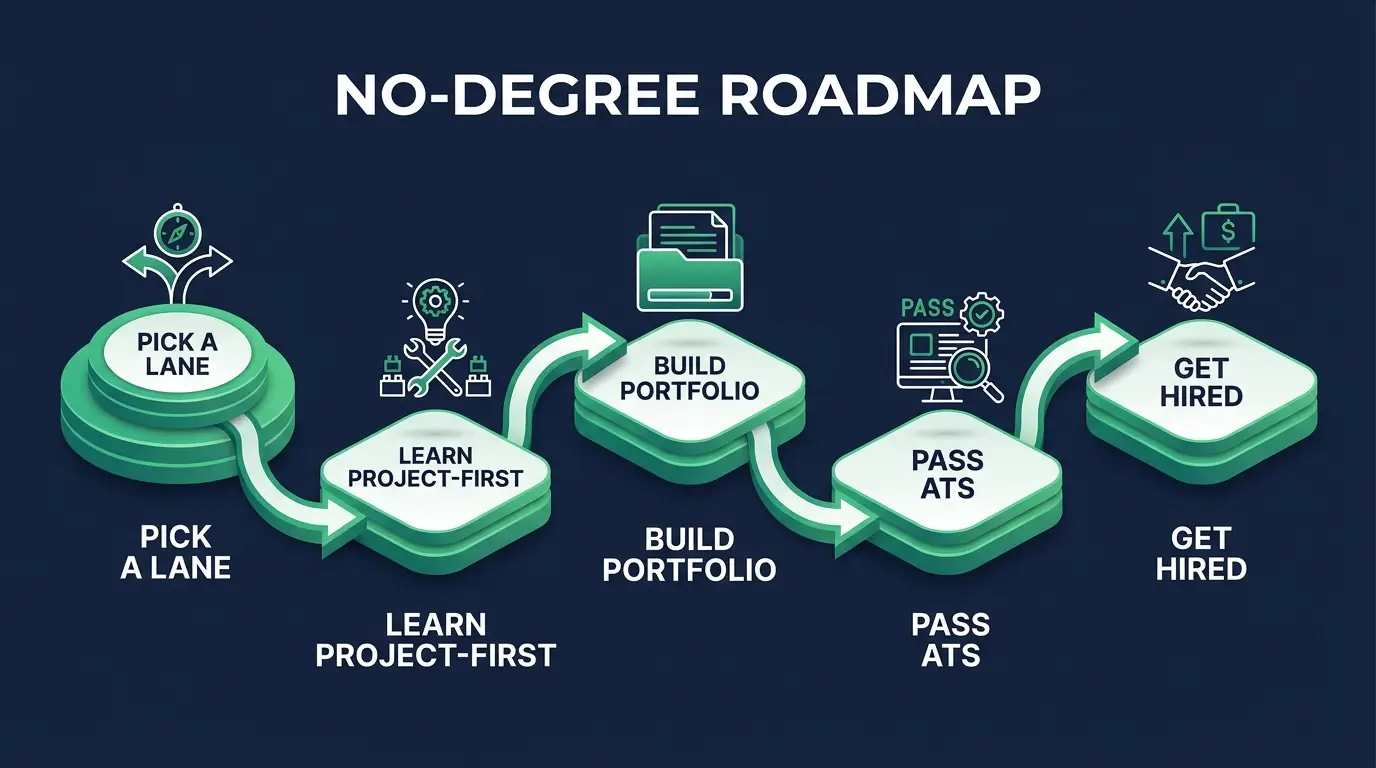
The no-degree roadmap that works
Same shape every time, whichever lane you picked:
-
Pick your lane and commit. Stop shopping. The people who never get hired are usually the ones still deciding what to learn six months in.
-
Learn project-first, not tutorial-first. Don't watch forty hours of video and call it studying. Learn just enough to build the first real thing, then go build it badly, then build it again. You learn the language by shipping the project, and I'd put this shift above talent, above pedigree, above anything else on this list.
-
Build a portfolio of real work. Three to five projects that look like the job you want. An email dev shows a template library. A Shopify dev shows a store you can actually buy something from. Real, clickable, live. This is the thing that replaces the diploma.
-
Get your résumé past ATS. Software scans it for keywords and format before a person ever reads it, and a gorgeous PDF that the parser chokes on gets auto-rejected without anyone telling you why. Build it for the robots first.
-
Apply to the right titles. Half of "I can't find a job" is applying to the wrong words. Search "email developer," "Shopify developer," "web administrator," "automation specialist." Not just "software engineer," where every human on earth is applying.
-
Use your network. Most jobs never hit a public board, they get filled by referral, in Discords and communities where people share openings and vouch for each other. Being in the room is an advantage you can just decide to have.
How long it takes and what it costs
Straight answer: one to six months to job-ready, depending on your lane and how hard you push.
Somebody focused on a lighter lane like email development, putting in real hours after work, can be building portfolio pieces in weeks and applying in a couple of months. PHP/Laravel or full Shopify work runs longer. Effort moves this number more than talent does, and I've watched that play out enough times to be fairly confident about it. People who treat it like a part-time job get there. People who dabble stay dabbling.
Now the money, because this is where the old story really falls apart.
A CS degree is four years and tens of thousands of dollars. A coding bootcamp runs $10,000 to $20,000 and doesn't guarantee the job either. I laid out the real numbers in what a coding bootcamp actually costs.
The self-taught path costs a fraction of that. A CodingPhase Diamond membership is $42/month, or $255/year (about $21 a month billed annually) for everything. Want lifetime access plus live weekly mentorship? The Tech Accelerator is $1,500 one time, still a rounding error next to a degree. There's a 7-day money-back guarantee, so trying it costs you a week and nothing else.
The math isn't close. The only real question is whether you'll do the work, and no amount of money buys that part for you.
What CodingPhase gives you to do this
I built CodingPhase to be the thing I wish existed when I was teaching myself off broken forum posts at 2am. What you get:
- 90+ courses across every lane above, so you're not stitching random YouTube videos together and hoping they add up.
- Guided beginner-to-job-ready paths that tell you what to learn next, so you never sit there wondering.
- Portfolio templates for every path, so the "build real work" step starts with a starting line instead of a blank page.
- A résumé builder made to pass ATS, so the robots don't delete you before a human looks.
- A job board and priority support.
- An 80,000+ member community, which is your network and your accountability in one place.
- Completion certificates for every course you finish.
Here's the honest tradeoff, because I owe you that. Self-paced means you set the pace. Nobody takes attendance. If you need someone standing over you with a deadline, that discipline has to come from you, and some people genuinely do better in a structured cohort with a schedule and a person to disappoint. That's a real thing and I'm not going to pretend otherwise. But if you'll show up for yourself a few hours a week, this is the cheapest and most flexible way into the industry I know of, and the community means you're not doing it alone at 11pm after a warehouse shift.

FAQ
Can you get a tech job without a degree? Yes. Plenty of tech roles, email development, Shopify, web administration, automation, junior web dev, don't require a degree at all. What they require is proof you can do the work, which a portfolio provides.
What tech job is easiest to get without a degree? Lanes with real demand and thinner competition are the easiest entry points: email development, web administration, and support-adjacent roles. I ranked them in the easiest tech jobs to get into.
Do employers really hire self-taught developers? Constantly. In most of these lanes, hiring managers care far more about whether your work is good than where you learned it. A strong portfolio beats a blank degree line most of the time.
How long does it take to get into tech without a degree? Usually one to six months to job-ready, depending on the lane and how many focused hours you put in each week. Effort drives the timeline more than anything else.
Is a bootcamp worth it if I don't have a degree? Sometimes, but they're expensive and don't guarantee a job. A self-paced membership gets you the same skills and portfolio for a tiny fraction of the cost. Compare the numbers in what a coding bootcamp actually costs.
That guy from the warehouse? He picked email development, shipped his first template library in seven weeks, and stopped asking me whether he was allowed to do this.
The door isn't locked. It never was for anyone willing to build the proof, and now you know what the proof looks like.
Pick your lane over at /career-paths, then start today at /#pricing. A year from now you'll be glad you stopped waiting for permission you never needed. I'm rooting for you, and I'll see you inside.