Is PHP a Good Career in 2026? An Honest Answer
On this page
You're scared, aren't you. You've put real hours into PHP, and now there's a quiet voice asking if you just bet your career on a skill that's circling the drain. Some senior dev on Reddit said it. A friend who codes in Go gave you that look. And now every tutorial you open feels like a waste.
Let me speak to that fear directly, because I'm not going to pretend it isn't there.
You're not worried about whether PHP "works." You know it works. You're worried about you five years from now, stuck maintaining something nobody respects while the cool jobs all want stacks you never learned. You're worried you'll be the person apologizing for their tech at parties.
I've trained people through exactly this knot of doubt, and I'll tell you what I tell them: the honest answer is messier and a lot more encouraging than the people scaring you let on. PHP can absolutely be a good career. It can also be a trap if you learn it wrong. Both things are true, and you deserve to hear both before you decide.
So let me lay it all out, the good and the ugly, and you decide for yourself.
The honest verdict, up front
Yes. PHP is a good career. It is one of the most reliable, lowest-drama ways to get your first paid backend job and keep getting paid for a long time.
It is not the most prestigious career. It will not impress the loudest people on tech Twitter. You will, at some point, open a codebase that makes you question your life choices.
But "good career" doesn't mean "cool language." It means steady work, real demand, and money that lands in your account every two weeks. By that measure, PHP delivers harder than most of the stacks people brag about.
Let me show you both sides so you can decide for yourself.
The genuine case for PHP
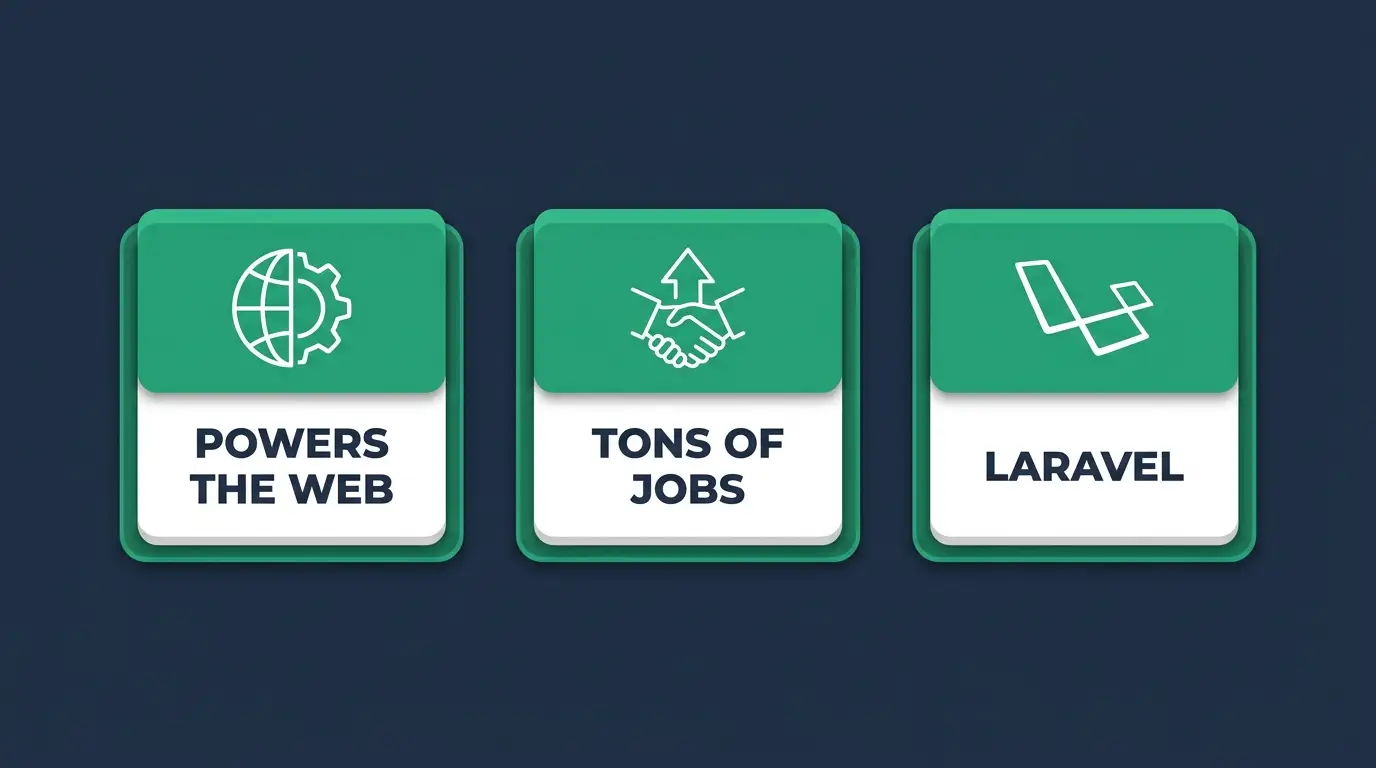
The installed base is enormous, and it isn't shrinking. Roughly three out of four websites that run a server-side language run PHP. WordPress alone powers somewhere north of 40% of the entire web. Every one of those sites is a customer, a bug, a feature request, a job. That work does not evaporate because a new language got popular.
Laravel made PHP genuinely pleasant. This is the part the "PHP is dead" crowd skips. Modern Laravel is one of the most loved backend frameworks anywhere. Clean routing, a real ORM, queues, testing baked in, a whole ecosystem (Forge, Vapor, Livewire, Filament) that lets a small team ship like a big one. People who actually write Laravel today are not suffering. They're moving fast.
The on-ramp is short. You can go from zero to a small working app faster in PHP than in almost anything else. Cheap hosting, instant feedback, a forgiving learning curve. For someone trying to get paid this year instead of someday, that matters more than purity.
Freelance and agency work is everywhere. Small businesses need WordPress fixes, plugin tweaks, custom Laravel dashboards, integrations. You can build a side income with PHP while you're still learning, which is something I tell beginners constantly. Want to go deeper on the role itself? I broke it down in how to become a PHP developer.

The honest counter-case
I'd be lying to you if I stopped there.
PHP has a reputation problem. Fair or not, a chunk of the industry still hears "PHP" and pictures 2009. Some hiring managers at trendy startups will quietly skip your resume. You're fighting a perception, and perception is slow to change.
You will inherit legacy code. A lot of PHP jobs are maintaining things built years ago by people who are long gone. No tests, mystery functions, files named final_v2_REAL.php. That work pays, but it can grind on you if you wanted to build shiny new things every day.
Prestige is lower. If your goal is FAANG bragging rights or the highest-paid niche on earth, PHP is not the shortest road there. The ceiling is real, it's just not the same ceiling as specialized Go or systems work.
WordPress-only work can be a trap. There's a floor of low-paid "fix my theme" gigs that some developers never climb out of. The money in PHP is real, but it lives in application work (Laravel, custom backends, real engineering), not in endless $15 plugin patches.
Here's the line I want you to keep: boring, in-demand skills pay your rent more reliably than trendy ones that everyone's chasing. PHP is boring in the best possible way.
Who PHP is great for (and who should skip it)
Learn PHP if you want a paid backend job sooner rather than later, you like shipping real features for real businesses, you're drawn to web apps over systems programming, or you want a freelance income stream you can start building this month. It's an especially strong pick if you're self-taught and need momentum.
Skip PHP if your heart is set on a specific niche it doesn't serve well, like high-performance systems, data science, or machine learning. If you already know you want to do ML, learn Python and don't look back. Curious how they stack up for backend web work? Read PHP vs Python before you commit.
There's no shame in either choice. The mistake is letting a Reddit comment pick for you.
Is PHP dead? The honest answer
No. And it's not close.
A dead language doesn't power 75%+ of the server-side web. A dead language doesn't ship a major version with real performance gains, named arguments, enums, and JIT, the way PHP 8 did. A dead language doesn't have a framework like Laravel pulling in tens of thousands of GitHub stars and a thriving paid ecosystem around it.
What people mean when they say "PHP is dead" is usually "PHP isn't trendy." Those are completely different statements. Trendy and employable are not the same thing, and confusing them is how people end up with an impressive-sounding skill set and no job offers.
Here's where AI fits in. AI tools are genuinely good at PHP boilerplate now. They'll scaffold a controller, write the CRUD, knock out a migration. That scares beginners. It shouldn't. What AI is bad at is knowing why the app exists, how the pieces should fit, and what the business actually needs. The developers who win this decade are the ones who understand architecture and the domain, not the ones who can type a foreach loop the fastest. AI just deleted the part of the job that was never the valuable part.
Final verdict: PHP is a good career. Pick Laravel over WordPress-only work if you can, learn real application architecture, and let AI handle the boilerplate while you handle the thinking. Do that and you'll have steady, well-paid work for as long as the web has businesses on it, which is to say, indefinitely.
FAQ
Is PHP still worth learning in 2026? Yes, especially if your goal is a paid backend job or freelance income soon. The demand is huge, the on-ramp is short, and Laravel makes the day-to-day genuinely enjoyable. Learn the modern stack, not 2010 PHP.
Does PHP pay well? It pays solidly, and Laravel and senior application roles pay well above the WordPress-gig floor. The range is wide, so where you aim matters. I laid out real numbers in the PHP developer salary guide.
Is PHP good for remote work? Very. A large share of PHP and Laravel roles are remote-friendly because so much of the work is web apps and agency projects. See current openings and how to land them in remote PHP developer jobs.
PHP or Python for a beginner? PHP if you want web backends and faster freelance income. Python if you're aiming at data, automation, or machine learning. Both are great first languages. The full comparison is in PHP vs Python.
Will AI replace PHP developers? No. AI speeds up the boilerplate and rewards developers who understand architecture and the business. The ones who treat it as a tool get faster. The ones who hoped to skip learning the fundamentals get exposed.
If you've been sitting on PHP because some stranger online called it dead, I want you to give yourself permission to ignore that noise and just start building. Steady beats trendy more often than the internet admits.
When you're ready to go from "thinking about it" to actually shipping, walk the full PHP developer career path with me. I'll show you exactly what to learn, in what order, and how to turn it into a paycheck. You've got this.