AI Side Hustles That Actually Pay (and the Ones I'd Avoid)
On this page
Someone sent me a DM last spring with a screenshot of a Stripe dashboard. $18,400 in one month. Caption said "AI side hustle, 2 hours a day." He wanted to know which course to buy so he could copy it.
I asked him one question. What does that person actually sell?
He didn't know. The video never said. And that's most of this category: a tool, a workflow scrolling by on screen, a revenue number, and nobody anywhere in the pitch who has a business problem and hands over money to make it go away.
The ones that work are boring services. A local company pays you because something is broken and paying you is cheaper than fixing it themselves. Nobody makes a viral reel about wiring up inventory alerts for a flower shop doing $40k a year. Which is why there's still room in it.
What actually makes something work
I run every idea through two questions.
First: is somebody already paying for this outcome in some other form? If a business currently pays an agency $1,200 a month to do it slowly by hand, you have a market. If nobody has ever paid for it, you're not early, you're just wrong.
Second: can you reach those buyers without an algorithm's permission? Cold email, a chamber meetup, a Facebook group for Shopify owners, a former coworker. This question kills more ideas than the first one, and it's the one people skip.
Automation building for small businesses
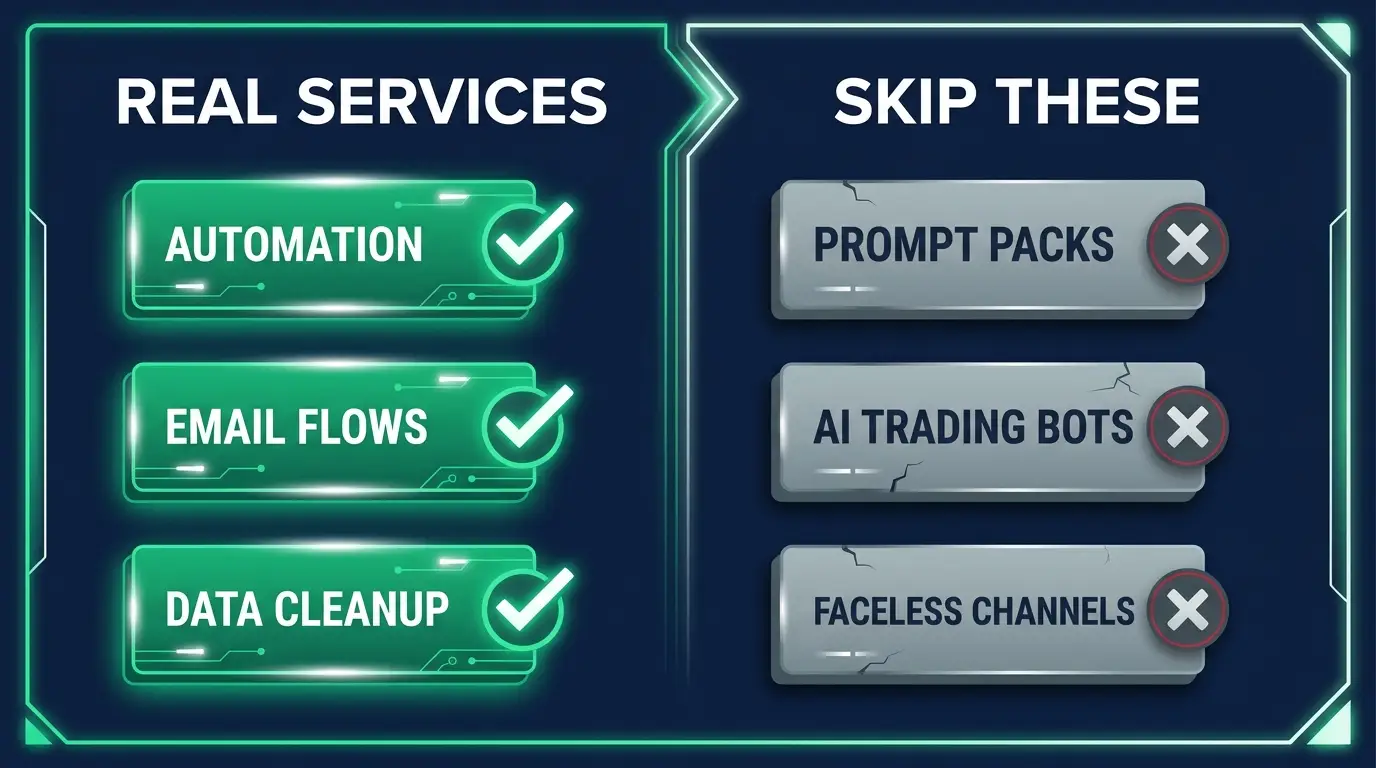
Small businesses run on copy and paste, and if you make me pick one thing off this list, I'm picking this. A form submission gets typed into a CRM by hand. Somebody's office manager spends four hours every Friday building a report nobody reads carefully. You build the workflow that does it in n8n or Make, charge to build it, then charge monthly to keep it alive.
Realistic money: $500 to $1,500 to build the first one, then $500 to $2,000 a month per client on retainer. The retainer is the whole point. APIs change, credentials expire, a client renames a column in a Google Sheet and the thing snaps at 6am on a Tuesday. They pay you so that isn't their problem.
Where people go wrong is thinking they sell automations. What you sell is the absence of a headache, which is why the discovery call matters more than the build. Long version in how to start an AI automation agency, and if you want to see what these look like before you pitch anyone, read these n8n workflow examples.
Difficulty is medium. You need to understand data, APIs, and error handling well enough to fix them at 8am when a client is annoyed. That's more than a weekend and a lot less than a degree.
Email flows for online stores
Every Shopify store has abandoned checkouts. Most of them have a welcome email that was set up two years ago by a founder at midnight and never touched since.
Setting up a proper Klaviyo flow set (welcome, abandoned cart, browse abandonment, post-purchase, winback) costs $300 to $500 for a small store, more once you're doing custom-coded templates and real segmentation. Ongoing management is $200 to $1,000 a month.
What makes this one good is that email revenue shows up in a dashboard. You point at a number and say "that flow made you $2,800 last month." Nothing else here is that easy to prove, and proof turns a one-off job into a retainer.
AI drafts the copy and speeds up the build. It does not know why a store's repeat buyers go quiet at day 45. That part is you. How to become an email developer covers the technical side that separates the $300 people from the $3,000 people.
AI content and SEO production
This is the one everybody starts with, and right now it has the worst odds on the page.
Businesses do pay for content, and AI does make you faster. But Google spent the last year actively deindexing low-effort AI pages, and I watched sites lose 60 to 80 percent of their traffic overnight in that June rollout. If your offer is "I generate 20 articles a month," you're competing on price with everyone on earth who has a ChatGPT subscription, and your client's site might get punished for buying it.
There's still a version that pays well: you own the whole pipeline. Keyword research, real interviews with the client's team, reporting that ties rankings back to leads. That's $1,500 to $4,000 a month and it's closer to a fractional marketing hire than a writing job.
The word-count version of this business is dying. Go in with your eyes open.
Chatbots and support agents for local businesses
A dental office gets the same eleven questions every day. Hours, insurance, parking, whether you take walk-ins.
You build a bot that answers those from their own documents, drop it on their site, and connect it to booking. The range I see is $500 to $2,000 to set up, $150 to $500 monthly.
One caution the tutorials skip. Medical and legal clients cannot have a bot inventing answers, and "the AI said it" is not a defense that goes anywhere good. Constrain it to their documents, hand off to a human when it's unsure, and put that limitation in the proposal instead of hiding it. Never built one end to end? Start with how to build an AI agent.
Product photos and ad creative for ecommerce
Small brands cannot afford a photo shoot. They can afford $200 for fifteen lifestyle images of their product that don't look like they were shot on a kitchen counter, because they were shot on a kitchen counter.
This one is open to you if you have any visual taste at all. The skill is knowing what a converting ad looks like and matching a brand's existing look so the new images sit next to the old ones without clashing. Melted logos and six-fingered hands lose clients fast.
Lower ceiling than the automation work, much faster ramp.

Data cleanup and migration
The least sexy thing on this list, and the one I've seen pay most reliably for people just starting.
A company moves from one CRM to another with 14,000 contacts, duplicate records, and phone numbers in nine formats. Somebody has to fix that. AI plus a script does in two days what an intern would do in three weeks and get wrong anyway.
$1,000 to $5,000 per project, with no retainer at the end of it and nobody making content about it. It also gets you inside a business's systems, which is where you find the automation work they didn't know they needed.
Voice agents for missed calls
A plumber missing calls while under a sink loses $400 jobs all day long. A voice agent that answers, qualifies, and books is one of the few things you can sell where the client does the math on the pain themselves in the first minute of the call.
Setup is $1,000 to $3,000, monthly $300 to $1,000. Latency and interruption handling are still finicky, and a bad voice agent is worse than voicemail, so test it hard on real calls before you charge anyone. I go through what these can and cannot do yet in the guide to AI voice agents.
The ones I'd skip
Faceless AI content channels. Rented land, thousands of identical channels, and platforms tightening monetization on mass-produced uploads. Some people win. Most produce 80 videos and $12.
Prompt packs. The product is a text file that becomes obsolete with every model release. And the only people making money selling prompts are selling them to people who want to sell prompts.
AI trading bots. Avoid these completely, and I'm not hedging on it. If a bot could reliably print money, nobody would sell you access for $97 a month.
Print on demand with AI art. Margins are thin, the market is flooded with the same generated designs, and the platforms are cracking down.
General rule: if the pitch opens with an income screenshot, close the tab. A real business opens with somebody's problem.
Why most of these fail
Honest base rate: most people who try any of this make nothing. Not because the ideas don't work.
Usually there was never a customer. Six weeks building the perfect workflow, zero conversations with anyone who might pay for it. It's the big one, and among developers it's close to universal.
Right behind that is distribution. You know how to build the thing and have no idea how to get in front of forty business owners, and learning to sell is half the job.
Then people quit around week three. The first outreach batch gets ignored, the first call goes badly, and the whole thing quietly gets shelved. Everybody's timeline is longer than the video promised.
The ones who stay in usually end up competing on price, which you lose the moment your offer is generic. Be the person who does this for HVAC companies, not the person who does automations.
The skill is the bottleneck and it's also the thing that protects you. Anyone can subscribe to the tool. Not many can debug a broken integration at 11pm and then explain to a client, in plain English, why it broke.
How to get the first $500
Small and specific beats clever here. Pick one service off this list. One. Then pick one type of business you already understand, because you worked there or your family runs one. Med spas, landscapers, apparel brands, whatever vocabulary you already speak.
Then audit a business you know, for free. Their site, their emails, how fast they answer a lead. Write two pages on what's leaking and what you'd fix first.
Do the first build cheap, or free, in exchange for a case study with a real number in it. That beats your next twenty cold emails, because it turns "I can do this" into "I did this for a company like yours."
Client two is where you charge properly. The one person agency is the model I'd build toward from there.

FAQ
What is the best AI side hustle for beginners? Automation building for small businesses, if you're willing to learn the technical side. Data cleanup if you want money faster with a shorter learning curve. Both have real buyers who are already paying somebody to do the work slowly.
How much can you realistically make with an AI side hustle? Somewhere between nothing and a few thousand a month, and the split is uncomfortable. Most people make nothing, because they never talk to a customer. People who land two or three automation retainers usually sit in the $1,000 to $4,000 a month range working part-time. I can't promise you a number and neither can anyone else.
Do I need to know how to code? Not for all of it. Product creative and basic chatbot setup are approachable without code. Automation work and migrations go much better if you understand APIs and debugging. People who can code charge more because they can fix things when they break.
How long before I make money? Plan on two to four months of building skill and doing outreach before the first real payment, if you're consistent. Faster with a network to pitch. Much slower if you keep learning instead of selling.
Are AI side hustles saturated? Content generation, yes, painfully. Service work for small local businesses is nowhere close, because most of those owners still haven't heard of these tools and the people who have won't do the unglamorous parts.
Every option on this page needs a real skill underneath it, and that's the bottleneck. The tools will change again by next year. Knowing how data moves and how to explain a broken system to the person paying you is what carries over.
That's what we build at CodingPhase. Diamond membership is $42 a month or $255 a year with a 7-day money-back guarantee, and Tech Accelerator is $1,500 one time if you want lifetime access plus live weekly mentorship. You also land in a community of 80,000+ people, plenty of them one step ahead of you and still remembering what week three felt like.
For the roadmap on the highest-paying option here, start with the AI automation career path. Then pick one thing and go talk to one business owner this week. That's the part everybody skips, and it's the part that works.