How to Start an AI Automation Agency (Without the Guru Nonsense)

On this page
A guy who runs a two-location dental practice showed me his intake process last spring. Someone fills out the form on his site, it emails his front desk, a receptionist copies the name and number into their scheduling software, then texts the person, then sets a reminder to text again if they don't reply.
Four steps. Every lead. Two people doing it between phone calls.
I asked how long the average lead sat before anyone touched it. Couple hours, he said, longer on Saturdays. A form submission that gets a text back in 90 seconds books way better than one answered three hours later, and I could wire that up in a weekend.
That's an AI automation agency, the whole business: you find the boring expensive thing a company does by hand, and you make it stop being done by hand.
It keeps getting sold to you as a magic money machine because the work really is valuable. What the pitch leaves out is that you have to be able to build the thing, and then keep it alive when it breaks at 2am on a Sunday.
What you're actually selling
Not "AI." Nobody wakes up wanting AI. They wake up annoyed that Denise spends every Friday afternoon copying invoice line items into QuickBooks.
The thing that closes most often for me is lead routing, or speed-to-lead if you want the sales word for it. A form or ad lead comes in, gets enriched, gets scored, hits the right salesperson's phone in under two minutes, and follows up on its own if nobody responds. Sales teams feel that one immediately because they can watch the response time drop.
Document and invoice processing is next: PDFs and emailed receipts turned into structured data and dropped into their accounting system. The AI layer earns its keep here, because the old rules-based extractors fell over on any invoice that wasn't the exact template they were built for.
Then there's the reporting digest. Every Monday at 7am your client gets revenue, top channel, and one line of plain-English context. Sounds small. Clients love it out of proportion to the build time.
Support triage sells too: incoming tickets get categorized, urgent ones escalate, and the easy 40 percent get a drafted reply a human approves before it sends.
Onboarding sequences. Content pipelines where the model drafts and a person edits before anything goes live. Data cleanup between two systems that were never meant to talk.
Notice the human review in a couple of those. Keep it there. Agencies that promise full autonomy on anything customer-facing end up writing apology emails.
What to charge
Most beginner content goes soft right here, so let me give you actual numbers.
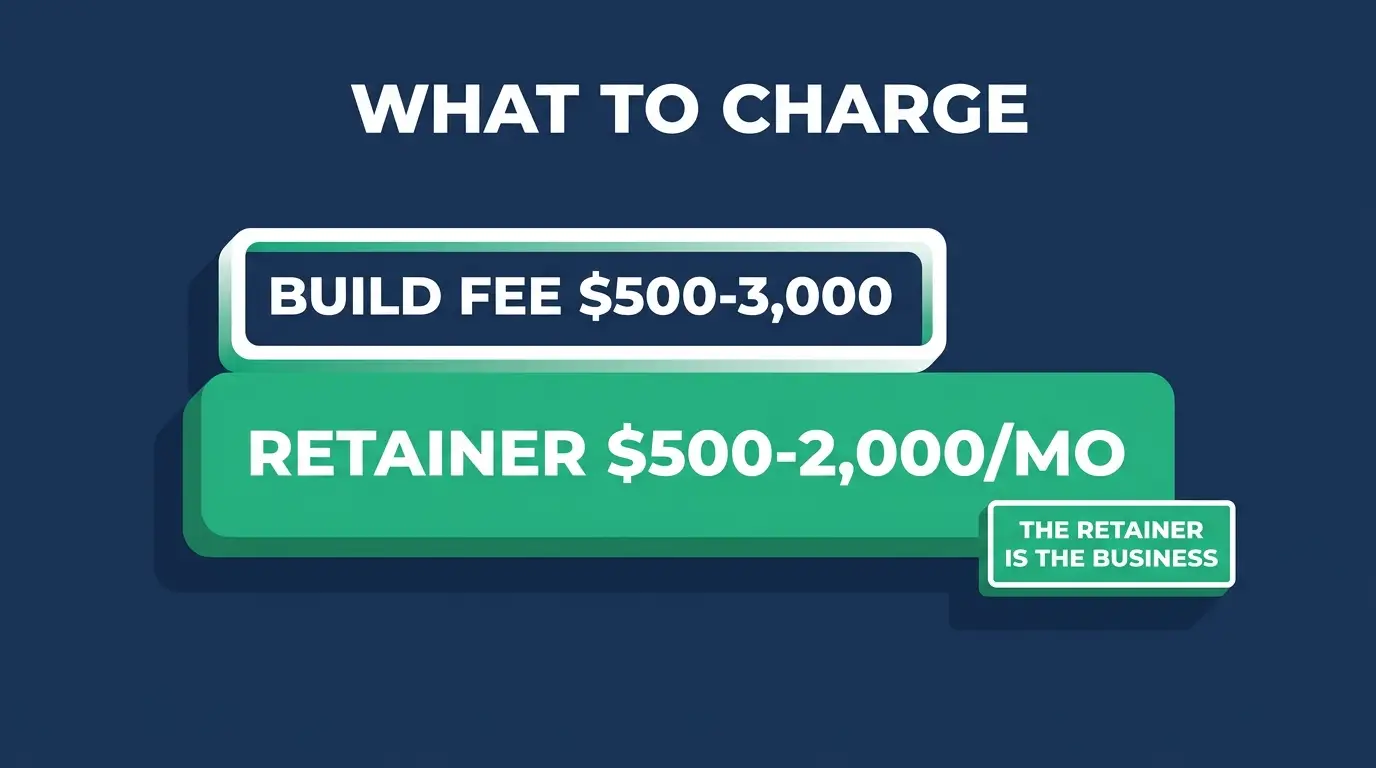
Build fees run roughly $500 to $3,000 per workflow. A single-trigger lead router with two integrations is near the bottom. Something with document parsing, error branches, a human approval step and a dashboard lands near the top, sometimes past it.
Retainers run $500 to $2,000 per client per month for monitoring, fixes, and the small changes they'll ask for constantly. The retainer is the business. The build fee just covers the month you spent building.
Now the honest part: your first two or three clients, you will charge less than this. Probably a lot less. I'd rather you take $400 for a build you'd normally price at $1,500 if it gets you a working system in production and a client willing to say on camera that it saved them six hours a week. Just be clear it's an introductory rate, and say so out loud, because otherwise you can never raise it.
The math that makes this a real income is the stacking. Four retainers at $900 is $3,600 recurring before you build anything new that month, and I broke that model down in the one-person agency post.
Price the outcome. If the process eats 20 hours a month at a $28 loaded hourly cost, you're removing about $560 a month of labor plus whatever the faster response time is worth in booked revenue. Quote against that number, never against how long it took you to build.

Getting your first client
This is the part that stops almost everyone, and content that skips it is doing you real damage.
Start with businesses you already have a relationship with. Your old boss. The guy who did your bathroom. Your cousin who runs a landscaping company with four crews and a whiteboard. You need someone who will let you sit with their process for an hour without a sales pitch attached, and strangers won't do that for you yet.
Then do a free audit. Not a discovery call. An audit: you ask them to walk you through one process end to end while you write down every step, who does it, and roughly how long it takes. Most clients have never once seen their own process written out. Watching them realize it takes 11 steps to onboard one customer does more selling than anything you could say.
Come back with before and after. Current state: 11 steps, roughly 45 minutes per customer, two people involved. Proposed: 3 steps, one approval click, about 4 minutes. Here's the build fee, here's the monthly, here's what happens if it breaks.
If you don't have warm contacts, cold outreach works, but only when it names a specific process at their specific company. "I help businesses leverage AI" gets deleted. "I noticed your booking form doesn't send a confirmation text, and your Google reviews mention people waiting on callbacks, here's a two-minute video of what I'd build" gets replies.
Build one thing for free if you have to, but only one, and only for a business you can name and show people. After that you're not somebody with an idea, you're somebody with a system running in production.
The stack you need
You have two real choices for the orchestration layer. n8n is open source, self-hostable, and gets stranger and a lot more flexible the deeper you go. Make is friendlier to look at and easier to hand off to a client who isn't technical.
I lean n8n for agency work because you can host it yourself, the per-execution economics don't punish you when a client's volume grows, and you can drop into code when a node won't do what you need. Start with what n8n actually is if it's new to you, then go look at real workflow examples instead of reading more theory. If you're coming from Zapier, the alternatives breakdown covers the pricing wall that pushed most agencies off it.
On top of that you need an AI layer for the parts that require judgment, like pulling a total off a scanned invoice that's laid out differently every time. And you need enough JavaScript to write a transform node, plus enough about APIs and auth to debug why a call is 401ing.
That last paragraph is the actual barrier to entry. Everything else in this post is business advice you could get anywhere.
What kills most of these agencies
Silent failures. A workflow breaks on a Tuesday. A credential expired, or an API quietly renamed a field. Nothing errors loudly. Leads stop routing. You find out eleven days later when the client calls you furious about the pipeline being empty. This is the number one killer and it's completely preventable: every workflow gets error handling, a failure alert to a channel you actually read, and something that pings you when a daily job hasn't run in 36 hours. Build the monitoring before you build the second client.
No retainer. You do a $2,000 build, you're thrilled, then next month you start from zero again. Ten one-off builds is ten times you had to find a client. Four retainers is four times, and they pay every month. If a client won't take a maintenance agreement, price the build higher and put an end date on your support.
Then there's scope creep, which always arrives politely. "While you're in there, could you also..." Six of those and you're doing $4,000 of work for $1,200. A scope document naming exactly which workflows, which integrations, and how many revision rounds fixes most of it. Changes outside the doc get a number attached.
Some clients will look at your n8n canvas, see boxes connected with lines, and quietly conclude they can maintain it themselves. That one is real and I won't pretend otherwise. You don't fix it by hiding your canvas from them. You fix it by being the person who takes the 2am break and the API deprecation off their plate. Stay useful every month or you will get churned.
And don't bill hours. Every hour of skill you gain makes you cheaper to hire, which is a strange thing to do to yourself. Price the outcome instead.
On the legal side, and I'm not a lawyer so treat this as a starting point: get a simple contract plus a written scope doc, and settle up front who owns the workflows if the relationship ends. Use the client's accounts and credentials, not your personal ones, so offboarding isn't a scramble. Have somebody who does this professionally look at your template once.
Is it too late?
The tools are easier than they've ever been and most small businesses have automated nothing. Not "not enough." Nothing. Your dentist, or the shop down the street with 12 employees and a spreadsheet holding the whole operation together. That gap isn't closing quickly.
What has changed is the noise. The "AI agency" space is full of people selling a $997 course on how to run an AI agency, taught by someone whose only AI agency income is that course. A lot of people are competing to sell you the pitch. Not many are competing to do the work, and the work is what businesses are actually paying for.
So what separates you has become pretty boring: can you build it, and can you keep it running. When a client's Shopify webhook starts failing, can you read the payload and figure out why. When their volume goes from 200 to 4,000 executions a month, do you know what that costs.
That's a skill problem rather than an access problem, which means it's open to you, and it takes months instead of years.

FAQ
How much can an AI automation agency make? Realistically, a solo operator with four to eight retainer clients is somewhere between $4,000 and $12,000 a month recurring, plus build fees on top. The first six months are usually thin while you're learning and collecting proof. I'd plan for a year to something stable and be pleasantly surprised if it's faster.
Do I need to code? You need to be technical, which is a slightly different thing. You can build a lot in n8n or Make without writing much. But the workflows that pay well involve API quirks and debugging, and that's where light JavaScript separates the people charging $2,000 from the people charging $300. No CS degree required. You do need to not panic at a JSON payload.
How long before I can charge for this? Building consistently, two to four months to your first paid build is reasonable. Do three or four workflows for imaginary clients first so you've already met the errors before a real client's money is involved.
Should I niche down? Eventually, and it's about reuse more than marketing. Your fifth med spa client takes a third of the time the first one did because you've already solved their intake and their reminders. Take whatever comes early, then lean into whichever industry you keep landing.
What's the difference between this and being an automation specialist at a company? Same skills, different risk. A salaried automation role pays steadily and someone else finds the clients. Plenty of people do the specialist path first, build real systems on someone else's payroll, then go independent with proof already in hand. That's arguably the smarter order.
What if I want something smaller than an agency? Reasonable. Plenty of people build automation income without clients or contracts. AI side hustles covers the smaller-scale versions of the same skill set.
The idea isn't the bottleneck here. You already understand the business model, you understood it about four paragraphs in. The bottleneck is being able to sit down in front of a broken workflow and fix it, and that's a skill you build by building.
That's what we do at CodingPhase. The AI automations path takes you from your first workflow to systems with error handling and monitoring you'd be comfortable putting in front of a paying client, and the freelance and agency material covers the pricing and client side. Diamond is $42 a month or $255 a year with a 7-day money-back guarantee, and the Tech Accelerator is $1,500 one time for lifetime access plus live weekly mentorship if you want someone reviewing your builds. There are 80,000+ people in the community, and plenty of them are further along this exact road and happy to tell you what broke for them.
Go find one business you already know. Ask them to walk you through one process. That's the whole first step, and it's free.