AI Automation Salary Guide

On this page
$70K on the low end, $150K and up at the top. That's the real spread for AI automation work in the US right now, and it's wider than almost any field I can name.
Sit with that for a second, because the gap is the whole story. Same job title, same tools, and the pay more than doubles depending on what you can actually do with them. I've watched someone go from $80K to $135K in under two years, not by switching companies twice, but by being able to point at a workflow that saved a business real money.
The frustrating part is that nobody will give you a straight number. You search "AI automation salary" and one article says $65K, the next says $200K, and a third quotes a single Reddit comment like it's the Bureau of Labor Statistics. So you end up more confused than when you started.
I'd rather just give you the real ranges and tell you what moves you up each band.
One thing to hold onto first: these are ranges, not promises. Pay moves with your city, your portfolio, the company's budget, and whether you can point at money you've saved or made. Nobody can guarantee you a number, and anybody who does is selling you a course, not the truth.
What an AI automation specialist actually gets paid
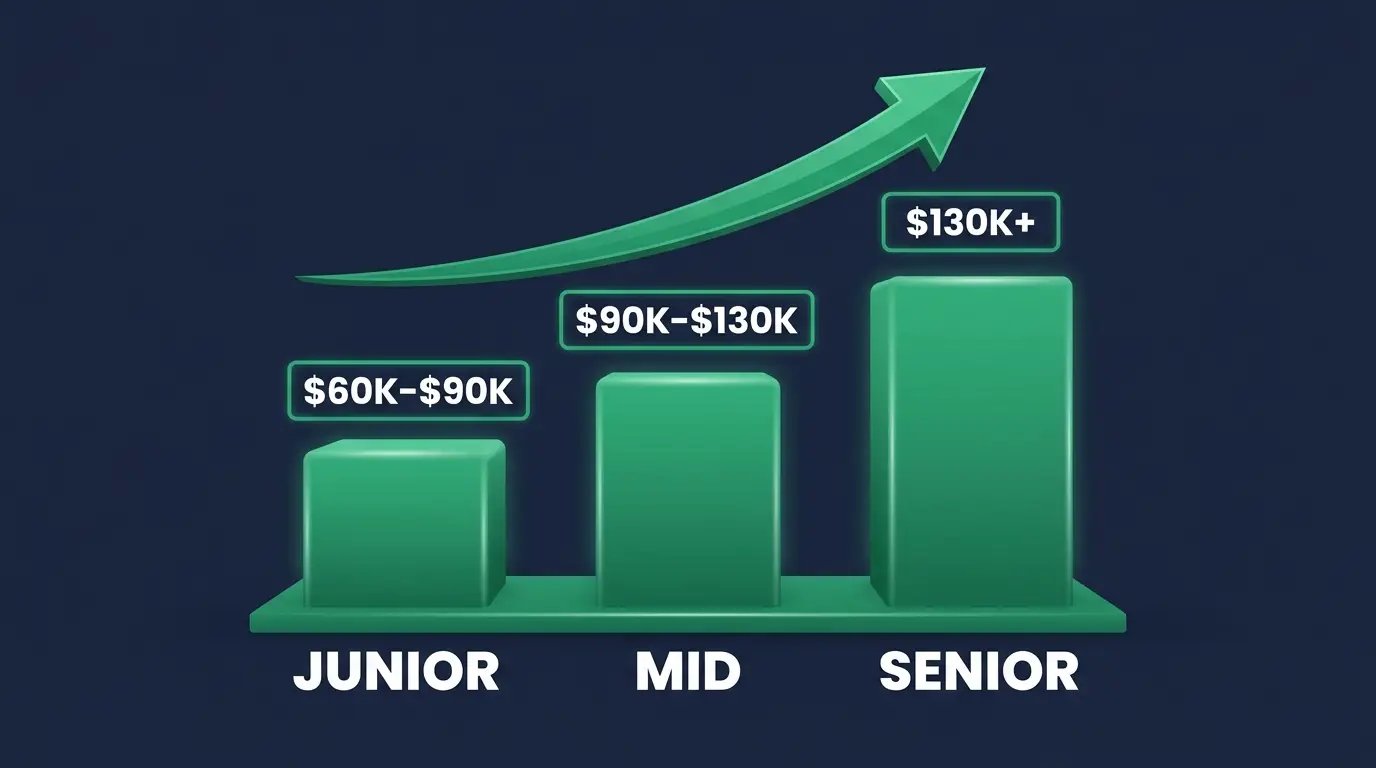
Let me give you the levels the way hiring actually thinks about them, in US dollars, for full-time employee roles.
Junior: roughly $70K to $90K. You can build workflows in tools like Make, n8n, or Zapier. You can wire an OpenAI or Anthropic API call into a flow and handle the output without it breaking. You've shipped a handful of real automations, even if some were for free or for a small client. You're useful on day one but you still need review.
Mid: roughly $100K to $130K. You design the system, not just the steps. You handle errors, retries, edge cases, and the boring reliability work that separates a demo from something a business can trust. You're comfortable with APIs, webhooks, and at least one real programming language when the no-code tool hits its ceiling. You can talk to a non-technical stakeholder and translate "we waste ten hours a week on this" into a working build.
Senior: $150K and up. You own outcomes. You architect automation across a whole company, you build with AI agents and not just single API calls, and you can stand in a room and say "this saved us $200K a year" with receipts. At this level the title often stops being "automation specialist" and becomes automation engineer, AI engineer, or solutions architect. The ceiling here is genuinely high, especially at companies where your work touches revenue directly.
Those bands overlap, and they should. A "mid" person in a hot market with a sharp niche can out-earn a "senior" with a generic resume. Level is a rough map, not your destiny.
Employee versus freelance: two different games
The salary numbers above are for W-2 employee roles. Freelance and contract is a separate world with a separate math, and people mix them up constantly.
As a freelancer you might charge $40 to $75 an hour starting out, and $100 to $200+ an hour once you have a track record and a niche. The big numbers look amazing until you remember the parts nobody puts on the landing page.
You eat the dead time. The hours you spend selling, scoping, invoicing, and chasing a client who's gone quiet, none of that bills. You cover your own health insurance, your own taxes, your own software. A $150/hr rate is not a $150/hr salary. It's closer to a $90K to $120K job once you account for unbilled hours and overhead, until you build enough demand to stay booked and raise rates.
The upside is real, though. The freelancers I've watched do best aren't selling hours at all. They're selling outcomes, "I'll build you a system that handles your inbound leads for a flat $6,000", and the hourly math stops mattering once the result is worth ten times that to the client.
Here's the reframe worth keeping: you don't get paid for the automation, you get paid for the problem it kills. A two-hour build that saves a company forty hours a month is not a two-hour invoice.
What actually moves the number
Two people with the same job title can be $50K apart. Here's what creates that gap, in roughly the order it matters.
Results you can prove. This is the whole ballgame. "I built automations" pays poorly. "I cut their support response time in half and saved two full-time salaries" pays well. Track every hour and dollar your work saves, from your very first project, even the unpaid ones. That number is your real resume.
Real API and code skill. No-code tools are a fantastic on-ramp, and you should start there. But the pay jumps when you can go past where they stop, calling APIs directly, writing the glue code, handling data the messy way the real world delivers it. The people stuck at the bottom of the range are usually the ones who can only click, never code.
Building with AI agents, not just API calls. Wiring one prompt into a flow is a 2023 skill. Designing systems where AI makes decisions, calls tools, and handles multi-step work with guardrails is what the higher bands are actually paying for now.
Your niche. "I do automation" is a commodity. "I build automation for law firms" or "for e-commerce ops" or "for real estate teams" lets you charge more, because you already understand the workflow and you're not learning their business on their dime. Depth beats breadth on a paycheck.
Where you are and who you work for. A remote role at a well-funded startup pays differently than an in-house role at a small local business. Industry matters too. The same skills aimed at a company where automation touches revenue will always pay more than the same skills aimed at a cost center.
The realistic path to six figures
I won't pretend this is a 30-day thing. Here's the honest shape of it.
Months 0 to 6: learn one automation platform well, learn enough Python or JavaScript to escape the no-code ceiling, and build five real automations. Free for friends, cheap for small businesses, doesn't matter. You need proof, not perfection.
Months 6 to 18: get paid. Junior role or freelance clients. Pick a niche. Start logging the hours and money your work saves, religiously. This is the period where most people quit, and it's also the period that decides everything.
Year 2 and on: you're building agent systems, you have a portfolio with numbers attached, and you can walk into a conversation and say what your work is worth in dollars. That's the moment $150K stops being a fantasy and starts being a negotiation.
For the full roadmap, I broke down the skills, tools, and first projects in how to become an AI automation specialist, and the day-to-day reality lives in is AI automation a good career. If you want to know where these jobs actually live, remote AI automation jobs covers where to look.

The honest tradeoffs
This field pays well, and I'd still tell you the downsides, because a salary guide that only sells the dream is worthless.
The tooling moves fast. The flow you mastered this quarter changes its pricing or gets eaten by a feature in another tool next quarter. You're signing up to keep learning, permanently. If that sounds exhausting rather than exciting, this might not be your lane.
The bottom of the market is getting crowded. Plenty of people can drag-and-drop a Zapier flow now, and that work is getting cheaper. The protection is climbing, the people who can code, architect, and prove results aren't crowded at all. The gap between "clicks buttons" and "builds systems" is exactly where the money sits.
And the numbers swing. A senior in San Francisco and a senior in a low-cost city are not on the same band, and a great month freelancing can be followed by a quiet one. Plan for the average, not the peak.
FAQ
How much does an AI automation specialist make in the US? Roughly $70K to $90K junior, $100K to $130K mid, and $150K and up for senior or engineering-titled roles. Those are employee ranges and they vary a lot by city, company, and what you can prove you've saved or earned them.
Can you make six figures in AI automation? Yes, and it's common at the mid-to-senior level, but it's not a beginner number. Six figures usually shows up once you can build real systems with code and agents, not just no-code flows, and you can point at measurable results.
Is freelance AI automation more profitable than a job? It can be, but not at the hourly rate it looks like. Freelance rates of $100 to $200/hr don't account for unbilled selling, admin, taxes, and software. The freelancers who out-earn salaried roles sell outcomes and flat-fee projects, not hours.
Do I need to know how to code to get paid well? You can start and earn at the lower end with no-code tools alone. But the pay jumps when you can go past where those tools stop, calling APIs, writing glue code, building agent systems. Code is what separates the bottom of the range from the top.
Why do salary numbers for this field vary so much? Because the title isn't standardized and the work ranges from clicking together a simple flow to architecting company-wide AI systems. Same job title, wildly different scope, so the pay spreads out accordingly.
If you're early and the numbers feel far away, that's normal, everyone starts at the bottom of the band. The good news is the path is concrete: learn the tools, learn enough code to escape them, and start logging the value you create from your very first build. Do that and the salary question stops being something you read about and starts being something you negotiate. If you want a guided way in, the AI automations career path lays out the whole route, and I'll be here for the parts that get hard.