Remote AI Automation Jobs
On this page
AI automation is one of the most remote-friendly jobs in tech right now. I'll go further: if you want a real tech salary without ever sitting in an office, this is the cleanest path I know of in 2026.
Here's why I'm so sure. The whole job is wiring tools together over the internet, Zapier, Make, n8n, a CRM, an AI step in the middle. There's nothing to do in person. The work was born remote. A team in Austin can hire someone in Manila to build the exact same flow they'd hire someone down the street for, and the result is identical.
So the supply of remote roles is huge. The problem is finding them, and that trips almost everyone up.
Because here's the catch nobody warns you about. The jobs are everywhere. The words "AI automation" almost never are. Companies hiring for this skill bury it under five or six different titles spread across marketing, ops, and engineering, and if you only ever type one phrase into one search bar, you'll walk away convinced the work doesn't exist.
It does. Let me show you where it actually hides.
Why the jobs feel invisible
Automation isn't a department. It's a thing other departments need.
A marketing team needs someone to wire their lead forms into their CRM and trigger the right emails. A sales ops team needs someone to stop reps from copy-pasting data between six tools. A small agency needs someone to build client workflows in Make so they can take on twice the clients without hiring twice the people.
None of those teams write "AI Automation Specialist" on the req. They write whatever title their HR system already has a slot for. So the work gets buried under names you'd never think to search.
If you want the full picture of what the day-to-day actually looks like, I broke that down in how to become an AI automation specialist. This post is about the hunt: finding the roles, reading the pay, and getting picked when you'll never shake the hiring manager's hand.
The exact titles to search
Stop searching "AI automation." Start searching these, one at a time, with "remote" added:
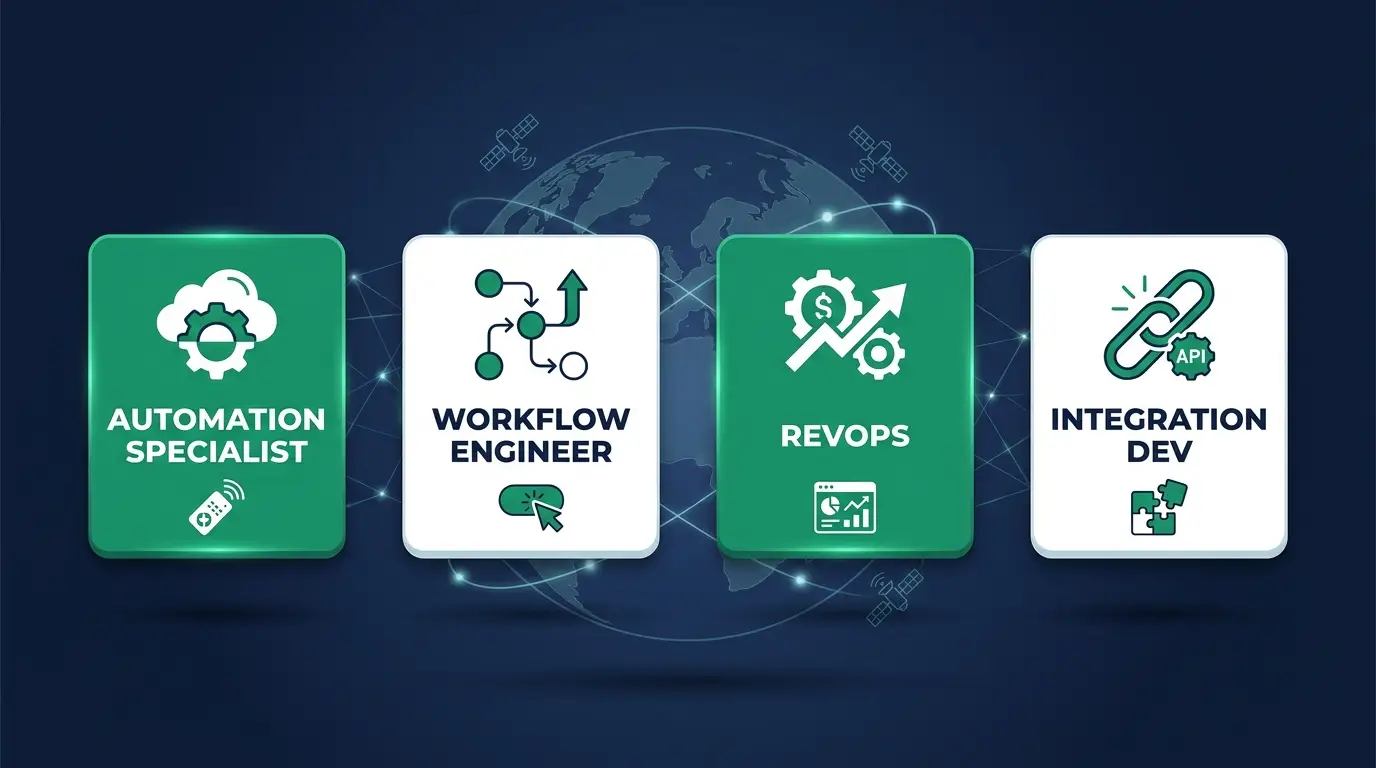
- Automation Specialist: the closest direct hit. Often lives on an ops or marketing team. Heavy on Zapier, Make, n8n, and increasingly AI steps inside those flows.
- RevOps / Marketing Ops Automation: "Revenue Operations" and "Marketing Operations" roles that are really automation jobs wearing an ops badge. You'll build lead routing, scoring, enrichment, and the plumbing between the CRM and everything else.
- Integration Specialist: connecting systems through APIs and middleware. More technical, often better paid, and the title throws off a lot of candidates who don't realize it's the same skill set.
- Zapier Expert / Make Expert: literal tool-name titles, common on freelance boards and at agencies. Easy to search, easy to prove you can do, because the proof is just showing your builds.
- AI Workflow Engineer / AI Automation Engineer: the newest crop. These lean into LLM steps, agents, and tools like n8n. The most "AI" of the bunch and growing fastest.
- Solutions Engineer / Implementation Specialist: at SaaS companies, the person who makes the product actually work inside a customer's stack. Quietly one of the best-paid versions of this work.
Run each title as its own search. Add filters for "remote." Set up alerts. You'll see a completely different job market than the one that looked empty yesterday.
Who's actually hiring remote
Three groups hire for this, and they hire differently.
Startups. Small teams drowning in manual work and allergic to headcount. They'll hand you a mess and a lot of freedom. The upside is you'll touch everything and learn fast. The downside is the role can be vague and the priorities change weekly. Most are remote by default because they were never built around an office.
Agencies. Automation, marketing, and "AI" agencies that build flows for clients on repeat. This is the fastest way to rack up reps, because you'll build dozens of workflows across dozens of businesses in a year. The tradeoff is volume pressure and client deadlines that aren't yours to move. Many are fully distributed.
In-house ops teams. RevOps, MarOps, and sales ops at established companies. More structure, clearer scope, steadier pay, and usually the best benefits. These can be remote or hybrid, so read the listing carefully instead of assuming.
If you're newer, agencies and startups will take a chance on you faster. If you want stability, an in-house ops team is the calmer water.

What remote pay actually looks like
Pay swings hard based on title, depth, and whether you're staff or freelance.
Entry-level automation and ops-coordinator roles tend to start modest. The jump comes the moment you can prove you build reliable systems that save real money or hours. "Engineer" and "integration" titles, and anyone comfortable with APIs and AI steps, sit meaningfully higher than pure no-code tool operators. Solutions engineering at a funded SaaS company is often the top of the range.
I keep a fuller breakdown current in the AI automation salary guide, so I won't throw a wall of numbers at you here. The pattern worth remembering is simpler than any single figure: you don't get paid for knowing the tools, you get paid for the outcomes the tools produce. A flow that recovers a client's abandoned carts is worth more than ten flows that just move data around, and your pay follows that logic whether you're remote in Ohio or remote in Lisbon.
Freelance or full-time
Both are legitimate. They're just different lives.
Freelance gets you earning fastest and lets you stack clients. Zapier and Make expert work is genuinely abundant on freelance platforms, and you can start while you still have a day job. The honest cost: you're now running a business. You'll chase invoices, write proposals, and ride the feast-or-famine cycle, especially the first year. Some months are quiet and that's normal, not failure.
Full-time remote trades that ceiling for stability, benefits, and one set of systems you get to know deeply instead of fifty you see once. The cost is a slower start and a real job search, since these roles are competitive precisely because they're remote.
A path I've watched work more than once: freelance to build the portfolio and the war stories, then convert that proof into a full-time remote offer once you're tired of chasing invoices. The freelance work is the resume.
How to stand out for a fully remote role
Here's the part that matters most, because remote hiring is brutal in one specific way: nobody can see you work. They can't watch you debug a flow or sit with you in a meeting. They hire the proof, not the person.
So build the proof.
Show real builds, not a list of tools. Anyone can write "Zapier, Make, n8n, HubSpot" on a resume. Almost nobody shows a screen recording of a flow they built, what it does, and the problem it solved. A short Loom walking through three real automations will beat a polished CV every time.
Make a tiny portfolio. It doesn't need to be fancy. A simple page with three to five workflows: the problem, the build, the result. Even practice builds count if you frame the problem honestly. The goal is to let a hiring manager see your thinking in two minutes.
Solve the company's actual problem in the application. Pull up the company, find one obvious manual process they probably hate, and describe the flow you'd build to kill it. This single move puts you ahead of nearly everyone, because you stopped talking about yourself and started doing the job.
Prove you can self-manage. Remote roles fear one thing above all: hiring someone who goes quiet. Clear writing, fast replies, and a portfolio that's obviously self-directed all whisper "this person won't disappear on me." That's half the remote hiring decision right there.
If you want the structured route through the skills behind all of this, the AI automations career path lays out what to learn and in what order.
FAQ
What's the best job title to search for remote AI automation work? Start with "Automation Specialist," then run "RevOps," "Marketing Ops," "Integration Specialist," "Zapier expert," and "AI Workflow Engineer" as separate searches with "remote" added. No single phrase surfaces all of these roles, which is exactly why the market looks empty when you only search one.
Do I need to know how to code to get a remote automation job? No, but it raises your ceiling. You can land no-code roles with Zapier and Make alone. The higher-paid integration and engineering titles expect comfort with APIs, webhooks, and basic scripting, plus AI steps inside your flows. Start no-code, add the technical layer as you go.
Are remote AI automation jobs actually remote, or hybrid in disguise? Many are genuinely remote, especially at startups and agencies that were distributed from day one. In-house ops roles are more likely to be hybrid. Always read the listing instead of trusting the search filter, because plenty of "remote" tags hide a "two days in office" line in the description.
Freelance or full-time to start? Freelance if you want to earn and build proof fast and can stomach the instability. Full-time if you want stability and to go deep on one company's systems. Many people freelance first, then convert that portfolio into a remote full-time offer.
How do I stand out when the hiring manager will never meet me? Replace claims with proof. Record short walkthroughs of real flows you built, keep a small portfolio of problem-build-result, and in your application describe a specific automation you'd build for that company. Remote hiring rewards visible work over polished resumes.
The work is real, it's remote, and it pays. The only reason it felt invisible is that you were searching for the brand name instead of the job. Change the words you type, build a little proof, and the market opens up.
Pick one title from the list, set up an alert, and build one workflow this week you can show someone. That's the whole game. If you want a guided way through the skills, I'll meet you on the AI automations career path, and we'll take it one flow at a time.