Front End Developer Bootcamp: An Honest Look Before You Pay
On this page
A student emailed me a photo of a financing agreement last spring. Sixteen thousand dollars for a front end bootcamp, deferred payments, a paragraph about an income share kicking in once he landed a job. He asked me one thing: "Is this the move?"
He was already halfway sold. The landing page had a smiling grad, a "94% hired" badge, and a countdown timer on the next cohort. I have seen that exact page a hundred times with different logos.
I did not answer yes or no. I told him to send me the fine print first, and what I read back to him is basically this whole post: what a front end bootcamp really is, what it costs, and the part they bury, which is what actually gets a beginner hired in the most crowded lane in tech.
What a front end bootcamp actually teaches
Front end means the part of a website you can see and click. Buttons, layouts, forms, the thing that reshuffles when you shrink the window. A front end developer builds that in the browser. Almost every bootcamp teaches the same core stack, and honestly they should, because it is the right stack:
You learn HTML and CSS to structure and style a page. You learn JavaScript, where most of the actual programming lives and where most people hit their first real wall. You learn a framework, usually React, because that is what job postings ask for. You learn Git so you do not lose your work or your mind. You learn responsive design so your site does not fall apart on a phone. And you build a portfolio project or two, which matters more than any certificate they hand you at the end.
A good program also teaches the stuff around the code: reading a Figma file, talking to a designer, opening a pull request without breaking the build. A weak one skips that and marches you through video lessons you could have found free.
Here is the thing worth sitting with. None of that curriculum is secret. Every topic on that list has a free path already mapped out on the internet. What you are paying a bootcamp for is not the information. It is the schedule, the deadline, and the person who answers when you are stuck at 11pm. Sometimes that is worth a lot. Sometimes it is worth sixteen grand less than they charge. If you want the fuller picture of front end versus the server side, I covered that in front end vs back end.
What it really costs
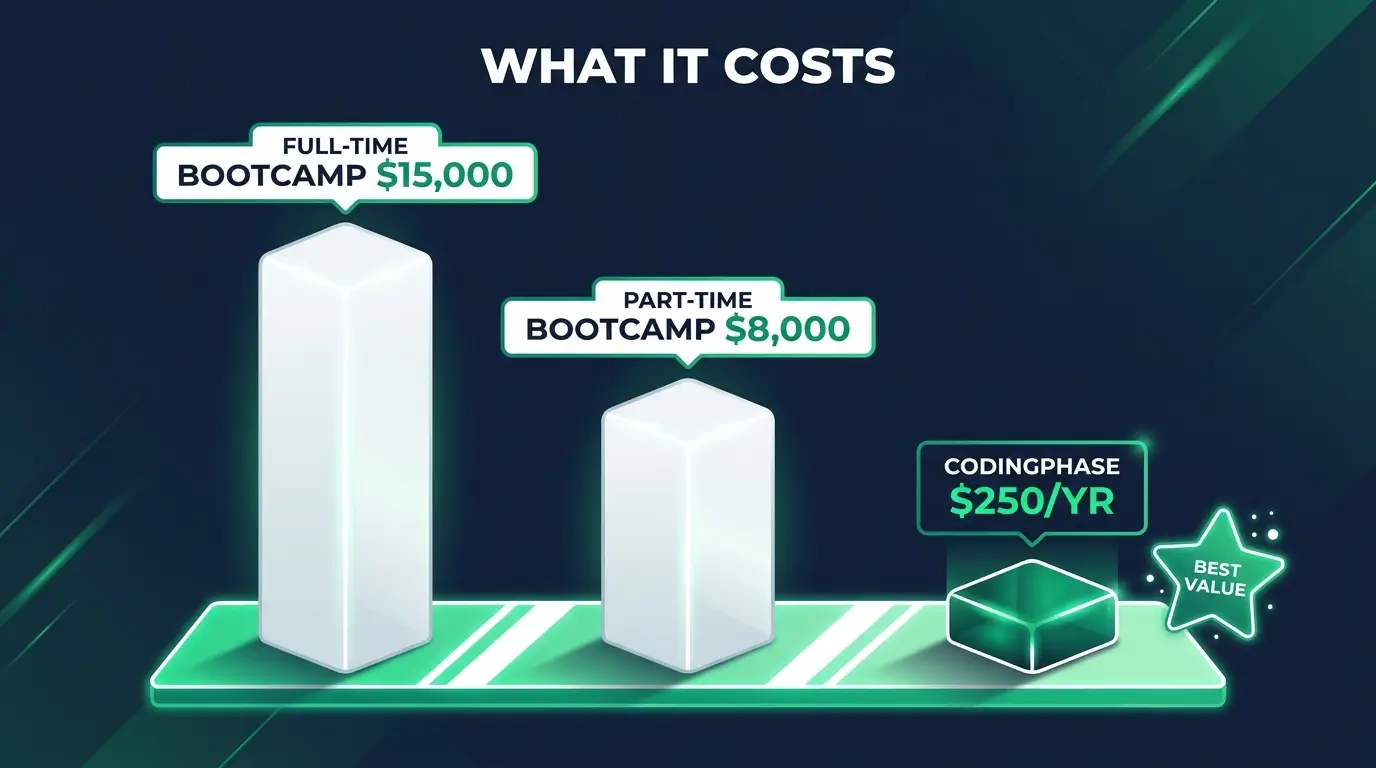
Full-time immersive bootcamps, the twelve-to-sixteen-week kind where you quit your job and code all day, commonly run around ten to twenty thousand dollars. Part-time and self-paced tracks cost less, sometimes a lot less. Prices move constantly, so verify the current number on the actual site before you trust anything, including this paragraph.
Then there is the income share agreement, the ISA. The pitch sounds fair: pay nothing now, pay a percentage of your salary once you are hired above some threshold. Read it slower than that. An ISA can cost more than the sticker price if you land a good salary, because you pay a cut of every paycheck for a set number of months. Some cap the total, some do not. The one my student sent me started collecting if he made a certain income doing anything at all, coding or not.
None of that makes an ISA a scam. It makes it a financial product, and you should treat it like one. I broke down the numbers in what a coding bootcamp actually costs, and I would read it before you sign any payment plan you do not fully understand.
The job placement problem
Now the badge, the "94% hired in six months" one. Once you know how those numbers get built, you cannot unsee it.
Placement stats are almost always self-reported and self-selected. The school surveys graduates, and the ones who got jobs are far more likely to answer than the ones flipping burgers and embarrassed about it. That is survivorship bias, and it quietly inflates every rate you see. The window is usually generous too, six months or even a year, long enough that plenty of those hires had nothing to do with the bootcamp. And "hired" often stretches to include contract work, low-paying apprenticeships, and jobs where the person barely touches code.
I am not saying every school lies. The number on the banner is a marketing asset, assembled to look as good as legally possible. If you want to see how much these definitions vary between programs, I compared them in coding bootcamps and job placement.
Here is the part that stings, and it is specific to front end. It is the single most crowded junior lane in tech. It is the thing everybody learns first, so it is the thing everybody applies for. A single junior front end posting can pull hundreds of applicants, a lot of them with the same React to-do app in their portfolio because they took the same course. A bootcamp certificate does not lift you above that stack. It puts you in the middle of it.

What actually gets you hired
A portfolio of real projects. Not the assigned to-do app that four hundred other grads also built. Something you designed and shipped because you wanted it to exist. A tool a local business could use, a site for a friend's band, a thing with real data and messy edge cases that broke and you fixed. When I look at a beginner, I am not reading their certificate. I am clicking their links to see if the stuff works. Somebody who can get a rough idea live and running on a phone beats somebody who aced the quizzes but never shipped anything.
And here is the honest one most bootcamps will never tell you, because it hurts enrollment. Front end is trending, which is exactly why it is crowded. Meanwhile there are adjacent lanes hiring more readily with less of a mob at the door. Email development. Shopify work. Web administration. Automation. These use most of the same skills you are already learning, pointed at a job fewer people are fighting for. I keep a running list of the easiest tech jobs to actually break into, and if you are learning to code partly to get hired, read it before you lock onto front end as the only door.
I am not trashing front end. I love it. The odds are just real, and you improve them by being strategic about which door you walk toward first. You can always move into pure front end later, from the inside, with a paycheck.
Bootcamp vs teaching yourself
I run a learning platform, so of course I have a bias here. Both sides, honestly, and you decide.
The self-paced route costs a tiny fraction of a bootcamp. The whole curriculum I described up top, the HTML, CSS, JavaScript, React, Git, the portfolio builds, exists in structured form for the price of a monthly membership instead of a car loan. That is the difference between owing sixteen thousand dollars and owing nothing.
But self-paced has a real downside and I will not pretend it does not. It needs you to show up when nobody is making you. No cohort, no start date, no classmate who notices you went quiet. Some people thrive on that freedom. Others need the deadline and the accountability of a group, and for them a cohort works better even at the higher price. Be honest about which one you are. If you have started five courses and finished zero, the thing a bootcamp is really selling you is discipline, and there are cheaper ways to buy that than a five-figure loan. I keep a list of affordable coding courses that actually get people hired for exactly this reason.
That is the actual tradeoff. Cost against accountability. Anybody who tells you self-paced is right for everyone is selling something, and so is anybody who tells you a bootcamp is.
How to vet a bootcamp before you pay
If you have read all of that and still want the cohort, good. Ask these before you hand over a deposit.
Ask them to define "hired" in their placement stat, in writing. Does a non-coding job count? Does a three-week contract count? If they get vague, that is your answer.
Ask about the refund window and what exactly triggers ISA payments to start. Read the trigger clause twice.
Ask who actually teaches. Working developers, or last cohort's graduates promoted into TAs? You want to know which you are getting.
Ask when the curriculum was last updated. A React course still teaching class components as the default is one nobody refreshed.
And ask whether you leave with a real portfolio, or a certificate. If the honest answer is a certificate and one cookie-cutter project, you are paying premium money for the thing that does not get people hired. If you are coming into tech without a degree, the portfolio matters even more, and I wrote about that whole path in getting into tech without a degree.

FAQ
Are front end bootcamps worth it? For some people, yes. If you need structure and live help, and you can afford it or the financing terms are genuinely fair, a good bootcamp can compress your timeline. For most people the same skills are available for a fraction of the cost, and the certificate itself is not what gets you the job. The portfolio is.
How long is a front end bootcamp? Full-time programs usually run three to four months. Part-time and self-paced tracks stretch longer, often six months to a year, because you are fitting the work around a job. Longer is not worse. Consistent is what matters.
Can you get a job after a front end bootcamp? People do, but the credential alone does not clear the bar, because junior front end is the most crowded lane there is. What clears it is real projects you can show and often a smarter target than the exact role every other grad is chasing. Treat the bootcamp as the start of your portfolio, not the finish line.
Is a bootcamp better than self-teaching? It depends entirely on you. A bootcamp buys structure and accountability at a high price. Self-teaching is cheap but demands you show up on your own. Pick based on your honest track record with finishing things.
Do I need a degree for a front end job? No. Plenty of front end developers have no CS degree. Employers hiring juniors care about whether you can build, which is why the portfolio does more work than any line on your resume can.
I built CodingPhase to be the honest, affordable alternative to that sixteen-thousand-dollar gamble my student almost took. Membership is $42 a month, or $255 a year, with a 7-day money-back guarantee, and if you want lifetime access the Tech Accelerator is a one-time $1,500. That gets you 90-plus courses, guided career paths from beginner to job-ready, an ATS resume builder, and a job board for when you are ready.
Here is what I will not do. I will not slap a "94% hired" badge on this page, because I would have to build that number the same shady way everyone else does, and I would rather keep your trust than win a comparison chart. What I can promise is the real curriculum, honest guidance about which doors are open, and a price that does not put you in debt to find out if you like this work.
If you are weighing us against another platform, I put the two side by side in CodingPhase vs Scrimba, and if the crowded front end lane has you curious about where hiring is easier, look at the AI automations path. Learn the craft first. Pick your door with your eyes open. You do not need a loan to start. You just need to start.