Coding Bootcamps With the Best Job Placement (How to Read the Stats)

On this page
A guy messaged me last year, about eight months out of a program he'd financed. His first line was "I picked them because they said 90%." He wasn't angry. That was somehow worse. He just sounded like someone who'd found out the tape measure was wrong after the wall was already up.
That 90% wasn't a lie. It was measured in whatever way produced the biggest possible figure, by people who get paid when the figure is big. Which is a different thing than a lie, and in some ways a more useful thing to understand.
I've watched this happen enough times to want to save you the tuition on the lesson.
How to read a job-placement rate (without getting fooled)
One question does most of the work: placed into what, and out of whom?
The second half is where everything hides. A school reports "90% placement." Ninety percent of which students, though? Usually it's 90% of "job-seeking graduates," and both of those words are quietly earning their keep.
"Graduates" removes everyone who dropped, failed, or was asked to leave. Cohort of 100, seventy finish, and now your 90% is 90% of 70. The people who didn't make it simply aren't in the math anymore. That's survivorship, and it's a gift to any school with an attrition problem.
"Job-seeking" is the slippery one. Schools let graduates declare themselves not currently seeking, and out of the denominator they go. Took a break? Freelancing? Went back to your old field because rent doesn't care about your career pivot? Filed under "not seeking," gone. The rate climbs because somebody didn't get hired.
Then the window. Most reputable reports use 180 days, which I think is fair, since six months to land a first role is a normal amount of time for a normal person. But some schools quote a rate with no window at all. "Eventually employed" is not a placement rate. It's a life update.
Salary numbers get the same squint. They're mostly self-reported through a survey that happy employed grads fill out and everyone else ignores, so the median floats upward on a bruised sample.
If you memorize one thing, memorize this: a placement rate is a marketing number until an auditor signs it. The closest thing to a gold standard is CIRR, the Council on Integrity in Results Reporting. It forces a standardized definition of "placed," it counts the people who dropped, and it hands the numbers to an outside firm. A school reporting through CIRR is telling you something real. A school waving a self-defined 95% is telling you it has a good copywriter.
Plenty of honest schools aren't CIRR-certified, so don't treat it as a purity test. Use the lens anyway. Audited or self-reported? Defined how? Over what window? Out of whom? Most homepage numbers don't survive those four questions.
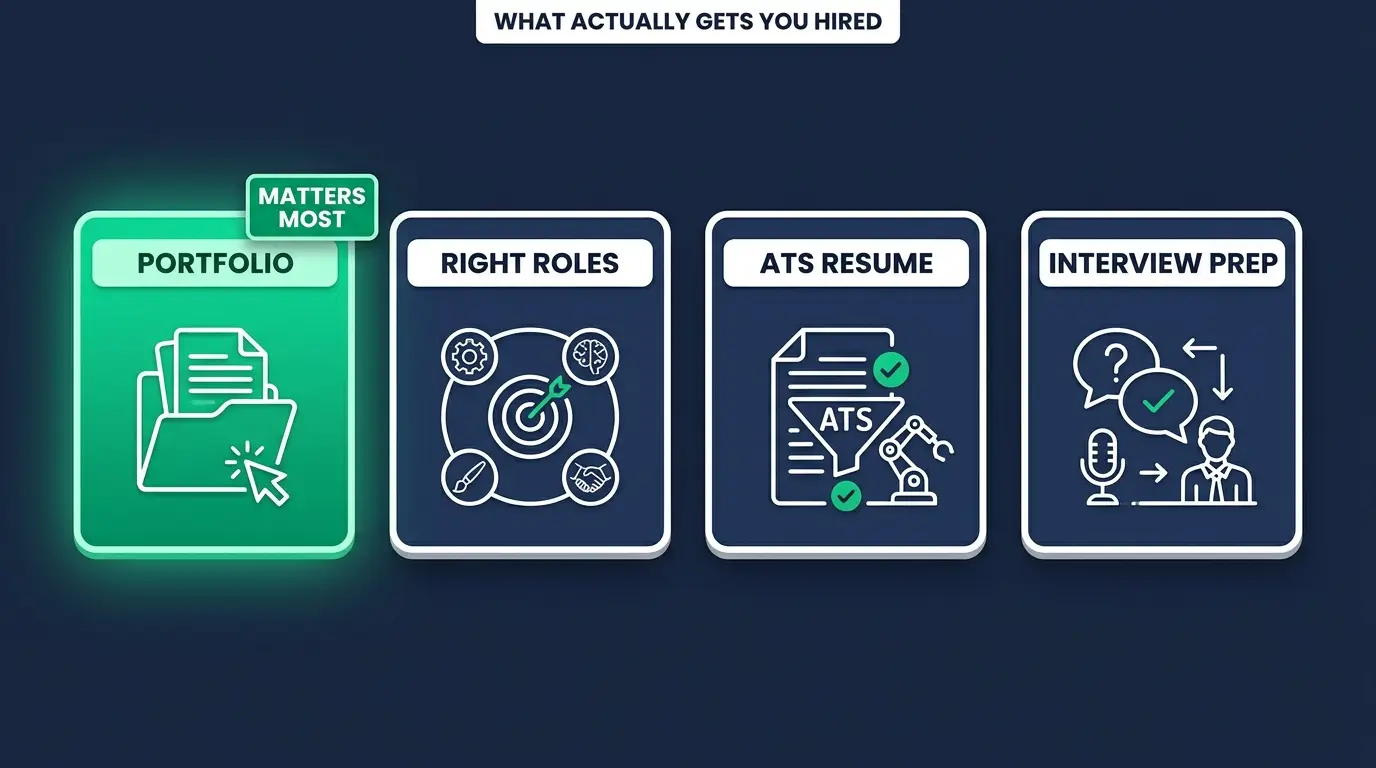
What actually gets you hired
Uncomfortable news for anyone shopping on placement rate: the school's logo is close to the weakest thing on your résumé. Nobody's clicking on where you studied. They're clicking on whether you can do the job.
A portfolio of real projects. Not the class project your entire cohort also built. Something that solves a problem, that you can talk about for ten minutes without notes, that a stranger can open and use. The portfolio is the interview before the interview, and three real projects will beat a certificate basically every time.
Applying to the right roles. A lot of "I can't get hired" turns out to be "I'm only applying to the one job title everyone else is chasing." Junior full-stack at a hot startup has 600 applicants. That email developer role two tabs over has eleven. Same skills. Wildly different odds.
Then there's the résumé, which is where I think most people bleed out without ever knowing it. Software reads you before a human does. Applicant tracking systems parse and rank and quietly discard anything that breaks on fancy formatting or misses the role's language, so your gorgeous two-column PDF with the icons can score a zero because the parser choked. The rejected candidate never finds out. They just assume they weren't good enough, when really they were unreadable to a robot.
And rehearsal. Not "I looked at some LeetCode." Out-loud reps: explaining your projects, walking through your decisions, handling "tell me about a time" without your brain going white. The gap between people who practice this and people who wing it is enormous, and closing it costs nothing.
The hiring manager isn't buying your school. They're buying whether you'll be useful on Monday.

The lanes with real openings for juniors
Here's where I get blunt in a way the schools can't afford to, because they're selling seats and I'm not.
Generic frontend is oversaturated. "Junior React developer" is the most crowded door in tech right now, and every bootcamp funnels every single graduate straight at it, so you're competing against a flood of people who built the same to-do app you did. You can absolutely win there. You're just playing on the hardest difficulty for no reason.
The openings are in the lanes nobody's fighting over, mostly because they're less glamorous and the schools barely mention them.
Email development. Every company that sends marketing email needs somebody who can build a template that survives Outlook. Specialized, weirdly enjoyable, starved for talent. See the email marketing specialist path.
Shopify development. Millions of stores and a permanent shortage of people who can customize themes, write Liquid, and ship what a store owner actually asked for. Freelance and full-time demand, both steady. Here's the ecommerce specialist path.
Web administration and content ops. The person who runs the CMS, keeps the site current, owns the day-to-day web presence. Unglamorous, always hiring, and a genuine on-ramp. More on roles like this in the easiest tech jobs to get into.
AI automation. Wiring tools together, building workflows, making a business run leaner. Barely existed three years ago, which is exactly why it isn't saturated yet.
PHP and Laravel. Deeply unfashionable, which is the point. Huge share of the web runs on it, the people who know it are aging out, the junior competition is thin. Boring pays.
If a job is the actual goal, pick the door with the shortest line instead of the one with the coolest logo over it.
How CodingPhase optimizes for the job, not the tuition bill
My pitch, with the part most schools leave out.
CodingPhase is built around the job. The career paths are organized by what's hiring, so you're not guessing which skill leads to a paycheck. Pick a lane with real openings and follow it from beginner to job-ready.
Every path ships with portfolio templates, so you build the projects that get you clicked on instead of staring at an empty editor. There's an ATS-tested résumé builder, because the robot screens you before a person does. A job board with priority support. An 80,000+ member community, which mostly matters because job hunting alone is miserable and job hunting with other people is survivable. Completion certificates for the paths you finish. All of it sits on top of 90+ courses you move through at your own pace.
The price is the honest part. $42 a month, or $255 a year (about $21 a month), with a 7-day money-back guarantee. If you want lifetime access plus live weekly mentorship, that's the Tech Accelerator at $1,500 one time. Put either next to a $15,000 bootcamp and the math isn't close. I broke the whole thing down in what a coding bootcamp actually costs.
Now the part I promised. We don't publish a guaranteed placement percentage, and I'd like you to read that as a feature.
I could invent one. Every incentive I have says invent one. But I just spent half an article showing you how these numbers get engineered, and I'm not going to turn around and hand you a shiny figure I'd have to define creatively to make look good. Your outcome runs on your projects, your applications, your reps. A $42 membership can't audit those for you. What I can promise is the tooling and the lanes that stack the odds in your favor, and I think that's a more honest offer than a percentage.
None of this needs a degree, by the way, a route I covered in how to get into tech without a degree.
Questions to ask any bootcamp before you pay
Copy these. Send them in an email. Watch how fast a school gets vague.
- Is your placement rate audited, and by whom? CIRR or a named outside firm is a real answer. "We track it internally" is not.
- What's your denominator? Every enrolled student, or only "job-seeking graduates"? The gap between those two numbers tells you everything.
- What counts as "placed"? A full-time software role is placement. An unrelated job, an internship, or a gig at the school itself shouldn't quietly count.
- What's the window, and where do dropouts go? Six months is fair. Ask specifically whether people who left the program are excluded from the rate.
- What happens to my tuition if I don't get hired? Read the refund or ISA terms like a contract, because that's what they are.
A school that's proud of its outcomes answers all five in a paragraph. A school that dodges just told you what its number is worth.

FAQ
What's a good bootcamp job-placement rate? An audited rate somewhere in the 60 to 75% range within 180 days is genuinely strong and believable. When you see 90%+ with no audit and no clear denominator, treat it as a marketing figure rather than a measurement. Higher isn't better if the school got to define it.
Do employers care which bootcamp I went to? Barely. For junior roles, hiring managers weigh your portfolio, your ability to explain your work, and whether you clear the résumé screen far more than your school's name. A strong project set from a cheap program beats a thin one from a famous one.
Why doesn't CodingPhase publish a placement percentage? Because an honest one depends on things we can't audit for you, and a dishonest one is exactly the number this article warns you about. I'd rather give you the paths, portfolio templates, résumé builder, and job board that improve your odds than sell you a figure I'd have to massage.
Which coding lane is easiest to get hired in right now? The less crowded ones: email development, Shopify, web administration, AI automation, and PHP/Laravel. Generic junior frontend is the hardest door because everyone's piled up at it. Pick the lane with the shortest line and real demand.
If a job is the goal, stop shopping for the biggest placement number and start working the four things that actually move it: your projects, your target roles, your résumé, and your reps. Pick a lane that's genuinely hiring over on the career paths page, build the portfolio the path hands you, and let the job board and the community do some of the carrying.
You don't need a $15,000 gamble to get hired. You need the right lane and the tooling to walk it. When you're ready, start a membership and pick your path. I'm rooting for you.