Easiest Tech Jobs to Get Into in 2026 (No Degree Needed)

On this page
Let me kill the word "easy" before it does any more damage.
No tech job is easy. Not one. Anyone selling you a role where the money shows up and the effort doesn't is selling you a dream so they can bill you for it, and I've watched beginners burn six months chasing that dream, quitting before they ever finished a single project they could show anybody.
But "easy" is still the word people type into Google, so let me translate it. What you're actually asking is which doors are open widest right now for someone with no degree, no connections, and a job they already have to keep. On that question, some roles really are more forgiving. Shorter runway. Cheaper to skill up for. Fewer people fighting you for the same seat.
That's my definition. Not "no work." Just "a route that exists for a normal person." Here's the honest version, ranked, with the path into each one.
What makes a tech job "easy to get into"
When I call a role accessible, I mean four things are true at the same time.
The formal-credential bar is low. Nobody's checking for a computer science degree. They're checking whether you can do the work, which removes the most expensive barrier most beginners think is standing in front of them.
You can become useful in months. The skill surface is narrow enough that a focused person gets to hireable in a season or two of real practice.
The applicant pool is thin. This is the one everyone misses. A junior frontend job gets 800 applicants. Email development gets maybe 30, and a good chunk of those can't actually do it once you hand them a broken template.
Portfolio beats pedigree. Real projects you can show will beat a nice résumé here, almost every time. That's a game a nobody from nowhere can win.
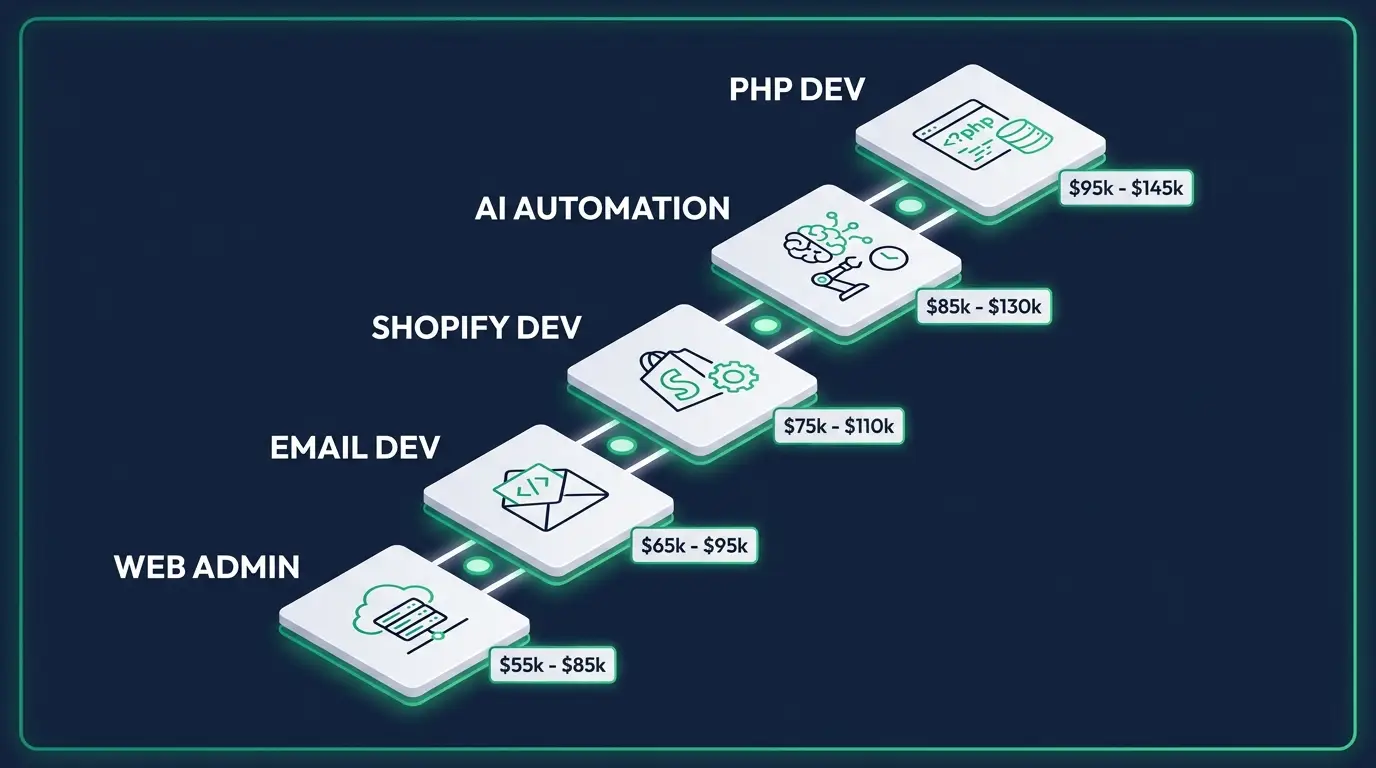
Every role below hits all four, and each one is a lane inside a CodingPhase career path, so you're looking at a map instead of a list.
The roles worth targeting
Ranked from widest door to still-open-but-steeper. If you're truly at zero, start at the top.
1. Web Administrator (the most beginner-friendly job in tech)
Start here. A Web Administrator, sometimes titled webmaster or web producer or e-commerce specialist depending on who wrote the job post, is the person who runs a company's website day to day. Publishing content. Building landing pages. Pushing product and promo updates through the CMS, QA'ing them before they go live, filling in the analytics and SEO fields nobody else wants to touch.
Now notice what that job is. It's content operations. Nobody is paging you at 3am because a database fell over, because server security and uptime belong to a different team entirely. That misunderstanding is exactly why the door stays open: people picture incident response, get scared, and never apply.
Salary ballpark: roughly $45,000 to $70,000 to start, climbing as you take on more of the site.
Why it's accessible: most of the work is learnable in weeks, the tools are visual, and every company with a website needs somebody doing it. Demand is everywhere and boring, which is the best kind of demand.
The honest catch: easy to enter still means you have to prove it. Show two or three sites you've built, migrated, or actually manage, and you're already ahead of most of the pile. Start here: /career-paths/web-content-manager.
2. Email Developer
My favorite hidden door in tech. An Email Developer builds the emails companies send, the campaigns and the automations and the receipt that lands in your inbox eight seconds after you buy something. HTML and CSS, plus fluency in a platform like Klaviyo or Mailchimp.
The cheat code is the applicant pool. Email HTML is finicky, genuinely annoying work, so most developers won't touch it. Which means the ones who can get paid for the rarity. You're competing with a handful of people, not a stadium.
Pay lands around $55,000 to $85,000, and the specialists at high-revenue e-commerce brands go well past that. The skill set is narrow and teachable, no CS foundation required. Your job is to make an email render correctly in Outlook. Sounds small. Pays like it isn't.
The catch: it's a specialty, so dabbling gets you nowhere. Commit, then build a portfolio of real templates that actually send. Path here: /career-paths/email-marketing-specialist.
3. Shopify Developer
Every store runs on a platform, and Shopify runs millions of them. Those stores constantly need someone to customize themes, fix a checkout layout, add a feature the merchant read about somewhere. That someone can be you.
The core skill is Liquid, Shopify's templating language, plus the HTML and CSS around it. Contained world, good docs, and a market of merchants who will never learn to do this themselves and know it.
Salary ballpark: roughly $60,000 to $95,000 employed, and freelance runs higher, because store owners pay real money for somebody who can just fix it today.
Why it's accessible: you learn one platform deeply instead of all of web development shallowly. Focus is what gets a beginner paid fastest.
The catch: theme work gets fiddly and clients have opinions about pixels. Ship a few real store customizations you can point at. Start here: /career-paths/ecommerce-specialist.
4. AI Automation Specialist
Newest door on the list. An AI Automation Specialist wires tools together so a business runs itself a little more: connecting apps, building workflows, dropping AI into whatever part of the week everyone dreads.
It rewards tool fluency over heavy programming, so you're orchestrating systems more than writing thousands of lines of code. And because the field is young, there's no established army of applicants ahead of you. Close to a level field, which almost never happens in tech.
Money is all over the place, from $60,000 into six figures, mostly because a business can measure the value in hours saved and will pay against that number. Spot a repetitive process, automate it, you're valuable. No degree in the conversation.
The catch is that you're partly inventing the job as you go, and there's no credential to hide behind, so you need outcomes. Build automations that solve real problems and write down what they saved. Path here: /career-paths/ai-automations.
5. PHP / Laravel Developer
The unglamorous pick, and I mean that as a compliment. PHP runs a huge share of the web, Laravel is its most loved modern framework, and nobody is making viral videos about either. That's the whole point. The demand is steady and the competition is thinner than the trendy stacks everyone floods into.
This is the most "real developer" role here, so it asks the most of you. In exchange you become an actual backend developer with a skill businesses have needed for twenty years and will probably need for twenty more.
Salary ballpark: roughly $65,000 to $110,000, with strong growth as you deepen.
Why it's accessible: mature ecosystem, excellent materials, and the hype moved elsewhere years ago, so the door isn't jammed.
The catch: this one is genuinely more coding than the rest, so budget more time than you want to. Steady and quiet and always hiring still beats trendy and oversaturated. Start here: /career-paths/php-developer.

The fastest way through any of these
The path for all five is the same shape. Pick one, build real projects in it, assemble a portfolio, apply. The bottleneck is never information. It's structure, and having somebody tell you what to build next.
That's why CodingPhase exists, and I'll be straight about the pitch. It's a project-first membership covering all five of these paths under one roof. Diamond is $42 a month, or $255 a year if you want the cheaper annual rate, with a 7-day money-back guarantee so trying it costs you nothing when it turns out not to be for you. (Lifetime access, the Tech Accelerator, is a one-time $1,500. You don't need it to start.)
What maps to this article specifically: portfolio templates for every path so you're never staring at a blank screen, an ATS résumé builder tuned to survive the screening software that eats most applications, a job board, and 80,000-plus people in the community for when you're stuck at 11pm and nobody's awake.
The part that matters most for a beginner: you can start in whichever lane fits and switch freely. Try Web Administrator, discover halfway through that the automation stuff is what you actually like, slide over. No re-buying, no penalty. You aren't betting your future on guessing right on day one.
What to avoid
Two mistakes cost beginners more time than anything else.
Don't start with generic frontend. "Learn React and become a frontend developer" is the most oversaturated path in tech, and it's where nearly every bootcamp funnels nearly every student. You're applying into the most crowded pool that exists with the weakest résumé in it. The roles above are less glamorous and much emptier. Crowded is your enemy, not difficulty.
Don't chase certificates over portfolios. No hiring manager in any of these roles cares about a certificate. They care whether you can do the work, and the only proof of that is the work. A wall of course completions is not a portfolio. Three real projects is. Build things you can show instead of collecting badges nobody asked you for.
Here's the line I want you to keep: the easiest job to get is the one with the fewest people applying for it. Read that twice.
If you want more on breaking in without a four-year degree, I wrote a full guide on how to get into tech without a degree. And if code itself scares you, there are real tech jobs without coding too.

FAQ
What is the single easiest tech job to get into with no degree? Web Administrator, hands down. It's content operations on a CMS, publishing and updating pages, not server or security work. The skills are learnable in weeks and companies everywhere need it. Widest door for a true beginner.
Can I really get a tech job without a degree in 2026? Yes, and in these roles it's more normal than you'd guess. Every job on this list hires on demonstrated skill. A portfolio of real projects beats a diploma for these positions almost every time.
How long does it take to get hired into one of these roles? With focused, consistent effort, most people can build a hireable portfolio in three to six months for the top roles. PHP/Laravel takes a bit longer since it's more coding. The variable is your consistency, not your talent.
Do I need to be good at math to get into tech? For these roles, no. None of them are math-heavy. They reward practical problem-solving and the willingness to finish things far more than any calculus you half-remember.
Is it worth paying for a course instead of learning free on YouTube? Free content has all the information and none of the structure. What you're paying for is a sequence, projects that add up to a portfolio, and not losing six months guessing what to learn next. If free was working for you, you'd already be done.
Can any of these actually get me to early retirement? The math is better than people assume once you're past the first few years, mostly because these jobs are remote-friendly and the ceiling is higher than the entry pay suggests. I ran the numbers in how to retire early with a tech job.
Pick a lane. It's the only decision that matters today, and you can change it later.
You don't need to be a genius, and you definitely don't need a degree. You need one accessible role, a handful of real projects, and enough structure to keep going on the days it stops being fun. That's it.
Browse all five paths and see which one clicks at /career-paths, and when you're ready to start building, join us at /#pricing. I'll see you inside.
Joe Santos Garcia