Tech Jobs Without Heavy Coding: 6 Roles That Pay Well and Aren't Saturated
On this page
Not every good tech job means grinding LeetCode and fighting 800 other applicants for a junior developer slot. There's a whole layer of roles that sit between the technical and business sides of a company. Some need light coding, some need almost none, and most of them are far less crowded than front-end or full-stack positions.
The catch most people miss: if you can code, even a little, these jobs get dramatically easier to land and pay more, because you become the rare technical person on a team full of people who aren't. You don't need to be a coding wizard. You need enough technical literacy to be useful, plus knowledge of a business domain most developers never bother to learn.
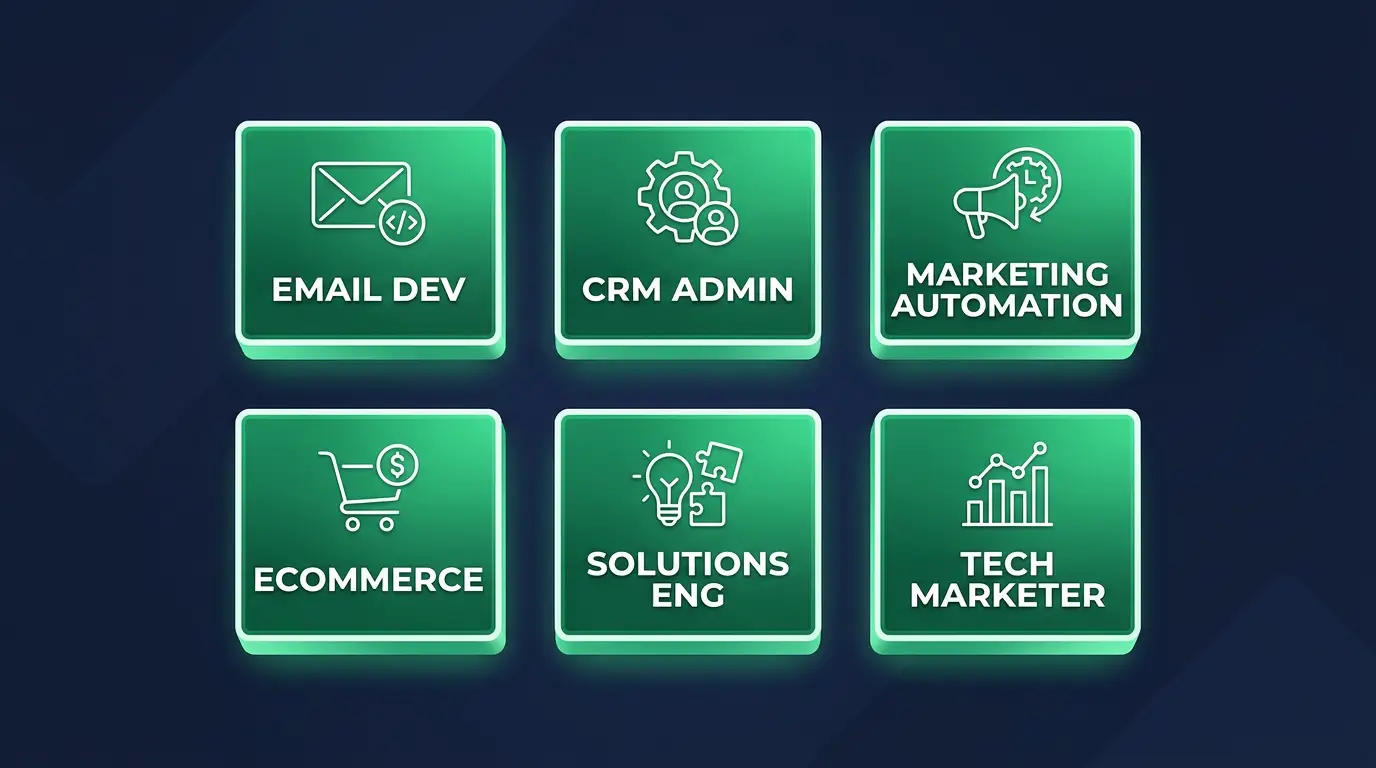
Here are six roles worth knowing about, what they actually do, and the honest tradeoffs of each.
1. Email Developer
Email developers build and code the emails companies send: HTML, inline CSS, and getting it all to render across Outlook, Gmail, and Apple Mail without falling apart. It sounds simple, but email HTML is stuck decades behind the modern web, and most marketers won't touch it. That's the whole opportunity. If you can build responsive, reliable email templates and wire them into a sending platform, you're rare and well-paid.
Coding level: moderate. Real HTML and CSS, just an old-fashioned flavor of it. Tradeoff: the front-end is constrained and dated. If you love modern frameworks, table-based email layout will test your patience.
2. CRM Administrator
A CRM administrator owns the system that runs a company's customer data and automation, usually Salesforce or HubSpot. The job is part configuration, part light development, part data architecture. Businesses run on these systems and constantly struggle to find people who can think in both code and business process. Salesforce admins in particular have a clear, well-paid career ladder.
Coding level: light to moderate. More configuration and logic than raw programming, though scripting helps a lot. Tradeoff: less pure coding, more stakeholder management. You sit close to the business, which suits some people and frustrates others.
3. Marketing Automation Engineer
This is the most engineering-heavy role on the list. You build the automated systems that move leads through a funnel: triggers, workflows, integrations, and data pipelines connecting the website, the CRM, and the ad platforms. It's genuine API work, scripting, and systems design, just aimed at marketing instead of a product backend. If you like back-end work but want to be the rare technical person on a marketing team rather than one of many on an engineering team, this fits cleanly.
Coding level: high. This is real technical work. Tradeoff: you'll work with marketing stakeholders who don't speak your language, so you'll spend time translating. That's a useful skill to build anyway.

4. E-commerce Manager
An e-commerce manager runs an online store's technology and growth: the platform, integrations, conversion optimization, and the analytics behind it all. Shopify, custom checkouts, payment flows, site performance. Coding ability lets you fix and build things yourself instead of routing every change through an agency, which makes you far more effective than a non-technical manager. Many of these roles tie directly to revenue, which means direct leverage on your pay.
Coding level: light to moderate, and the more you have the better you do. Tradeoff: the job is broad. You own outcomes, not just code, and it pulls you toward operations and merchandising.
5. Technical Solutions Engineer
A solutions engineer is the technical person who makes a software product actually work for customers: integrations, custom configurations, API work, and troubleshooting. It's client-facing engineering that sits between the product and the people using it. It pays well, leans on real technical skill, and fewer people apply because it isn't the default "build features all day" job most engineers picture.
Coding level: moderate to high, depending on the product. Tradeoff: client-facing means communication, other people's deadlines, and the occasional fire to put out. If you want to vanish into a codebase and never talk to anyone, look elsewhere.
6. Technical Marketing Specialist
A general marketing role becomes a different job when the person doing it can code. You can build landing pages, set up tracking and analytics properly, and automate the repetitive work that eats most marketers' weeks. You won't out-strategize a career marketer on day one, but you'll out-execute nearly all of them, because you can build the thing instead of waiting two weeks on an engineering ticket.
Coding level: light. Enough to build and automate, not enough to need a CS degree. Tradeoff: the title pays less than a senior engineering role on paper, and you'll invest real time learning marketing fundamentals. The leverage is in the combination, not the title.

How to choose between them
If you want to keep coding as the core of your day, go for marketing automation engineer or solutions engineer. Both are heavily technical.
If you'd rather lean toward strategy and business with code as your edge, CRM administrator, e-commerce manager, or technical marketing specialist make more sense.
Email developer sits in the middle: real front-end work, but in a narrow, scarce specialty where the competition is thin.
The common thread is that all six reward technical ability while sitting in teams where that ability is rare. That's the opposite of the traditional developer market, where everyone has the same skill and the supply crushes the price.
If you're already working as a developer and weighing whether one of these moves is worth it, here's the honest case for switching out of a traditional dev role, including what you give up, not just what you gain.
FAQ
Can you get a tech job without knowing how to code? Yes. Roles like CRM administrator, e-commerce manager, and technical marketing specialist need light coding at most, with the bulk of the work being configuration, strategy, and systems thinking. That said, even a little coding ability makes you noticeably more competitive and tends to raise your pay, because most candidates for these roles can't code at all.
Which of these pays the best? The most technical roles, marketing automation engineer and solutions engineer, generally pay competitively with traditional software engineering. Salesforce-focused CRM work also pays well. The more code a role involves, the higher the ceiling tends to be, but the generalist roles can pay strongly too once you factor in how rare a technical person is on those teams.
Why are these roles less competitive than developer jobs? Almost every coding program funnels graduates toward front-end, back-end, and full-stack roles, which floods those markets. These roles require a mix of technical and business or marketing knowledge that few people build, so the applicant pool is much smaller for similar or better pay.
What should I learn to get into one of these roles? Start with the domain closest to your strengths. If you like back-end work, learn marketing automation platforms and their APIs. If you like front-end, email development and landing pages are the fastest on-ramp. If you prefer business and data, learn a major CRM like Salesforce or HubSpot. The coding is your foundation; the domain knowledge is what makes the combination rare.
If you can already code, you've done the hardest part. The thing most people are missing isn't more algorithms, it's the business or marketing knowledge that turns a common skill into a rare one. Learn that layer deliberately and your technical ability stops being a commodity and starts being leverage.