Why Some Software Engineers Are Trading Full-Stack Roles for Martech Careers

On this page
If you're a front-end, back-end, or full-stack developer, this isn't a post telling you to quit engineering. Your skills are good. The problem isn't your skills. It's that you're competing in the most crowded part of the entire tech job market, against everyone who did the same bootcamp and the same LeetCode grind you did.
There's a quieter set of roles where the same skills are rare instead of common. Email developers, CRM administrators, marketing automation engineers, e-commerce managers. Jobs that sit between marketing and engineering, where being able to actually write code makes you the most capable person in the room instead of one of fifty equally qualified applicants.
I want to be honest about the tradeoffs, because there are real ones. But the math on these roles is worth understanding before you send your next hundred front-end applications into the void.

The honest problem with traditional dev roles
Front-end, back-end, and full-stack are the default destinations. Every coding course funnels people toward them, which is exactly why they're saturated. When a junior front-end role gets 800 applicants in a weekend, your portfolio isn't competing on merit anymore. It's competing on luck and referrals.
The skills aren't the issue. The supply is. You learned the thing everyone else learned, so the market treats it like a commodity and prices it accordingly.
Here's the part that took me a while to see. The value of a technical skill isn't just how hard it is to learn. It's how hard it is to find someone who has it in the context where it's needed. A developer who understands marketing systems is rare not because the coding is harder, but because almost nobody with coding chops bothers to learn the marketing side. That gap is the opportunity.
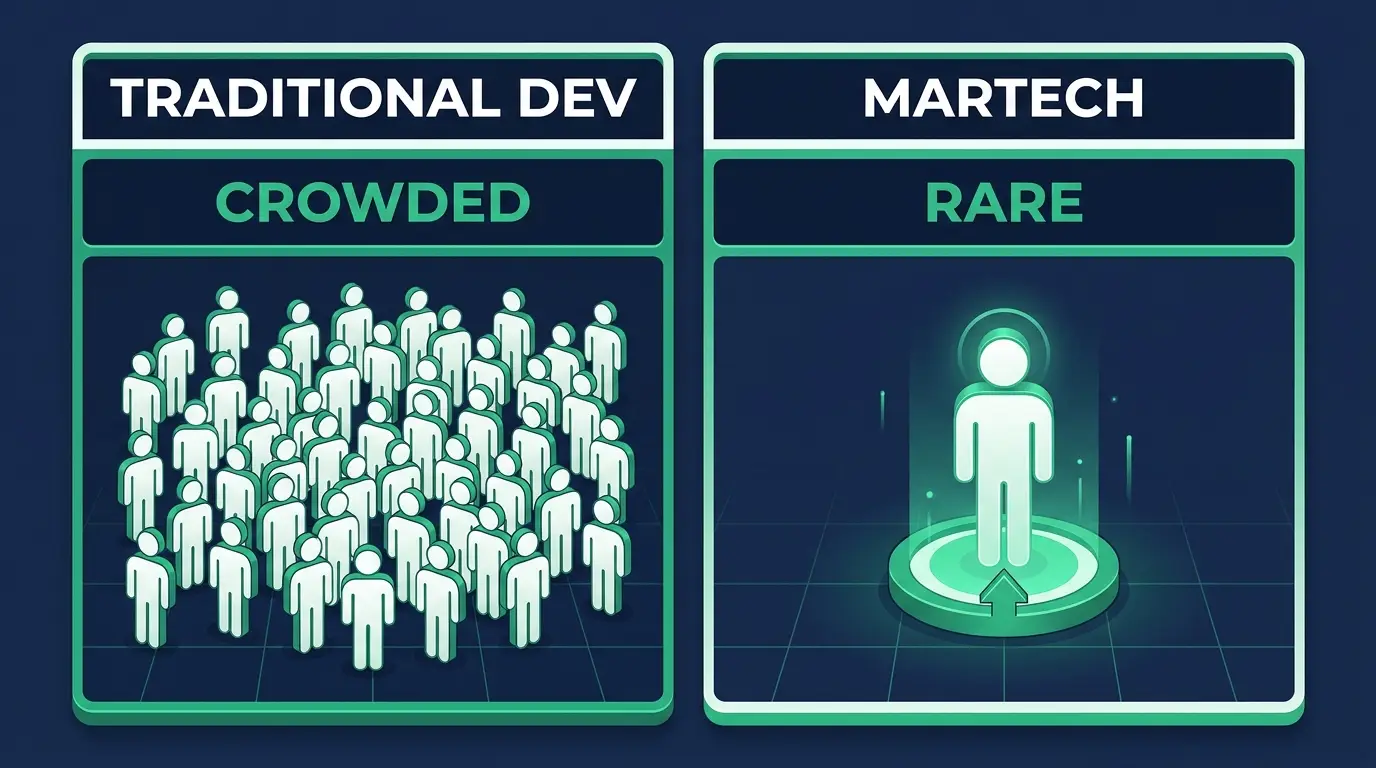
Where the same skills are worth more
These roles all reward engineering ability, but they sit in marketing and revenue teams, where most candidates can't write a clean script to save their lives. Your floor in these jobs is higher than most people's ceiling.
Below I'll walk through the case for each. If you'd rather see them laid out as a quick reference with the coding level spelled out for each, I broke that down separately in tech jobs without heavy coding.
Email Developer
You build and code emails: HTML, inline CSS, and the genuinely cursed world of rendering across Outlook, Gmail, and Apple Mail. It sounds simple until you realize email HTML is stuck in 2005 and most marketers are terrified of it. A developer who can build responsive, bulletproof email templates and wire them into an ESP is rare and well-paid. The technical bar is real; the competition is not.
The tradeoff: the front-end is constrained and old-fashioned. If you love modern frameworks, table-based email layout will annoy you. But the scarcity is the point.
CRM Administrator
You own the system that runs a company's customer data and automation, usually Salesforce, HubSpot, or similar. This is part configuration, part light development, part data architecture. Companies depend on these systems completely and struggle to find people who can both think in code and understand the business process. Salesforce admins in particular have a well-documented, well-paid career path.
The tradeoff: less pure coding, more configuration and stakeholder management. You're closer to the business, which some engineers love and some can't stand.
Marketing Automation Engineer
This is the most engineering-heavy of the bunch. You build the automated systems that move leads through a funnel: triggers, workflows, integrations, data pipelines between the website, the CRM, and the ad platforms. It's API work, scripting, and systems design, just pointed at marketing instead of a product backend. If you like back-end work but want to be the rare technical person on a marketing team rather than one of many on an engineering team, this is the cleanest fit.
The tradeoff: you'll work with marketing stakeholders who don't speak your language, and you'll have to translate. That's a skill worth building anyway.
Marketing Specialist (technical)
A generalist marketing role becomes a different job when the person doing it can code. You can build landing pages, run real analytics, set up tracking properly, and automate the grunt work that eats most marketers' weeks. You won't out-strategize a career marketer on day one, but you'll out-execute almost all of them, because you can build the thing instead of filing a ticket and waiting two weeks for engineering.
The tradeoff: the title pays less than a senior engineering role on paper, and you'll spend real time learning marketing fundamentals. The leverage comes from the combination, not the title.
E-commerce Manager
You run an online store's tech and growth: the platform, the integrations, conversion optimization, and the analytics behind it. Shopify, custom checkouts, payment flows, performance. Coding ability lets you fix and build things directly instead of outsourcing every change to an agency, which makes you dramatically more effective than a non-technical manager. Plenty of these roles have direct revenue impact, which means direct leverage on your pay.
The tradeoff: it's broad. You're responsible for outcomes, not just code, and the job pulls you toward operations and merchandising as much as engineering.
Solutions / Implementation Engineer (martech)
You're the technical person who makes a martech product actually work for customers: integrations, custom configurations, API work, and troubleshooting. It's client-facing engineering, sitting between the product and the people using it. It pays well, leans hard on real technical skill, and far fewer people apply because it isn't the default "build features" engineering job people imagine.
The tradeoff: client-facing means communication, deadlines driven by other people, and occasional firefighting. If you want to disappear into a codebase and never talk to anyone, this isn't it.

The tradeoffs, said plainly
I don't want to sell this as a clean upgrade, because it isn't.
You'll do less pure coding in most of these roles. If writing code is the only part of the job you enjoy, the automation engineer and solutions engineer paths protect that best, but the others will have you configuring, planning, and talking to people more than you might like.
You'll have to learn a second domain. Marketing, CRM systems, deliverability, analytics, attribution. It's real material and it takes real time. The advantage is that you're learning it on top of a skill most marketers will never have, not starting from zero.
Some titles look like a step down on paper. A "marketing specialist" doesn't carry the same prestige as "senior software engineer" at a dinner party. If title prestige matters to you, weigh that honestly. The compensation in the technical-heavy versions of these roles is strong, but you're trading a recognizable ladder for a less obvious one.
And the ceiling is different, not lower. The top of the marketing-engineering world looks different from the top of a FAANG engineering org. It's not worse. It's just a different shape, and you should want that shape before you switch.
How to think about the move
The honest summary: if you love the craft of engineering above everything and you're landing good roles, stay. There's nothing wrong with the traditional path when it's working for you.
But if you're staring at a saturated market, sending applications into a wall, and you'd rather be the rare technical person on a team than the hundredth qualified one, these roles deserve a real look. The skills transfer. The competition thins out. And being the developer who also understands the business is a position very few people occupy.
The switch isn't about abandoning what you learned. It's about pointing it somewhere the supply is low and the demand is quietly high.
FAQ
Do I have to give up coding to move into a martech role? No, but how much you keep depends on the role. Marketing automation engineer and solutions engineer roles are heavily technical. CRM admin and marketing specialist roles lean more toward configuration and strategy with coding as an edge. Pick based on how much hands-on building you want to keep.
Will I take a pay cut? Not necessarily. The technical-heavy roles like marketing automation engineer and Salesforce-focused CRM work pay competitively with engineering. The generalist titles can pay less on paper, but the leverage comes from being the rare technical person on a non-technical team, which tends to pull compensation and responsibility upward over time.
Why are these roles less competitive than front-end or full-stack? Because almost every coding program funnels graduates toward traditional dev roles, those markets are flooded. The martech-adjacent roles require a mix of coding and marketing knowledge that few people bother to build, so the applicant pool is far smaller for the same or better pay.
What should I learn first to make the switch? Start with the marketing systems that sit closest to your existing strengths. If you like back-end work, learn marketing automation platforms and their APIs. If you like front-end, email development and landing-page work is the fastest on-ramp. The coding you already know is the foundation; the marketing layer is what makes it rare.
If you can already code, you've done the hard part. The piece most developers are missing isn't more algorithms, it's the marketing and systems knowledge that turns a common skill into a rare one. That combination is exactly the kind of thing worth learning deliberately, because it's where engineering ability stops being a commodity and starts being leverage.