Front End vs Back End: An Honest Guide for Beginners
On this page
A guy messaged me last week and said he'd been stuck for three months. Not stuck on a bug. Stuck on a decision. Front end or back end. He'd watched maybe forty YouTube videos comparing the two and still hadn't written a line of code, because he was terrified of picking the wrong side and wasting a year.
I get that message a lot. And I want to give you the real answer, not the tidy one.
So yes, I'll break down front end vs back end properly, because you should understand the difference before you commit. But I'm also going to tell you something most of these comparison articles won't, because it doesn't get clicks: for a lot of people asking this question, "which side" is the wrong thing to be agonizing over. Hold that thought. Let me earn it first.
What front-end really is
Front end is everything the user actually touches. The buttons, the layout, the form that yells at you when you forget your email, the little spinner while something loads. If you can see it and click it in a browser, a front-end developer built it.
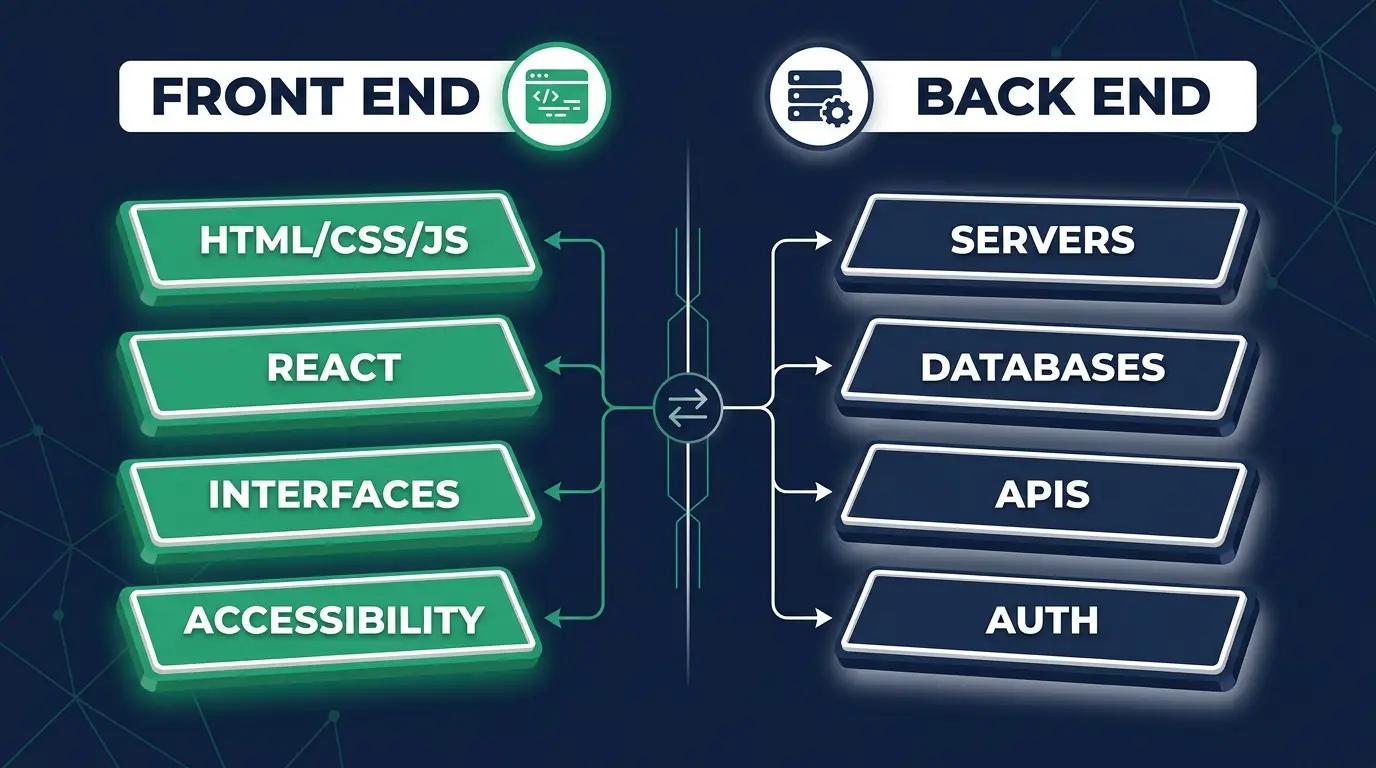
Day to day, you're taking a design, a Figma file or a screenshot or sometimes a sketch on a napkin, and turning it into a real interface people can use. That's HTML for structure, CSS for how it looks, and JavaScript for how it behaves. Most jobs then layer a framework on top, usually React, sometimes Vue, occasionally something newer that'll be old by the time you read this.
The part beginners underestimate is how much of the job is fighting the browser. Safari renders your button one way, Chrome another, and somebody's ancient Android phone does its own thing entirely. You learn to care about accessibility, so a blind person using a screen reader can actually navigate what you built. You learn to talk to APIs, pulling data from the back end and putting it on the screen without the whole page freezing.
It's visual and it's fiddly. You get instant feedback, which is addictive. Change a color, hit save, see it. That loop is why a lot of people fall in love with front end first.
What back-end really is
Back end is the part nobody sees and everybody depends on. The server, the database, the logic that decides what happens when you click "buy."
Say you log into your bank. The screen you see is front end. But something has to check your password, find your account in a database of millions, confirm you are who you say you are, pull your real balance, and make sure the guy next to you can't see it. That's back end. It's the rules, the data, and the security around the data.
You'll write in a language like PHP, Node, or Python, depending on the shop. (PHP still runs a big slice of the web, which is why PHP developer is one of the backend paths we teach.) You'll design databases, figuring out how information relates to other information so it doesn't turn into a swamp. You'll build APIs, which are basically the doors the front end knocks on to get data. You'll handle authentication, which is a polite word for "keeping the wrong people out." And when the app gets slow because ten thousand people showed up at once, you're the one who figures out why.
Back end rewards a certain kind of brain. If you liked the logic puzzles more than the art class, if you'd rather know how the machine thinks than how it looks, this is probably your lane. The feedback loop is slower and less pretty. You don't get to show your mom a beautiful screen. You get a database query that used to take four seconds now taking forty milliseconds, and honestly, that feels just as good once you're in it.
Full-stack, honestly
Full-stack means you do some of both. You can build the screen and the server behind it.
Here's the honest version, because the internet oversells this one hard. Full-stack is genuinely useful on small teams and for freelancers, where one person has to own the whole thing because there is no one else. If you want to build your own products someday, you'll drift here naturally.
But "learn everything" is a trap when you're starting out. You will not be equally good at both, nobody is, and trying to learn front end and back end at the exact same time as a total beginner is how people burn out and quit. Get competent at one. Get hireable at one. Then reach across. Most full-stack developers I know started as one thing and grew into the other, they didn't begin as a two-headed expert.

How they actually work together
Let me walk you through one click, because this is where it finally makes sense.
You're on a shopping site. You click "Add to cart." Here's what happens in the second after:
The front end catches your click and sends a request across the internet to the server. Think of it as writing a note that says "this user wants to add product 4471 to their cart" and mailing it. The back end receives that note. It checks that the product exists, that it's in stock, that your cart is really yours, then it writes the change into the database and mails a note back that says "done, here's your updated cart, three items, forty-two dollars." The front end catches that reply and updates the little cart icon in the corner so it now says 3, without ever reloading the page.
That whole handshake happened in under a second, and it happens every time you interact with anything online. Front end asks, back end answers, front end shows you the result. Once you see it as a conversation between the two, the whole "vs" framing kind of dissolves. They're not rivals. They're two ends of the same sentence.
Which suits how your brain works
People want a rule here and I don't fully trust the neat ones, but there is a real signal in what you gravitate toward.
If you're the person who notices when spacing is off, who has opinions about fonts, who wants to see the thing take shape as you build it, front end is going to feel more like play. You're wired toward the visible.
If you're the person who wants to know how it works underneath, who enjoyed the math you were told you'd hate, who finds a well-organized system deeply satisfying, back end will scratch that itch. You're wired toward the invisible machinery.
Difficulty-wise, people love to argue which is harder, and it's mostly a wash. Front end is easy to start and surprisingly deep once you hit real accessibility and state management. Back end has a steeper first hill, databases and servers are genuinely confusing at first, but the concepts stabilize. Pick the one you'll actually stick with through the boring middle part, because that's the part that decides whether you finish.
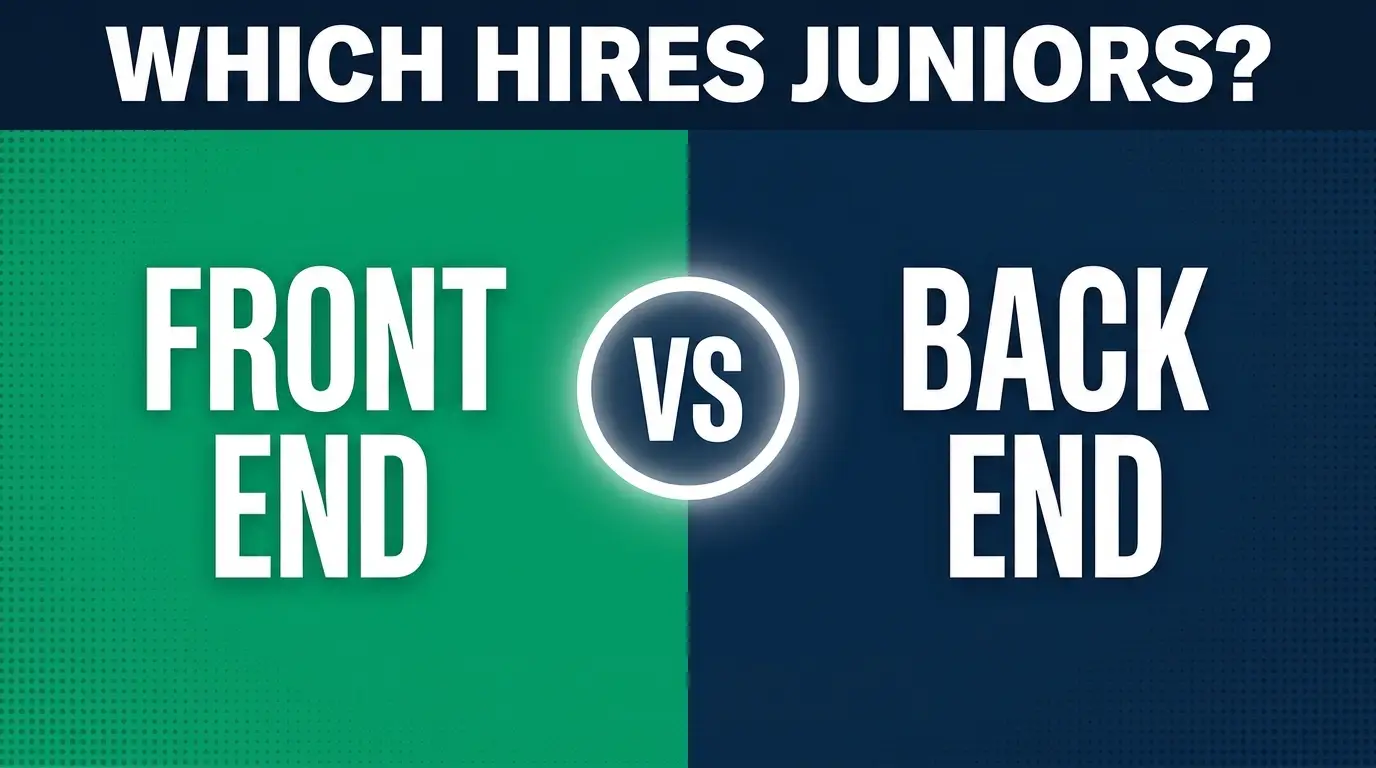
Which one actually hires juniors right now
Okay. The thing I promised.
Both of these are the most crowded entry doors in all of tech. When a company posts a junior front-end role, they get hundreds of applications in a weekend. Same for junior back end. Everybody watched the same "learn to code, six-figure job" videos and everybody aimed at the same two doors. So you can pick the perfect side, grind for a year, build a decent portfolio, and still be applicant number 312 for a role that's taking one person.
That's not me telling you to quit. It's me telling you the "front end vs back end" question is secondary to a question almost nobody asks: where are the actual openings that don't have a line around the block?
Because there are lanes that hire juniors precisely because nobody made them look cool on YouTube. Email development is one, it's real HTML and CSS, weirdly specialized, genuinely in demand, and almost nobody's competing for it. Shopify development is another, a whole economy of stores that need someone who can actually build and customize, hiring constantly. AI automation is the newest one, wiring tools together to save businesses hours, and demand is outrunning the number of people who can do it. Web administration and content ops sit in the same bucket, unglamorous, steady, hiring.
Here's the line I want you to keep: we teach what's hiring, not what's trending. I've watched too many talented people spend a year becoming applicant 312 when a small pivot would've made them applicant 4. The skills overlap almost entirely with front end and back end anyway. You're not throwing anything away. You're pointing the same effort at a door that opens.
If you want the fuller version of this argument, I laid it out in the easiest tech jobs to actually get into, and if the degree question is nagging you, how to get into tech without a degree covers that too.
FAQ
Is front end or back end easier?
Neither is universally easier, they're hard in different places. Front end is easier to start and see results fast, but gets tricky with accessibility, browser quirks, and managing state as apps grow. Back end has a rougher opening stretch, databases and servers throw a lot at you early, but it levels out. The honest answer is whichever one matches how you think will feel easier to you specifically.
Which pays more, front end or back end?
It's close, and it depends far more on your location, your seniority, and the company than on which side you chose. Back-end and infrastructure roles sometimes edge slightly higher at senior levels because scaling and security get expensive to get wrong, but plenty of senior front-end specialists out-earn back-end generalists. Chasing the side you think pays more is a bad reason to pick. Your skill level and whether you can actually land the job move the number way more than the label does.
Should a beginner learn front end or back end first?
Front end first, for most people. You see results immediately, which keeps you motivated through the early grind, and HTML and CSS are the gentlest on-ramp in all of programming. Once you're comfortable there, back end makes more sense because you already understand what it's feeding data to. That said, if you already know you love logic and data and screens bore you, start back end. Motivation beats optimization.
Do I have to pick one forever?
No. Whatever you start with, you can shift later, and a lot of developers do. The first choice just decides where you build momentum, not where you're stuck. Most people end up knowing more of both than they planned to.
Is front end or back end better for freelancing?
Front end and full-stack tend to be easier to freelance early because clients can see the work and small projects are plentiful. Back-end-only freelancing exists but usually needs more trust and a bigger reputation, since clients are handing you their data and logic. This is also where those adjacent lanes shine, Shopify and email work are full of freelance and contract gigs a beginner can actually win.
Whichever side pulls at you, the thing standing between you and a job isn't the label. It's real, hireable skill and a portfolio that proves it, aimed at a door that's actually open. That's the whole game.
That's what we built CodingPhase around. Diamond membership is $42 a month, or $255 a year if you want to commit, with a 7-day money-back guarantee if it's not for you. If you want everything for life, the Tech Accelerator is a one-time $1,500. Either way you get the guided career paths, so you're not guessing what to learn next, an 80,000-plus member community that'll answer your dumb questions without making you feel dumb, and a job board pointed at roles that hire. If you're still weighing your options, I wrote an honest CodingPhase vs Scrimba breakdown and a real look at what coding bootcamps actually cost so you can compare before you spend a dollar.
Pick a side, or pick a lane nobody's crowding. Just start. The three months my guy spent deciding would've been three months of real skill by now. Don't be that guy. Go build something.