How Much Does a Coding Bootcamp Cost? 2026 Prices From $9,800 to $22,500
On this page
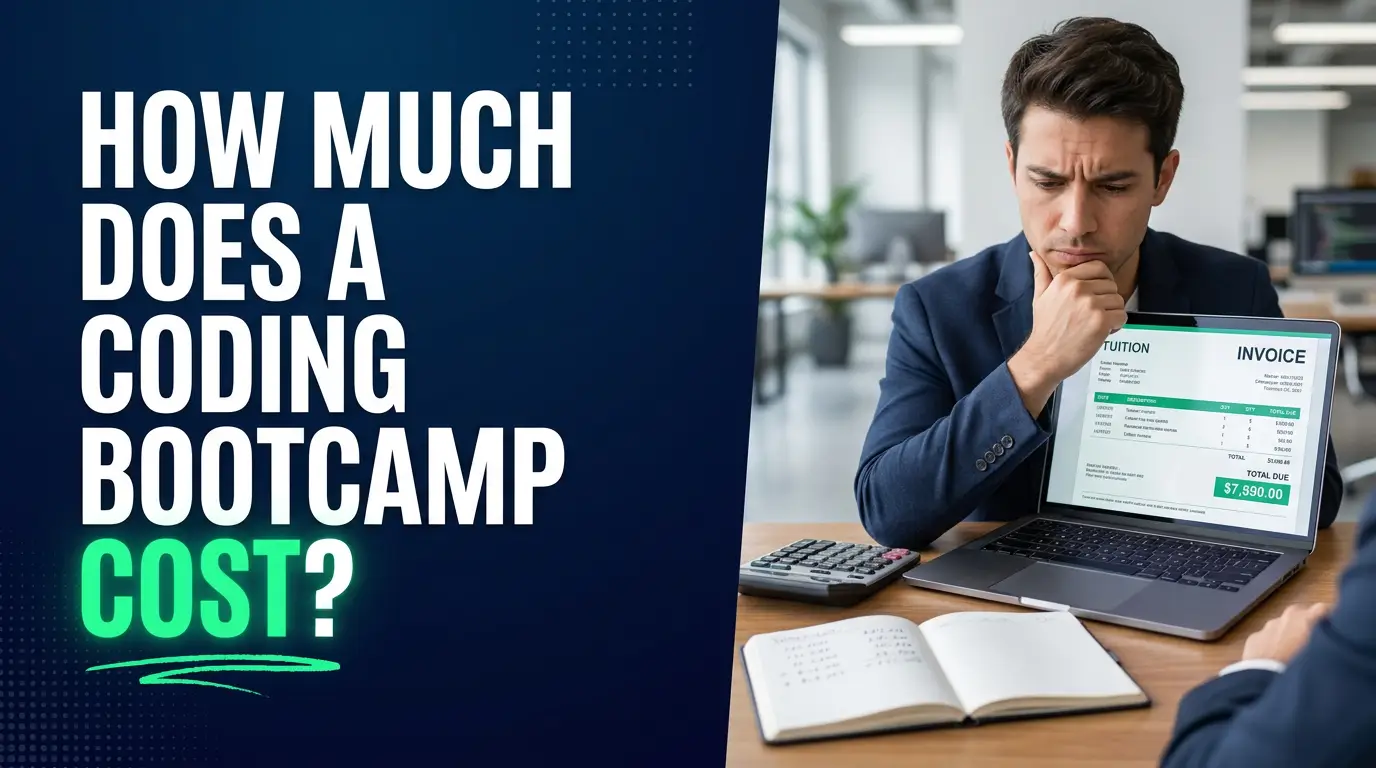
A coding bootcamp costs about $10,000 to $20,000 in 2026. Course Report's long-cited average is roughly $14,000, but the five well-known programs I priced in September 2026 ran from $9,800 (TripleTen, part-time online) to $22,500 (Codesmith), about $17,300 on average. Free options exist, and quitting your job for a full-time program usually pushes the real total past $25,000.
A guy messaged me at 11 at night with a screenshot. A financing agreement, $16,000, his cursor parked over the signature box. He'd been sitting there for forty minutes. His question was one line: "is this the only way in?"
I've been teaching people to code since 2016, and I've watched a lot of smart people sign that agreement out of fear instead of math. So here's the math.
I'm not here to trash bootcamps. They're a real product and they work for real people. I just want you signing up with your eyes open, or walking away on purpose.
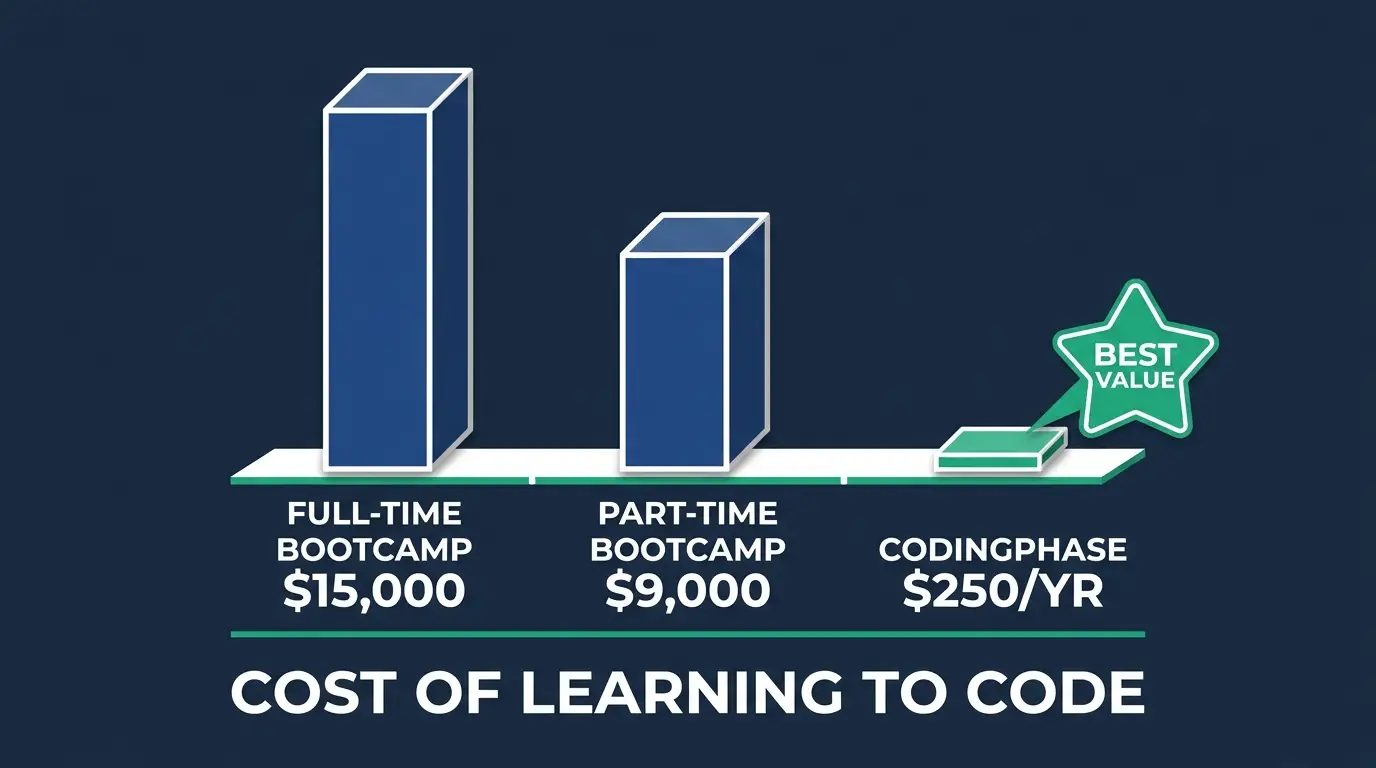
Coding bootcamp prices in 2026: five real programs
I went to each school's own site in September 2026 and wrote down the list price for its main software engineering program. No aggregator numbers, no "starting at" guesses.
| Bootcamp | Program | Tuition (list) | Length | Format | Ways to pay |
|---|---|---|---|---|---|
| Codesmith | Software Engineering + AI/ML Immersive | $22,500 | 14 weeks full-time, 39 weeks part-time | Live, remote | Installments, Ascent loans, scholarships |
| App Academy | 24-Week Online Software Engineering | $20,000 upfront | 24 weeks, Mon to Fri | Live online | Upfront, Climb loans, ISA or deferred tuition (15% of income for 3 years, capped at $31,000) |
| Hack Reactor | Software engineering bootcamp | $19,480 | 16 weeks full-time, 30 weeks part-time | Online with live instruction | Pay in full, 50/50 split, loans, scholarships |
| Flatiron School | Software Engineering Certificate | $14,900 | 15 weeks full-time, up to 60 weeks part-time | Online | Upfront, installments, student loans |
| TripleTen | AI Software Engineering | $9,800 upfront | 7 months at 20 hrs/week | Part-time, remote, self-scheduled | Installments via Lumion, Climb, Edly income-based loans |
Prices as of September 2026, taken from each school's official pricing or program page. Bootcamps change tuition often and run scholarships and discounts, so confirm the number with admissions before you sign anything.
The live, full-time programs cluster right around $19,500 to $22,500. The cheaper rows are the ones where you study part-time or on your own schedule. That's the pattern across the whole industry: you pay for live humans and a fixed calendar.
Also, the landscape is shrinking. General Assembly, one of the biggest names for a decade, stopped taking new consumer students on April 28, 2026, according to its own regulatory page. And 2U, the company behind most of the university-branded bootcamps (the Columbia, Northwestern, UC Davis style programs), announced in December 2024 that it was getting out of bootcamps. If you find a price for one of those online, check that the program still enrolls before you believe the number.
What a bootcamp costs by type
Full-time immersive (in-person or live online). The expensive tier. Everything in the top three rows of the table lives here, roughly $19,000 to $23,000 for 14 to 24 weeks. You're buying speed and live instruction, and you're giving up a paycheck to get them.
Part-time. Often the same tuition as full-time. Hack Reactor and Flatiron charge the same whether you go fast or slow, you just spread it over 30 to 60 weeks while you keep working. Cheaper in real life, because your income keeps coming in, but not cheaper on the invoice.
Self-paced online bootcamps. TripleTen is the example in the table at $9,800 upfront. Less live teaching, more platform, more flexibility. This is where most of the "affordable bootcamp" options sit, and I compared more of them in the best online coding bootcamps.
University-branded bootcamps. These carried a university's name but were usually run by an outside company. Many closed after 2U's exit, so treat older price lists for them with suspicion.
Free and low-cost. The Odin Project and freeCodeCamp cost nothing. A few programs charge nothing upfront and get paid through your future salary instead, which isn't the same as free. I sorted the genuinely free ones from the fake-free ones in my guide to free coding bootcamps.
The true total: what the tuition doesn't include
The tuition is not the real cost.
Quit a $45,000-a-year job for a 14-week immersive and you lose about $12,000 in wages on top of tuition. Rent, food and insurance don't pause for your career change either, and most people need another month or two of runway for the job search after graduation. Then there's the laptop if yours is old, and sometimes paid prep courses before you're even admitted.
So a $20,000 full-time bootcamp is realistically a $30,000-plus decision for someone leaving a normal job. A $15,000 one lands somewhere around $25,000 to $30,000. That's the number to sit with, not the one on the landing page.
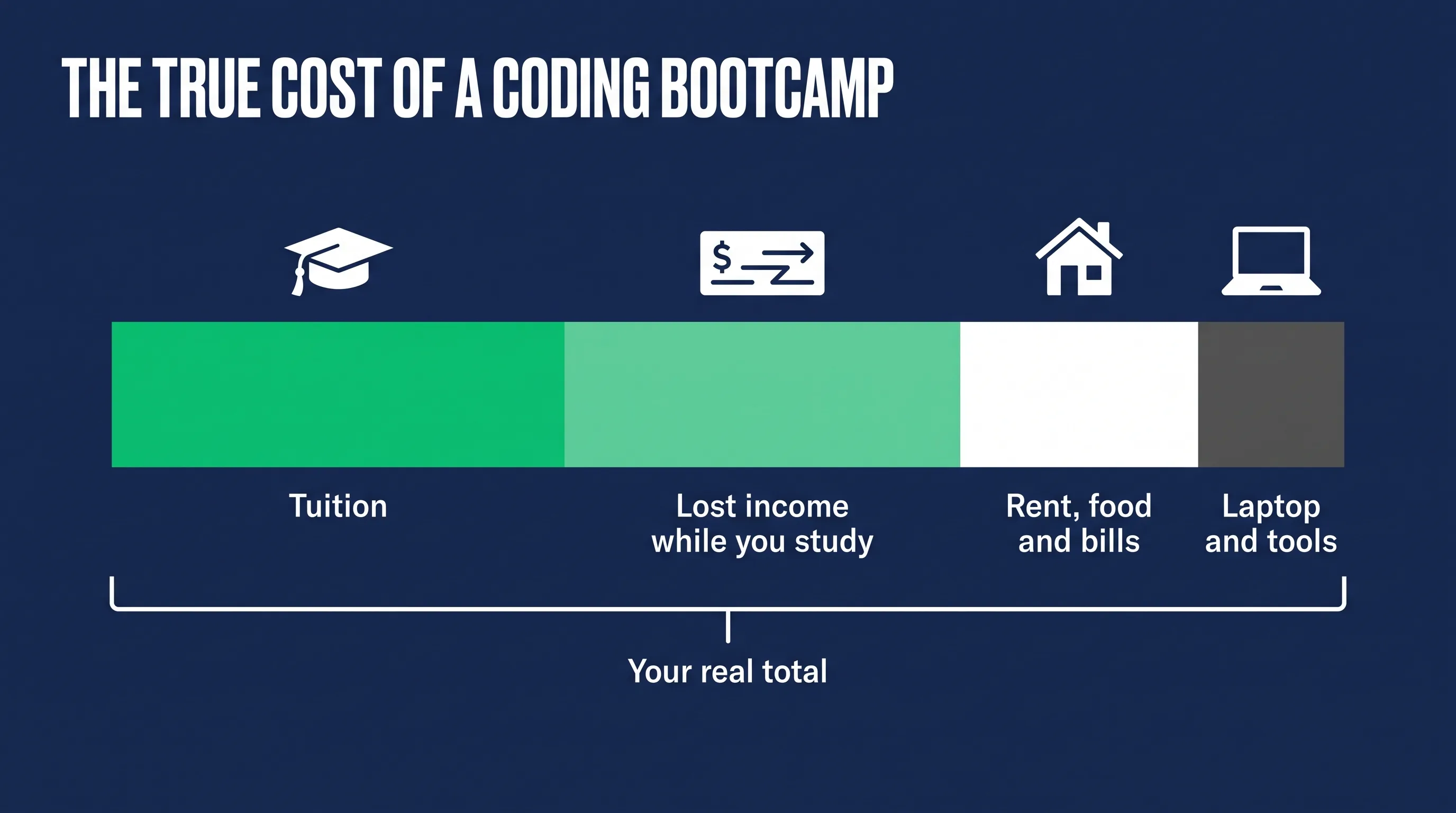
Part-time programs flip this math. The tuition is often identical, but you keep earning, so your true total is close to the sticker price. If you can survive the nights-and-weekends grind for six months or more, it's usually the cheaper way to do a bootcamp.
Why coding bootcamps cost so much
Bootcamps aren't gouging you for fun. The model is genuinely expensive to run.
The biggest line item is live human instruction. You're paying instructors and TAs to run scheduled cohorts in real time, people who could be earning senior-developer money instead of teaching you loops. That alone is why live teaching will always cost more than recorded teaching, and it's why the live programs sit at the top of my table.
Career services are the other big one: resume reviews, mock interviews, employer partnerships, a placement team whose entire job is getting you hired. Most bootcamps bundle that into tuition instead of pricing it on its own, so you pay for it whether you use it or not. The good programs pour money into it because their marketing lives or dies on placement stats.
Then rent in expensive cities for the in-person programs, software and admin for everyone. And marketing, which is a bigger slice than most people want to hear about. Paid ads, affiliate deals, sales teams. You are, in part, paying for the ad that brought you here.
None of that is a scam. It's a high-cost delivery model, and every dollar of it gets baked into your tuition.

How to pay for a coding bootcamp
Pay upfront if you can. It's almost always the cheapest total. TripleTen's $9,800 is its upfront price, and App Academy's $20,000 upfront is well under what its income-share option can cost you.
Installment plans. Codesmith, Hack Reactor and Flatiron all let you split tuition into payments. Ask whether there's a fee or interest baked in, because some plans are really loans with a nicer name.
Private loans. Lenders like Ascent and Climb partner directly with bootcamps (Codesmith lists Ascent, App Academy and TripleTen list Climb). These are real loans with interest, so run the total you'll repay, not the monthly payment.
Income share agreements and deferred tuition. Here's where I get annoyed. You pay nothing to start and hand over a slice of your salary once you're hired. At App Academy that's 15% of your income for three years after you land a job paying $50,000 or more, capped at $31,000. The upfront price is $20,000. Do well, and you pay up to $11,000 more than someone who wrote a check. The CFPB's 2024 consent order against BloomTech treated ISAs as private education loans. Treat one exactly like a loan, because legally that's what it is.
Your employer. Worth asking before anything else. If your company has a tuition assistance budget, a bootcamp can sometimes qualify, especially if you're moving into a technical role in the same company.
GI Bill and VET TEC 2.0. If you're a veteran, the VA's VET TEC 2.0 program was accepting applications as of September 2026. It pays tuition directly to approved schools plus a housing allowance, it's capped at 4,000 people per fiscal year, and you can only use it once. Check that your bootcamp is VA-approved first.
WIOA and scholarships. Workforce Innovation and Opportunity Act funding runs through your local American Job Center, and whether a bootcamp qualifies depends on your state's approved training list. Many bootcamps also run their own scholarships, like Hack Reactor's merit scholarship, which knocks $2,500 off.
What you're actually paying for (and whether you need it)
Strip the branding off and a bootcamp sells you a handful of things. Be honest with yourself about which ones you actually require.
Structure. A fixed schedule and curriculum so you never have to decide what to learn next. Genuinely valuable if you struggle to self-direct. Dead weight if you already finish courses with nobody watching.
Accountability. Cohorts, deadlines, people expecting you to show up. This is the thing most people are secretly paying five figures for, and it works. You can also manufacture it for free with a study group and a public promise you'd be embarrassed to break.
The network is real and hard to copy, though a big online community covers a lot of the same ground if you actually post in it. Career services are where bootcamps earn their reputation. If you're the kind of person who freezes at the job-hunt stage, a placement team is worth something. Plenty of grads still run their own search and land the job on the strength of their portfolio anyway.
Here's the one line I want you to keep: you get hired because you can build things and prove it, not because you attended a bootcamp. The bootcamp is one way to build those things. Probably the priciest one on the shelf.
Cheaper ways in: free and low-cost alternatives
People search for "best cheap coding bootcamp under $50" a lot, so here's the straight answer. There isn't a real bootcamp at that price. What you can get for under $50 is a free curriculum or a monthly subscription.
Free: The Odin Project and freeCodeCamp are both free and both good. The catch is structure. You'll be guessing what to learn next, and nobody's building your job search with you.
Under $50 a month: subscription platforms. I compared the main ones in the best affordable coding courses, and if you're weighing a backend-focused option, I also wrote up whether Boot.dev is worth it.
This is also where I tell you what we built, and I'll be straight about what it lacks.
CodingPhase is self-paced. The Diamond Membership lists at $60 a month or $365 a year, and there's always at least 30% off, so you really pay about $42 a month or about $255 a year (around $21 a month). There's a 7-day money-back guarantee. To be fair about it: $42 a month isn't the cheapest monthly option out there. The annual plan is where it wins on price.
What's inside:
- 90+ courses covering front-end, back-end, and the specific skills that get you hired
- Guided career paths from beginner to job-ready, so you're not guessing what to learn next
- An 80,000+ member private community
- Completion certificates for what you finish
- Portfolio templates for every path, because the portfolio is what lands the interview
- A resume builder built to pass ATS screening, the automated filter that kills most applications before a human sees them
- A job board and priority support for when you're ready to apply
The tradeoff is the live cohort, and you give it up entirely. No instructor waiting for you at 9am, no classmates in the same Zoom. You trade that for self-pacing and a community you have to reach into yourself, which some people love and some people quietly drown in. If you know you need someone standing over your shoulder, say so out loud before you spend anything.
There's a middle path. The Tech Accelerator is $1,500 one-time: lifetime access to everything in Diamond plus live weekly mentorship. Real live guidance for about a tenth of the full-time bootcamps in my table. Not free. A different order of magnitude, though.
Is a coding bootcamp worth it in 2026?
My honest verdict isn't "never."
A bootcamp is worth it if you genuinely can't self-direct, you learn best with live humans on a rigid schedule, and you can absorb $20,000 plus lost wages without wrecking your finances. For that person the structure is the product. If that's you, read up on which bootcamps have the best job placement and demand outcome numbers you can verify, ideally audited or third-party reported, before you sign.
It's overkill if you finish things on your own, you're on a budget, you can't afford three months without income, or you just want to find out whether you like coding before betting your savings on it. That last group is most of the career-changers I meet. The shrinking list of big-name bootcamps in 2026 doesn't help the case either.
I went deeper on the job-market side in are coding bootcamps worth it, and if front-end is your target, my front-end developer bootcamp breakdown covers that path. You don't need a degree for this field, and you don't need a $16,000 loan either: here's how people break into tech without a degree.

FAQ
How much does a coding bootcamp cost in 2026? Most cost $10,000 to $20,000. The five programs I priced in September 2026 ranged from $9,800 (TripleTen) to $22,500 (Codesmith), averaging about $17,300. Add lost income for a full-time program and the real total is usually $25,000 to $30,000 or more.
What is the average cost of a coding bootcamp? Course Report's widely quoted average is about $14,000, based on its older survey data. The big-name live programs I checked in 2026 run higher, around $19,500 to $22,500.
Why do coding bootcamps cost so much? Live instructors and TAs, career services teams, marketing, and (for in-person programs) rent in expensive cities. All of it is bundled into tuition whether you use it or not.
How much does a software engineering bootcamp cost? Every program in my table is a software engineering bootcamp, so the same range applies: $9,800 to $22,500 in 2026, with live full-time programs at the top.
How much does a web development bootcamp cost? Usually the same as a software engineering bootcamp, since most "web development" programs teach the same full-stack material under a different name. Expect $10,000 to $20,000 for a live program.
How much do bootcamps charge for career services? Most don't price it separately. Career coaching is bundled into tuition, which is one reason tuition is high. Ask what's included and whether the support continues after you graduate.
How do I pay for a coding bootcamp? Upfront (cheapest total), installment plans, private loans from lenders like Ascent or Climb, income share agreements or deferred tuition, employer tuition assistance, VET TEC 2.0 or the GI Bill for veterans, WIOA funding through your local American Job Center, and school scholarships.
Are income share agreements (ISAs) a good deal? Usually not as good as they sound. App Academy's ISA takes 15% of your income for three years once you earn $50,000 or more, capped at $31,000, against a $20,000 upfront price. The CFPB treats ISAs as private education loans. Run the total before you sign.
What's the best cheap coding bootcamp under $50 or $100? No real bootcamp costs that little. Under $100 you're looking at free curriculums like The Odin Project and freeCodeCamp, or a subscription platform. The cheapest bootcamp in my table is TripleTen at $9,800 upfront.
Are there free tech bootcamps? Yes, though some "free" ones get paid from your future salary. See my breakdown of free coding bootcamps for which ones are actually free.
Is a coding bootcamp worth it in 2026? For people who need live structure and can afford it, it can be. For most self-motivated career-changers on a budget, it's an expensive way to build the portfolio that gets you hired, which you can build for a fraction of the price.
What's the cheapest way to become a developer? Self-paced learning tied to a real career path and a portfolio. CodingPhase's Diamond Membership runs about $255 a year after the standing discount, and the Tech Accelerator is $1,500 one-time for lifetime access with live mentorship.
If you're the guy at 11pm with the cursor over the signature box, let me hand you a cheaper first step. Take a week, build something real, and see how you feel before you spend a dime you don't have to.
Start a career path and pick a direction that fits you, front-end, back-end, or something specific like becoming an email marketing specialist. When you're ready, the membership is right here at about $42 a month or $255 a year, with a 7-day guarantee so the risk sits on us.
You don't need permission or a $16,000 loan to start. You need to build one thing, then the next one. I'll be in the community when you get there.