The Best Affordable Coding Courses in 2026 (Free and Paid Picks That Actually Get You Hired)
On this page
A friend called me on a Tuesday night almost in tears. She had a bootcamp's checkout page open and her thumb was hovering over "pay $15,000." She'd been laid off, she was scared, and the bootcamp's salespeople had spent two weeks telling her this was her only shot.
I asked her one question: what do you actually want to do for a living?
She didn't have an answer yet. So I told her to close the tab.
You do not need to go into five figures of debt to learn to code. You might not need to spend a dollar. But the internet is a swamp of "best coding course" lists written by people who get a kickback on every click, so let me do the thing none of them do and tell you the truth about each option, including ours.
We run CodingPhase. I teach there. And I'm still going to send you somewhere else if that's the better fit for you, because a list that only points at my own door isn't worth reading.
How I judged every option on this list
Before I name names, here's the lens. When someone asks me where to learn, I'm weighing five things:
- Price, with no asterisks. Real monthly or one-time cost, not a "from $X" headline that balloons at checkout. Prices move, so I'll say "around" and tell you to check the current number yourself.
- Job-outcome focus. Does this teach you to build employable things, or does it teach you trivia that feels like progress?
- Project-based learning. You learn to code by writing code, not by watching someone else write it. The best options make you build.
- Breadth. Can it take you from zero to a real skill, or is it one slice of the puzzle?
- Community and support. When you're stuck at 11pm on a bug, is there anyone around?
No single course wins on all five. So I'll tell you who each one is actually for.
freeCodeCamp: the best free option for the disciplined and broke
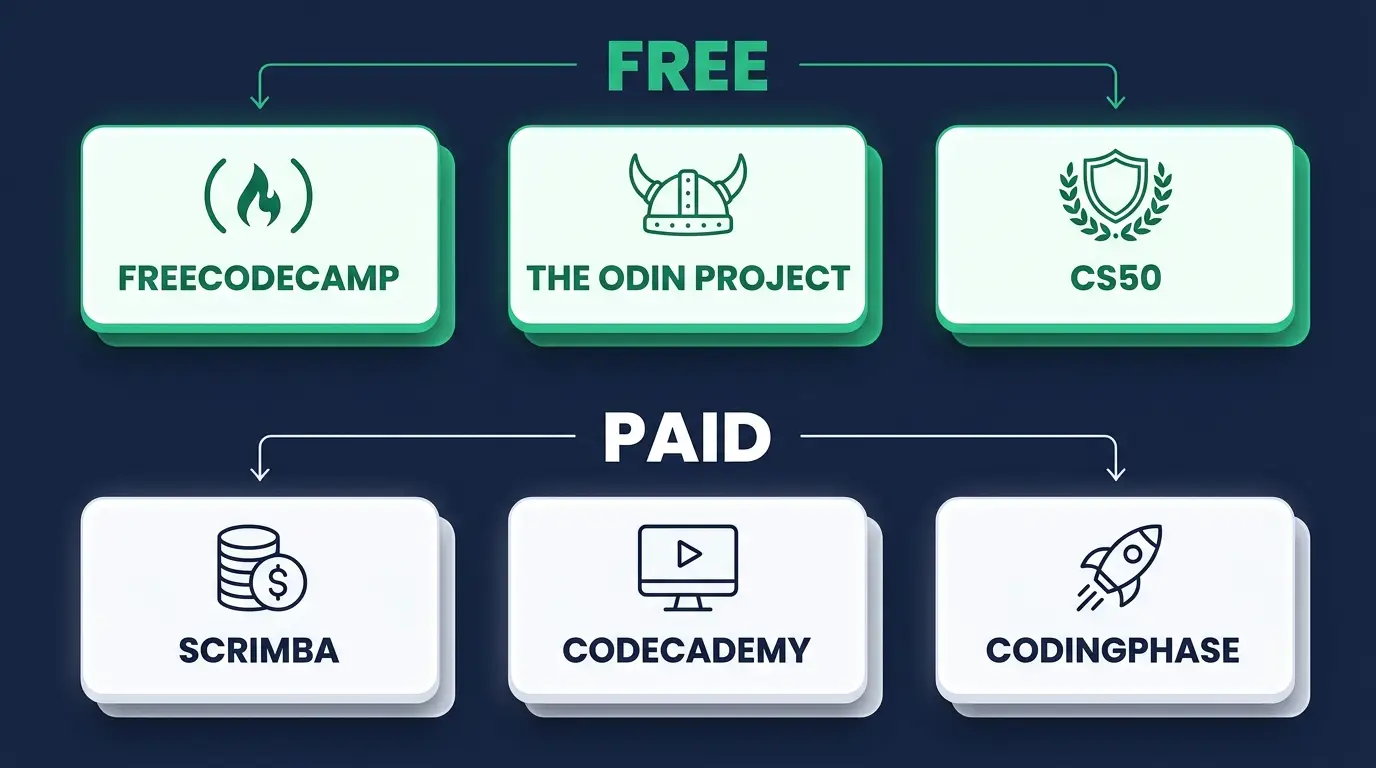
If you have more time than money and you can sit yourself down without a coach standing over you, start here. freeCodeCamp is free, enormous, and built around building. You earn certifications by completing real projects, not by clicking "next."
The curriculum covers responsive web design, JavaScript, data structures, front-end libraries, Python, and more. People have genuinely gone from zero to hired on this alone.
The honest con: there's almost no hand-holding. The structure is thin, nobody's checking on you, and it's easy to drift for three weeks and call it "learning." It rewards self-starters and quietly punishes everyone else.
Best for: broke, disciplined, self-directed people who'll show up daily without anyone making them.
The Odin Project: free full-stack for people who like a deep end
The Odin Project is the other free heavyweight, and it leans harder into full-stack web development with Ruby or JavaScript tracks. It's relentlessly project-heavy and it doesn't baby you. You'll set up your own environment, read real documentation, and build actual applications.
That's the magic and the curse.
The honest con: it can feel sink-or-swim. Odin throws you into the deep end on purpose, and some people thrive on that while others drown and quit. There's a community to lean on, but you have to reach for it.
Best for: people who want a free, rigorous full-stack path and aren't scared of being uncomfortable.
CS50 / edX: free Harvard-grade fundamentals
CS50 from Harvard, available free through edX, is one of the best things on the internet, full stop. It teaches you how computers and programming actually work: memory, algorithms, data structures, the why under the what. The lectures are genuinely thrilling, which is not a word I use about most coursework.
The honest con: it's academic, not job training. CS50 makes you a better thinker and a stronger engineer over the long run, but finishing it does not hand you a job-ready web-dev portfolio. It's a foundation, not a career path on its own.
Best for: anyone who wants real computer-science fundamentals, especially if you're worried you've been "faking it" with tutorials.

Scrimba: the most fun way to learn front-end
Scrimba does something nobody else does. Its lessons are interactive screencasts you can pause and edit right inside the video. You're not watching code, you're touching it. For front-end and JavaScript, that hands-on loop is unusually sticky, and the price is friendly at around $24.50/month on an annual plan (check current pricing).
The honest con: it's narrower. Scrimba is excellent at front-end and web, and that's mostly the lane it stays in. If you want back-end depth, niche career tracks, or anything outside web development, you'll outgrow it.
Best for: people who want to learn front-end and JavaScript in the most engaging format out there. We dug into the details in our CodingPhase vs Scrimba breakdown if you want the head-to-head.
Codecademy: polished interactive fundamentals
Codecademy has a free tier plus Pro at around $30 to $40/month (hedge it, prices shift). The interactive lessons are smooth and beginner-friendly, and the free tier alone can teach you the basics of a dozen languages without spending anything.
The honest con: it's lighter on real portfolio projects. You can finish a track and still not have a meaningful thing to show an employer, and Pro gets pricey compared to a few options on this list. The polish is great for learning syntax, less great for proving you can ship.
Best for: total beginners who want a frictionless first taste before committing to anything heavier. Our CodingPhase vs Codecademy comparison goes deeper on the tradeoffs.
Zero To Mastery: strong long-form courses plus community
Zero To Mastery runs a subscription library of in-depth courses with an active community attached. The long-form courses are thorough, the instructors are solid, and the Discord community is one of the better ones in this space for staying accountable.
The honest con: pricing and breadth move around, so check the current plan before you commit. Some tracks are deep and current, others less so, and a subscription only pays off if you actually use it consistently.
Best for: people who like one comprehensive course at a time and want a community to keep them going.
Coursera: when you want a certificate with a big name on it
Coursera is where you go if the name on the certificate matters to you. The Professional Certificates from Google, IBM, and Meta are the most recognized entry-level credentials in this price range, and the university courses (Michigan's Python for Everybody is the classic) are genuinely well taught.
Pricing is by subscription. A single program like the Google certificates runs about $49 a month, and Coursera Plus is about $59 a month or $399 a year for most of the catalog (check current pricing, they run sales a lot). Financial aid exists and plenty of people never apply for it.
The honest con: you're renting access by the month, so it gets more expensive every month you stall, and the certificate on its own rarely gets anyone hired. A lot of the coding content is also more academic than portfolio-driven. I did the full math in is Coursera worth it.
Best for: people who want a recognized credential and can finish a program in a few focused months without drifting.
CodingPhase: the lane nobody else teaches, priced for regular people
This one is ours, so read me with that in mind.
I have been doing this since 2016, and almost all of it with people who were never supposed to make it into tech. A stay-at-home mom fitting lessons around nap time. A guy who had enough of driving Uber twelve hours for gas money and a headache. No CS degree between them, no savings to gamble with.
Here is what most of this industry sells those two: a $300,000 job at Google with no degree and no experience. It is a lie, and it is a profitable one. Point a thousand beginners at the most competitive jobs on earth and maybe ten of them land one. The other 990 quietly decide they were not smart enough, and the platform puts the ten in its ads.
We aim somewhere less glamorous on purpose. Email development, martech, AI automation, Shopify, web administration, PHP. These are entry-level roles that are actually hiring, that do not ask for a degree, and that most "learn to code" sites have never bothered to teach because the salary screenshot is not sexy enough to advertise. Low competition is the whole point. You are not fighting four thousand other applicants for one junior React job.
Most platforms teach you the basics and stop there. HTML, a little JavaScript, a certificate, good luck. Basics do not get anybody hired. So the membership is built to carry you the rest of the way: 90+ video courses, interactive lessons where you write real code in the browser, guided career paths from beginner to job-ready, portfolio templates plus the projects to put in them, a résumé builder made to survive ATS screening, a job board, priority support, completion certificates, and an 80,000+ member private community for the 11pm bug that is ruining your week.
Diamond lists at $60 a month or $365 a year, and there is always at least 30% off, so what you actually pay is about $42 a month. That is less than $2 a day. Take the yearly plan and it drops to roughly $255, which is about 70 cents a day, cheaper per month than most of the options above. Check the pricing page for whatever the discount is today. There is a 7-day money-back guarantee, and I (Joe Santos Garcia) teach the courses.
What I am proud of is not a wall of six-figure screenshots. It is first jobs. Our students' first offers are usually not $100k, and I am not going to pretend otherwise. But $75,000 starting is a real number in these lanes after a couple of months of focused work, and I know plenty of people carrying a four-year degree and the loan payment who are not clearing that.
The honest con: we are not the cheapest option on this page. The free ones cost nothing and a couple of paid rivals start lower per month. Our math works out annually, not monthly. And if your dream is specifically FAANG software engineering, go run CS50 and grind algorithms, because that is a different sport than the one we coach.
Best for: career switchers with no degree and no experience who want one affordable system that takes them all the way to a first job in a lane that is actually hiring. The annual plan is the best value by a wide margin, and you can cancel anytime.

How to actually choose
Stop trying to find the "best" one. There isn't one. There's a best one for you this month. Route yourself:
- Broke and disciplined? Start with freeCodeCamp or The Odin Project today, for free, before you spend a cent.
- Worried your fundamentals are shaky? Run CS50 alongside whatever else you do.
- Want the most engaging way to learn front-end? Scrimba.
- Total beginner who wants a gentle first taste? Codecademy's free tier.
- Like one deep course at a time with a community? Zero To Mastery.
- Want a certificate with a brand name recruiters know? Coursera's Google or IBM programs.
- No degree, no experience, and you want one system that carries you to a first job in a lane that is actually hiring? That's us, less than $2 a day, cheapest on the annual plan.
Here's the line I'd tattoo on every beginner's wall: the best coding course is the one you'll still be doing in three months. Cheap and finished beats expensive and abandoned every time.
And if you're not even sure coding is the move, read tech jobs you can get without coding first. There's no shame in finding out the door's already open somewhere else.
Coding courses with certificates: do they matter?
A coding course certificate helps you get past a filter. It won't get you the job on its own.
Recruiters skim a certificate in about as long as it takes to read the name on it, then go looking for projects. Where certificates do earn their keep: career switchers who need something on a résumé that says "I finished a structured program," people applying to large companies with automated screening, and anyone whose employer will pay for the credential.
There are two kinds, and people mix them up. Completion certificates (freeCodeCamp, Codecademy, Scrimba, us) prove you finished a course. Vendor certifications (Google, AWS, Salesforce, Shopify) prove you passed a test on a specific tool, and those carry more weight in the lanes that use the tool. I went through which ones are worth the effort in online coding certificates, honestly.
My advice hasn't changed in years: get the certificate if it's cheap or free, then put ten times more effort into the project you'll show next to it.
Part-time coding courses: what's realistic
Most people reading this have a job, kids, or both. Good news: nearly every option on this list is self-paced, so part-time is the default rather than a compromise.
The number that matters is hours per week. At five to seven hours a week (an hour most evenings), expect roughly a year to get job-ready in a focused lane. At ten to fifteen hours, closer to six to nine months. The Google certificates on Coursera, for comparison, say most learners finish in under six months at about ten hours a week, and that's one certificate, not a full portfolio.
What actually breaks part-time learners isn't the pace. It's the gaps. Two weeks off turns into two months, and you restart from zero. A small daily habit beats a big weekend session, every time I've seen it tested.
If you need a live schedule to stay honest, that's where cohort bootcamps earn part of their price, and free coding bootcamps covers the ones that won't cost you anything to try.
Which language should your first coding course teach?
Pick the language from the job you want, not from a "top languages" chart.
- Websites and front-end: HTML, CSS, then JavaScript. Every web path starts here.
- Data, automation, or general-purpose: Python. It's the friendliest first language and it shows up everywhere from scripts to AI work.
- Backend web jobs: JavaScript with Node, Python, or PHP. PHP still runs a huge share of the web through WordPress and Laravel, and the PHP developer path is one of ours.
- Email development and marketing tech: HTML and CSS first, which surprises people. It's a real hiring lane that almost nobody teaches.
If you truly have no idea yet, start with HTML, CSS, and a little JavaScript. It's the fastest route to seeing something you built on a screen, and that feeling carries you through the boring weeks.
Self-paced, live, or bootcamp?
Coding courses come in three formats, and the format decides whether you finish more than the content does.
Self-paced (everything on this list) is cheapest and fits around a job. The downside is that nobody notices when you stop.
Live or cohort-based courses give you a schedule, classmates, and a teacher to ask. They cost more and you have to show up on their calendar.
Bootcamps are the intense version: full-time or structured part-time, career services, and a price tag in the thousands. Worth it for a few people, which is why I wrote are coding bootcamps worth it before recommending one to anybody.
FAQ
What is the cheapest way to learn to code? Free. freeCodeCamp, The Odin Project, and CS50 are all completely free and genuinely good. If you have discipline and time, you can get job-ready without spending anything.
Are free coding courses good enough to get a job? Yes, people get hired off free resources every year. The catch is structure and accountability. Free options give you the material but not the coaching, so you supply the discipline. If you can't, a cheap paid course with a clearer path may get you there faster.
Is a coding bootcamp worth $15,000? For most people, no. The expensive bootcamp model promises outcomes you can often reach with free or low-cost options plus consistency. Spend the money only if you've already proven you'll do the work and you need the structure and network it buys.
Free course or paid subscription: which should I pick? Try free first. If you finish a chunk of freeCodeCamp or Odin without quitting, you've proven you'll show up, and you can invest with confidence. If you keep stalling out alone, a structured, affordable subscription is worth the small monthly cost to get a clearer path.
What is the best coding course for beginners? The one you'll finish. For most total beginners that's a free, structured start like freeCodeCamp or Codecademy's free tier, then a paid, project-based course once you've proven you'll keep showing up.
Do online coding courses give you a certificate? Most do. freeCodeCamp, Codecademy, Scrimba, Coursera, and CodingPhase all issue completion certificates. Coursera's Google, IBM, and Meta Professional Certificates carry the most brand recognition, but a portfolio still matters more to employers.
Can I learn to code part-time while working full-time? Yes, and most people do. Five to ten hours a week gets you somewhere real in six to twelve months if you're consistent. Self-paced courses are built for exactly this.
Can I teach myself coding? Yes. Plenty of working developers are self-taught. What you give up is structure and feedback, so pick a course with a clear path and find a community to ask when you're stuck.
Is 40 too old to learn coding? No. Nobody hiring a junior email developer or Shopify developer asks how old you are. They ask to see what you built. What does get harder at 40 is finding the time, which is why a part-time, self-paced plan matters more than your birth year.
Do coders get paid well? Generally, yes. Junior roles in the lanes we teach often start in the $60k to $75k range in the US, and experienced developers earn well into six figures. Your first number depends heavily on the lane you pick.
How long does it take to learn to code well enough to get hired? Honestly, expect six months to a year of consistent work, more if you're part-time. Anyone promising "job-ready in 8 weeks" is selling, not teaching.
Close the bootcamp tab. Pick one option from this list that fits where you are right now, and do it for two weeks before you judge it. That's the whole game: start small, stay consistent, and let momentum do the convincing.
If a low-competition lane like email development, martech, or AI automation sounds like your kind of thing, come see what we're building at CodingPhase. And if a free option suits you better, go take it with my blessing. Either way, I'm rooting for you. Just start.