Is AI Automation a Good Career?

On this page
"AI is coming for the jobs, so there's no point learning anything tech right now." I hear that one constantly, and it's almost exactly backwards.
The jobs AI is hollowing out are the ones where a person was the glue between two systems, copying data from one box into another. AI eats that all day. But somebody has to build the machine that does the eating. That somebody gets paid very well, and right now there aren't enough of them.
That's what AI automation is. You're not racing the robot. You're the one wiring it up.
The people who lose to AI are the ones who pretend it isn't happening. The people who win are the ones who learn to wield it. AI automation is just the name for the second group getting paid.
So is it a good career? My honest answer: it's one of the highest-ceiling, least-crowded paths I've seen in years. But "good" depends on whether you're the kind of person who can handle the part nobody puts in the brochure. Let me give you both sides.

What an AI automation career actually is
First, let's kill the confusion. AI automation isn't "prompting ChatGPT for a living." It's not posting AI art on Instagram either.
You connect systems so work happens without a human babysitting it. A lead fills out a form, and an automation qualifies it, drafts a reply, books the call, and updates the CRM. A support ticket comes in, gets read, categorized, and routed before anyone touches it. You're wiring tools like Make, n8n, and Zapier together, and dropping AI models in as the brain at the steps where judgment used to be required.
If you want the full breakdown of the day-to-day and the skills, I wrote a whole guide on how to become an AI automation specialist. This post is the gut-check that comes before that one: should you even want this?
The honest case for it
Here's why I keep steering people toward it.
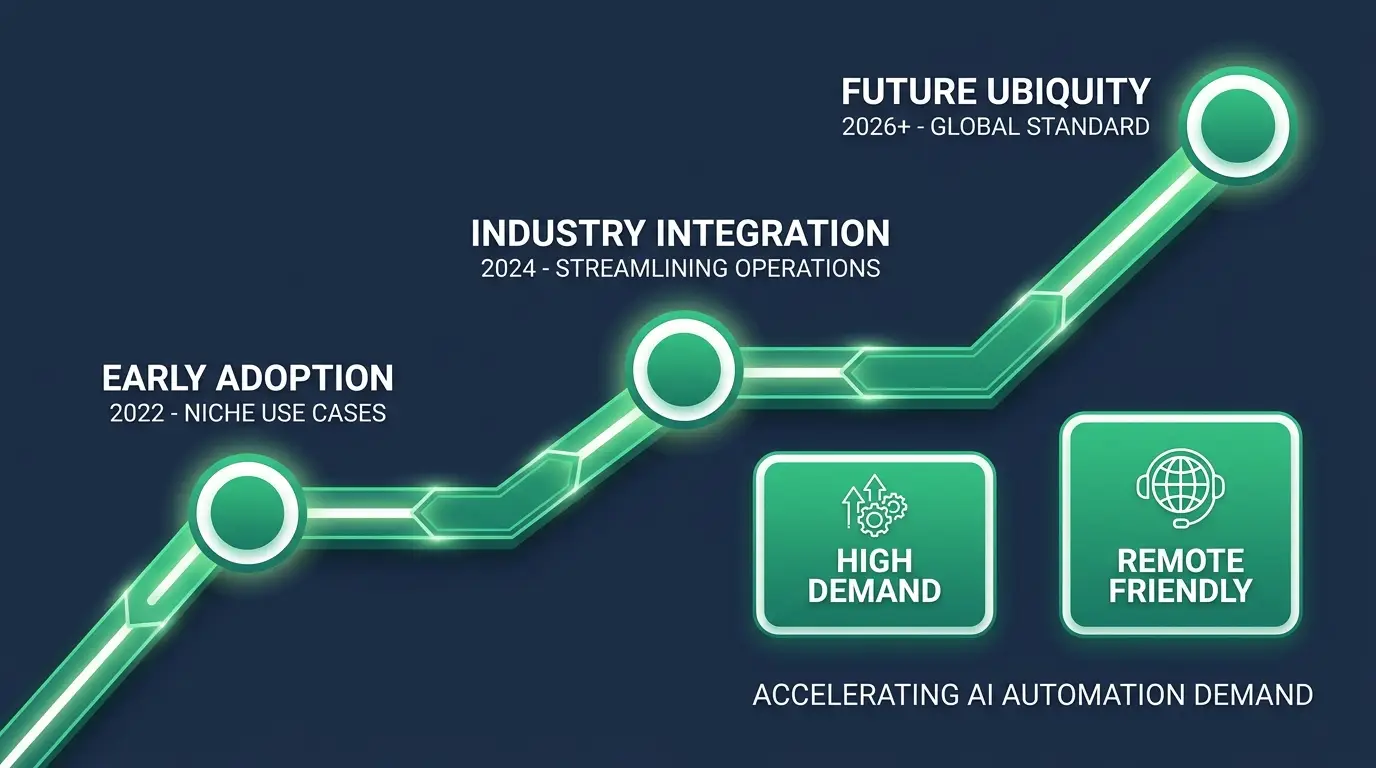
The demand is real and the supply is thin. Every business owner I talk to wants this and almost none of them can do it. They've heard AI can save them twenty hours a week, they've tried, and they hit a wall in week one. The gap between "I want automation" and "I can build automation" is enormous right now. That gap is your salary.
The ceiling is high for the time you put in. This isn't a field where you grind four years before anyone pays you. People build a real skill in months and start charging for it. The numbers genuinely surprised me when I dug into them, and I laid them out in the AI automation salary guide. The short version: it pays better than most people assume for how accessible it is.
It's remote-friendly by nature. The work lives in the cloud. You're connecting APIs and web apps, so there's nothing tying it to an office. That opens up a job market most people never see, which is exactly why remote AI automation jobs are some of the easiest tech roles to land from anywhere.
You don't need a four-year CS degree. You need to think in systems. If you can map out "when this happens, do that, unless this other thing is true," you already have the core wiring of an automation brain. The rest is tools, and tools are learnable.
And here's the reframe I want you to keep, the one that answers that student's panic:
AI automation is the role that rides the AI wave instead of being threatened by it. Everyone else is asking "will AI replace me?" You're the person they hire to do the replacing safely. You're on the boat, not in the water.
The honest counter-case
Now the part I refuse to skip, because if I only sold you the upside I'd be no better than the gurus.
The tools move fast, and you have to move with them. What you learn this quarter shifts next quarter. Models change, platforms ship new features, a tool you relied on gets bought or breaks. If you hate the feeling of never being "done learning," this will wear you down. The people who thrive here treat constant learning as the job, not a tax on it.
There's a real "will AI eat its own job" question. It's the smart objection, and you've probably already had it: if AI keeps getting better, won't it eventually build these automations itself? Here's my honest take. The building gets easier every year. But the part that doesn't automate away is knowing what to build, what should never be automated, and how to fix it at 2am when a client's whole lead flow silently breaks. The tool generating the workflow doesn't take the blame when it's wrong. You do. That judgment and accountability is the part you're actually paid for, and it's the last thing to get automated.
It can get messy and unglamorous. When an automation fails, it often fails quietly. Leads vanish. Orders don't sync. Nobody notices until it's a real problem, and then it's your name on the fix. Debugging someone else's tangled flow at midnight is the unsexy reality nobody posts about.
The bar is rising. Two years ago, knowing Zapier at all made you rare. That's no longer true. The easy stuff is getting commoditized, so the value is moving toward people who understand the business deeply, not just the tools. You can't coast on knowing which buttons to click.
I'd rather you walk in with eyes open than quit in month three feeling lied to.
So, who is it actually right for?
Strip away the hype and it comes down to temperament.
It's right for you if you like solving puzzles, you don't mind that the puzzle keeps changing, and you get a genuine kick out of making a tedious thing disappear. If you're curious by default, if you'd rather learn three new tools than do the same task three hundred times, this fits you like a glove. It's especially good if you want income that isn't chained to a desk in one city.
It's wrong for you if you want a skill you learn once and ride for twenty years. That career exists, but this isn't it. It's also wrong if you want pure heads-down technical work with zero people contact. The best automation people understand the business, which means talking to humans about what's actually slowing them down. If that drains you, you'll struggle.
If you read both lists and the "right for you" one made you nod, that's your answer. Start with the fundamentals on the AI automations career path and build something small that actually works before you worry about clients.
FAQ
Is AI automation a good career in 2026? Yes, for the right person. Demand far outstrips the number of people who can actually do the work, the pay is strong for how fast you can learn it, and it's remote-friendly. The catch is you have to enjoy constant learning, because the tools never sit still.
Will AI automation jobs get replaced by AI? The building part keeps getting easier, but the judgment part doesn't disappear. Knowing what to automate, what to leave alone, and how to fix it when it breaks is the human value, and that's the slowest thing to automate away. You're more at risk if you only know how to click buttons in one tool.
Do I need a computer science degree for AI automation? No. You need to think in systems and be willing to learn tools like Make, n8n, and Zapier. A degree doesn't hurt, but I've seen people with zero formal background out-earn CS grads here because they understood the business problem better.
How long does it take to get good at AI automation? Months, not years, to reach a paid level if you're consistent and building real projects. Getting genuinely senior, where you're designing whole systems and being trusted with critical workflows, takes longer. The fundamentals come fast; the judgment comes from reps.
Is AI automation better than learning to code? It's not either/or, and the people who can code a little and automate are the most valuable of all. But if traditional development feels intimidating, automation is a gentler, faster on-ramp into tech that pays well and uses a lot of the same logical thinking.
What is AI automation, exactly? Fair, the term gets used loosely. The plain-English version, with real examples of what these systems do, is in what is AI automation.
What jobs actually exist in this field? More than most people expect, across titles that don't always say automation. The full set, with pay ranges, is in AI automation jobs.
That message from my student? She didn't need to run from AI. She needed a place to stand inside it. AI automation is that place, as long as you go in honest about both the ceiling and the work.
If the "right for you" list sounded like you, don't overthink the next step. Pick one tool, automate one annoying thing in your own life this week, and feel what it's like to make work disappear. That little hit of "wait, I can do this" is where every automation career I've ever seen actually started. I'll be here cheering when you build the next one.