7 Best Zapier Alternatives in 2026 (An Honest Comparison)
On this page
That Zapier invoice is where most of these searches start.
You grabbed the $20 plan. Wired up a couple of automations, watched the first one fire, and thought, okay, this is insane. Then the business actually grew. More leads, more orders, more rows syncing every hour, and one random Tuesday the card gets hit for something closer to $300, because Zapier bills per task and your task count grew right alongside your traction.
I've watched this land on freelancers, agency owners, solo founders, over and over. Zapier didn't get worse. You just grew, and the pricing model started charging you for winning.
The other reason people leave has nothing to do with money. It's headroom. Zapier is probably the friendliest automation tool out there, and that friendliness has a ceiling. You start wanting branching logic that doesn't feel like duct tape. You want to run your own code inside a step. You want to self-host so customer data never leaves your machines. Eventually the guardrails that made it easy start feeling like handcuffs.
So here's where to go instead. I've built in most of these, broken a few live client workflows while learning them, and I'll tell you who each one is genuinely wrong for.
How I picked. Four things: what the price does when your volume climbs, how much real control you can get, how much pain the learning curve costs you, and whether you can self-host or you're renting someone else's cloud. Pricing moves constantly, so treat every number here as a starting point and check the current plans before you commit to anything.
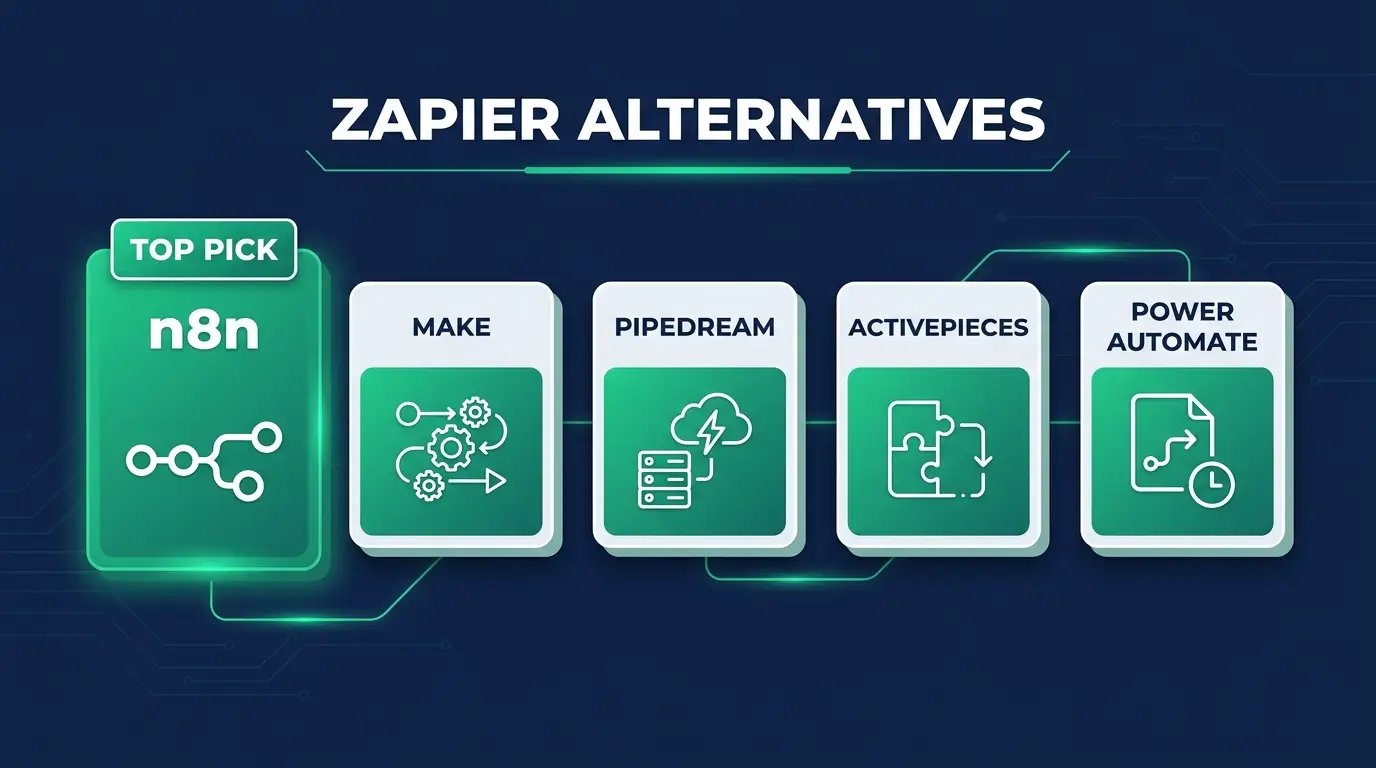
n8n
This is the one I point builders to first.
n8n is source-available and you can self-host it, which flips the entire cost equation. Instead of paying per task, you run it on a cheap server and push tens of thousands of executions without watching a meter tick. (The hosted plans and their limits are in my n8n pricing guide.) You still get a visual canvas like Zapier, plus real code nodes, an HTTP node that talks to basically any API you can reach, and a growing set of native AI nodes for agent and LLM workflows.
The tradeoff is the ramp. It takes longer to get comfortable, and if you self-host you now own the boring stuff: updates, uptime, backups, the occasional node that breaks after a version bump. There's a managed cloud plan if you'd rather not babysit a server, though that chips away at the whole reason you came.
Best for: builders, developers, and anyone whose task volume has already made Zapier expensive. If you're even slightly technical, this is where I'd send you. I wrote a full n8n vs Zapier breakdown and a plain-English explainer on what n8n actually is if you want to go deeper first.
Make (formerly Integromat)
Make is the clean middle ground: more power than Zapier, no code required. If you've never used it, here's what Make.com is and how it works.
The canvas is genuinely nice to work in, and it bills in "operations" instead of tasks, which usually lands cheaper for the same workflow. Branching, iterators, aggregators, error handling all feel built in rather than faked. The flip side is that same flexibility, because a busy scenario turns into spaghetti fast if you're not disciplined, and operations-based billing takes a minute to model in your head.
Best for: non-coders who've outgrown Zapier but aren't self-hosting anything. If you're choosing between exactly these two, I put them head to head in Zapier vs Make.
Pipedream
Developer-first, and it doesn't apologize for it.
You get triggers and actions like everywhere else, but the real draw is dropping into Node.js, Python, Go, or Bash inside a step and doing whatever you want. The free tier is legitimately generous, which makes it a great place to prototype before you spend a dollar. If writing code makes you tense up, though, this isn't your tool. The no-code layer exists, it's just thinner than what you'd feel in Make.
Best for: developers who want automation to feel like scripting.
Workato and Tray
Different neighborhood entirely, so I'll be quick.
These are enterprise integration platforms. Powerful, serious about scale and governance and compliance, and priced accordingly: no friendly self-serve page, you'll get on a call and then get a quote. If you're a freelancer or a small shop, this is wildly too much tool and I'd steer you somewhere else. If you're at a company with a real budget and a compliance team, you already knew that.
Activepieces
If what you like about n8n is the "own it yourself" part but you want something lighter, look here.
It's open-source, self-hostable, the builder is clean, and adding your own pieces is friendly. It's younger than the big names, so the connector library is thinner and you'll build more yourself. And as with anything self-hosted, uptime is now your problem. But the project moves fast and the philosophy is right: you own your automation instead of renting it.
Best for: people who want open source with no per-task meter and don't mind that it's still maturing. Check the current hosted and self-hosted plans, this one changes quickly.

Power Automate
If you already live in Microsoft, this basically comes with the furniture.
It's Microsoft's automation layer, and it's often bundled into Microsoft 365 licenses you're paying for anyway. The hooks into Outlook, Teams, SharePoint, and Excel run deep, which makes it the path of least resistance inside a Microsoft shop. It also does desktop automation, which most of these don't touch at all.
Step outside that world and it gets clunky. The licensing tiers are genuinely confusing, and the connector experience for random third-party apps isn't close to Make or Zapier.
Best for: teams already on Microsoft 365 who don't want to buy yet another subscription.
Native, built-in automations
Nobody selling you an automation platform wants to say this out loud: sometimes you don't need one.
If HubSpot is your home base, its workflows already handle emails, deals, and record updates. Running a store? Shopify Flow covers a big slice of ecommerce automation without leaving Shopify. CRMs and project tools increasingly ship automation as a standard feature, and people pay for a connector tool anyway because they never checked.
The ceiling is obvious. Native workflows stay inside their own walls, and the moment you need two apps talking to each other you're back to Zapier, Make, or n8n. But check first. It's free.
How to actually pick
Forget the feature checklists. Three questions settle it.
By budget. If cost at scale is the entire reason you're reading this, self-hosting n8n or Activepieces deletes the per-task meter completely. If you want managed but cheaper than Zapier, Make usually wins on price per action.
By technical comfort. No code, want it easy? Make. A little technical and willing to learn? n8n. Actually enjoy writing code? Pipedream. Already in Microsoft? Power Automate.
By whether you're billing clients. This one changes the math entirely. Automating your own business? Pick the cheapest thing that works and move on. But if you're building automations for clients and charging for them, the tool is the least valuable part of what you're selling. The value is walking into a business, spotting the expensive manual process nobody has questioned in four years, and designing a fix that doesn't collapse the first time it gets stressed.
Tools are cheap. Thinking is what gets paid.
Automation specialists charge $500 to $2,000 a month per client, and it isn't because they know where the buttons are. It's because they know which problems are worth automating.
Which is exactly why I'd never tell you to marry a platform. Learn to design systems that solve real business problems and you can pick up any of these in a weekend. Our AI automation career path is built around that on purpose, so you're learning automation rather than learning one vendor's menu. If you want the wider landscape first, I keep an updated list of the best AI automation tools and a full guide on how to become an AI automation specialist.

FAQ
What is the best free Zapier alternative? Pipedream, if you're comfortable writing a little code. If you'll self-host, n8n and Activepieces are effectively free past the cost of a small server, because you're not paying per task at all. Check the current limits, free tiers move around.
Is n8n really cheaper than Zapier? At scale, usually, especially self-hosted, because you're paying for a server instead of paying per task. Zapier's per-task model is what quietly inflates the bill as volume grows. The catch is you're taking on the setup and maintenance yourself.
Which Zapier alternative is easiest for non-coders? Make. It's the cleanest step up in power without needing code. If you're already deep in Microsoft 365, Power Automate feels easy for a different reason: it's sitting inside tools you open every day.
Should I self-host my automations? Self-host if cost at scale or data privacy actually matters to you and you're fine maintaining a server. Stay on managed cloud if you'd rather never think about uptime or backups again. No wrong answer, just control versus convenience.
Do I even need a Zapier alternative? Maybe not. If everything you want to automate lives inside one platform, go check that platform's built-in workflows before you pay for anything new.
Here's what I'd leave you with. Chasing the perfect tool is a trap, and it keeps you shopping instead of building. The people making real money in automation aren't loyal to any platform. They're problem solvers who'd rebuild the same workflow in n8n, Make, or Zapier without blinking.
If you want to become that person, that's what we do at CodingPhase. Diamond is $42 a month or $255 a year with a 7-day money-back guarantee, and it includes the full AI automation path plus everything else we teach. Want lifetime access and live weekly mentorship? The Tech Accelerator is a one-time $1,500. Either way: pick a tool this week, automate one annoying thing, let the skill compound from there. You've got this, and I'm rooting for you.