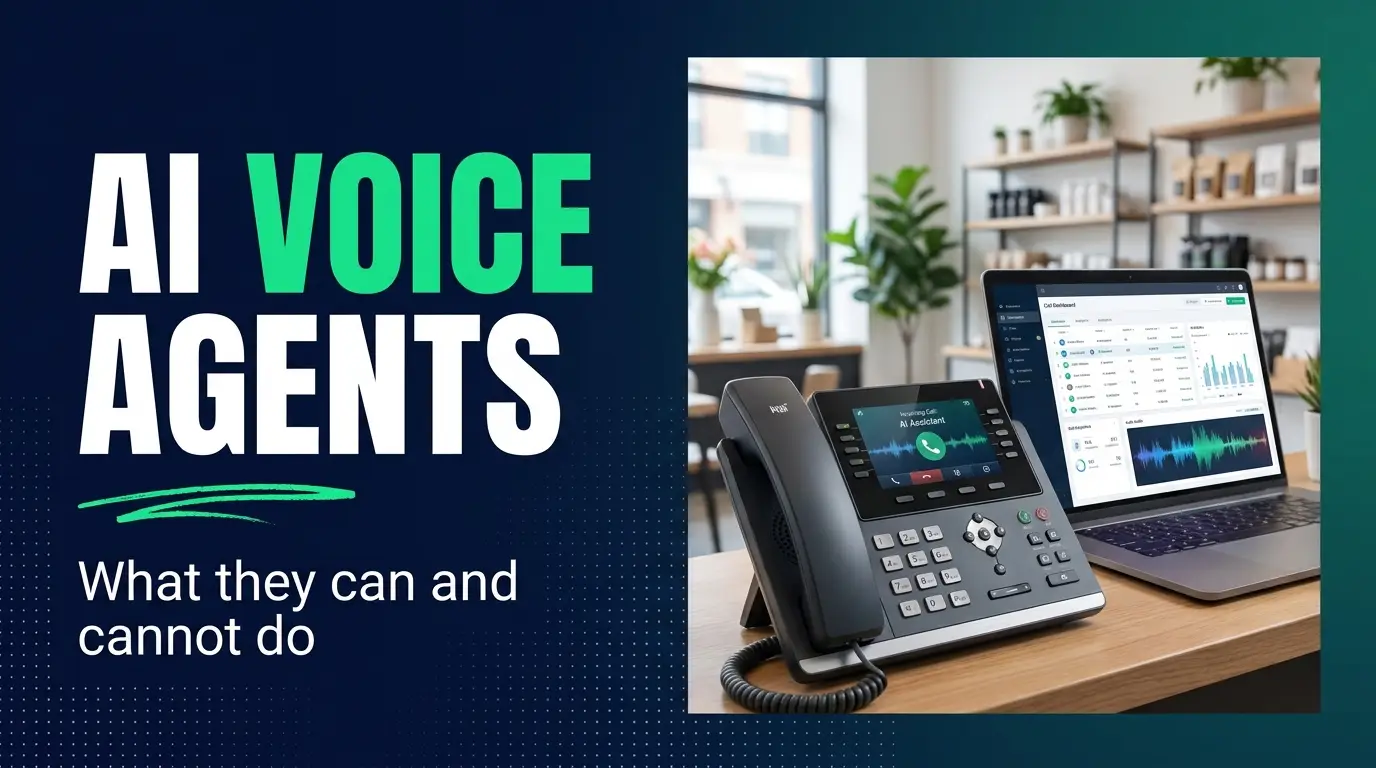
AI Voice Agents: How They Work, Where They Break, and What They're Worth
On this page
I called a company last month about a delivery. What picked up sounded almost like a receptionist, right up until I said "yeah, hi, I'm calling about order 4471, it says delivered but nothing showed up."
Half a second of nothing. Then, cheerfully: "Great! I can help you place a new order. What product are you interested in today?"
I said no, I already ordered, I'm asking where it is. It talked over me. I said "representative." It asked me to rate my experience.
That call cost the business a customer and probably ran them about four cents. The technology underneath is good now. Most of what's actually running on real phone numbers is garbage, and closing the distance between those two things is where the work is.
How a voice agent actually works
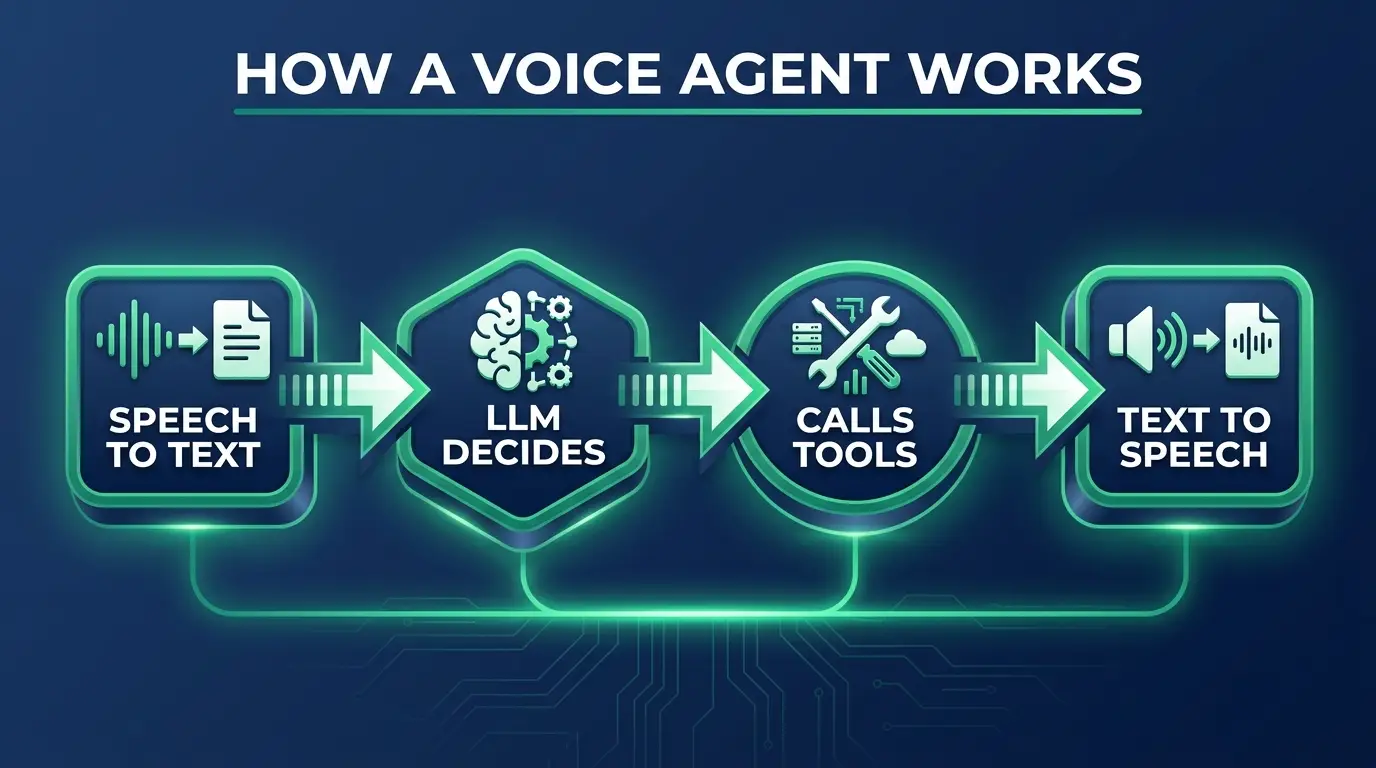
There are three moving parts running in a loop, and none of the marketing language matters once you see them.
Your voice hits the line and a speech-to-text model turns it into words, streaming, while you're still talking. Those words go to an LLM holding a system prompt about the business plus a set of tools it can call: check the calendar, look up an order, take a message, transfer to a human. The model decides what to say and whether to reach for a tool. Then a text-to-speech model turns the reply into audio and pushes it back down the line.
That loop runs for the length of the call, and everything you feel as "this sounds like a person" or "this thing is broken" comes down to how fast the round trip is.
Human conversation has gaps of maybe 200 milliseconds between turns. Push much past a second of dead air and the caller's brain flags it, they start talking again to fill the silence, that steps on the agent's reply, and now you're in the awful loop where two parties keep interrupting each other and neither finishes a sentence. Nothing the agent said was wrong. The timing was, and on a phone call the timing is most of what people are judging you on.
Newer speech-to-speech models skip the text hop in the middle, which cuts a chunk of that delay and keeps more of the tone. It feels better and it's harder to control, since there's no text step you can read before it goes out.
If the agent-plus-tools part sounds familiar, it should. Underneath, this is the same architecture as any other agent, which I walked through in how to build an AI agent. Voice bolts speech onto both ends and puts a deadline on the whole thing.
Where they genuinely work today
Inbound call answering is the big one, and it's about as unglamorous as it gets. A dental office. A plumber. The phone rings while everyone's with a client, it goes to voicemail, the caller hangs up and calls the next name on the list. An agent that picks up on the first ring, takes the name and the reason, and either books something or texts the owner is doing work that was previously not getting done at all. Easy sell, because you're replacing silence.
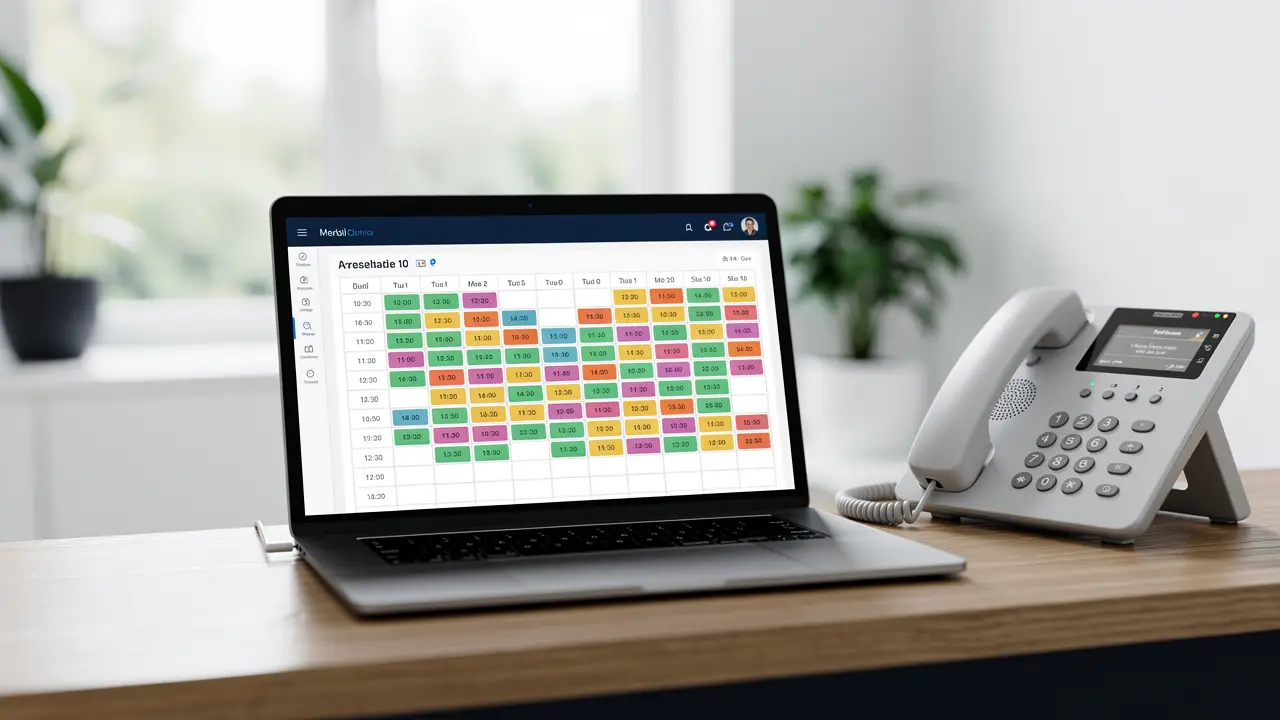
Booking and rescheduling works well when the agent has real calendar access. So does order status, if it can query the system instead of guessing.
Lead qualification is where I've seen the cleanest ROI. Somebody fills out a form at 11pm, the agent calls back within a minute while they still remember filling it out, asks four questions, and either books the consult or marks them cold. Speed to lead is a real, measured thing in sales, and no human team is doing that at 11pm.
After-hours, weekends, the lunch hour when the front desk is one person eating a sandwich in the back. Those are the hours where this stops being a novelty.
Outbound works differently. Reminders and confirmations to people who already have a relationship with the business, sure. Cold dialing is a legal minefield and I'll get to that.

Where they still fall apart
Most articles skip this part, and then you deploy one and find out on a customer.
When a caller cuts in mid-sentence, the agent has to stop talking immediately and process what was said. That's barge-in, it's improved a lot, and it still trips on people who say "mmhm" and "right" while listening, because the agent hears speech and stops. My mother-in-law does this constantly and no voice agent has survived a call with her.
Accents, background noise, an old man on a landline in a room with a TV on. Speech recognition trains on clean audio and real phone calls are not clean. If your customer base skews toward heavy accents, test with those callers before you promise anyone anything. The demo you saw was recorded on a good mic in a quiet room.
The confident wrong answer is the dangerous one. An LLM will not say "I don't know" unless you make it very hard to do anything else. Give it a vague prompt about a business and it will invent a return policy or promise a same-day appointment that isn't available. On a website that's an embarrassing chat log. On a phone call it's a verbal commitment a customer heard in a friendly voice, and they will hold the business to it. So constrain it hard: pull real data through tools, tell it explicitly to transfer rather than guess, and keep a short list of things it's allowed to state as fact.
Every agent also needs a fast, obvious path to a human, and it has to trigger on frustration rather than just on the magic word. If someone repeats themselves twice, hand off. Build the transfer before you build anything clever.
The part nobody likes to say out loud is that a lot of your callers want a person. Twenty years of phone trees taught them that the robot is the wall between them and a solution, and they are usually right. Some percentage will mash zero the second they hear a synthetic voice, and that percentage is your ceiling.
The legal part you cannot skip
Two areas to take seriously, and I'm a developer, not a lawyer, so treat this as a prompt to go ask one.
Call recording consent varies by state and by country. Some places only need one party to consent, some need everyone on the line, and those rules were written for humans recording humans but they cover your agent's transcripts and stored audio all the same. Plenty of jurisdictions also have rules about disclosing that a caller is talking to an automated system.
Outbound is the heavier one. There's a whole body of regulation around automated dialing, artificial and prerecorded voice messages, consent, calling hours, and do-not-call lists, and penalties get counted per call. That math turns ugly fast.
So check the actual rules for the jurisdictions your client calls into, get a real opinion in writing before you turn on anything outbound, and put disclosure and consent in the build from day one instead of bolting it on after a complaint. A blog post is not legal advice, and this section especially is not.
Building one
The stack splits in two, and most people who can demo one of these have only built the first half.
The voice layer is a platform that handles telephony, the speech models, turn-taking, and the transfer. You configure a prompt and a voice. Several serious ones exist and they leapfrog each other constantly on price and latency, so I won't hand you a winner that's stale in four months. Try two or three, call each from a cell phone in a moving car, pick by ear.
The layer behind it is where the value is. When the agent needs to book something, look up an order, or text the owner, it calls a webhook, and something on the other end has to do the actual work against real systems. That's automation. Most people I know building this professionally run n8n as that layer: the tool call hits a webhook, the workflow checks availability or queries the order database, handles the case where the API is down, and returns clean data for the agent to say out loud.
You can configure the voice in an afternoon. Getting it to work reliably inside a business's messy real systems takes a lot longer, and that's the part clients pay for.
Then test it like a hostile customer. Call it angry, call it from a parking lot, interrupt it, ask something outside its scope and see if it invents an answer. Listen to real recordings weekly for the first month, because the failure modes you find are never the ones you predicted.
For more shapes to steal, these AI agent examples and my rundown of the best AI agents cover the non-voice side of the same skill.
FAQ
How much do AI voice agents cost? Platform pricing is usually per minute of call time, and the common rate right now is around a dime a minute, plus telephony and the LLM calls. Check current rates yourself, this moves fast. For clients, most builders charge a setup fee plus a monthly retainer covering monitoring and prompt tuning. Setup runs a few hundred to a few thousand depending on how many systems it touches, and the retainer is where your income lives.
Can an AI voice agent answer my business phone? Yes. You either port your number to the platform or forward it, and you can forward conditionally so the agent only picks up after hours or when nobody answers in four rings. That conditional setup is the one I'd start with. Humans first, agent as the net.
Will callers know it's a robot? Most will, within a sentence or two, and that's fine. Trying to pass it off as human is a bad plan legally in some places and a worse plan for trust everywhere. Say it plainly at the top and let it be fast and useful instead.
Do I need to know how to code to build one? Not for the voice layer, which is configuration. You do need to be comfortable with APIs, webhooks, JSON, and authentication for the part behind it, which is where every real integration lives. That's learnable without a CS degree, and it's most of what AI automation work is.
I keep pointing people toward automation instead of voice specifically because the voice layer gets easier every quarter. Anybody can configure a nice voice. Connecting it to a calendar, a CRM, an inventory system, and a text that actually reaches the owner's phone, and having it not break on a Saturday, that's the skill somebody pays a retainer for.
That's what we teach in the AI automations path, same foundation whether the trigger is a form, an email, or a voice on a phone line. If you want to do this for clients, how to start an AI automation agency covers the business side. It's all inside Diamond at $42/month or $255/year with a 7-day money-back guarantee, or the Tech Accelerator at $1,500 one-time for lifetime access and the live weekly mentorship.
Build one for your own phone number first. Call it. Be annoying to it. You'll learn more in that hour than from any demo video, and you'll have something real to show the first client who asks.