Best AI Agents: The Honest List, Sorted by the Job You Need Done

On this page
A guy in our community sent me a video last month. An agent booking a flight, start to finish, nobody touching the keyboard. He wanted to know which one he should buy.
I tried the same thing that night with a similar setup. It reached the airline's cookie banner and sat there. Twelve minutes, burning tokens, politely narrating what it was about to do next.
Both of those are true at once. Agents do real work now, work I'd have called science fiction in 2023, and they also fall over in ways the demo reel never shows, usually on something stupid like a modal.
So here's my read on the best AI agents right now, grouped by the job you're hiring one for instead of by whose funding round was loudest. One warning before anything else: this category moves monthly. Something that was useless in spring can be genuinely good by fall, and a favorite can get noticeably worse after a model swap. Check what any of these does today before you commit a workflow or a client to it.
What I'm judging these on
Not benchmarks. Whether I'd let one near something that matters.
Can I see what it did after the run? Can I stop it mid-run? Does it fail loudly instead of quietly inventing a result and continuing? Everything below gets filtered through those questions, plus whether people I teach can get value out of it inside a week.
Coding agents
The category that delivered, and I say that as someone who spent most of a year rolling his eyes at it.
Claude Code, Cursor's agent mode, GitHub Copilot's agent features, and whatever Windsurf is calling it this month all do roughly the same thing: read your repo, plan a change, edit across multiple files, run the tests, try again.
I gave one a boring job on this site a few weeks back. Fifty-something lesson files that each needed a new metadata field added and validated against a schema. That's an afternoon of me copy-pasting, and one typo away from breaking the importer for everybody. It finished in about twenty minutes and flagged two files where I'd gotten the format wrong months earlier and never noticed.
They're good at boilerplate, at sweeping the same change across many files, at writing tests for code that already exists, and at explaining a codebase you inherited and are scared of. Anything architectural still needs you standing over it. Hand one a vague goal in a big codebase and it will build the wrong thing confidently and fast. The failure I watch for isn't broken syntax, it's an agent "fixing" a failing test by weakening the assertion until it passes. I've seen that twice and both times it looked green.
The honest tradeoff nobody says out loud: these make an experienced developer meaningfully faster, and they make a beginner slower in a way the beginner can't detect, because you cannot review code you don't understand. If you're still learning, use them to explain and to critique. Write the code yourself for a while longer.
General, browser, and research agents
ChatGPT's agent modes, Perplexity's research features, Gemini's Deep Research, plus the browser-driving experiments that appear and disappear every few months.
These are good at gathering. Ask twenty questions about a market and you get a decent cited draft in minutes, which makes for a fine first pass and a bad final one.
Two failure patterns show up over and over. They lose the plot on long multi-step web tasks, especially behind logins or checkout screens (fine by me, I don't want an agent buying things unsupervised). And they'll hand you a summary built on one mediocre blog post with the same confidence as a well-triangulated fact.
I treat them like a fast intern I trust with the searching and never with the conclusion.

The agents you build yourself
This is the bucket I care about most, because it's the one people get paid for.
Everything above is a finished product somebody else sells you. This is you wiring an agent into a real business's operations using n8n's AI agent nodes, Make's AI modules, Zapier's agent features, or the LangChain-style layer sitting under a lot of it.
The shape barely changes from project to project. Something triggers (an email lands, a form gets submitted). The agent reads context, picks from a small set of tools you handed it, does the work, and writes the result somewhere a human can check it.
One I built for a client: their support inbox. Email arrives, agent pulls the matching order out of Shopify, decides whether it's a shipping question or a refund, drafts the reply, drops it in Slack for a human to approve. Nothing glamorous anywhere in it. It saved that team somewhere around fifteen hours a week and they pay a monthly retainer for it, which is the part that matters.
No business owner wakes up wanting an AI agent. They wake up annoyed that chasing unpaid invoices eats half of somebody's Tuesday. Sell them the second thing, and the agent is just how you deliver it.
Picking the model is barely a decision. The wiring around it, the error handling and the approval step and the place the result finally lands, is where the work is.
If you're picking a platform, n8n is where I'd start once you're comfortable reading JSON without panicking, since you can self-host it and keep costs sane at volume. Zapier is friendlier and gets expensive fast once your runs multiply. Make sits between them. I went deeper on all of this in the best AI automation tools, and if you want the actual build process there's how to build an AI agent and a pile of AI agent examples you can copy.
Customer support agents
Intercom's Fin, Zendesk's AI agents, Sierra, Decagon.
Real adoption here, with real money behind it. Plenty of companies now resolve a serious chunk of tier-one tickets without a human touching them, and several vendors have moved to per-resolution pricing, which tells you they believe their own numbers.
The catch is the one chatbots had a decade ago. An agent grounded in a well-maintained help center works. Point one at a stale help center and it will lie to your customers at scale, politely, around the clock. Most of the work in a support agent rollout is content cleanup, and nobody's sales deck leads with that.
Voice agents
This is the fastest-moving category and the hardest to judge from a demo.
Latency and interruption handling decide whether people put up with a voice agent or hang up on it. ElevenLabs, Vapi, Retell, and Bland are the names you'll keep hearing, and they're usable now for appointment booking and after-hours intake.
They're also where the distance between a scripted demo and a live call is widest, because real humans mumble, talk over the bot, and go off script immediately. Call one yourself, in your own accent, from a car, before you sell it to anybody. I wrote up the whole category in AI voice agents.

The ones that are mostly demo
Start with anything promising to be your entire employee.
You know the video. One line of prompt, a finished product at the end, no interruptions, no errors, no clarifying questions. That's the run that worked, edited down. You're not seeing the eleven before it.
The autonomous agent swarms belong here too, the ones where agents hand each other tasks and argue about strategy. They're fun to watch, and I have yet to see one ship something in production that a single well-scoped workflow couldn't do more reliably for a fraction of the token spend. Maybe that changes this year. It hasn't yet.
Before I take any agent seriously I want to know three things. First, what does it do when it fails: retry, escalate to a person, stop cleanly, or quietly fabricate a result and carry on? That last one is disqualifying, and it's more common than you'd hope.
Second, can I see what it did? I want a trace of every step, every tool call, every input and output. If the vendor won't show you that, you can't debug it, and you definitely can't put a client's business on top of it.
Third, can I stop it? A kill switch, plus mandatory human approval before anything irreversible like sending money or deleting data.
How to actually pick one
If you write code for a living, run a coding agent in your editor and point it at well-specified boring work first. Earn the trust before you hand it the scary refactor. If you just need to know things fast, use a research agent with a personal rule that you open the sources before you repeat anything out loud.
You want to get paid for this. Build your own in n8n or Make. That skill is the one businesses hire for.
You're drowning in support tickets. Fix your help documentation first, then buy a support agent. Doing it in that order is the whole trick.
And if your business lives on the phone, get a voice agent, tested on real calls with real customers before it goes anywhere near your main line.
Using an agent is a skill you can pick up in a weekend. Building and deploying them for businesses that will pay you monthly is a career, and it's the one I'd point anyone at right now. That's what our AI automation path is built for: real workflows, real integrations, deployed. Diamond membership is $42/month or $255/year with a 7-day money-back guarantee, and Tech Accelerator is $1,500 one time if you'd rather own it and get the live mentorship.
FAQ
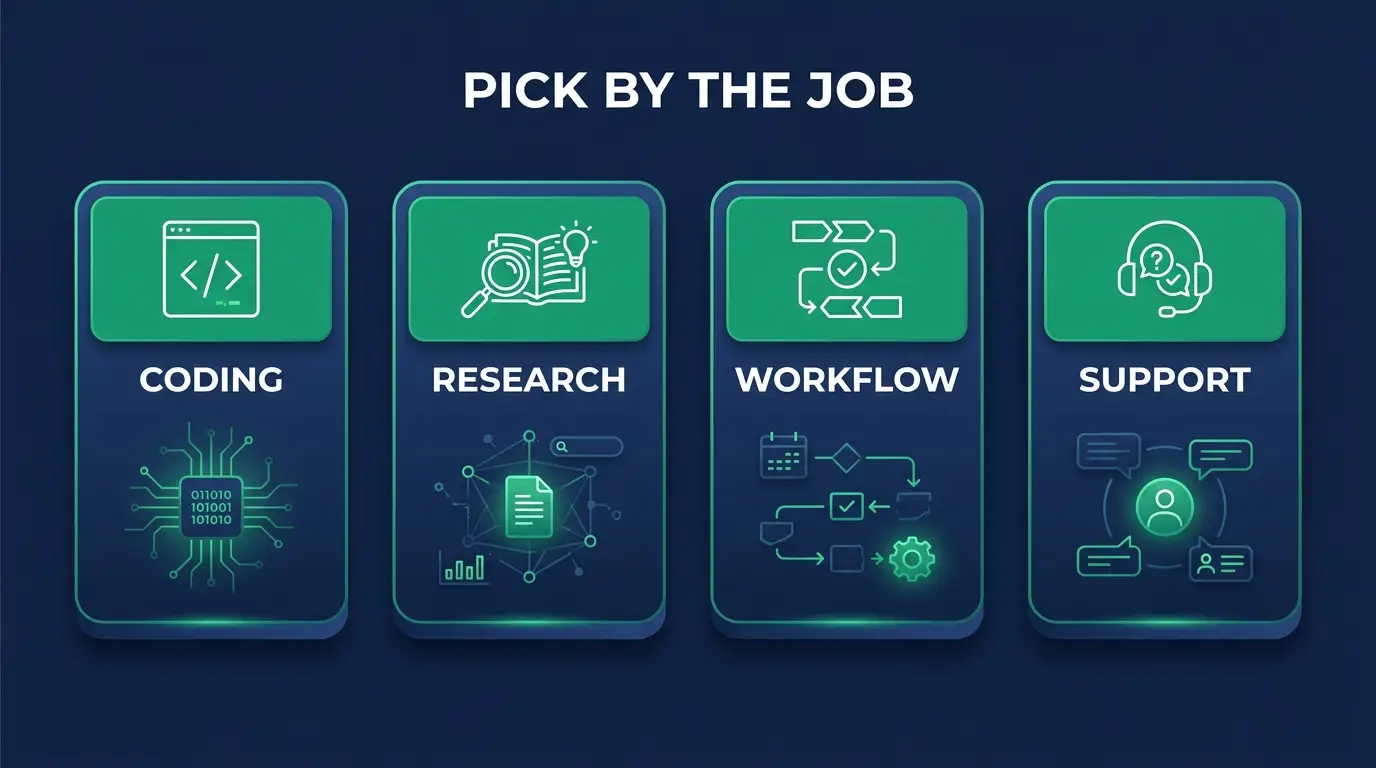
What is the best AI agent right now? There isn't one, which is annoying but true. For code, Claude Code and Cursor's agent mode are the ones I use. For research, ChatGPT and Perplexity's agent modes. For anything a business will pay you to run, something you build in n8n. Pick by the job, and re-check in a few months because these rankings genuinely shift.
Are AI agents worth it for a small business? For repetitive, high-volume, rules-heavy work, usually yes. Support triage, invoice chasing, lead routing, and data entry between systems all pay back quickly. For anything requiring judgment or a relationship, keep a human on it. The businesses that get burned are the ones that automated the customer relationship instead of the busywork around it.
What's the difference between an AI agent and regular automation? Regular automation follows a fixed path you defined. An agent decides which tools to use and in what order based on the situation. That flexibility is the value and also the risk, which is why guardrails matter so much. I broke this down further in AI agents vs agentic AI.
Can I build an AI agent without coding? Yes, to a point. n8n, Make, and Zapier all let you build working agents visually. You'll hit a ceiling eventually where you need to read an API doc, write a bit of JavaScript in a code node, or debug a webhook, and that's usually the moment your work becomes worth real money.
How much do businesses actually pay for this? What I see most often is a build fee in the low thousands plus a monthly retainer for maintenance and monitoring. The retainer is the real prize, and it's justified, because these things break when an API changes and somebody has to notice.
What about agents that write code? That's its own category now and it moves faster than the rest. The current options and what each is actually good at are covered in the best AI coding agents.
If you take one thing from this, make it the habit of asking what happens when the agent fails. That question alone will keep you out of most of the trouble in this space, and it's the question people who deploy agents ask before people who demo them ever think to.
The tools on this list will all look different a year from now. The judgment about what's safe to hand over and what isn't, that part keeps paying. Come learn it with us, we'll be here.