AI Agents vs Agentic AI: The Difference, Explained Plainly
On this page
A student sent me a screenshot last month of a job posting that wanted "3+ years of Agentic AI experience." Under it he wrote: "bro I've built like nine AI agents, is that the same thing or is this a different skill I don't have."
It's the same thing. Mostly. And the fact that a working developer had to ask me tells you everything about how badly the industry has mangled these two words.
The short answer
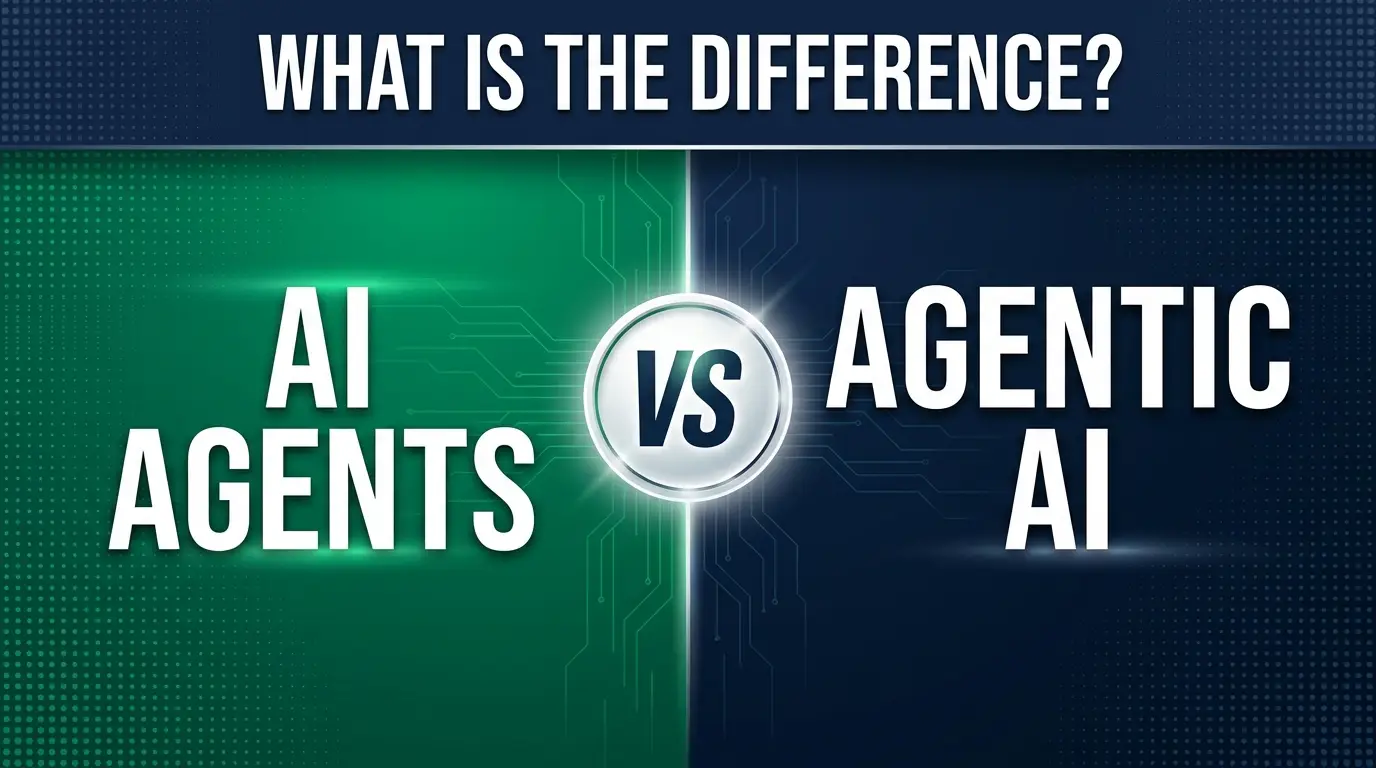
An AI agent is a specific system. It's a language model with a goal, a set of tools it's allowed to call (search, a database query, an email send, an API), and a loop that lets it decide what to do next, look at the result, and keep going until the goal is met or it gives up. The loop is what makes it an agent. Take the loop away and you have a chatbot with plugins.
Agentic AI is a property. It means a system plans across multiple steps, picks its own actions, and works toward an outcome instead of answering one prompt at a time. An AI agent is one implementation of agentic behavior, probably the most common one, but the word describes how something acts rather than naming a product.
Agentic is the adjective. Agent is the noun. Every vendor deck you've ever sat through blurs those two on purpose, because "agentic" sounds like a category somebody can sell you a platform for.
The autonomy ladder
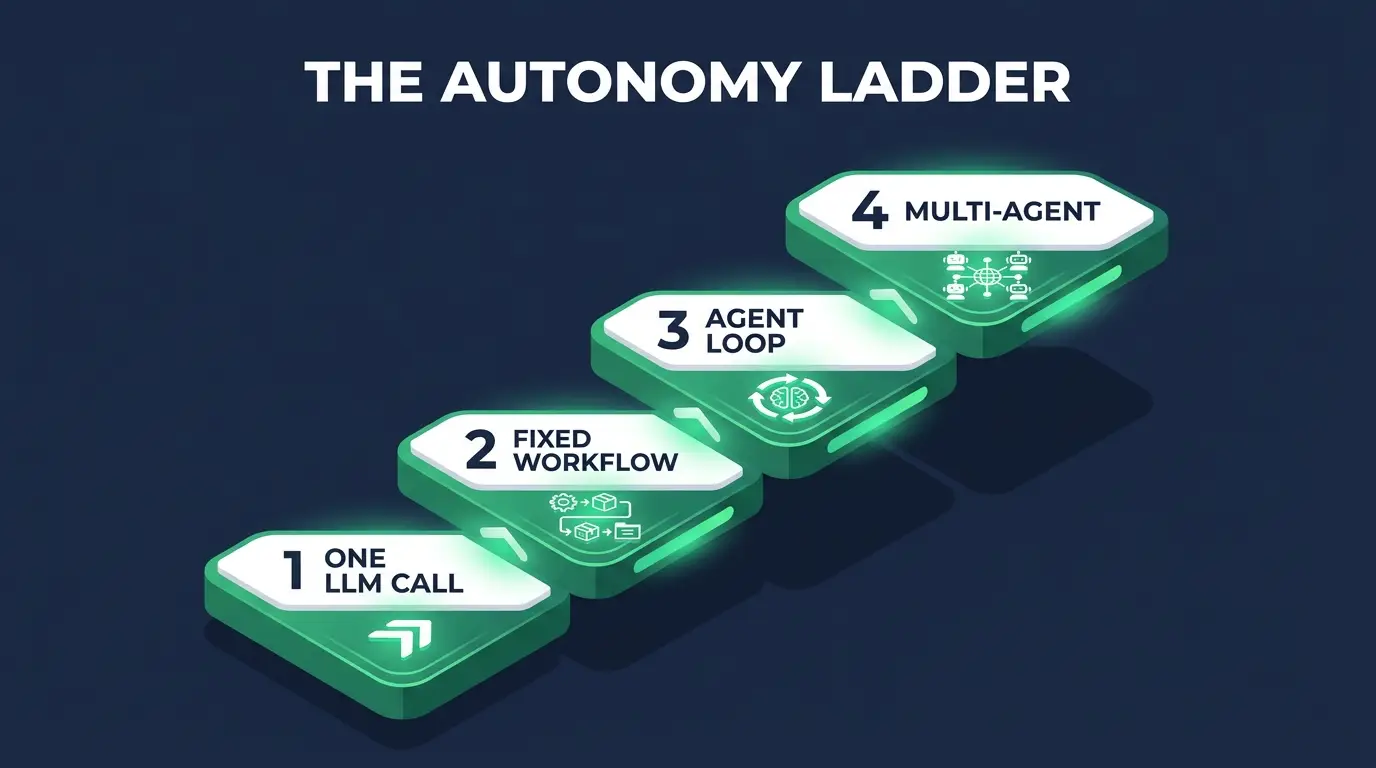
The vocabulary matters a lot less than the choice you make when you sit down to build. There are four levels of autonomy to pick from, and the pick has real consequences for what it costs and for how badly your Tuesday goes when it breaks.
One email into support@, run up all four rungs:
"Hey, I ordered the black hoodie in medium but I meant large. Order 4417. Can I swap it? I need it before the 22nd."
Level 1: a single model call. You paste the email into a model and ask it to draft a reply. It writes something polite about exchanges. It has no idea whether order 4417 exists or whether larges are in stock. You read it, you fix the facts, you send it. The model wrote the prose, and everything in there that had to be true came from you.
Level 2: a fixed workflow with model steps in it. This is where most real business automation lives, and where n8n, Zapier, Make, and every other workflow builder earn their money. You build a pipeline: email arrives, a model classifies the intent as "exchange request" and pulls out the order number, the workflow hits your Shopify API for order 4417, checks stock on large, generates a return label, drafts the reply with the real tracking number in it, and drops it in Slack for a human to approve. The path is decided by you, in advance. The model handles the fuzzy bits, reading unstructured English and writing a natural reply, while the plumbing handles everything that has to be correct. If it breaks, you can point at the node.
Level 3: an agent. Now you hand a model the goal ("resolve this customer's request") and a toolbox: lookup_order, check_inventory, create_return_label, issue_refund, send_reply, escalate_to_human. Nobody wrote the sequence. The model calls lookup_order, sees it shipped two days ago, decides on its own to call check_inventory, finds large is out of stock in black, and then makes a judgment call you never programmed: it checks charcoal, offers that as an alternative, and flags the date risk. That's genuinely useful, and the same freedom is why, on a different Tuesday, it issued a refund on a $340 order because the customer's email was worded aggressively and issue_refund was sitting right there in the toolbox. If you want to see the wiring up close, I broke it down in how to build an AI agent.
Level 4: multiple agents. A triage agent reads the inbox and routes. A returns agent owns exchanges and talks to an inventory agent. A supervisor agent checks outbound replies against your policy doc. On a whiteboard this looks incredible. In production it's four independent things that can each be confidently wrong, plus the fun of debugging a conversation between two language models that agreed with each other about something false.
Levels 3 and 4 are agentic. Level 2 has a model in it and is not agentic in any meaningful sense, no matter what the tool's homepage says. Level 1 barely counts as automation, since it's really just typing with help.

Why the difference actually matters when you're building
Climbing a rung gets you more capability and less predictability. At level 2 you answer "why did it do that" by opening the workflow and reading it top to bottom. At level 3 the answer is buried in a reasoning trace, and it might be different next time on the identical input. Same email, same data, different path, because that's what sampling from a model does. Most teams reach for that before they need it.
It costs more in the literal sense too. A level 2 workflow makes one or two model calls per email. An agent in a loop makes eight, or twenty, each one dragging the whole growing conversation history along in its context. I've watched a support agent prototype run roughly 15x the token spend of the deterministic version it replaced, for an outcome the client couldn't tell apart.
The failure surface widens in a nastier way too, because giving a model tools means giving it the ability to do things. A wrong answer is embarrassing. A wrong issue_refund call is money. Every tool you hand an agent is a permission granted to something that occasionally makes things up.
So my rule is boring on purpose: solve it at the lowest rung that works. If you can draw the decision tree on paper, build the decision tree. Reach for level 3 when the branches are too many to enumerate, or when the task is research-shaped and every input needs a different sequence of moves. That's a real category, just a much smaller one than the hype implies, and most businesses paying real money for automation right now have a level 2 problem. My n8n guide covers the tool most people should start with, and these examples show what the agent version looks like once you've earned it.
Where the marketing muddies it
Be suspicious of any definition you read here, including mine, because there's no standards body. Academic papers predate the LLM era by decades and use "agent" much more loosely (anything that perceives an environment and acts on it, which technically includes a thermostat). Vendors landed on "agentic" around 2024 because "AI-powered" had stopped moving deals.
What that produced:
- Chat interfaces with a search button, sold as agents. One tool call is not a loop.
- Rebranded RPA and workflow builders, sold as "agentic platforms," where the flow is still a fixed sequence you drew by hand.
- Multi-agent frameworks pitched for problems a single well-scoped agent handles better with fewer moving parts.
- "Autonomous" demos that only work because someone hand-picked the input. You can spot these by how clean the sample data is.
Multi-agent in particular is oversold. The pitch is division of labor, specialist agents each doing one job well. In practice most of the wins people credit to multiple agents come from better prompts and tighter tool definitions, both of which you can do inside one agent. There are legitimate cases, mostly genuinely parallel work over separate contexts, or where isolation is a safety requirement (the reviewer must not be the writer). Outside of that, adding agents mostly adds ways for a system to talk itself into something wrong. Start with one, and split it when you can name exactly what the split fixes.

FAQ
Is agentic AI the same as an AI agent? Close enough that people swap them in conversation, but they're different parts of speech. An AI agent is a concrete system: a model, a goal, tools, and a loop. Agentic AI describes behavior, meaning the system plans and acts on its own across multiple steps. Every AI agent is agentic. Not everything called agentic is an agent.
What is an example of agentic AI? A coding assistant that reads a bug report, searches your repo, opens the relevant files, writes a patch, runs the test suite, sees the failure, and fixes its own patch before asking you to review it. Nobody scripted that sequence. It chose each step based on what the last one returned.
Is ChatGPT an AI agent? When it answers a question from its training data, no. When you give it a task and it browses, runs code, checks the output, and iterates on its own, it's behaving as an agent for that task. Same product, different mode. If you're shopping around, I ranked the ones worth your time.
What's the difference between agentic AI and regular automation? Regular automation follows a path you defined. Agentic systems decide the path at runtime. That's why automation is easier to trust and agents handle messy work better.
Do I need to know how to code to build AI agents? Not to start. You can build capable level 2 and even level 3 systems in n8n or similar tools with no code. Code becomes necessary when you need custom tools and real error handling, which is roughly the point where hobby projects turn into things clients pay for. The AI automation specialist path walks through that progression.
Knowing these words is table stakes. It'll keep you from getting sold a multi-agent framework for a problem two API calls could solve. But nobody pays for vocabulary. They pay for the thing that runs at 3am and handles 400 emails correctly without anybody watching it.
That's what our AI automations path is built around: start with the deterministic workflows businesses actually need, then add autonomy deliberately, one rung at a time, once you understand what it costs you. It's inside Diamond at $42/month or $255/year with a 7-day money-back guarantee, or lifetime through the Tech Accelerator at $1,500 one time if you'd rather pay once and be done.
Whichever way you come in, build something small this week. Nine agents is already more real experience than most people posting about this have. Keep going.