n8n vs Zapier: Which Automation Tool Should You Actually Learn?
On this page
A student sent me a screenshot last year of his Zapier invoice. Two clients, nothing fancy, mostly lead routing and a few Slack pings. The number at the bottom was 289 dollars. He asked me if he'd done something wrong. He hadn't. He'd just built enough automation to be useful, and useful is what the pricing model charges for.
That is the question sitting under "n8n vs Zapier," and almost every comparison online dodges it. Feature grid, a sprinkle of pricing, and you leave more confused than you arrived.
I have built automations both ways. I've watched a Zapier bill climb quietly while nobody was looking at it, and I've also stood up an n8n instance on a cheap server and pushed tens of thousands of executions a month through it for less than a coffee. Here is what these tools actually are, where each one hurts, and which deserves your time if you want to make money with this skill.
The one-line verdict
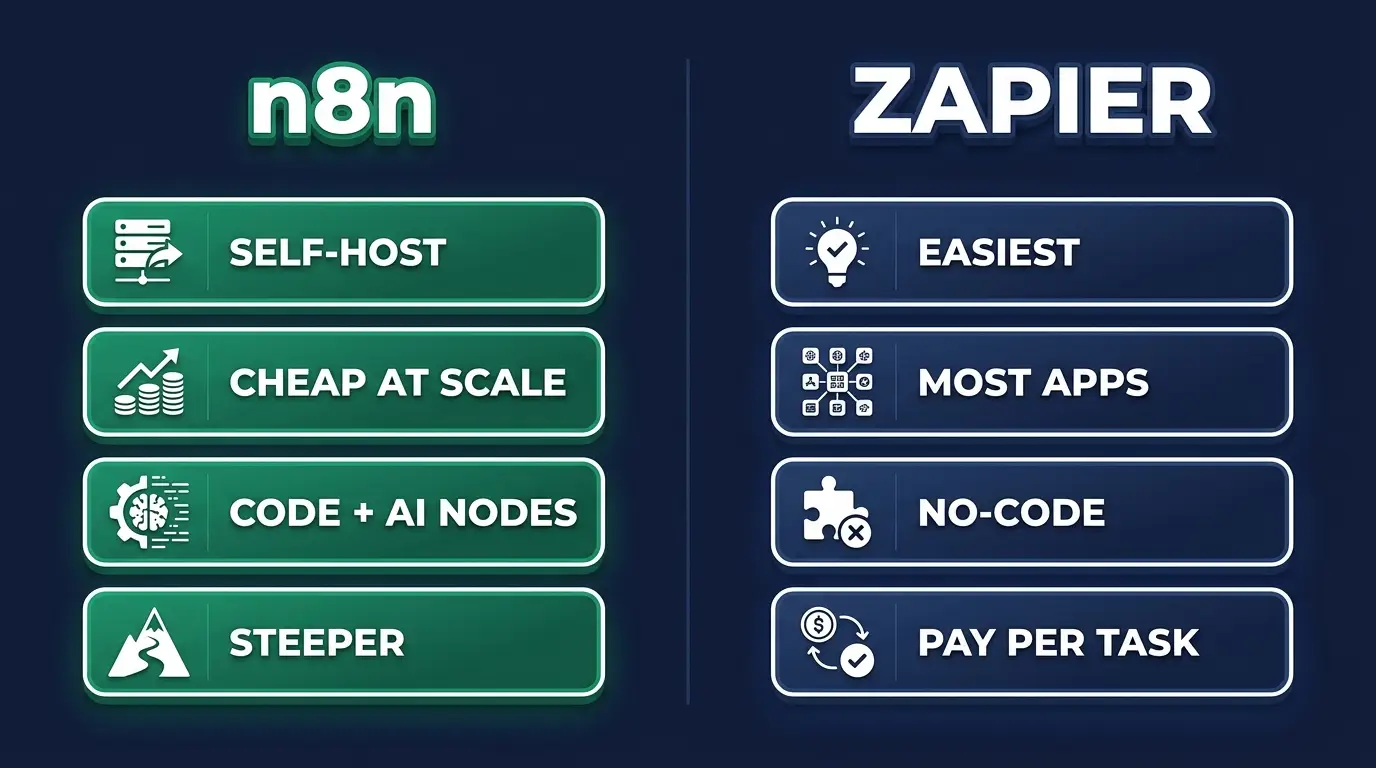
Pick Zapier if you want fast and simple and you don't mind paying for it. It's the friendliest on-ramp in the whole automation world, and for a small business wiring up a handful of internal tasks, it's often just the right call.
Pick n8n if you want power and low cost at scale and you're willing to learn a little more. It rewards the effort with flows Zapier can't touch, and a bill that barely moves as your volume explodes.
That's the whole fight in two sentences. The reasoning is below so you can decide for your own situation.
Ease of use
Zapier wins here and it isn't close.
Zapier is built for someone who has never written a line of code. You pick a trigger ("new row in a Google Sheet"), pick an action ("send a Slack message"), map a few fields, turn it on. The language is plain English, the templates are everywhere, and you can have something working in ten minutes on your first day. That first win feels great. I remember mine.
n8n asks more of you up front. It's a node-based canvas where you drag connections between steps, and while that's still visual, the mental model sits closer to how data actually moves. You'll run into JSON, expressions, and the shape of a payload traveling between nodes. Not hard. Not zero, either.
Here's the honest tradeoff. Zapier's simplicity is a gift on day one and a cage on day ninety, when you need something the interface just won't let you say. n8n's learning curve is a tax you pay early and then basically never again. The skill you build learning n8n travels with you to whatever tool comes next, because it's really a skill about how data flows. The skill you build learning Zapier mostly transfers to using more Zapier.
Pricing and how it bites you at scale
Zapier charges you per task. Every action a Zap performs counts, and you buy a monthly bucket of them. A workflow with five actions burns five tasks every time it fires, so multiply that across a few thousand runs a month and a couple of clients and you get my student's 289 dollar screenshot. Check their current plans before you quote anyone, since the numbers move around, but the shape never changes: more automation means a bigger bill, forever.
Self-hosted n8n breaks that link. n8n is source-available and runs in Docker on a server you control, so you're paying for the box, not the work. A five or ten dollar a month server will chew through tens of thousands of executions without the price twitching. Add a client, add a workflow, add another ten thousand runs, and your cost sits exactly where it was. There's also a paid n8n cloud if you'd rather not babysit a server, and that one does have tiers, so weigh it against what your time is worth.
The reframe I want you to keep: with Zapier you rent the automation, with self-hosted n8n you own it. For a hobby or two internal tasks, renting is completely fine. For a business, ownership is margin.

Power and flexibility
Real client work gets weird. Always. This is the section that decides everything.
n8n has a built-in Code node. When the visual blocks can't do the thing, you drop into JavaScript or Python and just do it. Loop an array, reshape a payload some vendor's API returned in a format nobody would design on purpose, call a function. That single escape hatch is why n8n almost never hits a hard wall. Zapier has a code step too, and it works, but it's narrower and it feels bolted on rather than native.
The AI and LLM nodes are the other gap. In n8n you can chain model calls, build agents, and wire up retrieval without duct-taping four services together to fake it. If you're building anything with AI in 2026, and you probably should be, that matters. Zapier has shipped AI features too. They're fine. n8n was built by people who saw where this was going a bit earlier.
Self-hosting also means client data stays on infrastructure you own rather than passing through somebody else's cloud. For a client in health or finance, that's often the thing that lets you win the contract at all.
Zapier has a power ceiling and you will find it. n8n's is high enough that most people never do.
Integrations
Give Zapier its due, because it earns this one. Zapier's integration library is the biggest in the business, thousands of apps, connected and polished and tested. If your workflow depends on some obscure SaaS tool, the odds Zapier already has a clean native connector for it are excellent. That breadth took years and a lot of money and it's a real advantage.
n8n covers every big platform and the list keeps growing, but its actual superpower is the HTTP Request node. If a service has an API, and almost everything does, n8n can talk to it whether a pre-built node exists or not. That costs you a few minutes and a look at the docs. It also means "does n8n integrate with X" answers yes nearly every time, as long as you're willing to wire it yourself.
Zapier wins on raw count and on convenience. n8n wins on never being blocked. Which one matters more comes down to whether you'd rather click a button or never hear the word "unsupported."
Which should YOU learn?
Now the part the feature grids never answer honestly.
If you're automating a few things inside your own small business, the "new lead hits my CRM and pings my phone" kind of thing, Zapier is a perfectly good answer. Low volume, low complexity, and your time is worth more than the subscription. Learn enough to solve your own problems and go run your business.
If you want to build automations for other companies and get paid for it, learn n8n. This is the one I'd bet on, and the reason is economics, not taste. You charge a client somewhere between 500 and 2000 dollars a month to run their automations. Their volume grows, which is the point, and a per-task tool quietly eats the difference. Self-hosted n8n keeps your cost flat while the invoice stays the same. That gap is your profit. For a freelancer or a one-person shop, that's a business advantage, not a technical preference. If you want ideas for what to sell, start with these n8n workflow templates and examples.
Nobody tells you this while you're picking between logos: the money isn't in the tool. The money is in knowing how to think in automations, how to walk into a business, find the repetitive work bleeding their hours, and design a flow that kills it. The tool is the wrench.
That's what we teach in the AI automation path at CodingPhase. Not "click here in Zapier." The thinking. The data flow, the API calls, the AI nodes, and how to package the whole thing as a service somebody pays for monthly. One tool you can pick up from a YouTube video in an afternoon. Building a business around this takes longer and is worth more, and that's what our career paths and job board exist to get you to.
Membership is 49 dollars a month or 250 a year with a 7-day money-back guarantee. If you want lifetime access plus live weekly mentorship, the Tech Accelerator is a one-time 1,500 dollars. Either way you get the whole library, not just one course.

FAQ
Is n8n really free? The self-hosted version is source-available and you run it yourself, so you're paying for the server, which can be a few dollars a month. There's also a paid n8n cloud plan if you'd rather not manage infrastructure. So free as in you own it, not free as in effortless. I keep the current cloud numbers in n8n pricing.
Is n8n hard to learn if I cannot code? It's a step up from Zapier, but you don't need to be a developer to start. You can build plenty with the visual nodes alone and pick up the code parts when a workflow forces you to. Most people who actually commit to it are comfortable within a couple of weeks.
Will Zapier really get that expensive? Depends entirely on your volume. A few low-traffic Zaps stay cheap for years. Because you pay per task, though, multi-step workflows across several clients add up faster than people expect. Do the math on your task count before you commit, and check their current tiers, since those change.
Can I use both? Sure, and plenty of people do. Zapier for quick internal wins, n8n for the heavy client work where cost and flexibility decide whether you make money. Learning n8n doesn't mean throwing Zapier away. For a fuller map of the landscape, see our guides on Zapier vs Make and the best AI automation tools.
Which one gets me hired or paid faster? For selling automation as a service, n8n's economics give you a real edge, which is why we lean into it. If you want the full picture on turning this into income, read how to become an AI automation specialist and running a one-person agency.
If you're still on the fence, pick the tool that matches your goal rather than the one that demos best. Playing with your own automations is a great use of a weekend and it costs you close to nothing to find out which side you land on.
Want to go deeper on the tool I'd bet a business on? Start with what n8n is, then follow the n8n tutorial and build your first real workflow. Whichever way you go, you've got this, and we're here to help you turn it into something that pays.