Google's June SEO Update Is Tanking Sites. Here's the 3-Part Fix.

On this page
Last week I audited a site that had lost almost half its pages.
Not half its rankings. Half its pages. They weren't sitting on page four of the results somewhere. They were gone from Google's index entirely, like they'd never been published.
If you run a site, or you manage sites for clients, go check yours before you finish reading this. I'll give you the exact report to open in a minute.
Here's what's going on. Since spring, and picking up hard through June, Google has been quietly purging what it considers AI slop from its index. Google hasn't announced it as a purge, and officially there's nothing to see here. But SEOs everywhere are watching the same pattern: pages that ranked fine for months are being removed, and sites built on mass-produced AI content are losing them by the hundreds.
The old game was "rank above the other guys." The new game is different, and this is the reframe I want you to keep: you're no longer competing for position, you're convincing Google your page deserves to exist at all.
Different game. Different rules. Let me walk you through the three things that decide whether a page survives, because once you see the pattern, the fix gets obvious.
Why Google is doing this
Google has been fighting machine-generated filler since late 2022, when ChatGPT made it free to produce. The helpful content update, the spam updates, the core updates through 2024 and 2025, they're all the same war. This year's cuts are just the latest escalation.
And the reason it keeps escalating is simple: search is Google's whole business. Billions of searches a day, the revenue engine of a multi-trillion-dollar company. Everyone declaring "Google is dead" is reading vibes, not numbers.
The problem is that the volume of AI content finally outpaced Google's ability to sort it on the fly. So they changed strategy. Instead of trying to rank good pages above bad ones, they started cutting at the index layer. Pages don't get demoted anymore. They get removed.
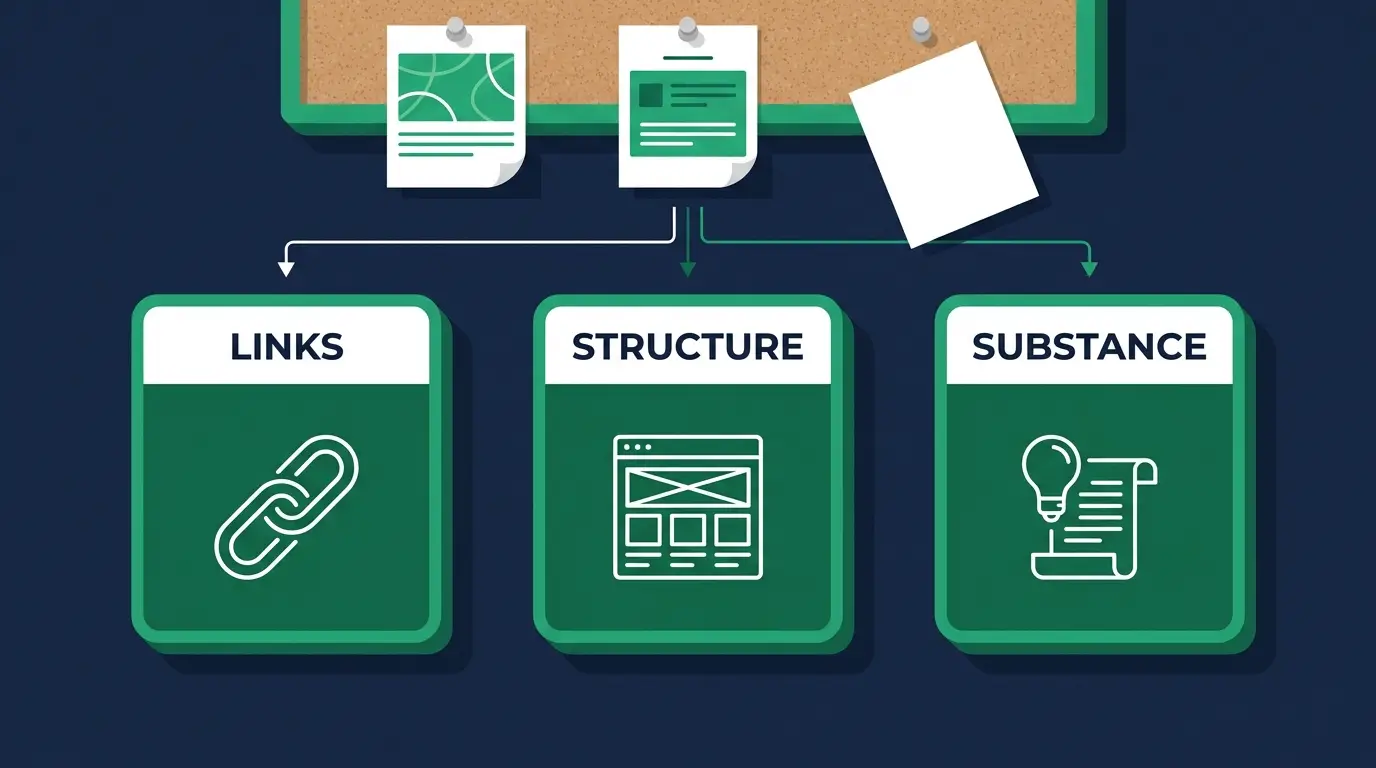
Three things determine which side of that cut your pages land on: the links pointing at them, how they look when rendered, and what they actually say. The first two are quick fixes. The third is the real reason most pages are dying.
Factor 1: Links, or why orphan pages die first
Picture a corkboard covered in pages. The ones held up by the most pins are the ones Google trusts. The ones with no pins fall off the board. That's the purge in one image.
The first pins you control are internal links. Every page you publish needs links pointing at it from other pages on your own site, ideally pages that already get traffic and are already trusted. A new page with zero internal links pointing at it is called an orphan page, and Google treats orphans like they don't exist.
Then you need external links, and there are two kinds that matter right now.
The first kind lifts your whole domain. For a local business that's what I'd call hyper-local trust links: the chamber of commerce, a youth sports sponsorship, a community charity. They point at your homepage, not at individual posts, because their job is raising the trust of the entire site. Five to ten of these covers most local sites.
The second kind is the one almost everyone misses. I think of it as the "this isn't slop" link: one external link, from one unique domain, pointing at each individual page. A blog comment, a social profile, a mention somewhere real. Its job is not to push rankings. Its job is to clear a much lower bar: a human linked to this page on purpose, so don't delete it. One per page, and don't stack fifteen links from the same domain, because only the first one counts for this.
If you take one operational rule from this whole post, take this one: no page goes live without at least one external link from a unique domain pointing at it within a couple of days of publishing. That single habit is the difference between a page that survives the trim and a page that vanishes by the end of the month.
Factor 2: What Google sees when it renders your page
Google renders your page in mobile Chrome, then pattern-matches what it sees against the kinds of pages users actually engage with. Think about what a decade of winning pages looks like: subheaders breaking up the content, bullet lists, an FAQ near the bottom, real images, internal links woven into the body.
Now picture the average AI-generated page: 1,800 words of solid text, an H1 on top, and a brick wall of paragraphs. On a phone screen, those two pages don't even look like they're from the same internet. One looks like a human built it for other humans. The other looks like it fell out of a content factory, largely because it did. Google's pattern matcher isn't being subtle about which is which.
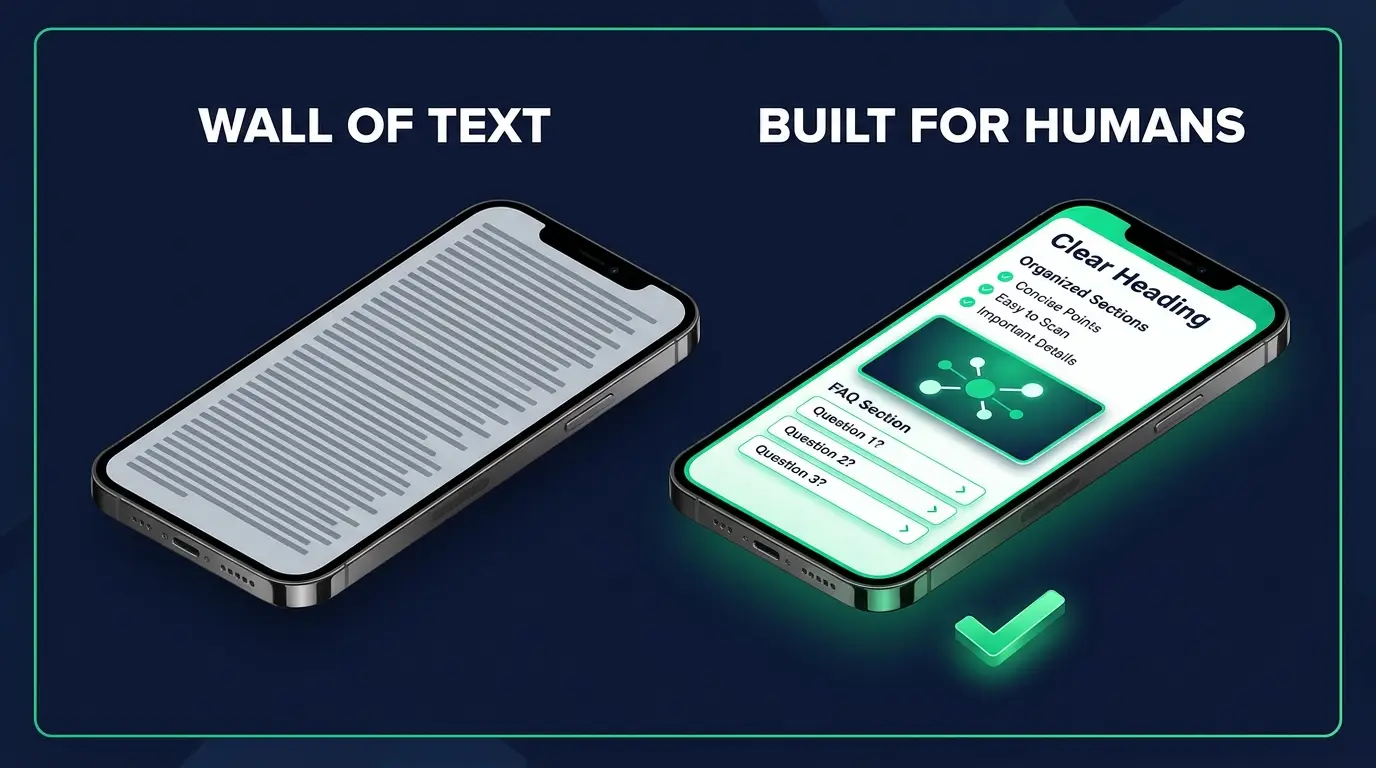
The fix is almost embarrassingly simple. Five things:
- A subheader every 100 to 200 words, so the page scans.
- At least one bulleted or numbered list (like this one).
- An FAQ block answering real questions people search.
- Two or three real images. Photos of the actual business beat everything. If you must use AI images, use good ones, because both Google and your readers can tell.
- Internal links inside the body of the content, not dumped in the footer.
Do those five and your page stops looking like slop. But here's where it gets interesting, because a page can have perfect links and perfect structure and still get cut.
Factor 3: Your content isn't low quality. It's redundant.
This is the part almost nobody is saying out loud.
Most AI content isn't getting cut because it reads badly. The grammar is clean. The right terms show up in the right places. It's getting cut because when Google puts your page next to the ten pages already ranking for that query, yours says the exact same things in different words. Google does not need an eleventh page that covers the same ground as the first ten. So it cuts yours.
This is why the agencies pumping out a hundred AI pages a month are getting wrecked. AI, by default, writes the average of everything it has read on a topic, and the average of everything written about "plumber Houston" is precisely what already ranks for "plumber Houston." Your page is a copy of the consensus. Google already has the consensus. You're adding nothing.
The fix is to do the research before you write, not after. Here's what that actually looks like:
- Read the top 10 results for your target query. Actually read them, and note what they all say, because that's your list of what not to repeat.
- Mine "People Also Ask" for the questions those ten pages don't answer.
- Search Reddit for the city plus the service. Real threads, real complaints, real questions from people who live there.
- Do the same in local Facebook groups.
- Read your top three competitors' Google Business Profile reviews. What do customers rave about? What do they complain about? That's language and substance no AI training set has.
- Audit your own listing for missing categories, unlisted services, and unanswered Q&A.
By the time you sit down to write, or hand AI a brief to write from, you have a list of things to say that are not in the first ten results. That's the entire game right now: not the consensus, the gap.

The AI search bonus you get for free
Here's where this connects to the other shift happening in search. ChatGPT pulls its web results largely from Bing's index. Google's AI Overviews pull from Google's index. Same quality bar, both directions.
That means the pages being cut from the index are the same pages AI search skips when it assembles an answer, and the pages that survive the cut are the ones that get cited. People have documented AI answers changing when pages drop out of the index. So this one fix protects you in two places at once: classic rankings and AI answers. If you want to go deep on that second front, I wrote a full answer engine optimization guide.
Your 5-minute diagnostic
Open Google Search Console. Go to the Pages report and click "Why pages aren't indexed." Look for two lines: "Crawled: currently not indexed" and "Discovered: currently not indexed."
If those numbers have been spiking recently, you're in the purge.
And understand what "crawled, currently not indexed" actually means. Google visited your page, read the whole thing, and decided no one needs to see it. That's not a demotion. That's Google calling the page worthless. On a healthy site, that category should be at or near zero.
The honest tradeoffs
I won't pretend this is free. The research-first process takes real time, maybe an hour per page done by hand, and if you're shipping forty pages a month across clients, that math gets painful fast. This is exactly the kind of workflow worth systematizing with automation, and it's the sort of thing we teach in the AI automation path: use AI to run the research and drafting legwork, keep the human judgment on what the page should say.
The other honest note: Google hasn't confirmed a "purge," and some of what people attribute to it may be ordinary index pruning that's been happening for years. It doesn't really matter which it is. The pages are disappearing either way, and the survivors share the same three traits. Build for those traits and the naming debate is irrelevant to you.
FAQ
How do I know if my site got hit by the June update? Open Google Search Console, go to Pages, and check "Crawled, currently not indexed" and "Discovered, currently not indexed." A recent spike in either, especially the first, means your pages are being cut rather than just ranked lower.
Is AI-written content banned by Google now? No. Google's own guidance targets unhelpful content however it's produced. AI content gets cut when it's redundant and unstructured, which is what AI produces by default. AI content built on gap research, with real structure and real links, survives fine.
What does "crawled, currently not indexed" mean? Google fetched and read your page, then chose not to keep it in the index. It's the strongest quality signal Google sends short of a manual action. Fix those pages first: add the missing substance, structure them properly, and point an internal link and one external link at them.
How many links does a page need to survive? Less than you'd think. Internal links from a few pages that already get traffic, plus one external link from one unique domain per page. For local sites, add a handful of high-trust local links to the homepage to lift the whole domain.
Should I delete my deindexed pages? Not immediately. First check whether the page is redundant. If it says nothing the top ten don't already say, rewrite it around the gaps you find in People Also Ask, Reddit, and competitor reviews. Delete only the pages that have no reason to exist even after research.
If half your pages just vanished, treat it as the wake-up call it is: the era of publishing the consensus is over, in Google and in AI answers alike. The skills that survive this update, real research, structured pages, automation that scales judgment instead of replacing it, are exactly the skills we teach. Start with how to automate your SEO workflow, and if you're building this muscle for clients, the one-person agency playbook shows you how to get paid well for it. The purge is only bad news for people selling slop. For people who do the work, it just cleared the field. I've got you.