Answer Engine Optimization: How to Get Found When AI Answers the Question
On this page
Search used to be simple. You typed something into Google, you got ten blue links, and you clicked one. The whole game of SEO was about earning a spot in that list and convincing people to choose your link over the others.
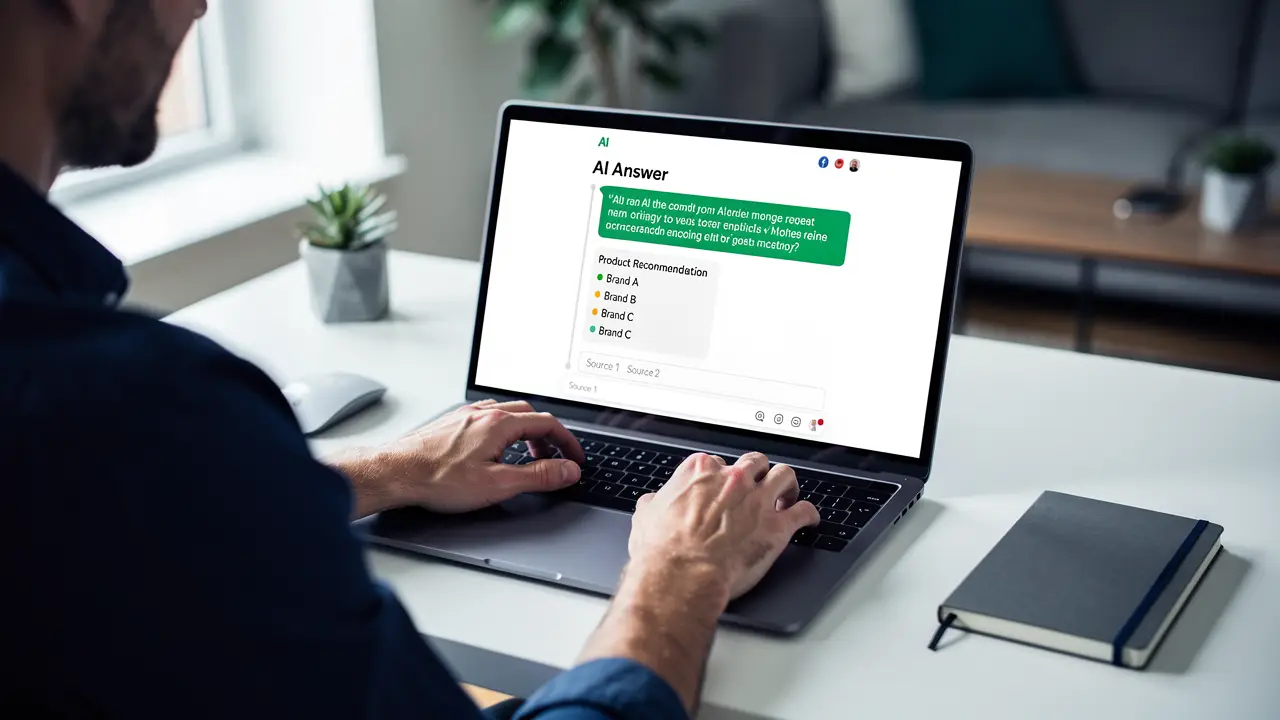
That game is changing fast. Today, you ask a question and an AI hands you a finished answer, often without you ever clicking through to a website. ChatGPT, Google's AI Overviews, Perplexity, Gemini, and Copilot read across dozens of sources, synthesize what they find, and decide on the spot which brands to mention and which to ignore. The user gets their answer. The websites that fed that answer may never get a visit.
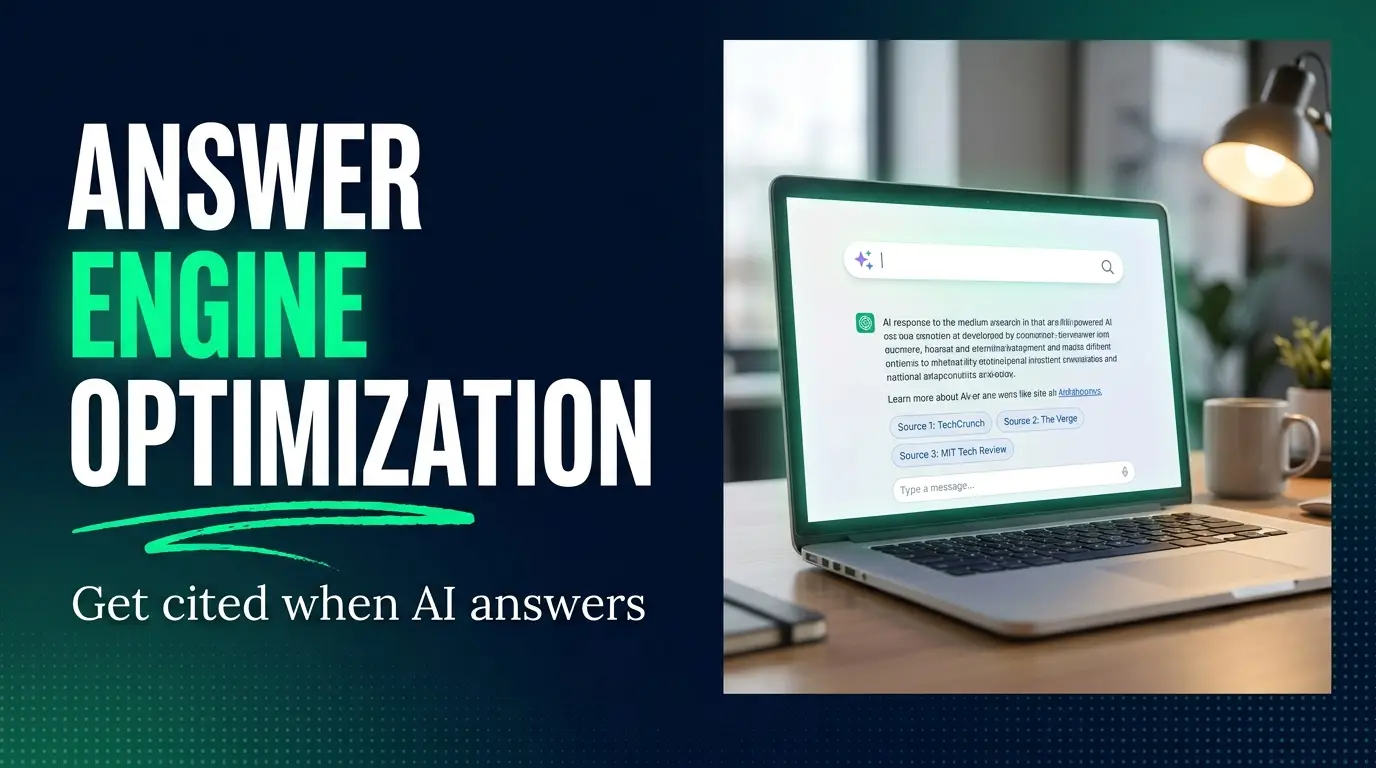
This shift has a name: Answer Engine Optimization, or AEO. You'll also see it called Generative Engine Optimization (GEO) or Large Language Model Optimization (LLMO). The labels differ, the practice is the same. AEO is the work of making your content visible and useful to AI systems that deliver direct answers, so that when an AI builds a response, your brand is in it.
This guide walks through how AI search actually works, why each platform behaves differently, how to find your visibility gaps, and exactly what to do to start showing up. It's long, but it's meant to be a complete playbook you can come back to.
Why this matters right now
It would be easy to dismiss AEO as a trend that's a year or two from mattering. The numbers say otherwise.
As of late 2025, when an AI Overview appears at the top of a Google results page, the click-through rate for the number one organic result drops by roughly 58%. Read that again. For every 100 clicks that top-ranking page used to earn, more than half now stay inside Google's answer box. The link is still there. People just don't need it anymore.
Meanwhile, the audience for AI answers is enormous. ChatGPT alone serves around 900 million weekly users and handles something close to 12% of the search volume that Google sees. AI referral traffic to websites has grown nearly tenfold in the past year. This is not a niche channel anymore.
Here's the part that should change how you think about it, though. Raw traffic from AI is still small, often a fraction of a percent of a site's total visits. But that traffic converts at rates that make traditional channels look sluggish. Companies tracking this carefully have reported AI visitors converting at more than 20 times the rate of organic search visitors. The volume is tiny; the quality is exceptional.
There's a simple reason for that. When an AI recommends you, it has already done the persuading. It told the user why you're a good fit before they ever arrive. The visitor lands pre-qualified, already half-convinced, ready to act rather than browse. That's a fundamentally different kind of traffic than a cold click from a search result.
So you have two options. You can treat this as someone else's problem and watch your organic traffic slowly erode as answer boxes absorb the clicks. Or you can learn how the system works and position yourself inside it while most of your competitors are still ignoring it.
AEO doesn't replace SEO. It sits on top of it.
Before going further, let's kill a fear that stops a lot of people from acting: the idea that AI is going to wipe out SEO entirely.
This worry comes from what's sometimes called zero-sum bias, the assumption that if something new rises, something old must fall by the same amount. We've watched this exact panic play out before. When the App Store exploded around 2010, the consensus was that the web was finished and mobile apps would eat everything. Apps did explode. The promise was real. But the web didn't die. It grew right alongside the apps.
AI search looks like the same story. It's growing quickly, and the growth is real. But Google still processes billions of searches a day, and traditional organic traffic still drives enormous business value. The smart move isn't to abandon one for the other. It's to play both games at once.
And here's the encouraging part: the skills that make you good at SEO are the same skills that make you good at AEO. Quality content, topical authority, technical health, and earned mentions all carry over directly. Think of SEO as the foundation and AEO as the way you future-proof everything built on it. The fundamentals don't change. The strategy on top of them evolves. (If you're looking at this as a career, what an SEO specialist does now that AI answers exist covers the job side.)
Most businesses haven't even started. That gap is the opportunity. Solid SEO work tends to produce AI mentions organically, before anyone optimizes for them deliberately, simply because the content is good and people find it useful. Now imagine doing it on purpose, knowing which platforms cite what and building the exact signals that make AI want to name you.
Part One: How AI Search Actually Works
If you don't understand the machinery underneath, every tactic in this guide will feel like a random checklist. Understand the mechanics first, and the strategy becomes obvious.
Two sources of truth
AI search pulls from two very different places.
The first is training data: the massive snapshot of text the model learned from during training. Books, websites, PDFs, social posts, video transcripts, a frozen slice of the internet. When you ask ChatGPT who runs Apple and it instantly answers Tim Cook without searching anything, that's training data. It already learned the pattern.
The problem with training data is that it's static. It refreshes only every several months. If you launched your product last week, the model has no idea it exists, at least not from training.
That's where the second source comes in: real-time retrieval, usually through a process called RAG (retrieval-augmented generation). When a question needs fresh information or is too specific for the model's baked-in knowledge, the AI goes out to the live web, pulls back a set of relevant pages, reads them, and generates an answer based on what it just found.
This matters because it gives you two distinct ways to influence what AI says about you. You can become so widely and consistently mentioned across the web that you're absorbed into the training data itself. And you can make sure your pages surface when the AI searches the web in real time. That second path is, quite literally, SEO. Ranking well, earning links, and publishing quality content all directly affect whether your pages get picked up during retrieval.
Query fan-out: one question becomes many
This is the single most important concept to understand about modern AI search, and it explains almost everything else.
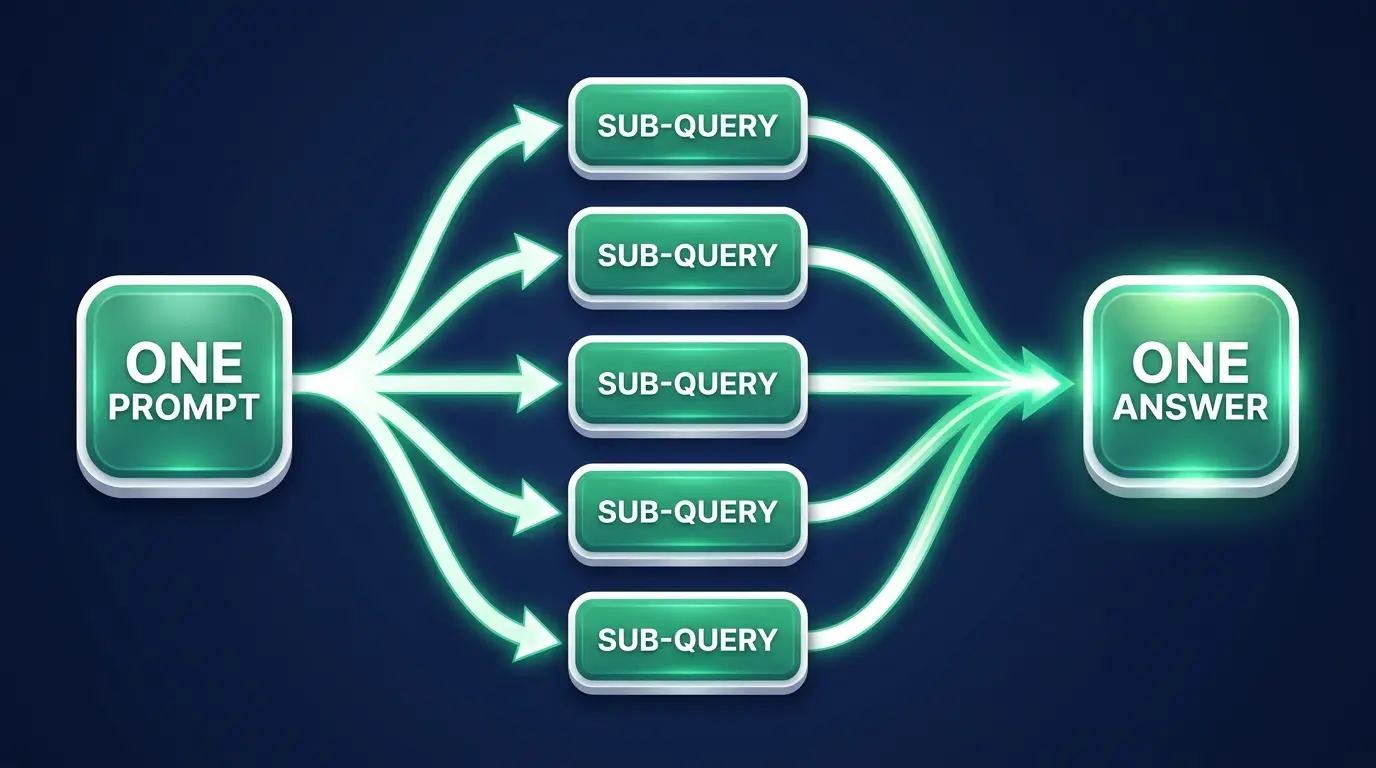
Old search engines were one-to-one: one query, one set of results. They evolved to many-to-one, where "Sydney plumber" and "plumbing service in Sydney" returned roughly the same results. AI flipped the model again, to one-to-many. One prompt gets expanded into many smaller searches running at once. This is query fan-out.
Say someone types, "Plan me a 5-day trip to Japan in November." The AI doesn't search for that phrase. It fans the request out into dozens of long-tail sub-queries running simultaneously behind the scenes: best neighborhoods to stay in Tokyo, November weather in Kyoto, whether the Japan Rail Pass is worth it, and so on. It gathers information from across all of those, then stitches it into one answer.
Research into this behavior has found that an average prompt triggers somewhere between 9 and 11 fan-out queries, with some prompts spawning close to 30. Deep research modes go much further. One documented case saw a single query about buying a red phone case trigger over 400 separate searches.
The strategic implication is huge. In old SEO, you could optimize one page for one keyword and call it done. In AI search, you need to be relevant across an entire topic, arguably across an entire niche. If your "how to start a podcast" page covers only the basics and never touches equipment, hosting, or promotion, the AI will simply find someone else's page that does. The breadth of your coverage is now part of how visible you are.
You can actually observe these fan-out queries in tools built for this, such as the AI responses report in a brand visibility platform like Ahrefs Brand Radar. But treat them carefully. These sub-queries are synthetic, generated by the AI in the moment. They're inconsistent, so the same prompt can fan out differently each time, and the vast majority have zero search volume because no human would ever type them. Don't think of them as a new keyword list. Think of them as a window into what topics the AI considers important for a given question.
Citations are probabilistic, not ranked
In traditional search, rankings are fairly stable. If you're third for a keyword today, you'll likely be near third tomorrow.
AI citations don't work that way. They're probabilistic. The training data creates patterns, the retrieved pages add their own signals, and a "temperature" setting introduces deliberate randomness so the model doesn't spit out identical answers every time. Ask the same question five times and you might be cited in three of those responses, with competitors filling the other slots in different combinations.
That's why the right mental model is AI visibility, not AI rankings. It's a probability distribution, not a leaderboard. There's no fixed position to capture.
That said, clear patterns drive the probabilities:
- Consensus matters. When many independent sources say the same thing about your brand, the model is far more likely to repeat it. The more places you're mentioned consistently, the higher your odds of being surfaced.
- Freshness matters. Content cited by AI tends to run noticeably fresher than what ranks in traditional results, often around 25% more recent. The systems actively favor up-to-date information, especially on topics that change.
- Authority still matters. Pages that already rank well have a big head start. A large share of AI Overview citations come from pages already sitting in Google's top 10.
But authority isn't the whole story, and this is where opportunity lives for smaller players. A meaningful slice of pages cited in AI Overviews don't rank in Google's top 100 at all. On platforms like ChatGPT, the overlap with Google's rankings is even lower. So brands that aren't dominant in classic search can still earn real AI visibility.
Part Two: The Platforms Don't Behave the Same Way
Here's a mistake that quietly costs people visibility: treating "AI search" as one thing and optimizing for it uniformly. The platforms differ more than most people assume.
Consider the overlap. Looking at the top 50 most-cited domains across Google AI Overviews, ChatGPT, and Perplexity, only a handful appear on all three. The overlap sits around 14%. If you optimize only for one platform, you can be effectively invisible on the others.
Each platform also has its own taste:
Google AI Overviews lean toward authoritative, established sites: health, finance, encyclopedic content, and Google's own properties. YouTube alone accounts for a meaningful share of AI Overview citations, and that share has been climbing fast. Reddit shows up heavily here too.
ChatGPT leans toward publishers and media. Reddit, Wikipedia, Amazon, and major editorial outlets are among its most-cited sources. The typical domain rating of its top-cited pages is extremely high, partly because of content licensing deals with some publishers. The overlap between ChatGPT's citations and Google's top 10 is small, often in the single digits to low teens as a percentage.
Perplexity is the most aligned with traditional Google rankings. A much larger share of its citations come from pages already ranking in Google's top 10. If you're already winning in classic search, Perplexity is where you'll likely see the fastest AI visibility.
Google's AI Mode is its own animal, and this surprises people: even though AI Mode and AI Overviews are both Google products with highly similar answers, they pull from strikingly different sources. The citation overlap between them is small. AI Mode's top source is YouTube by a wide margin, and it leans much harder on Quora and social platforms like Facebook and Instagram than AI Overviews do.
So which should you prioritize? Two considerations.
First, market share. Google's AI features and ChatGPT command the vast majority of AI search traffic right now. Perplexity is growing but still smaller in volume. If you have to choose, that's where the eyeballs are.
Second, overlap with what you already do well. If you rank well in Google, you've got a natural head start with Overviews and Perplexity, so lean into it. ChatGPT cares more about publisher authority and editorial mentions, so a mention on a respected outlet or an active Reddit thread may matter more there than your own page's ranking.
One important nuance: the link between Google rankings and AI citations is weakening over time. The share of AI Overview citations coming from Google's top 10 has dropped considerably as Overviews pull more from YouTube, Reddit, and pages outside the top results. AI visibility is increasingly its own game, and many heavily-cited domains in AI search get little traditional search traffic at all.
You don't need a fully separate strategy per platform. The fundamentals (quality content, earned mentions, topical authority) help everywhere. But knowing where each platform pulls from tells you where to focus first.
Part Three: What "Winning" Actually Looks Like
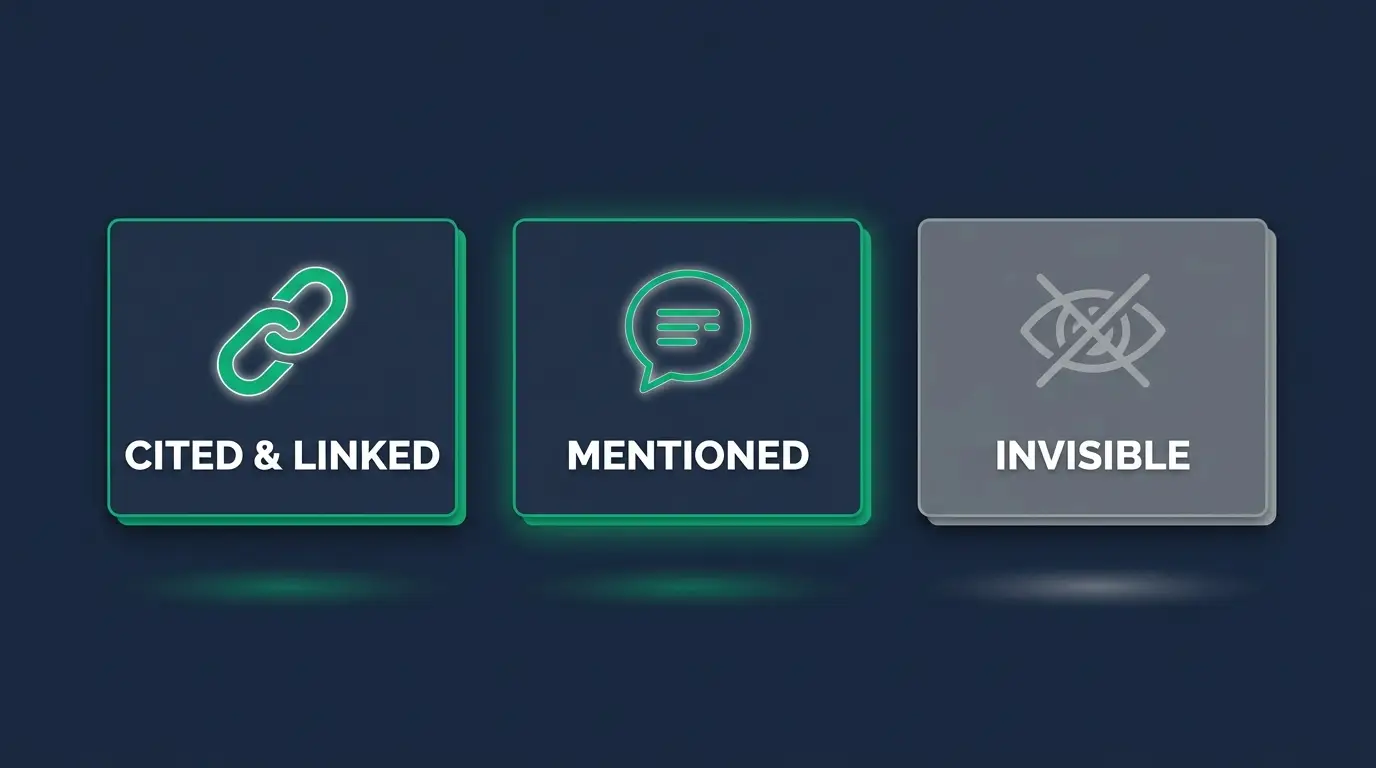
Most people hear "AI visibility" and picture one thing: a clickable link in an AI answer. That's only one of three outcomes, and it may not even be the most valuable for your business.
Cited and linked. The AI includes a clickable link to your page. Best case for direct traffic and the easiest to measure.
Mentioned but not linked. The AI names your brand but gives no link. You may get no direct traffic, but the user now knows your name, and if they're interested, they'll search for you. This is word-of-mouth at scale.
Not visible at all. You're simply not in the conversation. Worth knowing, because you can't fix what you don't know is broken.
Here's the counterintuitive bit: most people assume a mention comes with a link. It usually doesn't. On average, only around 28% of AI mentions include a link, meaning roughly seven out of ten times your brand comes up, there's no link attached. It varies sharply by platform. Perplexity links generously, attaching links to around half its mentions. AI Overviews are stingy, linking only about one time in ten.
So is an unlinked mention worthless? Far from it. Think about how language models learn. Every time your brand appears on a credible page tied to a specific topic, that's another training example connecting your name to that topic. The more the model sees your brand near a subject, the more confidently it names you when someone asks about it. It's the same associative wiring that makes you think "jelly" when you hear "peanut butter." Unlinked mentions are what build those associations.
The data backs this up emphatically. In a study spanning tens of thousands of brands, branded web mentions had the strongest correlation with AI visibility of any factor measured, stronger than backlinks, domain rating, or referring domains. Even when AI gives you no link, being named is building your presence inside the model. It compounds.
There's also a nuance on the linked side. When you weight mentions by how many people are likely asking similar questions, the mentions that do include links tend to cluster on the highest-traffic queries. Links are relatively rare, but they show up disproportionately where the most eyeballs are.
Which type of visibility matters most depends entirely on your business. If you sell a product, you want to surface when people ask about your category, where someone can click through and buy. A query like "best running shoes" surfaces brands a buyer can act on immediately. If you're a publisher or creator, training-data visibility is the long game: every article cited and every video referenced reinforces your authority inside the model over time.
Part Four: Find Your Gaps Before You Optimize
You can't fix what you haven't measured. The starting point for any AEO effort is a brand gap analysis: the difference between where your brand should show up and where it actually does, across Google, AI answers, and the wider web.
Map your entities
Before measuring anything, get clear on what you're measuring. Your brand gets referred to in many ways, so map them all: your main brand name, sub-brands, product names, proprietary features, proprietary metrics, and the personal brands of key people at your company. Each of these has its own visibility profile.
Then connect each entity to the topics and attributes people should associate with it. Models don't understand brand names in isolation; they infer meaning from how a brand is described. Clarify what problems you solve, what qualities you're known for, and what context you belong in. A quick way to surface this is keyword research: look for the recurring adjectives and modifiers people use alongside your brand or category. Affordable, AI-powered, enterprise-grade, whatever fits. That becomes your benchmark for what you should be known for.
Run the audit
Drop your domain into a research tool and pull your baseline: domain rating, referring domains, organic keywords, organic traffic, and traffic value, your traditional SEO snapshot. Then move to the AI metrics, which is where AEO lives. In a brand visibility report, four numbers matter most:
- Mentions: how often your brand is named in AI responses.
- Citations: how often your site is actually linked as a source.
- Impressions: estimated exposure based on how often responses naming you are shown.
- AI share of voice: how often you're mentioned compared with competitors.
The real power is in the filters. You can isolate prompts that mention your brand, responses that mention you but don't cite your site (missed citation opportunities), and queries where a competitor appears but you don't.
Categorize your gaps
It helps to sort what you find into six buckets:
- Visibility gap: You appear less often than competitors.
- Narrative gap: AI describes you differently than you'd position yourself (calling a premium tool a "budget option," say).
- Topic gap: subjects you should own but aren't associated with.
- Format gap: content types AI favors (guides, videos, comparisons) that you don't produce.
- Web mentions gap: third-party sources that mention competitors but not you.
- Demand gap: searches in your space where your name never comes up.
Together these give a complete picture: not just how often you show up, but whether you show up for the right things, in the right way, in the right places.
Prioritize
You'll find more gaps than you can fix. Every fix falls into one of three actions: fix (improve something that exists), build (create something new for an uncovered opportunity), or influence (strengthen offsite visibility through outreach and mentions). Weigh each opportunity by how much demand it could drive, whether it supports your credibility, and whether it improves your odds of being cited.
Start with quick wins. A page that already ranks but needs a content update to close a topic gap is low effort and high impact. Missing from a listicle all your competitors appear on? That's a web mentions gap you can close with outreach. Run the same audit on competitors, too, to surface topics and connections worth pursuing.
Part Five: Keyword and Prompt Research for AEO
The good news is that a lot of your existing keyword research carries over. Half the battle is knowing which keywords belong to traditional SEO and which belong to AEO, and treating them differently.
Build your list the usual way: seed keywords (broad terms in your niche) plus modifiers (add-ons like "best" or "how to"). Paste seeds into a keyword tool, use the matching-terms report, and layer in modifiers to surface hundreds or thousands of real queries.
Then vet them. Run every candidate through three tests:
- Business potential: if you ranked number one, would it actually help your business? "What is espresso" has volume but no buyer intent. "Best espresso machine under $500" has intent and budget.
- Intent: Google the term and look at what ranks. If every result is an e-commerce page and you've got a blog post, you won't break in. Match the intent or move on.
- Difficulty: check the referring domains and domain ratings of the top pages. A few low-authority sites in the top 10 is a good sign.
Now add a fourth, AEO-specific filter: can AI fully satisfy this query on its own? If the AI Overview answers it so completely that no one needs to click, ranking traditionally is a trap. AI Overviews appear on roughly a fifth of all keywords, but for informational and question-style queries that figure climbs much higher, and nearly all keywords that trigger Overviews are informational.
This points you toward two distinct plays.
For queries AI can't satisfy, the organic click is still up for grabs. Free tools are the clearest example. Search "backlink checker" or "mortgage calculator" and you won't find an AI Overview, because the user needs to actually use something. Add modifiers like calculator, checker, generator, tool, template, finder, and maker to surface these, or filter directly for transactional intent.
For queries AI does satisfy, don't ignore them, target them differently. Your goal shifts from earning a click to earning a mention inside the AI response. To do that, it helps to know what AI cites. Across studied citations, listicles make up a striking share, around 44% of cited pages. They show up so often because they help the AI build consensus: if your brand appears across many lists, that's many sources recommending you. Filter brand-visibility reports for queries containing "best," "top," "versus," "review," or "alternative" where competitors appear but you don't. That's your short list. Just remember that citations refresh constantly, often every couple of days, so revisit regularly.
Finally, prompt research. People don't type keywords into ChatGPT; they have conversations. "I'm a small agency owner looking for a marketing platform, which should I choose?" The same question asked ten ways yields ten answers naming ten different brands, and each prompt fans out into sub-queries that mostly never repeat. So you can't chase individual prompts the way you chase keywords. The goal is to build visibility across an entire topic, which is exactly what execution is about.
Part Six: Create Content That Gets Cited
The data on what AI actually cites is clarifying, and some of it contradicts old SEO habits.
Length doesn't matter. Across a large sample of cited pages, the correlation between word count and being cited is essentially zero. More than half of cited pages run under 1,000 words. If you've been padding articles to 3,000 words because you think longer ranks better, that logic doesn't apply here. AI doesn't care how long your page is; it cares whether your page answers the question.
Freshness matters a lot. Cited content runs meaningfully fresher than what ranks in traditional results. On ChatGPT specifically, the overwhelming majority of top-cited pages were updated recently, many within the last month. If your content hasn't been touched in half a year, you're at a disadvantage. But don't just swap the publish date, models can detect superficial changes. Make real updates.
Format matters. Listicles, comparisons, and reviews get cited heavily because they hand AI clear, structured recommendations. Data-driven content with original stats performs well because AI loves citing specific numbers. Comparison pages (X versus Y) map directly onto how people ask AI questions.
Structure for both humans and machines
You don't need a secret AI format. AI is trained on what humans find valuable, so content that genuinely serves readers is content AI wants to cite. A few principles sharpen that for both audiences:
BLUF: Bottom Line Up Front. Start every section with the answer, not the windup. Instead of "Over the past few years, link-building strategies have evolved significantly…," write "The most effective way to build backlinks today is original research." Humans scan in an F-pattern, reading the top closely and skimming the middle. Models weight the beginning and end of a passage more heavily too. Bury your key point three paragraphs in and both will miss it.
Atomic content. Every section should stand on its own. AI chunks your content into pieces when it processes it, and you can't control where the cuts fall. Take any H2, read it completely out of context, and if it only makes sense with the rest of the page, rewrite it until it doesn't. If every section is self-contained, the meaning survives no matter how it's chunked.
Entity-rich writing. Models understand text through entities (brands, products, people, places, concepts) and the relationships between them. "This tool helps with SEO" gives AI almost nothing. "A keyword research tool helps you find low-difficulty, high-traffic keywords" gives it specifics to work with. The more concrete you are, the more useful you are when AI needs a precise answer.
Simple, declarative sentences. One idea per sentence, clear subject-verb-object structure. This isn't dumbing down; it's making your meaning easy to parse. If a sentence takes two reads to understand, simplify it.
Two extra moves can push your odds further. First, label your original ideas with your brand. Models tend to flatten originality, absorbing a novel framework into general knowledge without crediting whoever coined it. If you create a concept, name it after your brand, define it explicitly, and distribute it widely across your blog, social channels, and elsewhere. The more places it appears with your name attached, the harder it is to flatten.
Second, refresh your sleeper pages. These are pages that once ranked well and have quietly declined. They already have backlinks and authority; they just need a refresh, and because freshness is such a strong AI signal, updating them is one of the fastest paths to visibility. Find them by sorting your top pages by traffic decline, then confirm the page has real backlinks (so it's a content problem, not a links problem) before updating.
Part Seven: Earn Mentions, Optimize YouTube, Fix the Technical Basics
Mentions are the strongest lever
A lot of SEO isn't about your own site at all; it's about getting named on other people's pages, the ones AI already pulls from. Since branded web mentions correlate more strongly with AI visibility than any traditional metric, this is where much of the real work lives. Think in three tiers:
Tier one: third-party editorial. Industry publications, review sites, authoritative listicles and comparison posts, and creator reviews. Hardest to earn, most valuable, and exactly the pages AI loves to cite. Use a cited-domains report to find which sites AI pulls from in your niche, then go after them. You don't have to wait until a page is already cited, either; find pages with strong link profiles covering your topic and get included before they get cited. A content search for "best" or "versus" titles in your space, minus your brand name, surfaces lists you're missing from.
Tier two: user-generated and community content. Reddit, Quora, niche forums. Reddit in particular is both heavily cited and a foundational training source. The play is not to spam your brand name, which backfires fast, but to find threads asking questions your expertise genuinely answers and contribute real value. To find relevant Reddit pages already ranking in Google, pull Reddit's organic keywords filtered for top-five rankings plus your niche terms.
Tier three: your own properties. Your YouTube channel, podcast, and professional social content are all indexed and can all serve as sources AI pulls from. The more places your brand appears in a positive, topically relevant way, the more training examples the model has.
And keep track of all of it. Mentions disappear when pages get updated and lists get refreshed, and sometimes AI picks up wrong information from outdated sources. Audit your mentions periodically, watch for drops, check sentiment, and if you spot misinformation, fix your own content first and then request a correction from the source.
YouTube deserves its own attention
YouTube is the most-cited domain in Google's AI Overviews, and YouTube mentions show one of the strongest correlations with ChatGPT visibility of any factor measured. There's a clear reason: leading models were trained on enormous volumes of YouTube transcripts. YouTube isn't just a platform AI cites; it's one AI learned from.
Target search hits over viral hits. A viral video spikes and dies once the algorithm exhausts interested viewers. A search hit earns steady traffic month after month because people actively look for the topic, and those are exactly the videos AI pulls from. Find them by pulling the keywords YouTube videos rank for in Google, filtered to the top three results plus your niche terms.
Then optimize each video to rank: put the keyword in the title (save the cleverness for the thumbnail), write a real summary in the description with the keyword up top, add timestamps so chapters can surface in search, actually say the keyword in the video since Google understands audio, and match the format that's already winning for that query. Finally, layer in AEO by checking which queries pull YouTube videos into AI answers and building content around those topics.
The technical floor
None of this works if AI literally can't access your site, and a surprising number of sites block it by accident. Around 6% of websites block OpenAI's crawler, often unintentionally.
Six checks:
- robots.txt. Look for disallow rules targeting GPTBot, OAI-SearchBot, ClaudeBot, or Google-Extended. Many sites inherit blocks from templates or platform defaults, so check even if you never set one. Visit yourdomain.com/robots.txt and scan for those names.
- JavaScript rendering. Some AI crawlers can't render JavaScript. If your content only loads via JS, those crawlers see an empty shell. Server-side rendering fixes it. Test by disabling JavaScript in your browser and visiting your own site; if the content vanishes, you have a problem.
- Page speed. When AI retrieves pages in real time, slow pages can get dropped before they're even scored. If you've already optimized core web vitals for SEO, you're most of the way there.
- Clean HTML structure. Logical heading hierarchy (one H1, H2s for sections, H3s for subsections) helps AI parse and chunk your content correctly. This ties directly back to BLUF, atomic content, and entity-rich writing.
- Schema markup. The evidence that structured data directly improves AI citation is mixed, but it doesn't hurt and helps any system understand your content. Don't obsess over it; do add sensible types to new pages.
- Hallucinated URLs. AI assistants sometimes invent URLs that 404. Check your analytics for AI-referred traffic hitting 404s, and redirect any consistent offenders to the most relevant real page so you capture traffic that would otherwise be lost.
Part Eight: Measure What's Working
Measuring AI visibility is genuinely harder than measuring SEO, because a lot of the data is hidden or doesn't exist. But you're not flying blind. Track three things together.
AI referral traffic. When someone clicks through from an AI platform, it can show up as a referral. The catch is that not every platform passes referral data cleanly; some strip it, so the visit lands in analytics as direct traffic and becomes effectively invisible. Set up a custom channel group that isolates known AI sources by their domains, then watch which platforms send traffic, which pages they favor, and how those visitors behave. Treat the numbers as a directional undercount, not gospel.
AI bot activity. Instead of tracking humans, track the crawlers. AI bots hit your pages far more often than people do, and the pages they crawl most heavily are your strongest citation candidates. There are training bots (like GPTBot and Google-Extended) and search/citation bots (which fetch pages in real time and can drive referral traffic). Server logs or a bot-analytics tool with a Cloudflare integration will show which bots visit, how often, and which pages they focus on. A citation bot repeatedly hitting one page is a strong sign that page is being used as a source.
Self-reported attribution. This is the simplest and maybe most important, because much of AI's impact never shows in analytics at all. Someone asks ChatGPT, gets your name, then types your URL directly or Googles your brand, registering as direct or organic traffic. The only way to catch it is to ask. Add a "How did you hear about us?" question to your signup, checkout, or post-purchase flow with options for specific AI assistants and AI search. Companies doing this have found a few percent of conversions attributable to AI that they'd otherwise have missed entirely, converting at far higher rates than organic.
No single source tells the whole story. Referral traffic shows what AI sends you, bot analytics shows what AI pays attention to, and self-attribution shows what actually drives revenue. Together they give a clear enough picture to act on.
Is AEO Worth It?
Look only at raw traffic and you might say no. AI referral traffic still averages a small fraction of a percent of total visits, and Google sends vastly more traffic than all the AI platforms combined.
But the story flips on quality and trajectory. AI visitors convert at dramatically higher rates because they arrive pre-qualified, already told why you're a fit. Multiple companies have reported AI becoming a top acquisition channel or driving meaningful revenue from tiny traffic volumes. And the channel is growing fast, roughly tenfold in a year, with ChatGPT now sending more traffic than several major social platforms.
The deeper value isn't even the clicks. It's the brand awareness happening inside the AI conversation. Every recommendation is an impression you never had before, and most of those impressions turn into a search for your name later, or recognition when someone sees you in a feed. AEO isn't an alternative to SEO; it's a new layer on top of it, and the brands building that layer now, while it's early, gain an advantage that compounds as AI search grows.
There's a real risk to manage, too: AI is vulnerable to misinformation. Tests where fake sources were planted about an invented brand showed some platforms repeating the false details as fact a meaningful share of the time. The defense is to fill every information gap about your brand with specific, official content, FAQs that answer common questions, concrete numbers and dates, not vague claims, because when AI has to choose between vague truth and specific fiction, it often picks the specific fiction. Monitor what AI says about you, and when you spot errors, publish content that contradicts them and pursue corrections at the source.
One more reason not to wait: the same quality bar now decides whether your pages stay in the index at all. Google has been quietly cutting redundant, unstructured pages, and the pages that survive that cut are the ones AI search cites. I broke down what the June update is doing to sites and the three-part fix separately.
Your First Week
If you want a concrete starting point, here's what to do this week:
- Check robots.txt for AI bot access. Five minutes, and it's the most common technical blocker.
- Set up AI analytics. Create an AI traffic channel and add a "How did you hear about us?" question to your signup or checkout. Start measuring from day one.
- Refresh your most important pages. Pick your top five to ten and make meaningful updates: new stats, current examples, fresh information.
- Run your brand gap analysis. Establish a baseline before you optimize so you know where you stand.
- Identify your top ten mention targets, the pages where a mention would move your AI visibility most.
Then make it a rhythm: a monthly visibility check and a quarterly competitive audit. Rinse and repeat.
AI search is still early. The tools are evolving, the data keeps improving, and the opportunity is only growing. The single biggest advantage available right now is simply starting before everyone else does.
AEO is new, but the muscle underneath it (understanding how search works, then building content and authority on purpose) is the same one we drill at CodingPhase. If you want to turn this into a skill people pay for, start with how to automate your SEO workflow and the AI automation career path built around exactly this kind of work. The brands winning AI search are the ones who started early. Same goes for the people learning to do it.