PHP vs Python: Which One Should You Actually Learn?
On this page
"PHP or Python, which one should I actually learn first?" I get this question almost every week, usually from someone who's been stuck on it for a month and just wants a straight answer instead of another Reddit thread full of people insulting each other.
So here's me being straight with you: there is no wrong answer here, and anyone who tells you one of these languages is "dead" is selling you their own bias. PHP and Python both have real jobs. Both pay rent. Both have people making six figures with them right now. They're just not the same bet, and that's the part nobody slows down to explain.
PHP is the one that gets you building for the web and earning soon. Python is the one that opens data, AI, and automation, with the widest set of doors long term. Neither of those is "better." They point at different lives.
So my honest answer to "which should I learn first?" depends entirely on what you're trying to do with yours, not on which language has better vibes online.
Let me break it down the way I'd break it down for my own little brother.
The one-line answer
Learn PHP if you want to build and freelance for the web fast and start earning soon.
Learn Python if you want data, AI, automation, or the widest set of doors open long term.
That's it. That's the whole post in two sentences. Everything below is me showing my work so you can trust the answer.
What each one is actually best at
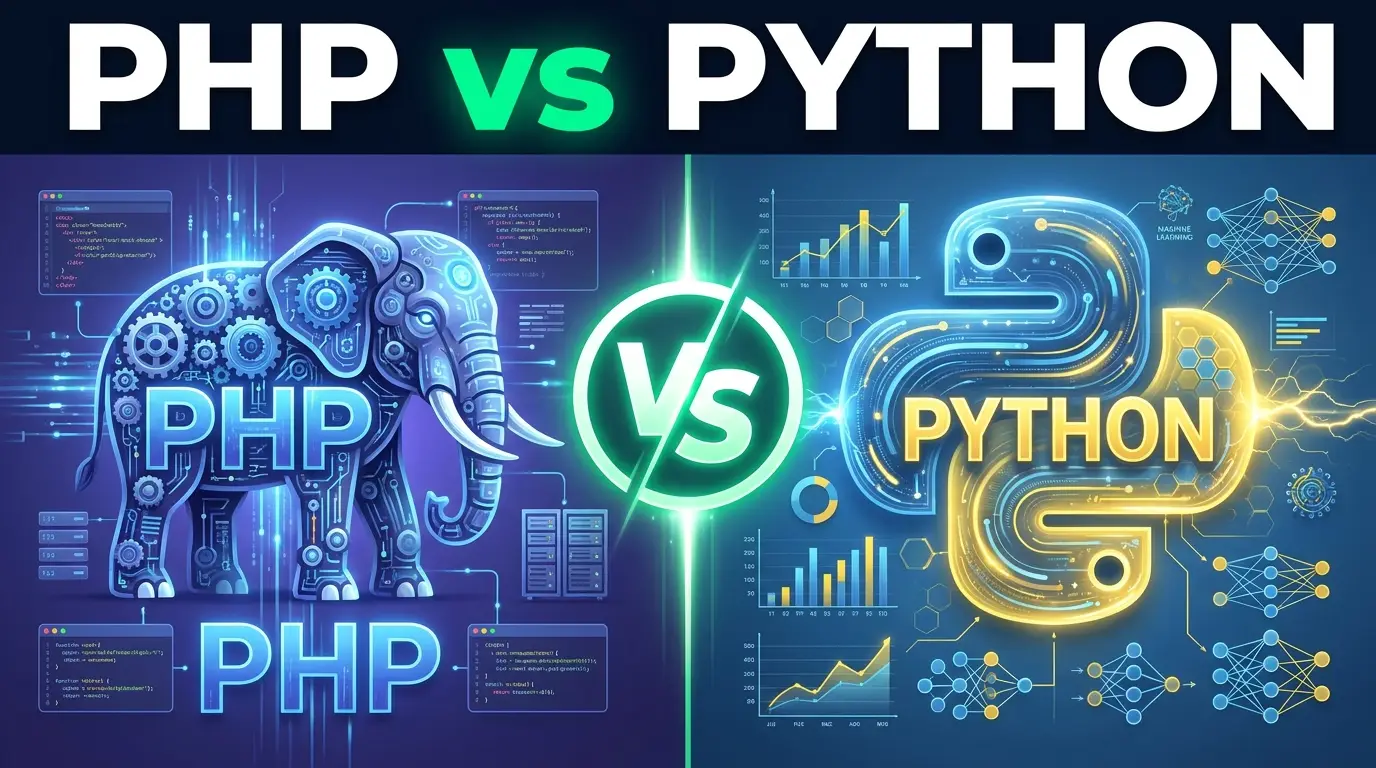
PHP runs the web. Not "is used on the web." Runs it. Somewhere around three out of four websites with a known server language are running PHP. WordPress alone powers a massive chunk of the entire internet, and WordPress is PHP under the hood. Add Laravel, the modern PHP framework that genuinely feels good to write, and you've got a language built for one job and ruthlessly good at it: shipping web apps and sites that make money.
Python is the swiss army knife. It does web too (Django, FastAPI, Flask), but that's not why people love it. Python is the language of data analysis, machine learning, AI, scripting, automation, scientific computing, and the little tool you write to rename 4,000 files at 2am. When a self-driving car team or an AI lab picks a language, it's almost always Python.
So PHP is a specialist with a huge home turf. Python is a generalist that happens to dominate the hottest field on earth right now.
The honest head-to-head
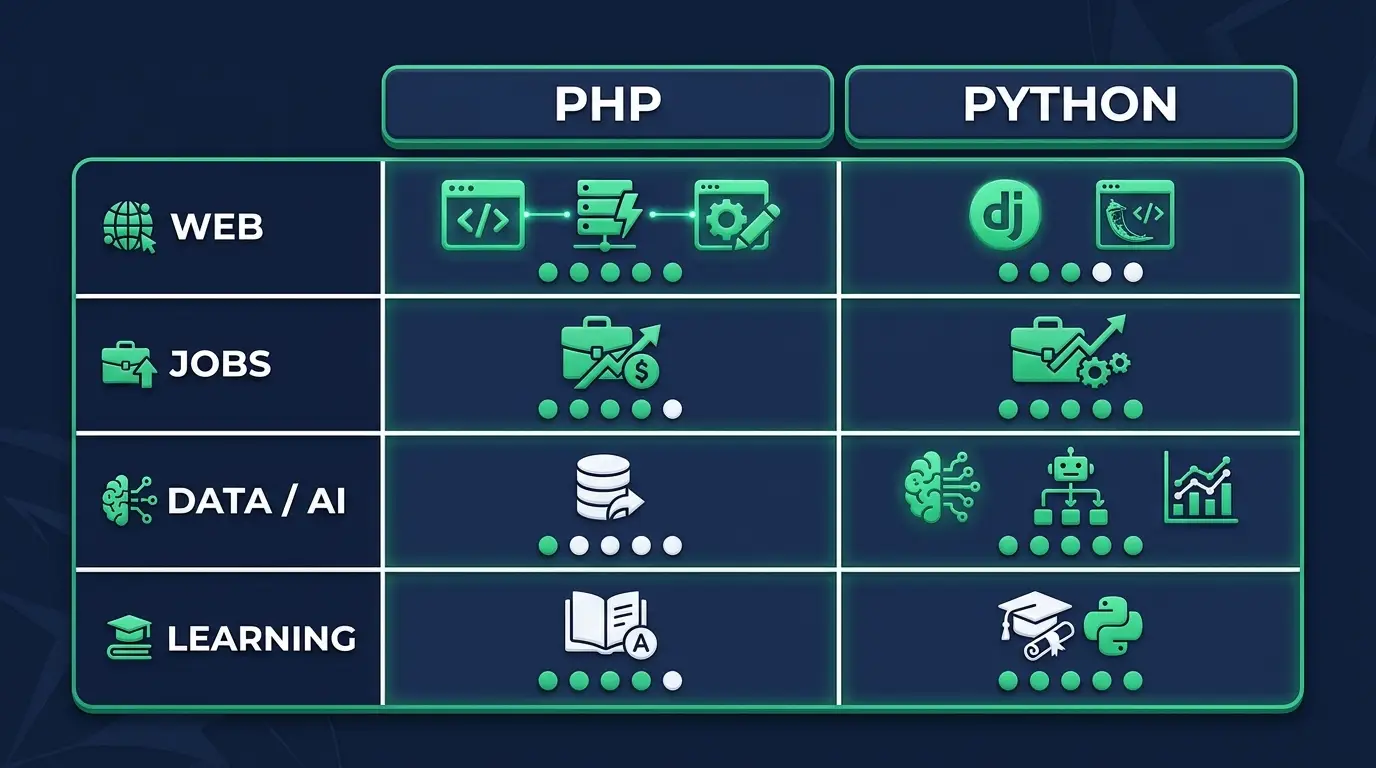
Web dominance: PHP wins, and it's not close. If your goal is websites, PHP's grip on the web is the single biggest reason to learn it. The infrastructure, the hosting, the CMS ecosystem, the sheer volume of existing sites that need someone to maintain them. Python does web fine. PHP is the web.
Job market: basically a tie, different shapes. Both have enormous demand. Python job postings often look more numerous and more prestigious (AI, data, big tech). PHP jobs are quieter but everywhere, because every agency, every small business site, every WordPress install eventually needs a developer. Python jobs can be more competitive at the entry level because every bootcamp grad learned Python. PHP has less hype, which means less competition for the work that's sitting right there.
Freelance and the WordPress economy: PHP, hands down. This is the part people miss. If you want to make money soon, on your own terms, PHP is the faster road. The WordPress economy is gigantic. Small businesses need sites, fixes, custom plugins, theme work, and they'll pay you this month, not after you've built a portfolio of ML projects. I've watched students start charging for WordPress work within a couple of months of starting. That's harder to do with Python freelancing, where the gigs lean toward data and automation and usually want more proof first. If freelance income is the goal, read is PHP a good career and you'll see why I keep pointing beginners there.
Data, AI, and machine learning: Python, no contest. PHP simply doesn't play here. Every major AI library, every data science course, every ML pipeline lives in Python. If the words "machine learning engineer" or "data analyst" make your eyes light up, the choice is already made for you.
Learning curve: Python is gentler, PHP is more forgiving in practice. Python's syntax reads almost like English, and that's a real gift when you're new. Fewer symbols, cleaner indentation, less to trip over. PHP has rougher edges and a reputation for letting you write messy code. But here's the honest flip side: PHP's "just drop it in a file and it runs on a cheap host" simplicity gets beginners to a live, working website incredibly fast. Seeing your thing online is rocket fuel for motivation.
The ceiling: both go high, in different rooms. Senior PHP engineers building serious Laravel applications make excellent money and are deeply respected by people who actually ship. Senior Python engineers in AI and data can hit some of the highest salaries in the industry. Neither language caps your income. Your skill and your specialty cap your income.
Where they actually overlap
Here's the comforting part. The first 80% of learning either language is the same 80%.
Variables, loops, functions, conditionals, working with arrays and objects, talking to a database, thinking in logic. That foundation transfers. If you learn PHP first and want Python later, you are not starting from zero. You're learning new syntax for ideas you already own.
So the choice matters less than the internet makes it feel. The fundamentals are portable. Your first language is just the doorway, not the whole house.
That's the reframe I want you to keep: your first language is a door, not a marriage.
The verdict
Let me be decisive, because "it depends" is a cop-out and you came here for an answer.
Pick PHP if you want to build for the web, you want to start freelancing and earning as fast as possible, and the WordPress and Laravel economy sounds like a place you'd happily work. If your real goal is "I want to make money with code this year," PHP is your shortest line to that. Start with how to become a PHP developer and look at the PHP developer career path to see where it leads.
Pick Python if you're drawn to data, AI, machine learning, or automation, or if you genuinely don't know what you want yet and you want the option that keeps the most doors open. Python is the safer bet for "I want maximum flexibility for the next ten years."
And if you're truly torn? Lean toward whichever goal feels more you when you picture your workday. Building websites for clients, or wrangling data and training models. That gut answer is more reliable than any ranking.
FAQ
Is PHP dead in 2026? No, and it's not close to dead. PHP runs most of the web and gets active development. It carries a dated reputation from its early years, but modern PHP with Laravel is clean and genuinely pleasant. "Dead" languages don't power most of the internet.
Which pays more, PHP or Python? At the top, Python roles in AI and data tend to reach the highest salaries. But strong PHP and Laravel developers make excellent money, and PHP often gets you to your first paycheck faster, especially through freelance and WordPress work. Top pay comes from your specialty and skill, not the language label.
Should a complete beginner learn PHP or Python first? If you want to build websites and earn soon, PHP. If you want the gentlest syntax and the widest long-term options, Python. Both are fine first languages, and the fundamentals carry over either way.
Can I learn both? Yes, and many developers do. Learn one well enough to build real things and get paid first. Adding the second is far easier once the fundamentals are in your bones. Don't try to learn both at once as a beginner.
Is Python better than PHP for getting a job? Neither is universally "better." Python has more total postings and more hype, which also means more competition at entry level. PHP has steady, everywhere demand and a freelance market that's friendlier to beginners. The better bet is the one that matches the work you actually want.
Whichever way you lean, the worst move is to keep researching languages instead of writing code. The students who win aren't the ones who picked the "perfect" language. They're the ones who picked one and started building.
If you want a clear, paid-fast path into web work, the PHP route is the one I'd hand a beginner today. We walk through the whole thing at codingphase, from your first line of code to your first client. Pick your door and come build with us.