PHP Developer Salary Guide: What You Can Really Make in the US
On this page
Senior PHP engineers in the US are clearing $130,000 to $150,000, and the strong ones go past that. Say it out loud and watch the room get quiet, because PHP is still the language everyone loves to call dead.
It's not dead. It runs most of the web you touch every day, and the people who keep that machine running get paid well to do it.
But here's the part nobody tells you straight: the salary range for "PHP developer" is enormous. Two people with the same title can be $50k apart. The number on your offer has almost nothing to do with the word PHP and almost everything to do with what kind of PHP you actually write.
PHP carries a reputation, and that reputation quietly shows up in some offers. So let me give you the real picture, with real numbers, and the honest stuff most salary articles skip.
The ranges up front (and why they're ranges)
I'll give you numbers, but read them as bands, not promises. Two PHP developers with the same title can be $40k apart, and it usually comes down to what kind of PHP they actually write.
Here's roughly where US salaries land in 2026:
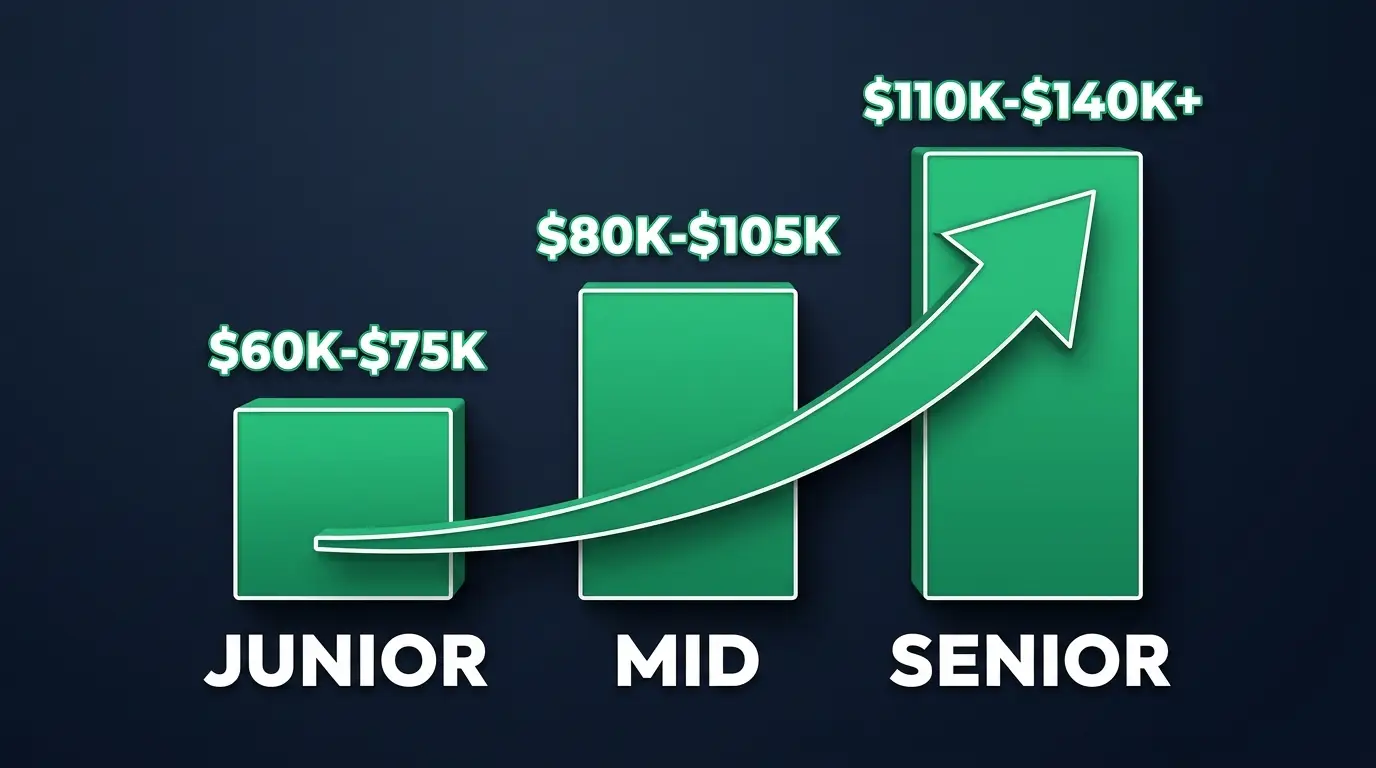
- Entry / junior: ~$60,000 to $75,000
- Mid-level: ~$80,000 to $105,000
- Senior: ~$110,000 to $140,000+
- Freelance / contract: commonly ~$40 to $100/hour
Those bands move with your city, your stack, and whether you build applications or just patch sites. A senior Laravel engineer at a funded SaaS company can clear $150k. A senior "PHP developer" who only maintains old WordPress themes might top out around $90k and feel stuck. Same word on the resume. Very different careers.
What you make at each level
Junior ($60k to $75k). You can read a codebase, fix bugs, and ship small features with guidance. You know the basics of a framework, you understand requests and database queries, and you don't break production too often. This is the level where the WordPress-vs-application split starts. If your junior job is theme tweaks and plugin glue, you're at the bottom of this band. If it's building features in a Laravel app, you're at the top.
Mid ($80k to $105k). You own features end to end. You design a database table without asking. You write tests because you've felt the pain of not having them. You can debug a slow query and actually fix it. This is where most working PHP devs sit, and where the pay gap between "site builder" and "app developer" gets wide.
Senior ($110k to $140k+). You make architecture decisions other people build on. You think about how the system behaves at scale, not just whether the feature works on your laptop. You mentor, you review, you get pulled into the hard problems. The plus sign matters here. Senior engineers at the right companies, with deep Laravel and real systems experience, go well past $140k.
What actually moves the number
This is the part worth tattooing on your monitor.
Laravel depth is the biggest lever. It's not close. Companies hiring PHP for new products are almost always hiring Laravel, and they pay for people who genuinely know it, not people who watched one course and built a to-do app. Queues, events, the service container, Eloquent relationships you didn't fight with, testing with Pest or PHPUnit. That depth is the difference between the bottom and top of every band above.
API and architecture skills. If you can design a clean API, reason about how services talk to each other, and structure an app so it doesn't rot in two years, you've left the commodity tier. This is what separates a $85k mid from a $130k senior more than years of experience does.
Database and performance at scale. Anyone can write a query. Getting paid well means knowing why that query is slow, what an index does, and how the app holds up when traffic is 50x what you tested. Performance work is rare and it pays.
Moving past WordPress-tweaking into real application development. I'll say this plainly because nobody else will: if your entire skill set is editing themes and installing plugins, the market prices you near the floor. The jump from "I make WordPress sites" to "I build applications" is the single most valuable move in this whole guide.

Employee vs freelance
Both can pay well. They pay well differently.
As an employee, you trade upside for stability: salary, benefits, a steady paycheck, someone else carrying the business risk. The bands above are the employee numbers.
As a freelancer or contractor, your rate depends almost entirely on what you build. WordPress freelance work is crowded and gets bid into the ground. You'll see people charging $25/hour, and clients who think a website should cost $300. That's the low end, and it's a grind.
Laravel and custom application work is a different market. A solid Laravel freelancer building real SaaS features bills $60 to $100+/hour, sometimes more for specialized or rescue work. The same person who'd struggle at $40/hour doing WordPress can charge double once they're shipping applications.
The pattern repeats everywhere: the work you choose sets your ceiling more than the title or the contract type does.
Location and remote
Where you live still matters, but less than it used to.
San Francisco, New York, and Seattle pay the highest local salaries and have the highest cost of living to match. Austin, Denver, and Atlanta sit a notch below with much friendlier rent. Smaller cities pay less locally.
Remote is where it gets interesting. A developer in a low-cost city earning a salary benchmarked to a higher-cost market is doing quiet salary arbitrage, and it's one of the best moves available to PHP devs right now. You don't have to move to a tech hub to get paid like you did. If remote is your goal, I wrote a full breakdown of remote PHP developer jobs and where to actually find them.

How to increase your salary
Concrete moves, in the order I'd do them:
- Master Laravel for real. Not tutorial-deep. Build something with queues, jobs, events, and a real test suite. This alone can move you a full band.
- Learn architecture and testing. Tests prove you can be trusted with a codebase. Architecture proves you can be trusted with decisions. Both are senior-level signals you can start sending now.
- Build real apps, not just sites. A small SaaS, an API that does something useful, a tool people actually use. One real application on your GitHub beats ten WordPress sites in an interview.
- Read systems, not just syntax. Learn what happens between the browser and the database. The devs who understand the whole system get the senior offers.
If you want the full path from zero to hired, I laid it out in how to become a PHP developer.
An honest reality check
I'm not going to sell you a fantasy.
WordPress-only work sits at the floor and stays there. It's real work and it pays some bills, but if that's all you do, don't expect the top of these bands.
PHP's reputation can suppress some offers. There are companies and recruiters who hear "PHP" and mentally dock a few thousand. It's not fair, and modern Laravel is genuinely good engineering, but you should know the bias exists so it doesn't surprise you in negotiation.
And AI has changed the work. The boilerplate parts of PHP are getting automated fast. That scares people, but it shouldn't scare you if you understand the system. AI rewards developers who know what the code should do and can judge whether it's right. It punishes the ones who only knew how to copy and paste. Be the first kind.
FAQ
Is PHP still worth learning for the money in 2026? Yes, if you learn Laravel and build applications. A huge share of the web runs on PHP, and the demand for people who can maintain and build on it is steady. The money is real for application developers. It's thin for site-only work.
How much does a junior PHP developer make? Roughly $60,000 to $75,000 in the US, depending on city and stack. Laravel-focused junior roles pay at the top of that; WordPress maintenance roles pay near the bottom.
Does Laravel pay more than plain PHP or WordPress? Clearly. Laravel is where new product development happens, and that's where the budgets are. It's the single biggest factor in PHP pay.
Can I make six figures as a PHP developer? Yes. Senior Laravel engineers regularly land $110k to $140k+, and remote roles benchmarked to high-cost markets push it higher. You get there through depth and architecture, not just time served.
Is freelance PHP worth it? It depends entirely on what you build. WordPress freelancing is a race to the bottom on price. Laravel and custom application freelancing pays $60 to $100+/hour for people who are genuinely good.
If you're staring at an offer wondering whether you're being valued fairly, the answer usually isn't to argue harder. It's to be worth more, on paper and in the interview. That means going deep on Laravel, building real applications, and learning the system underneath the syntax.
That's exactly the path we walk together at codingphase. If you want to see where it leads, take a look at the PHP developer career path, and if you're still deciding whether this is your lane, is PHP a good career is an honest place to start.
You're not behind. You just need the next right move. Let's go get it.