Is Email Development a Good Career?

On this page
"Email is dead. Nobody reads email anymore, so why would anyone get paid to code it?"
I hear some version of that constantly, and it's wrong in a way that quietly makes a few people very employable. Email isn't dead. It's the channel companies trust most with their money, which is exactly why they need someone who can build the things and make them work.
Here's the part that trips people up. The skill looks unglamorous from the outside, so most people who could do it walk right past. That's the whole reason it's worth a serious look.
But "it pays and nobody's doing it" isn't the same as "it's right for you." So the real question isn't whether email development is a real career. It is. The question is whether it's a good one for the kind of person you are.
Let me answer that the way I'd answer you on a call, without the brochure.
The honest verdict, up front
Yes. Email development is a good career, for the right person, and with one catch I'll be straight about.
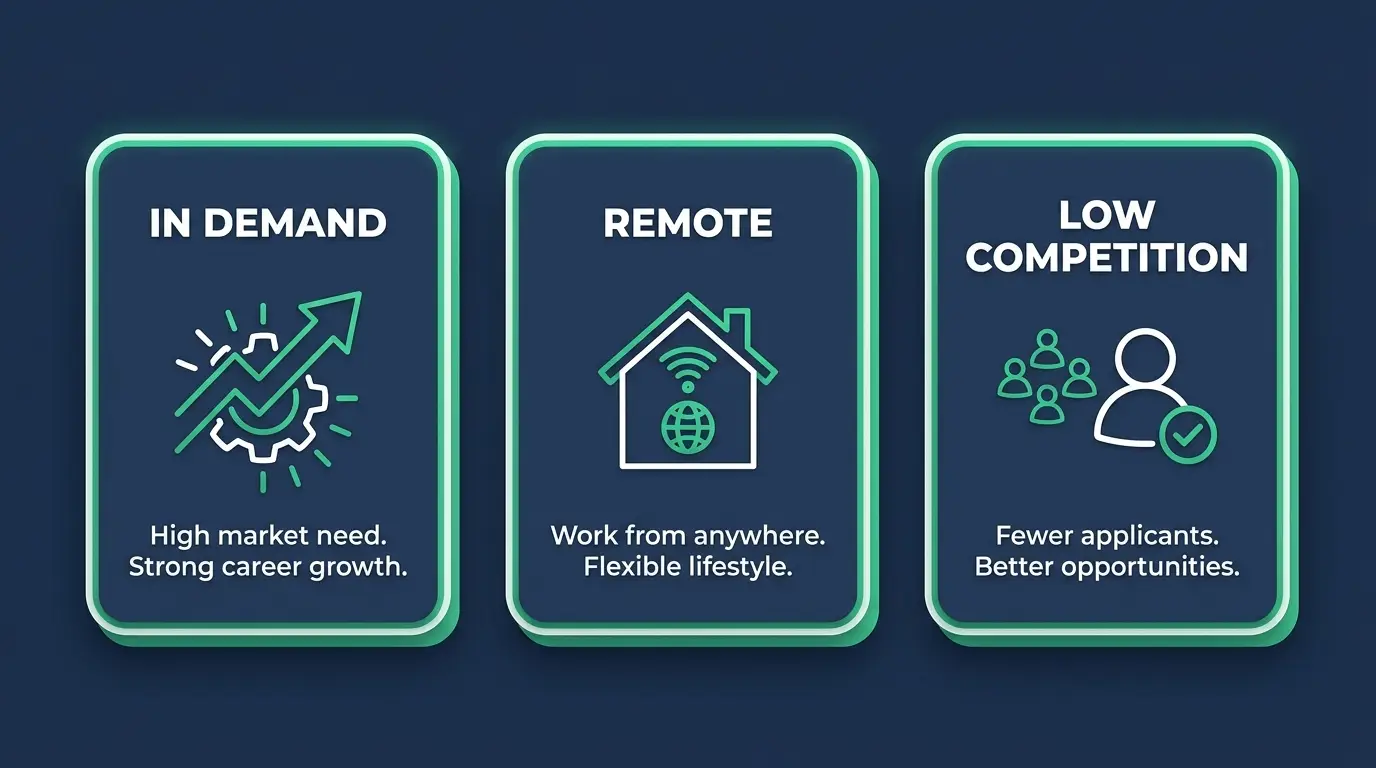
The short version: it pays well for the barrier to entry, the competition is a fraction of what you'll face in front-end or full-stack, it's about as remote-friendly as tech gets, and you don't need a degree to do it. That's a genuinely strong hand.
The catch is that it's a niche, and a niche is a real choice with real edges. If you walk in expecting it to be the same career as "software engineer at a big tech company," you'll be disappointed by the wrong things. If you understand what you're actually signing up for, it's one of the most underrated on-ramps in the whole industry.
So this isn't a yes or a no. It's a "yes, if you're the right person." Let me show you both sides so you can tell.
The genuine case for it
I'm not talking this up because I teach it. I'm talking it up because the math is quietly excellent, and almost nobody looks at it.
The demand is steady and boring: in the best way. Every company that sends email needs someone to build it. E-commerce brands, SaaS companies, agencies, media. Email is still one of the highest-ROI channels in marketing, which means it doesn't get cut when budgets tighten. That's not a hype cycle that spikes and crashes. It's a steady drip of "we need someone who can actually code these" that never really stops.
The competition is thin, and that's the whole game. Right now a junior front-end opening can pull hundreds of applicants in a single weekend. Email developer roles don't do that. The field looks unglamorous from the outside, so most people who can code walk right past it toward the crowded front door. That perception is your moat. You're not the fiftieth qualified applicant. You're often one of three.
It's remote-friendly by nature. The work is digital end to end, code an email, test it, load it into a platform, ship. There's nothing about it that requires a desk in a specific building, and a lot of these roles are hired fully remote or on contract. If location freedom matters to you, this field hands it over without a fight.
The pay is solid for what it asks of you. In the US, entry-level lands around $50k to $70k, mid-level around $70k to $95k, and senior or specialized roles on enterprise platforms cross $100k. (I broke the full picture down in the email developer salary guide.) Stack that against the barrier to entry and it looks even better.
Which brings me to the barrier: there almost isn't one. No degree. No algorithm interviews. No four-year runway. You need HTML, CSS, the email-specific layer on top, and one sending platform. That's a few focused months, not a few years. For a career that pays what this one does, that on-ramp is unusually short.

The honest counter-case
Here's where most posts go quiet. I won't, because the downsides are exactly how you decide if this is for you.
It's a niche, and niches have edges. You're not learning a skill that transfers to a hundred different jobs. You're going deep on something specific. That depth is the source of your value, and also the reason your options are narrower than a generalist's. If you crave maximum optionality, a niche will feel small to you, and that's a real feeling worth respecting.
The tech is old and constrained on purpose. Email HTML is stuck in 2005. Outlook still renders with a Word engine. Half the modern CSS you know simply doesn't work, so you build layouts with nested tables and inline styles like it's a different decade. The scarcity that makes the job pay comes from this friction, but if you got into coding because you love elegant, modern front-end, some days this will genuinely annoy you.
The title carries less shine. "Email developer" doesn't land at a dinner party the way "software engineer" does. Nobody's impressed at the party. If outside prestige is a thing you need from your work, weigh that honestly now instead of resenting it in eighteen months.
The ceiling is a different shape. This is the one people get wrong most. The top of email development doesn't look like the top of a FAANG engineering org. There's no staff-engineer-at-a-trillion-dollar-company ladder here. It's not lower, but it is a different shape: specialized platform expertise, automation, lifecycle systems, freelance leverage. You should want that shape before you commit to it, not discover you wanted the other one after you're three years in.
None of that makes it a bad career. It makes it a specific one. Which is the only honest thing a career ever is.
Who it's a great fit for: and who should skip it
Let me be specific, because "it depends" helps nobody.
You'll probably love it if:
- You want into tech fast, without a degree or a year of LeetCode, and you'll trade a little prestige for a short runway.
- You like solving constrained, puzzle-shaped problems. Making one layout render clean across forty inboxes that all disagree is genuinely satisfying if that's your kind of fun.
- You want remote work and steady demand more than you want a famous job title.
- You're a marketer who's tired of waiting two weeks on engineering and wants to become the technical one. (If that's you, the email developer vs. email marketer breakdown is worth a read.)
- You're an engineer staring at a saturated market and you'd rather be rare than be the hundredth applicant.
You should probably skip it if:
- Modern front-end is the only part of coding you enjoy. Table-based email will wear on you, and resentment is a bad foundation for a career.
- Title prestige is non-negotiable for you. That's allowed. Just be honest about it.
- You want the widest possible range of future roles. A niche trades breadth for depth by definition, and that's not the trade you want.
The fit matters more than the field. A good career for the wrong person is still a bad time.
Does it have a future? The AI question, answered straight
This is the fear underneath every "is it a dead-end" question right now, so let me take it head-on.
AI is not coming to erase email development. It's coming to change the boring parts of it, and that's a different thing entirely.
Yes, AI can spit out boilerplate email markup faster than you can type it. But someone still has to know why the layout breaks in Outlook, how dark mode mangles the colors, whether the thing will actually land in the inbox instead of spam, and how the sending platform truly behaves under the hood. AI doesn't know your client's deliverability history or why this particular table is fighting you. A human who does, and who uses AI to move faster, is more valuable, not less.
Here's the reframe I keep handing students, and it's the line I want you to walk away with: AI replaces the typing, not the judgment: and email development has always been paid for the judgment.
The developers who get hurt are the ones who only ever did "turn this mockup into HTML" and nothing else. The ones who understand rendering, deliverability, automation, and the platform are getting a productivity multiplier, not a pink slip. Point your learning at the judgment, not the typing, and the future is on your side.
The final verdict
Is email development a good career? Yes, a genuinely good one, for someone who wants a fast, no-degree path into a remote-friendly, decently-paid technical role and is happy being a rare specialist instead of a famous generalist.
It's not for everyone, and the people telling you it is are selling something. The old tech, the niche shape, the quieter title. Those are real, and if they're dealbreakers for you, this isn't your field, and that's fine.
But if the tradeoffs read like features instead of flaws while you scrolled this, if "less crowded, no degree, remote, solid pay" sounds like exactly what you've been looking for, then stop circling it. A narrow skill that's rare beats a broad one that's everywhere. This is one of the few fields where being able to code makes you the rare one in the room instead of one of a thousand.
FAQ
Is email development future-proof? No job is fully future-proof, but email development is more durable than most people assume. Email remains one of the highest-ROI marketing channels, so the demand to build it doesn't disappear when budgets tighten. The work shifts as tools improve, but the core need, someone who can make email render and convert across messy inboxes, has been steady for two decades.
Will AI replace email developers? No, but it changes the job. AI handles repetitive markup faster, while a human still owns rendering quirks, deliverability, automation, and how the sending platform behaves. The most valuable email developers use AI as leverage on top of real understanding, which makes them harder to replace, not easier.
Is email development a dead-end job? Not if you keep growing. It's a dead end only if you stop at "turn this mockup into HTML" and never learn the platform, automation, and lifecycle side. Developers who go deep into enterprise ESPs and marketing automation move up into senior, specialized, and high-paying lanes. The ceiling is a different shape than big-tech engineering, but it's real.
Is email development worth learning in 2026? Yes, especially in 2026. The barrier to entry is low (no degree, a few focused months), the competition is far thinner than front-end or full-stack, and the roles are remote-friendly with solid pay. It's one of the best risk-adjusted on-ramps into a technical career right now, precisely because so few people bother to learn it.
How much do email developers make? In the US, roughly $50k to $70k entry-level, $70k to $95k mid-level, and $100k+ for senior or specialized roles on enterprise platforms. Freelancers commonly charge $40 to $100+ an hour. Pay tracks how rare your specific skills are, the harder the platform and the more automation you handle, the higher it climbs.
Do I need a degree to become an email developer? No. It's a skills-based, portfolio-driven role. Employers care that you can build emails that render and convert, not which degree you hold. A portfolio of working, cross-client-tested emails outweighs any credential here.
If you read the counter-case and the tradeoffs still sounded like the job you've been looking for, that's your answer, and the next move is just to start. That's the whole idea behind our email marketing specialist career path: take the coding you have (or the coding you're about to learn), point it somewhere the supply is low and the demand is quietly high, and stop competing with a thousand other people for the same crowded role. If you want the step-by-step version, how to become an email developer walks the whole path.
You don't need permission to pick the door fewer people are walking through. I've got you.