Email Developer vs Email Marketer

On this page
Two people I know started on the exact same email team. Same junior title, same desk, same Monday standup. Then they made one different choice and ended up in two different careers.
One of them got curious about why the campaigns looked perfect in the design file and then fell apart in Outlook. She started learning the HTML, the inline CSS, the ugly table hacks that make an email render in every inbox. Today she's an email developer who gets pinged the second a build breaks, and she names her own rate.
The other one leaned the opposite way. He fell in love with the strategy: the segments, the offer, the subject lines, the numbers after the send. He never wrote a line of code. He's an email marketer now, running the calendar and owning the revenue, and he couldn't fix a broken template if his quarter depended on it.
Neither chose wrong. They just answered a question most people never realize they're being asked: do you want to build the email, or decide what it is?
People treat these two titles as the same job because they share a word and sit on the same team. They're not even close. Let me name the confusion back to you and then settle it.
The one-line difference
Here it is, as plainly as I can put it:
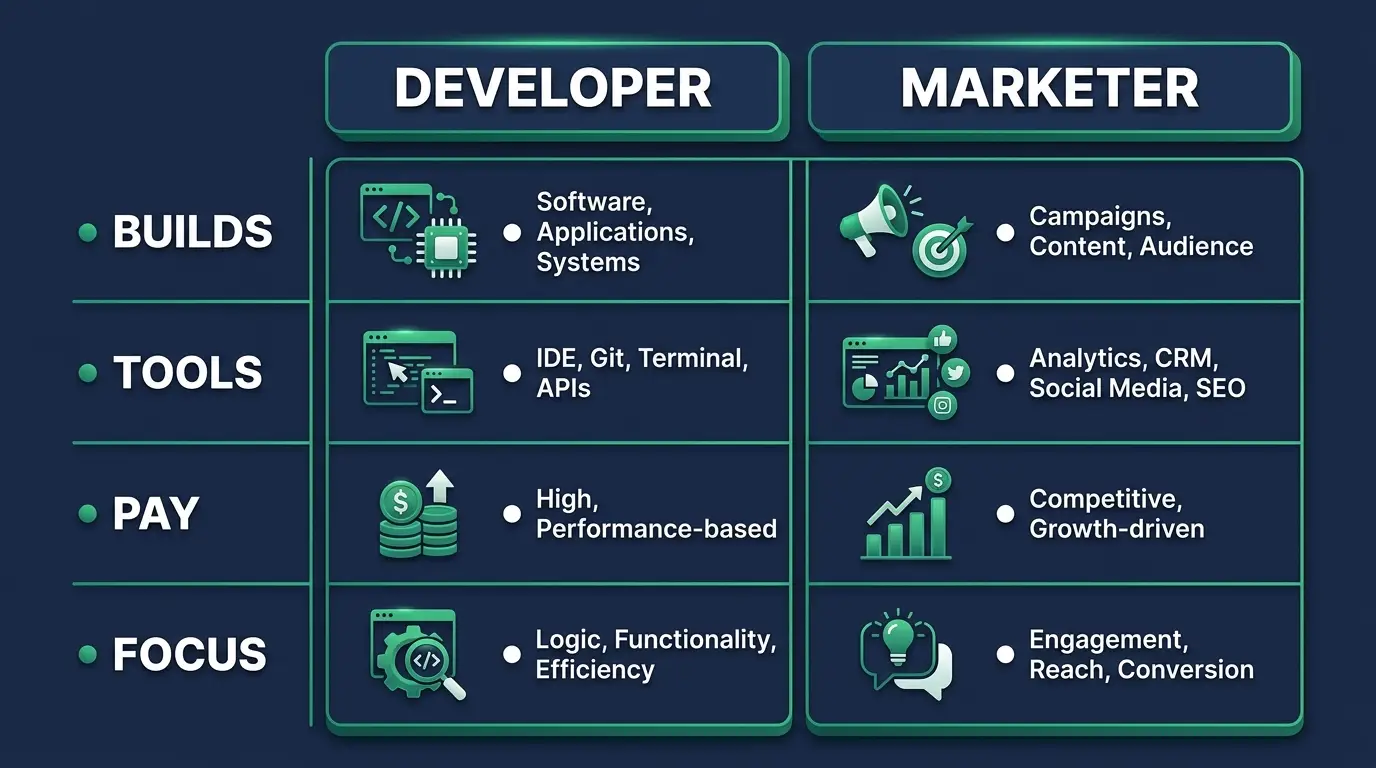
The email developer builds the email. The email marketer decides what the email is.
The developer takes a concept and turns it into coded, tested, working HTML that renders everywhere and ships through the platform. The marketer decides who receives it, when it goes out, what the offer is, what the subject line says, and whether the whole thing actually worked.
One owns the how. The other owns the why, who, and when. Everything else is detail.

What each actually does day-to-day
An email developer's day is heads-down and build-focused. A designer or marketer hands you a Figma mockup and a deadline. You code the email in table-based HTML and inline CSS, test it across Outlook, Gmail, Apple Mail, and dark mode, fix the three things Outlook broke, load it into the ESP, wire up any dynamic content, send yourself a test, and ship. Some days it's net-new builds. A lot of days it's adapting a proven template for the next campaign. It's focused, deadline-driven, and quietly satisfying when a tricky layout finally renders clean everywhere.
An email marketer's day is strategy and results. You're planning the calendar, segmenting the audience, writing or directing the copy, setting up the offer, and deciding the send time. You live in the ESP's reporting, not its code editor. You watch open rates, click rates, revenue per send, and unsubscribes, then change next week's plan based on what those numbers told you. You're in meetings about the promotion, the lifecycle, the list growth. The email itself is one piece of a bigger machine you're responsible for.
Same email. Two completely different jobs around it.
The honest head-to-head
Here's where it matters, on the axes that actually decide your day and your paycheck.
Core skills. The developer's craft is technical: HTML and CSS (the old, table-based kind), responsive email techniques, rendering quirks across clients, and knowing an ESP's template system cold. The marketer's craft is strategic: copywriting, segmentation, offer design, analytics, deliverability strategy, and a feel for what makes people click. Both are real skills. They're just pointed at different problems.
How much coding. This is the cleanest line between them. The developer codes most of the day. The marketer can run a great program writing almost no code at all, dragging blocks in a template builder and living in the reporting dashboard. A marketer who can code is a rare and valuable hybrid, but coding is not the job. For the developer, it is.
Pay. Honest US ranges, because pay swings on location, platform, and seniority. Email developers land around $50k to $70k entry-level, $70k to $95k mid-level, and $100k+ for senior or specialized work on enterprise platforms. Email marketers cover a wider band depending on whether they're a coordinator running sends or a lifecycle strategist owning revenue: roughly $45k to $65k early, $65k to $90k mid, and well into six figures for senior CRM and lifecycle leaders who own a real revenue number. The very top of the marketing side can out-earn the dev side, because it ladders into management and owns business outcomes. The developer side pays more reliably at the junior level, because the skill is harder to find.
Demand and scarcity. Both roles are in demand. But here's the uncomfortable truth: there are far more people who can do marketing than people who can code email that renders across forty inboxes. The marketing applicant pool is deep. The developer pool is thin, because most marketers are terrified of the code and most front-end devs won't touch the cursed, 2005-era HTML it requires. Scarcity is the developer's edge, plain and simple.
Career path. The marketer ladders toward email manager, CRM manager, lifecycle lead, head of retention, and eventually marketing leadership. It's a recognizable management track. The developer ladders toward senior email developer, then into systems and automation work, enterprise ESP specialization (Salesforce Marketing Cloud, Braze, Iterable), and marketing-engineering roles. One path tilts toward people and strategy. The other tilts toward depth and systems.
Who they report to. Both usually sit under marketing. The marketer reports up the marketing chain and is measured on campaign and revenue results. The developer often reports to a marketing or lifecycle lead too, but is measured on whether the builds ship clean and on time. The marketer answers for outcomes. The developer answers for execution.

Where the two roles overlap
On a big team, these are two different people who hand work back and forth. The marketer plans and briefs. The developer builds and ships. They overlap at the handoff, and the best teams have them speaking each other's language.
The marketer needs to understand enough about rendering and ESP limits to brief something buildable. The developer needs to understand enough about the campaign goal to make smart calls when the mockup doesn't quite work in code. That shared middle is where good email actually happens.
And on a small team? The line collapses entirely. Plenty of companies have one person who plans the campaign, writes the copy, codes the email, tests it, sends it, and reads the report on Monday. If that's the job you're walking into, you're not picking between these roles. You're doing both. That's exactly why understanding both is worth your time even if you only want to be one.
Can you do both?
You can. And if you're technical, this is where the real leverage hides.
A marketer who can also code email is dangerous in the best way. They can build the thing they imagined instead of filing a ticket and waiting two weeks. They can test an idea the same afternoon they have it. On a small team, that person is worth two hires.
A developer who understands the marketing, why this audience, why this offer, why this send time, stops being "the person who turns mockups into markup" and becomes the technical brain on the team. That's the version that gets fought over at raise time.
Here's the reframe I'd tattoo on this whole topic: the rarest, best-paid person in email isn't the best coder or the best marketer. It's the one who can do enough of both that nobody can route around them. You don't have to master both on day one. But know that the combination is the ceiling, not either skill alone.
If you're a developer eyeing this whole space, I made the broader case in why engineers are switching to martech, email is one of the cleanest on-ramps in it.
The verdict: which one to pick
Let me make this decisive instead of wishy-washy.
Pick email developer if you like building things, you'd rather solve a concrete puzzle than sit in a strategy meeting, you want a technical skill that's genuinely scarce, and you like the idea of being the rare person on a marketing team who can actually code. The coding scarcity is your edge, and at the junior level it pays more reliably because so few people can do it. If you already know a little HTML and CSS, this is the faster, less crowded door.
Pick email marketer if you're energized by strategy, psychology, and results, you like owning a number and moving it, you'd rather write the subject line than debug the Outlook bug, and you see yourself eventually leading people and a program. The ceiling here is high and it ladders into management. You don't need to code to do it well, though learning to will make you rare. The day-to-day of that seat is laid out in the email marketing specialist job guide.
Neither is the consolation prize. They're different jobs for different brains. The mistake is picking the one that sounds prestigious instead of the one that matches how you actually like to spend a Tuesday.
FAQ
Which pays more, email developer or email marketer? At the junior level, email developers tend to pay a bit more reliably because the coding skill is scarcer and harder to fake. Over a full career, the top of the marketing side can pull ahead, because senior lifecycle and CRM leaders own revenue and move into management. Rough US ranges: developers $50k to $70k entry, $70k to $95k mid, $100k+ senior; marketers a wider band that climbs higher at the leadership end. Pay tracks rarity early and ownership later.
Which role is harder? They're hard in different ways. The developer's job has a steep technical learning curve, making one layout render across Outlook, Gmail, Apple Mail, and dark mode is a genuine engineering problem. The marketer's job is hard in a fuzzier way: there's no "correct" answer, just results you're accountable for, and you're constantly guessing at human behavior. Technical-hard versus judgment-hard. Pick your poison.
Can you switch between them? Yes, and people do, in both directions. A developer who learns segmentation, copy, and analytics can move into marketing. A marketer who learns to code email can move toward development. The switch is easier than starting from zero because you already understand the team, the tools, and the goal. You're adding one layer, not learning the whole job.
Do you need to code to be an email marketer? No. You can run an excellent email program using a template builder and a reporting dashboard without writing a line of HTML. But learning even a little code makes you noticeably rarer and more self-sufficient, because you can build and test ideas without waiting on someone else. It's not required. It's leverage.
If you've read this far and the build it side is pulling at you, that's worth listening to. The coding piece is the rare one, and it's the one most people walk past because it looks harder than it is. That's the whole idea behind our email marketing specialist career path: take a bit of code, point it where the supply is thin, and become the person the team can't route around. If you want the full roadmap, I wrote how to become an email developer and a straight-talk email developer salary guide to go with it.
Whichever side you pick, pick it because it fits you, not because of the word it shares with the other one. I've got you.