Email Developer Salary Guide
On this page
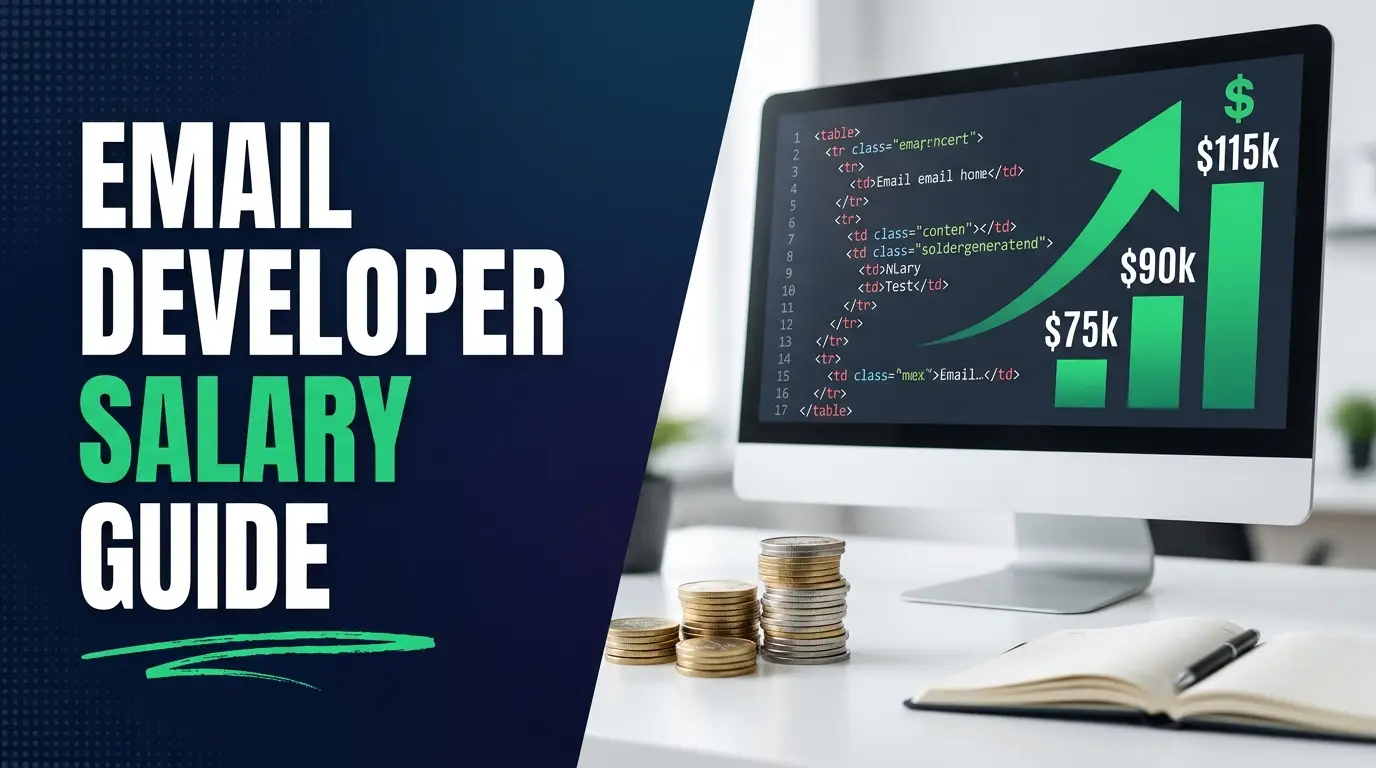
$48k versus $110k. Same exact job title, "email developer," and a $60,000 gap between two paychecks. One person scraping by, the other clearing six figures, both writing email code for a living.
That gap is the whole story of this career, and almost nobody explains it honestly.
I've seen folks talk themselves out of email dev because they heard it's "just templates" and assumed the pay matched that. Then I've watched someone who actually knows the craft quietly out-earn full-stack friends who spent four times as long learning to code.
So before you decide whether this skill is worth your time, you deserve the real numbers. Not a fake average. The actual range, US dollars, and the stuff that decides where you land inside it. Because most of that gap isn't luck or location. It's choices you get to make.
Let me give it to you the way I'd give it to a friend who asked me over coffee.
The honest answer, up front
Here's the whole picture before I break it down:
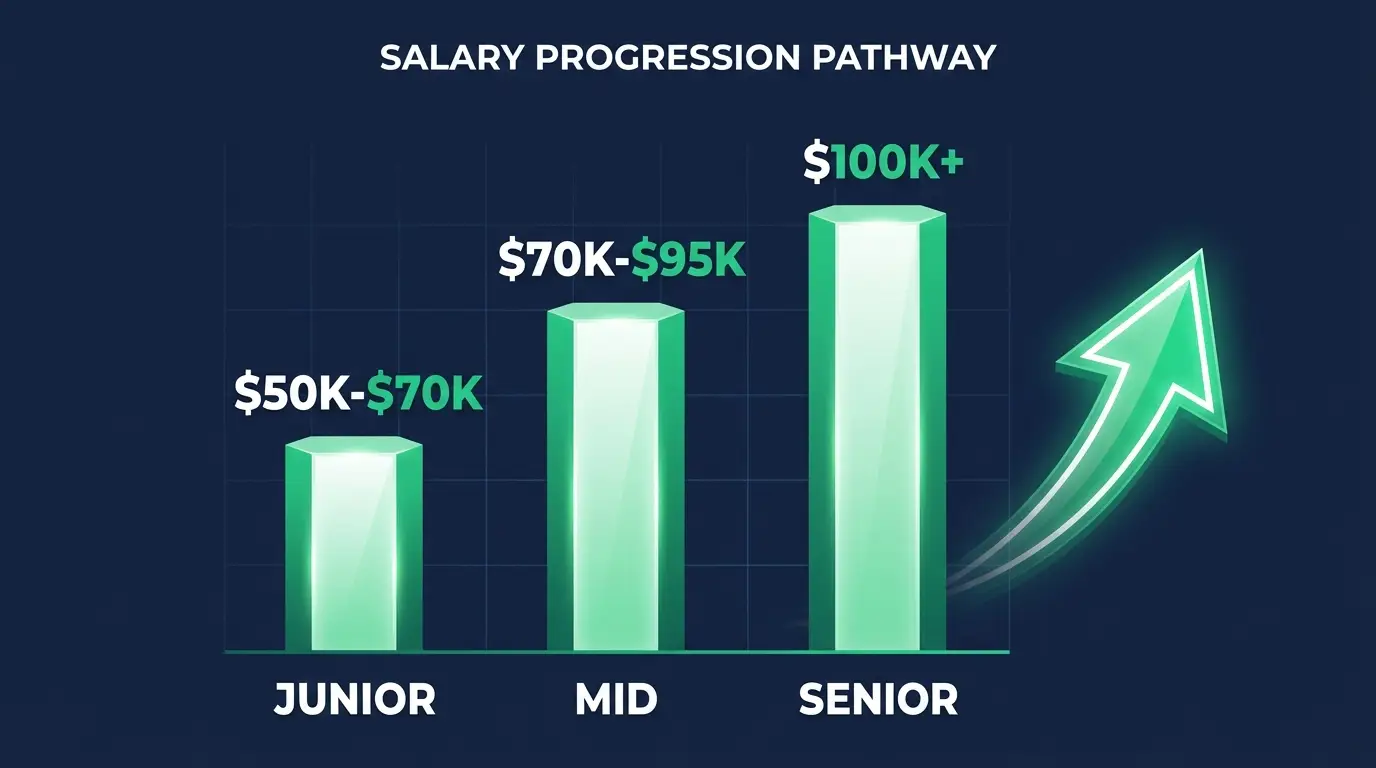
- Entry / junior: roughly $50k to $70k
- Mid-level: roughly $70k to $95k
- Senior / specialized: $100k+
- Freelance / contract: commonly $40 to $100+/hour
Those are US figures, and they're ranges on purpose. Anyone who tells you "the average email developer salary is $73,412" is selling you false precision. Pay swings hard based on where you live, which platform you know, and whether you do template work or systems work. The range is the honest answer.
The encouraging part: this is a job where you can move from the bottom of that list to the top in a few years, on purpose, by learning specific things. Most careers don't give you that clean a lever.
What you make at each level
Junior: $50k to $70k
This is where you land your first role. You can code a clean, responsive email by hand, get it to render across Outlook, Gmail, and Apple Mail, and load it into an ESP without breaking it.
You're not expected to architect automations yet. You're expected to take a design and ship a working, tested email. That's a real skill, and it's why even the entry number starts at $50k and not minimum wage. Most marketers can't do any of this, which is the whole reason you have a floor.
If you come in already knowing one platform well, you'll start at the upper end. If you're applying with a portfolio of working emails and zero platform experience, expect the lower end and a fast climb.
Mid: $70k to $95k
This is the bulk of the market, and it's where most working email developers actually sit.
At this level you handle complex builds without hand-holding, dynamic content, personalization, modular template systems, basic-to-intermediate automations inside the ESP. You're not just translating a mockup. You're solving the rendering problem, building the thing to be reusable, and catching the issues a junior wouldn't see coming.
The jump from junior to mid isn't about coding faster. It's about owning the build end to end and being trusted with it.
Senior / specialized: $100k+
This is where the ceiling stops being a ceiling.
Senior email developers know a hard enterprise platform deeply, build real automation, and understand deliverability, why mail lands in spam, how authentication works, how to keep a sender reputation clean. They're often the person a marketing team can't function without.
The title might still say "Email Developer," or it might shift to "Lifecycle Developer," "CRM Developer," or "Marketing Engineer." The pay follows the responsibility, not the label. And there are far fewer people at this level than the demand calls for, which is exactly why the number keeps climbing past $100k.
What actually moves the number
Two people with the same job title can be $40k apart. Here's where that gap comes from.
Which platform you know. This is the single biggest lever. Knowing Mailchimp or Klaviyo gets you in the door. Knowing an enterprise ESP, Salesforce Marketing Cloud, Braze, Iterable, moves you up a tier on its own. These platforms are harder, the companies running them are bigger, and the pool of people who genuinely know them is tiny. Rarity is the whole game, and the platform you learn is the fastest way to make yourself rare.
Automation skill. A developer who only codes templates sits at the bottom of the range. A developer who also builds the flows, the triggers, the dynamic logic, and the data wiring sits at the top. The closer you get to engineering the system instead of decorating it, the higher the pay.
The industry you're in. Tech, SaaS, finance, and high-volume e-commerce pay more than nonprofits, small agencies, or local businesses. Same skills, different budget behind them.
Company type. A funded SaaS company or a big retailer that sends millions of emails will pay more than a five-person shop. More email volume means more revenue tied to email, which means more budget for the person who makes it work.
The pattern under all of it is the same: pay tracks rarity, and rarity is something you can build on purpose. That's the line worth keeping. Your salary isn't set by the job title. It's set by how hard you are to replace.

Employee vs. freelance: the hourly math
A lot of email developers freelance, either fully or on the side, and the hourly numbers look very different from a salary.
Freelance and contract rates commonly run $40 to $100+/hour, and the spread maps to the same things that move a salary:
- $40 to $60/hour: newer freelancers, template work, simpler ESPs. You're proving yourself and building a client list.
- $60 to $90/hour: You know a platform well, you build clean and fast, and you have a portfolio that closes the conversation before it starts.
- $90 to $100+/hour: specialist territory. Enterprise ESP expertise, automation work, deliverability knowledge, and clients who'd lose real money without you.
Freelancing pays more per hour on paper, and less stable per month in reality. You're not just doing the work. You're finding clients, sending invoices, chasing payments, and covering your own insurance and downtime. The higher rate is partly skill and partly the cost of carrying all that risk yourself.
If you want the deeper version of this, including how remote contract work actually gets found, I wrote a whole piece on remote email developer jobs.
How location and remote work change it
The numbers above assume the US. Two things bend them.
Location. A senior salary in San Francisco or New York looks different from the same role in a low cost-of-living city, and both look different from many international markets, where you might adjust the whole range down meaningfully. Cost of living drags local salaries with it.
Remote work flattens that. And this is the good news. Email development is one of the most remote-friendly roles in martech, the work is digital end to end. When you work remote for a company headquartered in an expensive city, you can earn closer to their pay scale while living on your cost of living. That arbitrage is real, and it's a big part of why this job is worth taking seriously if you don't live in a tech hub.
Remote also widens your market from "who's hiring in my city" to "who's hiring, anywhere." When your applicant pool is already small because few people learn this skill, opening it up nationally is a quiet advantage most candidates never get.
How to actually increase your salary
Not vague advice. The specific moves that pull the number up.
Learn a hard ESP on purpose. If you know Klaviyo, the most valuable thing you can do next is learn Salesforce Marketing Cloud, Braze, or Iterable. This is the clearest, most direct raise available to you. The platform is the leverage.
Move from templates to automation. Stop being the person who only codes the email. Become the person who builds the flow it lives in. Learn the triggers, the segmentation, the dynamic logic. The moment you own the system and not just the markup, you've changed tiers.
Learn deliverability. Authentication, sender reputation, why mail lands in spam. Most email developers never touch this, which is exactly why knowing it makes you the one a team protects.
Build a portfolio that proves it. Working, tested emails with the cross-client screenshots that show they render. A portfolio closes the negotiation before it starts, because it removes all the doubt an employer normally carries.
Specialize where the supply is thin. Pick the platform fewer people know, the industry with bigger budgets, the automation work most developers avoid. Broad and common pays the floor. Narrow and rare pays the ceiling.
If you're still earlier than this and figuring out the foundations, start with how to become an email developer, the roadmap that gets you to that first $50k to $70k role in the first place.
An honest reality check
I'm not going to pretend the number only goes up.
The floor work is real, and it pays floor money. If all you ever do is turn a mockup into HTML on an easy ESP, you'll sit at the bottom of the range and stay there. The high end isn't automatic. It's earned by deliberately learning the hard, rare things.
The title carries less prestige than "software engineer." If a recruiter or your relatives need a flashy job name to be impressed, "email developer" won't do it on its own, even when the paycheck is strong. You're trading a recognizable ladder for a less crowded one. Decide if that trade is fine with you, for a lot of people it absolutely is.
AI changes the work; it doesn't erase the pay. AI speeds up the boilerplate markup. It doesn't understand your client's deliverability problem or why Outlook broke your layout this time. The developers who use AI to ship faster while knowing what's happening underneath are getting more valuable, not less.
The reframe I keep coming back to: a rare skill pays more than a common one, and rarity is a choice. You don't compete your way to a higher salary in this field. You specialize your way there.
FAQ
What's the entry-level email developer salary? In the US, roughly $50k to $70k for a junior role. You'll start at the upper end if you already know an ESP well, and at the lower end if you're coming in with a strong portfolio but no platform experience. Either way, the climb from there is faster than in most entry-level tech roles, because the skill that raises your pay, knowing a harder platform, is concrete and learnable.
Can you make six figures as an email developer? Yes, and the path is clearer than people expect. Six figures lives in senior and specialized territory: deep knowledge of an enterprise ESP like Salesforce Marketing Cloud or Braze, real automation engineering, and deliverability expertise. It's not the floor of the field, but it's a deliberate, reachable destination, not a lottery ticket.
What can I charge as a freelance email developer? Commonly $40 to $100+/hour in the US. Newer freelancers doing template work sit at the lower end; specialists who know a hard ESP, build automations, and have a portfolio that closes deals reach the top. Remember the higher rate also covers the instability, client-finding, and overhead that a salaried role doesn't make you carry.
Does email development pay more than email marketing? Often, yes, because coding is the rarer skill. Plenty of people can plan a campaign; far fewer can build a bulletproof, cross-client email and wire it into the ESP. That scarcity is what pushes the developer's pay up. The two roles are genuinely different jobs, and I broke down exactly how in email developer vs. email marketer.
Why does the salary range vary so much? Because the job covers a wide span of difficulty. Pure template work on an easy platform sits at the bottom; enterprise ESP expertise plus automation plus deliverability sits at the top. The same title can pay $50k or $120k depending on how rare your specific skills are. The range isn't vagueness. It's the real shape of the field.
If those numbers landed differently than you expected, higher, more reachable, more in your control. That's the point. The salary isn't fixed by the title. It's set by how rare you make yourself, and rarity is something you can actually go build.
That's the whole idea behind our email marketing specialist career path: take the coding you have, point it at the platforms and skills where pay tracks scarcity, and climb a ladder that far fewer people are standing on. You don't need permission to start. You just need to pick the door fewer people are walking through. I've got you.