Remote Email Developer Jobs
On this page
You want a tech job you can do from your kitchen table. A real one, paying real money, not a gig that quietly turns into commuting three days a week six months in.
And you do not want to spend half a year grinding LeetCode just to get auto-rejected by a Google recruiter who never reads your resume. I get it. That whole gauntlet filters for one narrow kind of person, and it tells you almost nothing about whether you can actually build things people need.
So here's a door most people walk right past: email development.
The reason this role fits what you want is that everything about it lines up. The work is digital from the first keystroke to the final send, so location genuinely does not matter. The output is verifiable in a way that protects you in interviews, an email either renders correctly in Outlook or it doesn't, and anyone can check, no whiteboard required. And the talent pool is thin enough that you're not the nine-hundredth applicant fighting for one slot.
Let me show you where these jobs actually live and how to be the person who gets one.
Why email development is unusually remote-friendly
Most "remote" tech jobs are remote by permission. Email development is remote by nature. There's a difference, and it's the whole reason this works.
The work is digital end to end. You get a design, you code it, you test it across clients, you load it into a platform, you ship. There is nothing in that loop that requires you to be in a building. No hardware, no lab, no "come into the office for the standup." A laptop and an internet connection is the entire toolkit.
It's async-friendly. A campaign build isn't a real-time scramble. A marketer hands you a Figma file and a send date. You build it on your own clock and deliver. That rhythm, clear input, clear deadline, independent execution, is exactly the shape of work that survives across time zones. You don't need to be online the same hours as your team to do it well.
Your output is verifiable. This is the quiet superpower. In a lot of remote roles, managers can't tell if you actually did good work, so they compensate with meetings and surveillance. With email, the proof is the email. It renders correctly across forty inboxes or it doesn't. Litmus screenshots don't lie. That makes trust easy to grant a remote hire, because results speak before you have to.
Put those three together and you get a role that doesn't merely tolerate remote. It was practically built for it.

Who actually hires remote email developers
The jobs are real, but they're spread across four very different kinds of employers. Knowing which is which changes where you look and how you pitch yourself.
In-house brands, e-commerce, and SaaS. Any company that sends a lot of email needs someone to build it. Retail and DTC brands live and die by their email program. SaaS companies run constant lifecycle and onboarding sends. These roles mean one brand, deeper work, and a steadier rhythm. Many of these teams went remote-first years ago and never came back.
Agencies: CRM, lifecycle, and email shops. These are agencies whose entire business is building email for other companies. They're some of the most consistent remote employers in the space because their work was always client-facing and distributed. The upside: you'll touch dozens of brands and platforms in a year, which is the fastest way to build real reps. The pace is higher, but so is the learning.
Martech and ESP vendors. The email platform companies themselves, the ones that make the sending software, hire developers for implementation, solutions, and template work. These tend to be technical, well-paid, and very remote-comfortable, because the vendors sell remote-friendly tools and live the lifestyle.
Contract and freelance. A huge slice of email work is project-based. Brands need a campaign built, an agency is slammed and needs an extra pair of hands, a template system needs a rebuild. Contract is often the quickest door in for someone new, because clients care about whether you can deliver the email far more than where you sit.
Where to actually find the jobs
This is where most people stall, because they search the wrong words. The same job hides under five different titles, and if you only search one, you miss most of the market.
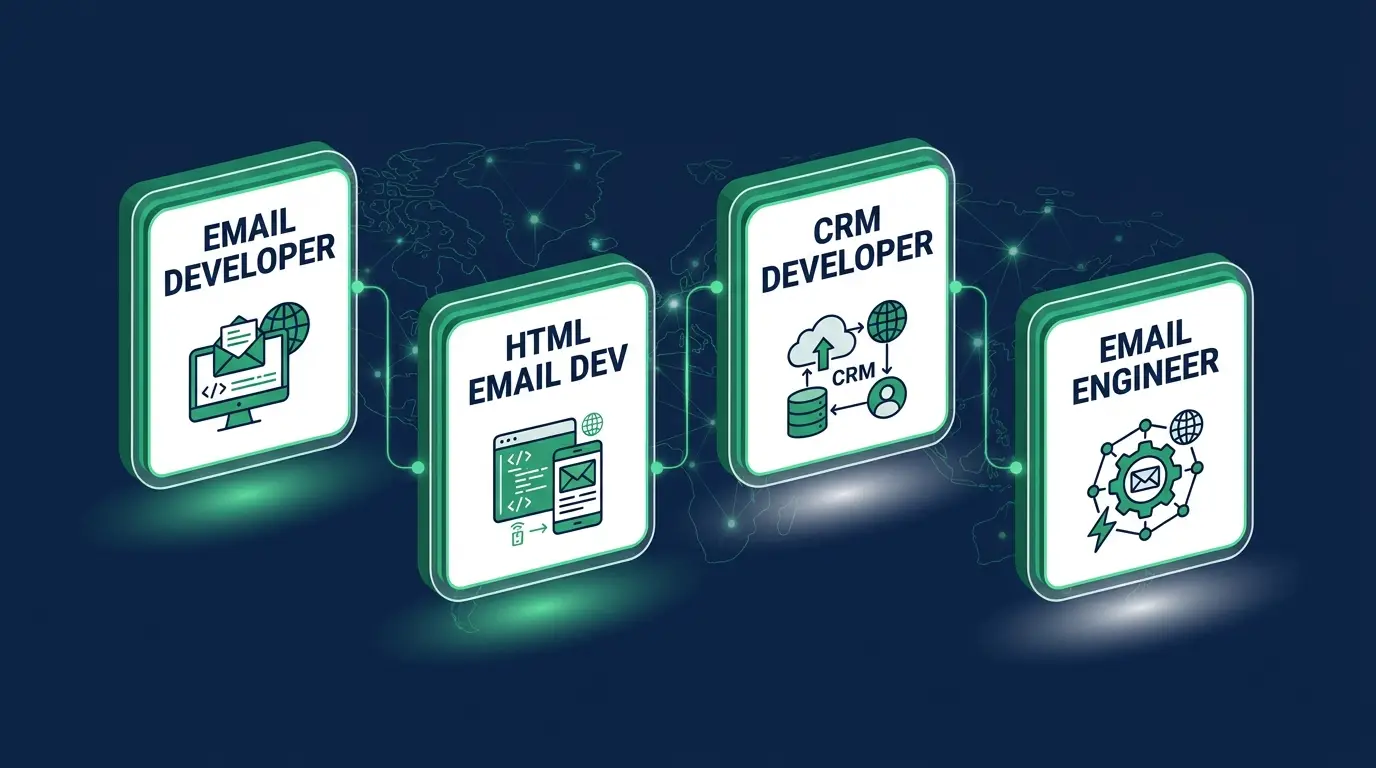
Search these exact titles:
- Email Developer: the core term.
- HTML Email Developer: common at agencies and on freelance platforms.
- Email Marketing Developer: when the role blends building with a little campaign work.
- CRM Developer / Lifecycle Developer: same coding skill, framed around the customer journey, often at bigger companies.
- Marketing Engineer / Email Engineer: the more technical, automation-heavy framing.
Run every one of these as a search. The role wears all of these names, and the listing that's perfect for you might be sitting under a title you never thought to type.
Where to run those searches:
- LinkedIn, with the remote filter on. Set up saved searches for each title so new posts come to you instead of you hunting daily.
- Remote-focused job boards: the ones dedicated to remote and distributed work tend to surface these roles cleanly, because remote-first companies post there on purpose.
- Agency career pages directly. Make a list of ten email/CRM/lifecycle agencies and check their careers pages every couple of weeks. Agencies often hire off their own site before they ever pay to post a listing.
- Freelance platforms for contract work. "HTML email developer" is a steady, searchable category, and a few well-reviewed gigs become a portfolio and a referral pipeline fast.
The trick isn't volume, it's coverage. Five titles times a few channels, set up as saved searches so the jobs find you. That beats refreshing one job board with one keyword every morning and wondering why it's quiet.
How to stand out for a remote role specifically
Landing any email job and landing a remote one are not the same challenge. For remote, an employer is taking a bet they can't easily walk back. They're trusting someone they'll never see to deliver without supervision. Everything you show them should quietly answer the question they're really asking: can I trust this person to ship good work on their own?
Lead with a portfolio that proves rendering. Don't tell them you can build cross-client email. Show them. Code three or four real emails, test them across clients, and publish the screenshots that prove they render in Outlook, Gmail, Apple Mail, and dark mode. A remote hire is bought on evidence, and rendering proof is the most convincing evidence there is. (I broke down what a strong one looks like in email developer portfolio examples.)
Communicate like the async worker you'll need to be. In a remote role, your writing is you for most of the day. Clear, calm, complete messages signal that you'll be easy to work with across a time zone. Sloppy, vague application emails signal the opposite. The way you write to them during hiring is a live audition for how you'll work.
Signal reliability over brilliance. Remote teams don't need a genius who goes dark for three days. They need someone who hits the date, flags problems early, and does what they said. Anywhere you can show you delivered on a deadline, a freelance gig, a project, even a self-set build, say so plainly.
Show a self-starter. The single best remote signal is that you did something nobody assigned you. You taught yourself the craft, built a portfolio, shipped emails on your own initiative. That's the exact muscle remote work demands, and proof you have it eases the biggest fear a remote manager carries.

What remote pay looks like
Pay tracks the same ranges as on-site email work, with one real twist I'll get to. These are rough US figures, adjust down for many international markets, up for high cost-of-living hubs:
- Entry / junior: roughly $50k to $70k. You can code clean, tested emails and work inside a platform.
- Mid-level: roughly $70k to $95k. You handle complex builds, dynamic content, and automations without hand-holding.
- Senior / specialized: $100k and up, especially on enterprise platforms like Salesforce Marketing Cloud, Braze, or Iterable. Rarer platform, higher pay.
- Freelance / contract: commonly $40 to $100+/hour, climbing with your platform expertise and the results you can point to.
The twist that matters for remote: going remote widens your market past your own city. If you live somewhere with thin local demand, on-site means you compete for the handful of jobs within driving distance. Remote means you compete for jobs everywhere, and you can be paid on a national or even international scale instead of your local one. For a lot of people, that single shift is worth more than any raise. (For the full breakdown, I put together a dedicated email developer salary guide.)
The honest tradeoffs of remote email work
I won't sell remote as pure upside, because it isn't, and you deserve the real picture before you commit.
Isolation is real. Coding emails alone in your apartment all day is quieter than people expect. If you draw energy from a room full of coworkers, full-remote can wear on you. Some people thrive in it; some discover they need a coworking space or a hybrid setup to stay sane. Know which one you are.
Time zones cut both ways. Async freedom is great until your team is eight hours ahead and every answer takes a day. Working across zones takes discipline, overlapping deliberately, writing things down, not letting questions stall a build. It's a skill, not a perk.
Contract work is less stable. A lot of the fastest remote on-ramps are contract, and contract income comes in waves. A great month can be followed by a quiet one. The flexibility is real, and so is the instability. Plan for it instead of being surprised by it.
You have to be self-directed, full stop. Nobody is walking by your desk to keep you moving. Remote rewards people who manage their own time and punishes people who need external structure. This is the one tradeoff with no workaround, if you can't drive yourself, remote will expose it fast.
Here's the reframe I keep handing people who want this: remote work doesn't remove the manager looking over your shoulder. It replaces them with you. That's a better deal, but only if you're someone who can hold yourself to it.
FAQ
Are there entry-level remote email developer jobs? Yes, though they're more competitive than mid-level remote roles, because "entry-level" and "remote" are both things lots of people want. The way in is a portfolio that proves you can already ship cross-client email, plus a willingness to start with contract or agency work where they care about output over years of experience. Entry-level remote is real, but you earn it with evidence, not just a résumé.
Do I need years of experience to land a remote role? No. You need to prove you can do the work, which a portfolio does better than a tenure number. Many remote teams, especially agencies and contract clients, will hire on the strength of three or four genuinely good, cross-client-tested emails. If you're starting from scratch, how to become an email developer lays out the full path.
Is remote email work usually contract or full-time? Both exist, and the split depends on the employer. In-house brands and SaaS companies tend to hire full-time and remote. Agencies do a mix. A large chunk of freelance-platform work is contract. Early on, contract is often the faster door in; full-time tends to follow once you have reps and references.
Can I do remote email development internationally? Often, yes. It's one of the more borderless tech roles, since the work is fully digital and async-friendly. Plenty of companies hire across borders or work with international contractors. The practical limits are usually time-zone overlap and how a given company handles payment and contracts across countries, not the work itself.
If a remote tech job is what you actually want, you don't need to survive a six-round algorithm gauntlet to get one. You need a skill that's digital by nature, verifiable by output, and rare enough that you're not lost in a crowd of a thousand. Email development is all three, and it's exactly what our email marketing specialist career path is built to get you to, the coding, the platforms, and the portfolio that makes a remote team comfortable saying yes to someone they'll never meet in person.
Pick the door fewer people are walking through, then learn to work like someone who doesn't need watching. I've got you.