Ecommerce Jobs: Every Role, What It Pays, and Where to Start
On this page
Type "ecommerce jobs" into Google and look at what comes back. LinkedIn says 25,000 openings. ZipRecruiter says the pay runs from $14 an hour to $72 an hour. Indeed shows you listings in Wichita for some reason. Glassdoor throws another 8,000 at you.
Not one of those pages tells you what any of these jobs are.
So you scroll through titles like ecommerce coordinator, digital merchandiser, ecommerce operations manager, and you have no idea whether they're three names for the same desk or three different careers. You can't tell which one you're qualified for. You definitely can't tell which one pays.
I've watched people apply to forty of these and get nothing back, not because they were unqualified, but because they were firing at titles instead of at a job.
Let me lay the whole field out.

What all of these jobs actually have in common
Every role on this page exists because a company sells something online and that store makes money whether or not anyone is watching it.
That's the thread. Someone has to add the products. Someone has to make the product page load fast enough that a shopper on a bad phone connection doesn't bail. Someone has to notice that checkout broke on Safari at 2pm on Black Friday. Someone has to decide which twelve items go on the homepage this week.
At a five-person brand, that's one person doing all of it. At Nike, that's four departments. Same work, sliced differently, and the slicing is what produces twenty job titles for what is basically one skill set.
Which is good news for you, honestly. It means the skills transfer sideways across every title in the list, and you only have to learn them once.
Where you actually start
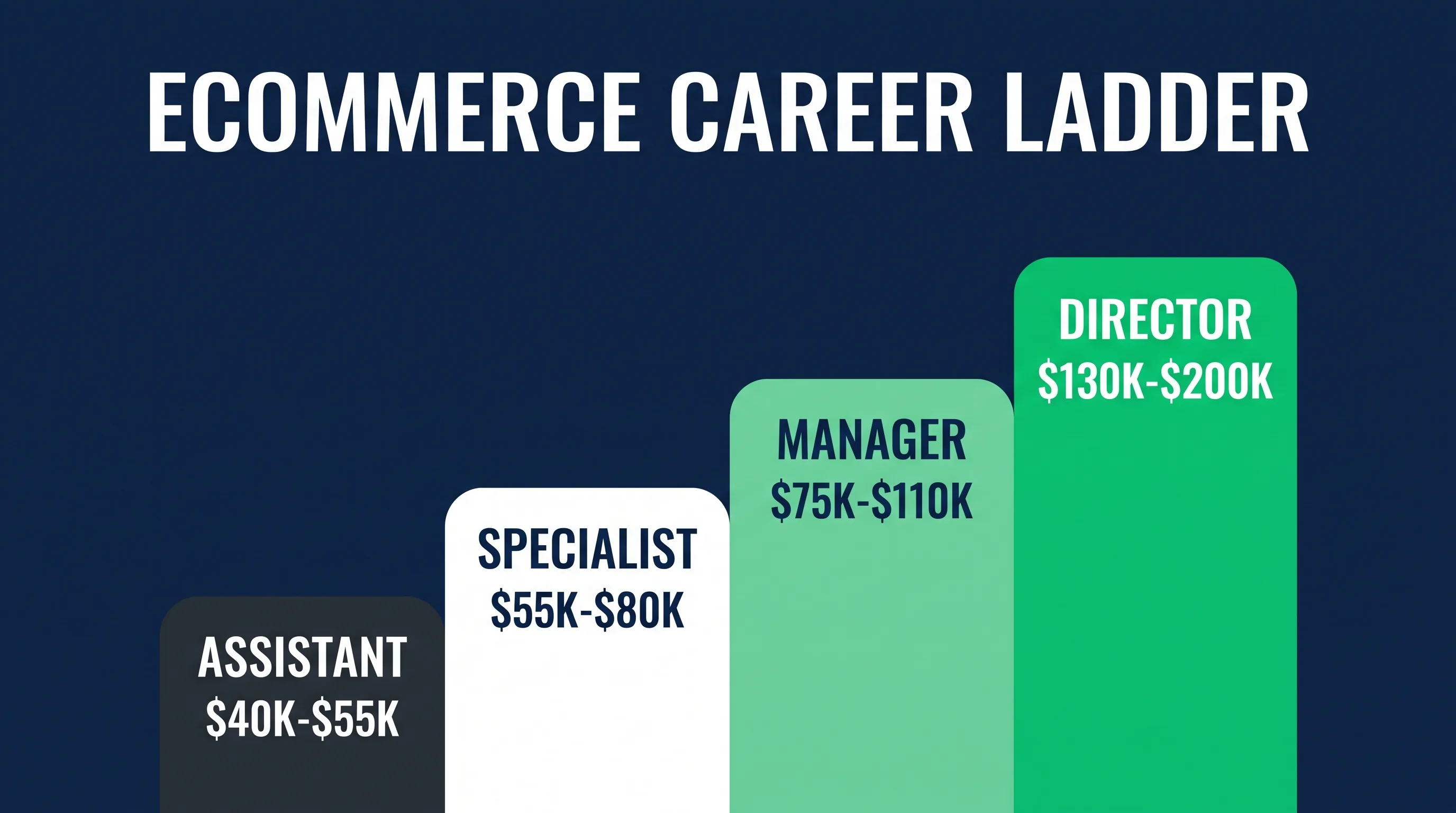
Ecommerce assistant. The entry door. You're uploading products, writing product descriptions, fixing typos in collections, pulling basic reports, answering the occasional "why isn't this showing up on the site" from someone in marketing. Roughly $40k to $55k. Nobody calls it glamorous, and I won't either. But it puts you inside a real store with real revenue attached, which is the one thing a course by itself cannot hand you.
Ecommerce coordinator. Same neighborhood, slightly more rope. You're coordinating launches, keeping the promo calendar straight, chasing the photographer for images that were due Tuesday. Around $45k to $60k. A lot of coordinators are just assistants whose company decided to sound more serious in the job post.
If you're coming from retail, customer service, or admin work of any kind, these two titles are the shortest path from where you are to a tech-adjacent paycheck. I put a wider list of those low-barrier entry points in the easiest tech jobs to get into.
The middle, where most of the jobs live
This is where the titles multiply and where most of the 25,000 postings sit.
Ecommerce specialist is the generalist. You own chunks of the store end to end: merchandising, promotions, product data, the basic analytics, and usually the platform itself. At a small company it's the whole job. Call it $55k to $80k. This is the title we named our own track after, because it describes the person who can both build the store and run it, and that combination is genuinely rare.
Ecommerce manager is the specialist with budget and people. You own the revenue number for the site. You're deciding what gets promoted, what gets fixed first, and where the money goes, and you're the one in the meeting explaining why conversion dipped. $75k to $110k, and higher at bigger brands.
Ecommerce merchandiser (or digital merchandiser) is the closest thing to a storefront window dresser. Which products appear where, how collections are ordered, what the search results surface, what shows in the "you might also like" slot. $55k to $85k. People underrate this one. Reordering a collection page well can move more revenue in an afternoon than a month of ad spend.
Ecommerce analyst lives in the data. Funnel drop-off, cohort behavior, which traffic source actually pays for itself, why mobile converts at half the rate of desktop. $65k to $95k. If you like spreadsheets and arguments settled by evidence, this is your seat.
Ecommerce operations manager owns everything behind the buy button. Inventory sync, fulfillment, returns, the integration between the store and the warehouse system that breaks at the worst possible moment. $80k to $115k. Unsexy, extremely hard to replace.
Ecommerce marketing manager runs acquisition and retention for the store: email, paid, lifecycle, promotions. $70k to $100k. This one overlaps heavily with the email side of things, and plenty of people move between the two. If that's the direction pulling at you, email marketing jobs covers that whole ladder.
Ecommerce product manager and ecommerce project manager get confused constantly. The product manager decides what the site should do next and owns the roadmap ($100k to $150k). The project manager makes sure the replatform ships on time and nobody forgets the redirects ($80k to $110k). Different jobs, one letter apart.
The technical lane
Ecommerce developer is the one that pays best without a management title attached, and it's the one with the most competition, because "developer" pulls in every bootcamp grad and every freelancer on Upwork.
You're building and maintaining the store itself. Themes, custom sections, apps, checkout behavior, the API work that connects the store to everything else the business runs on. $75k to $140k depending on how deep you go. Theme edits sit at the bottom of that range. Custom app development and Shopify Plus work sit at the top. I broke the whole spread down in the Shopify developer salary guide, and the gap between those two ends is bigger than most people expect.
Worth being clear about something here, since job boards blur it: an ecommerce developer builds the store, an ecommerce specialist runs it. Overlapping skills, different day. The developer writes the code that makes a bundle upsell work. The specialist decides which bundle to sell and watches whether it worked. Being able to do both is the version of this career that makes you very hard to replace, which is the argument I made in is Shopify development a good career.
Store manager titles, like "Shopify store manager" or "online store manager," sit somewhere between specialist and manager and mean whatever the company writing the post wants them to mean. Read the responsibilities, ignore the title.
The ceiling
Ecommerce director is where this path tops out for most people, at roughly $130k to $200k, with equity in the mix at larger companies. You own the online channel: the P&L, the team, the platform strategy, the three-year plan for replatforming that everyone dreads.
Above that you're into VP of Ecommerce and Chief Digital Officer territory, which exists, but at that altitude the job stops being about stores and starts being about org charts.
The useful thing about the director number is what it tells you about the floor. Someone uploading products for $45k and someone running the channel for $180k are on the same ladder. That is not true of most jobs you can enter with no degree.
The whole map, in one table
Rough US ranges. They're wide on purpose, because company size and city move these numbers more than your title does.
| Role | Typical US range | Where it sits |
|---|---|---|
| Ecommerce assistant | $40k to $55k | Entry |
| Ecommerce coordinator | $45k to $60k | Entry |
| Ecommerce specialist | $55k to $80k | Core |
| Ecommerce merchandiser | $55k to $85k | Core |
| Ecommerce analyst | $65k to $95k | Core |
| Ecommerce marketing manager | $70k to $100k | Core |
| Ecommerce developer | $75k to $140k | Technical |
| Ecommerce manager | $75k to $110k | Senior |
| Ecommerce project manager | $80k to $110k | Senior |
| Ecommerce operations manager | $80k to $115k | Senior |
| Ecommerce product manager | $100k to $150k | Senior |
| Ecommerce director | $130k to $200k+ | Leadership |
One caveat I'd rather say out loud: a $45k assistant job at a good brand where you touch everything will make you more money in three years than a $60k coordinator job where you only update a spreadsheet. Early on, optimize for what the job lets you touch.
Which one should you go for
If you're starting from zero, aim at assistant or specialist and let the rest come. Those are the roles that hire on demonstrated ability rather than a résumé of previous ecommerce titles, and both of them see the whole store, which is how you find out what you actually like.
From there the branches are pretty clean. Liked the building part? Push toward developer. Liked the numbers? Analyst. Liked being the person who decides? Manager, then director. Liked the plumbing behind the order? Operations.
You don't have to pick today. You have to get inside a store.
The thing that actually gets you hired
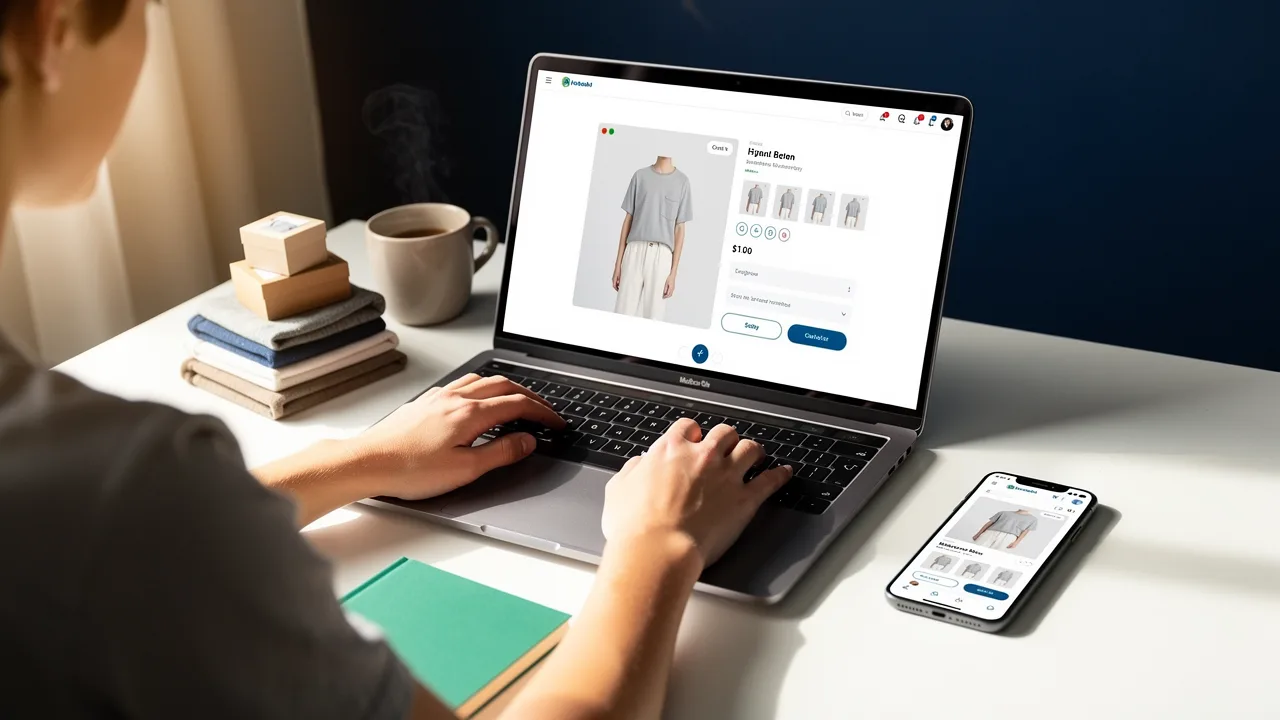
Build a store. A real one, live, with real products in it.
That's it. That's the trick, and almost nobody does it, which is why it works so well. Every other applicant is sending a résumé that says they're "passionate about ecommerce and digital growth." You're sending a URL.
Pick a niche you actually care about, stand the store up on Shopify, write the product copy, set up the collections, wire the email flows, install analytics, and then write down what happened. Even with zero sales you now have specific things to say in an interview: why you structured collections that way, what you found when you looked at where people dropped off, how you fixed the mobile product page.
Hiring managers for these roles are not looking for credentials. They're looking for evidence you've had your hands on a store before, because the alternative is teaching you Shopify from scratch while the Q4 calendar is on fire. Do the same thing with a friend's small business and you've got a case study, which beats a certificate every time. The build order for that is in how to become a Shopify developer, and the tooling side is in the best Shopify developer tools.
Our Ecommerce Specialist path walks that exact route, building stores first and then learning to run them, because those are the people who get hired for the jobs above the entry line.
The honest downsides
Ecommerce is seasonal in a way that will absolutely affect your life. Q4 is not a normal quarter. From roughly October through the new year, the store is the business, and the hours reflect that. If you take this job, you're taking that.
It's also measurable, relentlessly. Nobody argues about whether conversion went down. Everyone can see it in the dashboard. Some people find that clarifying and some find it exhausting, and you should know which one you are before you sign up.
The middle titles can go stale, too. An ecommerce specialist who never learns the technical side or the analytics side spends four years doing the same product uploads with a nicer title. The way out is picking up a hard skill nobody else on the team has, which is the same advice I'd give in tech jobs without coding, only here the coding is optional right up until you want the top of the range.
And remote is real but not universal. Plenty of these jobs are remote or hybrid, especially the developer and analyst ones. Warehouse-adjacent operations roles are often on site, for obvious reasons. Remote Shopify developer jobs has more on how that market actually looks.
FAQ
What do you do in an ecommerce job? You keep an online store making money. Depending on the title, that means adding and organizing products, building or fixing the site, running promotions and email, watching the analytics, or managing the inventory and fulfillment behind the orders. At small companies one person does most of it. At large ones each of those is a separate team.
Is ecommerce a good career? For most people coming from retail, admin, or customer service, yes. It pays better than the job you're leaving, it has a ladder that runs to $200k, and it hires on proof rather than degrees. The honest catch is that it's operational work with a brutal Q4 and constant measurement. If you want quiet and predictable, look elsewhere.
Is ecommerce a stressful job? Sometimes, and it's concentrated. Peak season and site launches are genuinely stressful because revenue stops if something breaks. February is usually calm. The stress is spiky rather than constant, which suits some people and wrecks others.
Do you need a degree for ecommerce jobs? No. This is one of the friendliest fields in tech for people without one. A live store you built, a case study from a small business, and a clear explanation of what you changed and why will beat a marketing degree with no hands-on work in most hiring processes.
What are the 7 major types of ecommerce? B2C, B2B, C2C, C2B, D2C, B2G, and C2G. Interviewers occasionally ask this to see if you know the vocabulary. In practice almost every job on this page is B2C or D2C, with B2B being the growth area worth knowing about because the tooling is less mature and the people who understand it are scarce.
What's the difference between an ecommerce specialist and an ecommerce manager? Ownership. The specialist executes across the store. The manager owns the revenue number, the budget, and usually a person or two. In smaller companies they're the same job with a different salary band. There's a fuller picture of what an ecommerce manager does all day if you're weighing the jump.
Is ecommerce actually a good career, though? For most people coming from retail, service, or admin work, yes, with real caveats around peak season and constant measurement. The full honest answer is in is ecommerce a good career.
What other job titles should I search alongside these? Quite a few, because ecommerce skills overlap with email and web content work at most companies. There are over 70 titles covering the three disciplines in the marketing job titles guide, along with the boolean search that surfaces them all at once.
If you're staring at a job board right now feeling like everyone else already speaks this language, they don't. Half the people holding these titles fell into them from a retail floor or a customer service queue and learned it on the job, which is exactly the route that's still open to you.
Pick one store to build this month. Yours, a friend's, a fake brand for a niche you love. Get it live, break it, fix it, and write down what you learned. That single link in your application is worth more than every "passionate about digital growth" line on the internet, and it's the fastest way I know to turn 25,000 confusing listings into a job that's actually yours.