How to Become a Shopify Developer (The Honest Roadmap)

On this page
You can already build a website. Maybe a few. You know HTML, you've fought with CSS, you can wire up a contact form without panicking. And yet you keep hearing the same thing in every corner of the dev world: the general "web developer" market is packed, and the steadier money is sitting one lane over, in Shopify.
You've probably half-dismissed it. Shopify feels like the safe, less glamorous cousin. Drag-and-drop themes, merchants who want their logo bigger, not exactly the stuff people brag about on Twitter.
Here's what I want you to hear: that quiet reputation is the whole opportunity. Less hype means less competition, and a platform powering millions of live stores means real businesses with real budgets who need someone who actually knows what they're doing.
I've watched people go from "I've only ever built static sites" to shipping paid Shopify work in a single quarter. Not because Shopify is magic, but because it sits in a sweet spot almost nobody talks about straight.
So let me talk about it straight.

What a Shopify developer actually does all day
Forget the title for a second. Here's the work.
A brand has a store. The store needs a custom section on the homepage. The product page needs a size chart that pulls from a metafield. The checkout needs a tweak. An app the founder installed slowed the site to a crawl, and now they want it fast again.
You're the person who makes those things happen.
Most of the job is theme work. You're inside a Shopify theme, editing templates, building sections merchants can drag around themselves, and wiring up the storefront so it looks and behaves the way the brand wants. Some days it's a brand-new custom theme. Plenty of days it's surgery on an existing one.
A real chunk is integration glue. Connecting a subscription app, a reviews widget, a loyalty program, an email tool. Making third-party pieces play nice without wrecking page speed.
And the best-paid slice is performance and conversion. A store that loads a second faster makes more money. A product page that's easier to buy from makes more money. When you can tie your code to revenue, you stop being "the theme person" and start being someone a brand fights to keep.
That's the day-to-day. Now let's get you there.
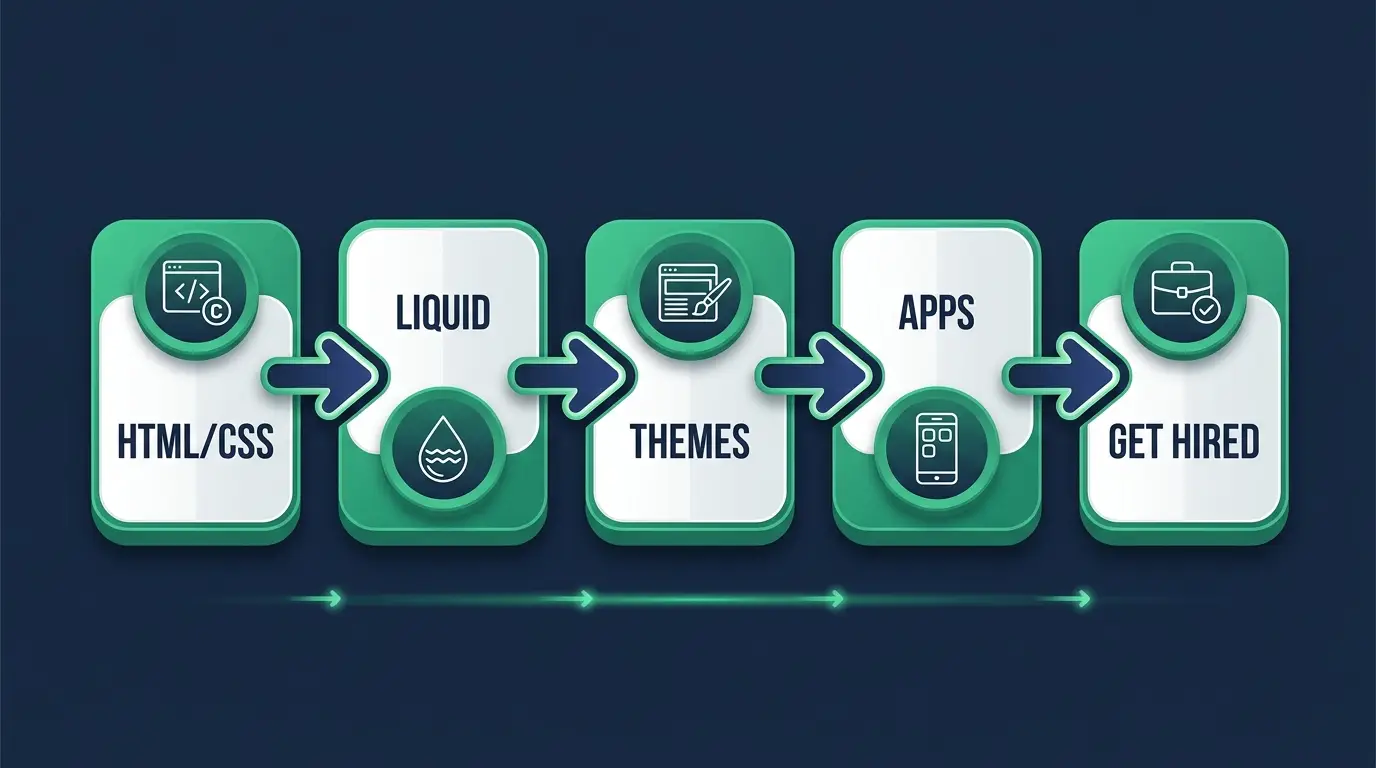
The skills, in the order that actually works
People try to learn this backwards. They jump straight into Liquid and get lost because they skipped the foundation. Do it in this order.
1. HTML and CSS first. This is the whole game for storefronts. A Shopify theme is HTML and CSS with a templating layer on top. If you can build a clean, responsive product card from scratch, you're already most of the way to being useful. Don't rush past this.
2. JavaScript, the practical kind. You don't need to architect a framework. You need to handle a click, fetch from an endpoint, update the cart without a page reload, and not break the page when something's missing. Vanilla JS gets you far here.
3. Liquid. This is Shopify's templating language, and it's how the theme talks to store data. Products, collections, variants, metafields. Liquid is where "I know HTML" becomes "I can build a Shopify store." It's learnable in days once your fundamentals are solid.
4. Theme architecture, specifically Online Store 2.0. This is the modern theme system: JSON templates, sections everywhere, app blocks. Learn how sections, snippets, templates, and the theme settings schema fit together. This is what separates someone who edits a theme from someone who builds one.
5. The Shopify admin. You can't develop for a tool you don't understand from the merchant's seat. Spin up a free development store. Add products, set up metafields, configure navigation, install apps. Live in the dashboard until it's boring.
6. App and API basics. You don't have to become an app developer to get hired, but you should understand the Storefront API, the Ajax cart API, and what an app actually does. This is where mid-level money starts.
7. Performance and CRO. Lighthouse scores, lazy loading, cutting render-blocking junk, trimming app bloat. This is the skill that pays for itself.
If you want a curated kit instead of guessing, I broke down the best Shopify developer tools I actually reach for.
A realistic timeline
Here's the honest version, not the bootcamp-ad version.
With consistent daily effort, 1 to 3 months to job-ready is normal. The range is wide on purpose, because it depends on two things: where you're starting and how many hours you put in.
If you already know HTML, CSS, and some JavaScript, you can be doing real Shopify work in 4 to 6 weeks. Liquid sits comfortably on top of fundamentals you already have.
Starting from zero, give it closer to 3 months. The first month is fundamentals. The second is Liquid and theme architecture. The third is building real projects and polishing a portfolio.
More focused hours per day compresses that timeline. Someone treating this like a full-time effort moves faster than someone doing an hour after work. Both arrive. One just gets there sooner. There's no shortcut that skips the reps.

How to actually get hired
A certificate doesn't get you hired here. Proof of work does.
Build three to five real stores. Not tutorials you followed. Real builds where you made decisions. A custom homepage section. A product page with metafields driving a feature. A store you made measurably faster. Need direction? I collected Shopify developer portfolio examples worth modeling.
Pick the path that fits you. Agencies are the fastest on-ramp because they need volume and will train you. DTC brands hire in-house developers and pay well for someone who understands their store deeply. Freelance and Upwork let you start earning while you're still leveling up. Shopify Plus partners handle the biggest merchants and pay the most, but they want experience.
Apply before you feel ready. The student from the top of this post got that $85k role. He wasn't "ready." He had four solid builds and could talk about every decision in them.
For where these roles actually live, see remote Shopify developer jobs and the full ecommerce specialist career path.
What you'll earn
Real US numbers, not inflated screenshots.
- Entry level: roughly $60k to $80k. Theme customization, fixing bugs, building sections.
- Mid level: about $80k to $110k. You own builds, handle integrations, and touch APIs.
- Senior: $120k to $150k and up. Custom themes, app work, performance, leading projects.
The typical working range lands around $75k to $140k, with freelancers above or below depending on how they price and who they serve. A specialist who can prove they raised a store's conversion rate charges what a generalist can't. I went deeper in the Shopify developer salary guide.
The honest tradeoffs
I won't sell you a brochure. Here's what's real.
You're tied to one platform. Your Liquid and Online Store 2.0 knowledge is Shopify-specific. That's the deal you're making: faster to learn, narrower in reach. It's a great trade early on, but know you're making it.
Some theme work is repetitive. "Move this section, change that color, add a banner." Plenty of days look like that. The interesting work, custom features and performance, you have to grow into.
Liquid is a constrained language on purpose. It's safe and simple, which also means limited. You'll occasionally hit a wall where you wish you had a real backend, and you'll route around it with apps or the Storefront API.
None of these are dealbreakers. They're the texture of the job. If you want a fuller weighing of it, read is Shopify development a good career and how it stacks up in Shopify developer vs web developer.
Here's the line I'd tattoo on a sticky note for you: Shopify pays you to be the bridge between a brand's vision and what a store can actually do. The closer your work sits to their revenue, the more you're worth.
FAQ
Do I need a computer science degree to become a Shopify developer? No. Almost nobody in this field has one. Employers and clients care about whether you can build and fix a store, and a portfolio answers that better than a diploma.
How long does it take to learn Shopify development? With consistent effort, 1 to 3 months to job-ready. Faster if you already know HTML, CSS, and JavaScript, since Liquid layers right on top.
Do I need to know how to code before learning Shopify? You need the basics, and you'll learn them as step one. HTML and CSS come first, then JavaScript, then Liquid. You don't need to be an advanced programmer to start.
Is Shopify development still in demand in 2026? Yes. The platform keeps growing, brands keep launching stores, and most can't maintain them alone. Developers who understand performance and conversion are especially sought after.
Can I make money freelancing as a Shopify developer? Yes, and it's one of the faster ways to start earning. Small theme fixes and custom sections are steady freelance work, and rates climb as you specialize.
Are Shopify certifications worth doing? Some are useful for credibility with clients and none of them substitute for a store you built. The breakdown is in Shopify developer certifications.
Where are the actual jobs? Four separate markets that want different things from you: agencies, in-house brands, app companies, and freelance. They're mapped out in Shopify developer jobs.
If you read all this and thought "okay, I could actually do that," you're right. The path is clearer than almost any other route into tech, and the pay is real.
Start with the fundamentals, build real things, and let your work do the talking. That's exactly how we teach it inside codingphase, step by step, with nobody left to figure it out alone. Come learn with us, and let's get your first store shipped.