Shopify Developer Salary: What You'll Actually Make (2026 Guide)
On this page
Okay, but what does building Shopify stores actually pay?
That's the question under every other question. People dress it up as "is this a good career" or "is it worth learning Liquid," but what they really want to know is the number. Will this cover rent. Will this replace the job I hate. Can I make real money here, or is it side-hustle territory.
So let me answer it straight, because nobody seems to.
A junior Shopify developer at a small agency lands somewhere around $65k to $75k. A solid mid-level dev who knows Liquid, the theme architecture, and a bit of app work clears six figures in a lot of markets. And the freelancers who niche down and treat it like a business? Some of them out-earn both, by a wide margin.
Those ranges hide a lot, though, and the honest version has more texture than a single number. Let me break it down properly.
The honest ranges first
I'll lead with the truth most salary articles bury: these are ranges, not promises. Two people with the same title can make $40k apart because one only edits themes and the other ships custom apps. Keep that in your head as you read.
Here's roughly where US Shopify developers land right now:
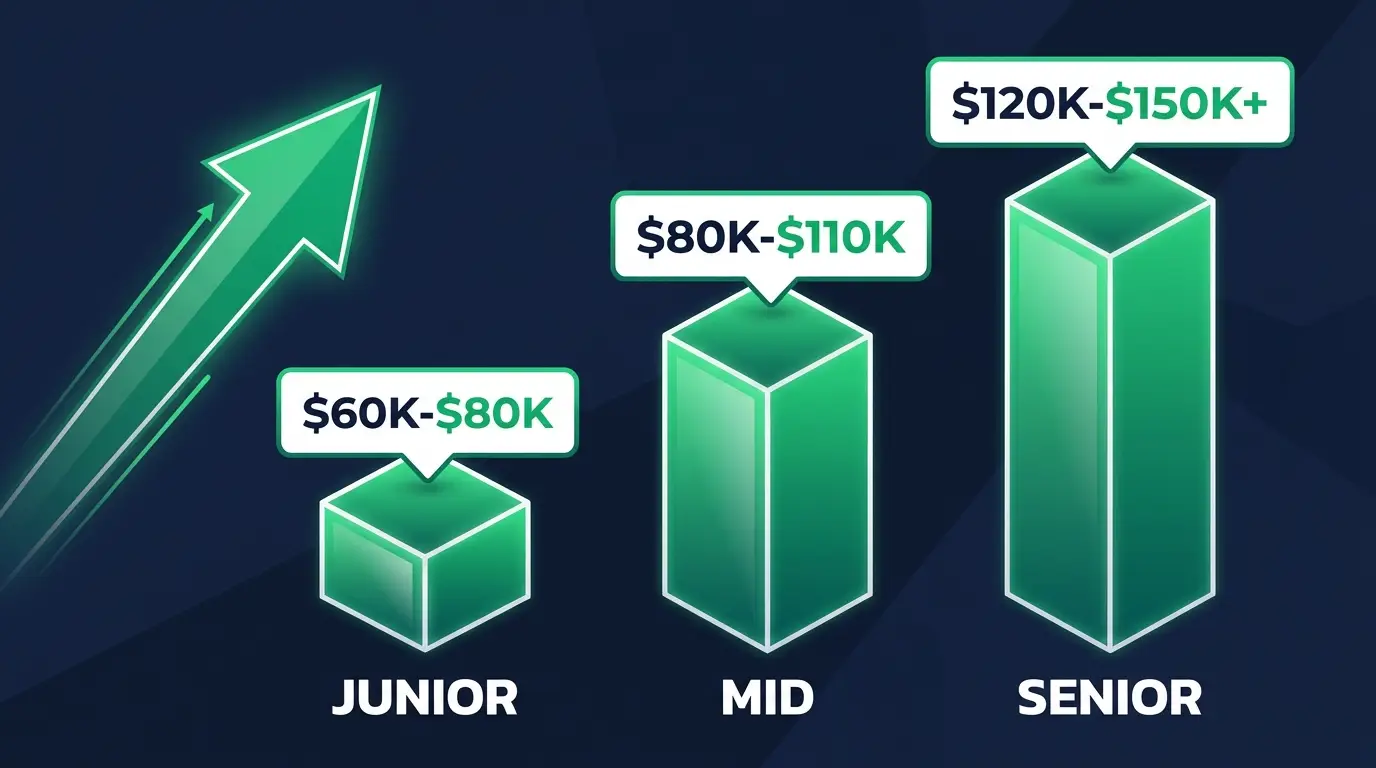
- Entry / junior: around $60k to $80k
- Mid-level: around $80k to $110k
- Senior: around $120k to $150k, and higher at the top
- Freelance / contract: commonly $50 to $120 an hour
The typical Shopify developer overall sits somewhere between $75k and $140k. Where you fall in that spread is mostly about what you can build, not how long you've been around.
What you make at each level
Junior ($60k to $80k). You're comfortable in Liquid, you can take a Figma file and turn it into a working theme, you fix bugs and tweak existing sites. You're useful, you're just not trusted with the scary stuff yet. Your friend's offer at $72k? Right in the pocket. Not lowballed.
Mid-level ($80k to $110k). Now you own projects. You build custom theme sections from scratch, you've touched the Storefront API, you know why a page is slow and how to fix it. Agencies stop checking your work as closely. This is where most working Shopify devs spend a few years.
Senior ($120k to $150k+). You build apps, not just themes. You're fluent in the API, you architect solutions for stores doing real revenue, and clients ask for you by name. At the top end, senior Shopify engineers at product companies and big agencies clear $160k or more, especially with equity in the mix.
The jump from mid to senior is the biggest pay leap in this whole path. It's also the one most people stall on, because it requires leaving the comfort of theme work.
What actually moves the number
Title and years matter less than this list. These are the things that drag your salary up:
- Liquid and theme depth. Table stakes. It gets you in the door, but on its own it caps you. Theme-only developers are the most common and the easiest to replace, which is exactly why they're paid the least.
- App and API development. This is the real lever. The moment you can build custom apps with Remix, hit the GraphQL Admin API, and handle webhooks, you stop competing with the crowd. Pay climbs fast here.
- Shopify Plus and enterprise. Plus stores run a business's whole operation. Companies pay a premium for someone who's worked with checkout extensibility, B2B, and high-traffic launches without breaking anything.
- Performance and conversion skills. If you can show a merchant their store loads faster and converts better after you touched it, you're no longer a cost. You're a revenue line. That changes the negotiation completely.
- Theme-only vs app-builder. I'll say it plainly because it's the whole game: theme-only work pays the least, app and Plus work pays the most. Most of your raise lives in that gap.
That's the reframe I want you to keep: on Shopify, you don't get paid for time on the platform, you get paid for what you can build on it.

Employee vs freelance
Two different lives, both valid.
As an employee, you trade ceiling for stability. Steady paycheck, health insurance, paid time off, and the gift of not chasing invoices. A mid-level employee at $95k is doing fine and sleeping fine.
As a freelancer or contractor, $50 to $120 an hour sounds wild until you do the math on the unpaid parts. The hours you spend finding clients, writing proposals, and waiting on payments don't bill. Plus you cover your own taxes, software, and the months that are quiet.
Here's the honest version. A freelancer at $90/hour who bills 25 solid hours a week, after the dry spells and the admin, often lands in roughly the same place as a $110k employee, just with more freedom and more stress. The freelancers who genuinely out-earn employees are the ones who specialize, in Plus, in apps, in conversion, and stop selling hours to anyone with a credit card.
Location and remote
This job is one of the better ones for geographic arbitrage.
Shopify work is remote-friendly by default. The agencies are distributed, the clients are everywhere, and most of the work happens in a browser and a code editor. That means you can live somewhere affordable and still earn close to big-city rates.
A developer in a lower cost-of-living city, working remotely for a coastal agency or international clients, often comes out ahead of someone paying $3,000 a month in rent for a slightly bigger number on the offer letter. Take-home and quality of life beat the headline figure. I've watched students in smaller markets quietly do better than friends grinding in expensive cities.
The catch: remote means you're competing globally. You can't be just okay. You have to be clearly good, and you have to communicate well in writing, because that's how remote teams judge you.

How to actually increase your salary
Skip the vague advice. Here's what reliably moves your pay, in order of impact:
- Learn app development. Pick up Remix, the GraphQL Admin API, and how to build and deploy a real app. This is the single biggest raise available to a theme developer. It's also where the fewest people bother to go.
- Get Shopify Plus experience. Volunteer for the Plus project at your agency. Learn checkout extensibility and B2B. Plus on your resume reads as "trusted with real money."
- Add conversion and performance. Learn to measure and improve load times and conversion rates. When you can tie your work to revenue, you stop negotiating like a contractor and start negotiating like a partner.
- Build a portfolio that proves it. Two or three real stores beat any certificate. Show before-and-after, show the app you built, show the speed numbers.
- Specialize, then raise your rate. Generalists get average pay. "The Plus migration person" or "the headless Hydrogen dev" sets their own price.
If you're earlier than all of this, start at the beginning with how to become a Shopify developer, then come back to this list.
An honest reality check
I'm not going to sell you a fantasy.
Shopify pay is platform-dependent. Your income is tied to one company's ecosystem staying healthy and merchants spending on custom work. That's mostly a good bet right now, but it's a real concentration of risk you should name out loud. Broadening into general web skills is your insurance.
Theme-only work is getting squeezed. Page builders and AI tools handle more of the simple stuff every year. If your whole skill set is "I move sections around in Liquid," your pay will feel the pressure. That's not fear-mongering, it's just where the floor is heading.
And AI is changing the work, not erasing it. It writes Liquid snippets and boilerplate faster than you can. But it doesn't architect a Plus migration, debug a checkout extension under launch pressure, or own the outcome when a client's store goes down on Black Friday. The developers who use AI to move faster are pulling ahead. The ones who fear it are falling behind. Pick which one you want to be.
If you're still weighing the path itself, I wrote a full take on whether Shopify development is a good career that pairs with this.
FAQ
How much does a Shopify developer make in the US? Most US Shopify developers earn between $75k and $140k. Juniors start around $60k to $80k, mid-level sits at $80k to $110k, and seniors reach $120k to $150k and beyond. The range is wide because it tracks what you can build, not your title.
Can you make six figures as a Shopify developer? Yes, and it's common at the senior level. The fastest route is app and API development plus Shopify Plus experience. Theme-only developers rarely cross $100k, while app builders and Plus specialists clear it regularly.
Is freelance Shopify development worth it? It can be, at $50 to $120 an hour, but the headline rate hides unpaid time on sales, admin, and dry months. Specialized freelancers out-earn employees. Generalists usually land about even, with more freedom and more uncertainty.
Do I need a degree to earn well as a Shopify developer? No. Pay here follows your portfolio and your skills, not your diploma. Real stores you've shipped, an app you've built, and proof you improved a client's revenue matter far more than a degree.
What's the highest-paying Shopify skill? Custom app development with Remix and the GraphQL API, especially combined with Shopify Plus and conversion work. That stack moves you out of the crowded theme market and into the part of the ecosystem that pays the most.
If you're sitting on an offer and wondering if it's fair, or you're staring at the jump from theme work to apps and not sure where to start, that's exactly the kind of thing I built codingphase for. Come look at the remote Shopify developer jobs worth chasing and the full ecommerce specialist career path, and let's get you to the number you actually deserve. You're more ready than you think.