Shopify Developer vs Web Developer: Which Path Pays Off Faster?
On this page
You're learning to code, and now you're stuck on the question before the question: do you go wide as a general web developer, or do you niche down into Shopify? You can feel the stakes in it. Pick wrong and you've burned a year of your life on the harder road.
Here's what nobody tells you when you ask that out loud. The HTML, CSS, and JavaScript underneath both paths are basically the same. The skills aren't what splits them. What splits them is the pond you decide to swim in.
Go the "junior web developer" route and you're doing what everybody is told to do. Polish React projects, apply to everything, and a year later you might still be applying, competing with 300 other people for one posting, getting ghosted, wondering if you wasted the time.
Go all-in on Shopify and the math changes. Liquid, theme customization, app integrations, the boring backend stuff store owners actually pay for. Fewer people specialize in it, so the line behind you is shorter, and your work plugs straight into someone's revenue.
So let's actually settle this one. Which path pays off faster, and who each one is really for. No hype, just the real tradeoffs.
The one-line difference
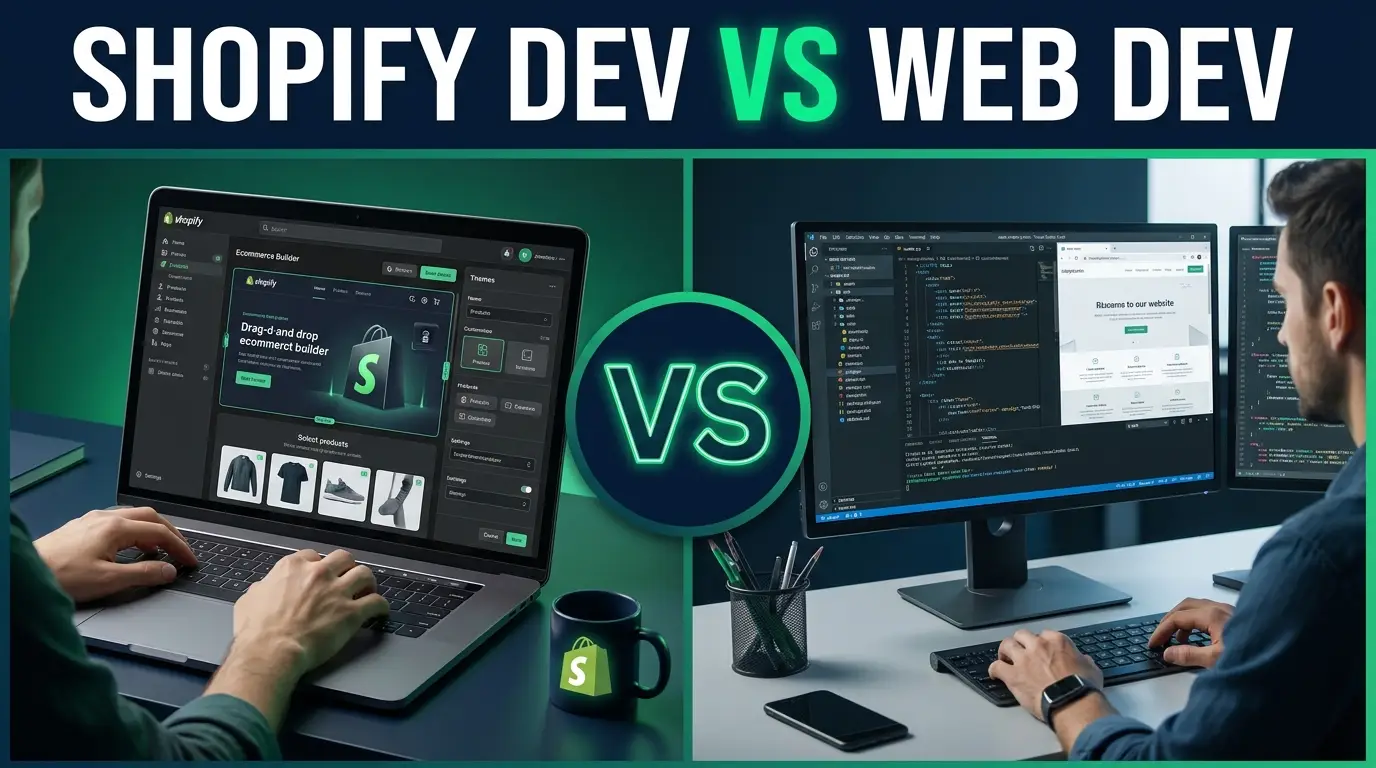
A web developer learns a broad, portable skill set that works anywhere. A Shopify developer learns one commerce platform deeply, where the work plugs straight into someone's sales.
Breadth versus leverage. That's the whole fight.

What each one does day to day
A general web developer builds and maintains websites and web apps. HTML, CSS, JavaScript, then a framework or two (React, Vue, maybe a backend like Node or Laravel). One day you're styling a marketing page, the next you're wiring up an API, the next you're debugging a state bug nobody can reproduce. The work is varied and the stack is yours to carry from job to job.
A Shopify developer lives inside the Shopify ecosystem. You build and customize themes with Liquid (Shopify's templating language), tweak checkout flows, integrate apps, set up custom sections, and sometimes build private apps with their API. Your client is almost always a store owner, and your work has a number attached to it: their revenue.
Same core skills underneath. Both of you write HTML, CSS, and JavaScript. The difference is everything wrapped around it.
The honest head-to-head
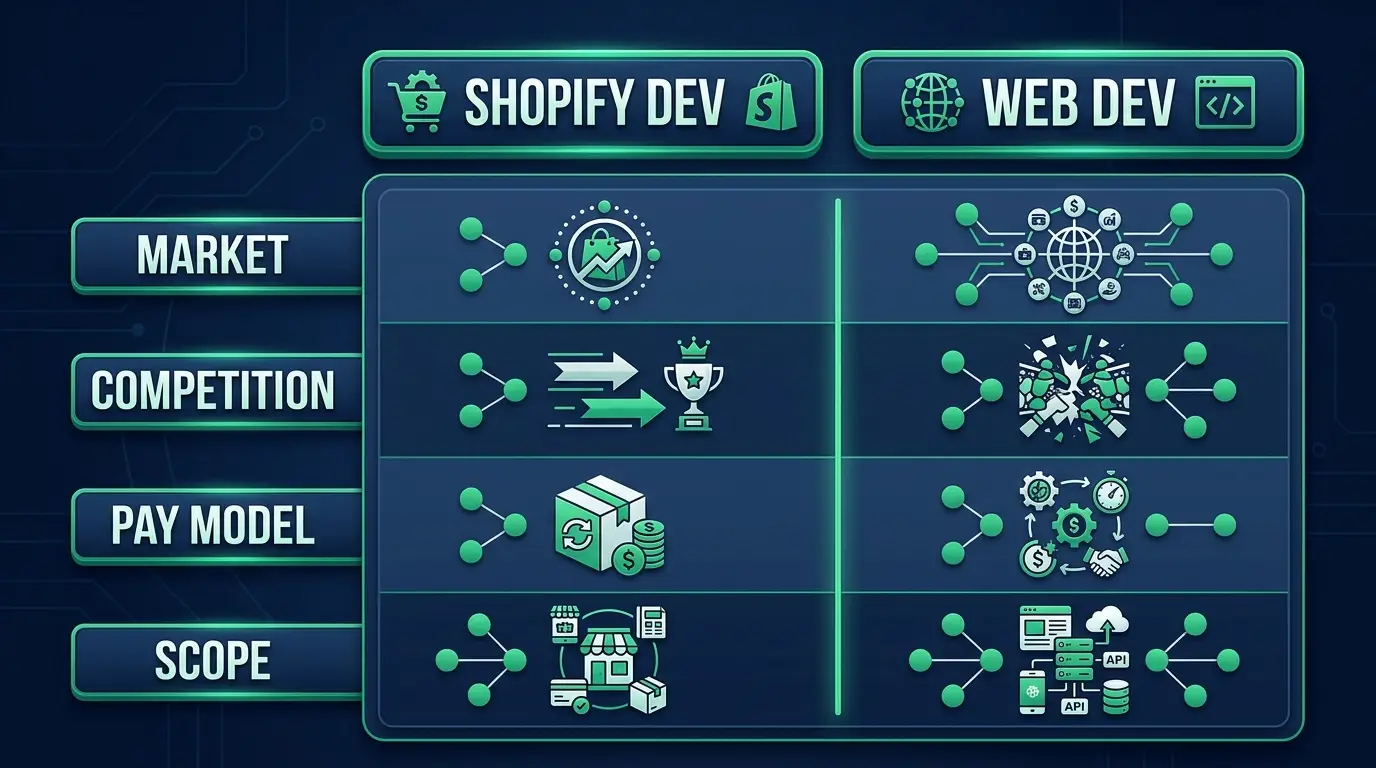
Saturation and competition. This is the big one. "Learn web development" has been the default advice for a decade, so the entry-level pool is packed. Every bootcamp graduates another cohort of React developers into the same job listings. Shopify is narrower on purpose, and fewer people specialize in it, so when a store needs Liquid work, the line behind you is shorter. Thinner competition is real leverage when you're starting out.
How you get paid. A web dev role is usually salaried or billed by the hour, and your pay tracks your seniority. A Shopify developer's work ties directly to a store making money, and that changes the conversation. Fixing a broken checkout or speeding up a slow theme isn't a cost to the client, it's more sales. When your work is attached to revenue, you can charge for the outcome, not just the hours. That's the pay ceiling people miss.
Breadth versus niche. General web dev is a Swiss Army knife. You can build anything for anyone, and your skills move with you across industries. Shopify is a scalpel. Incredible inside its lane, useless outside it. That focus is exactly why you get hired faster, and exactly why it's a smaller world.
Learning curve. Web dev's curve is long and lumpy. There's always one more framework, one more tool, one more thing that's suddenly "the standard." Shopify gives you a defined box: learn Liquid, learn the theme structure, learn the app ecosystem, and you can be billing clients in months instead of years. Less to learn before you're useful. Less to keep up with after.
Job security. Here's where general web dev pulls ahead. Your skills aren't tied to one company's roadmap. Frameworks change, but the fundamentals carry you anywhere. Shopify developers carry platform risk: you're betting on one company staying dominant. Shopify is huge and growing, so that bet looks safe today. But it's still a bet on someone else's business, and that's a tradeoff you should name out loud before you commit.
Here's the line I want you to keep: breadth gives you options, but a niche gives you leverage. Early on, leverage usually pays the rent faster.

Where they overlap
Don't treat these as rival universes. They share a foundation.
Both need solid HTML, CSS, and JavaScript. Both need to think about performance, responsive design, and clean code. A strong Shopify developer is a web developer who picked a lane. And a web developer can add Shopify later as a high-value specialty without starting over.
The skills compound. Nothing you learn on one side is wasted on the other.
The verdict: pick X if, pick Y if
Pick Shopify development if you want income sooner, you'd rather go deep on one thing than chase ten, and you like the idea of work that's tied to real business results. It's less saturated, the freelance path is faster, and "I make store owners more money" is an easy thing to sell. If you're trying to quit a job you hate and replace that income this year, this is usually the faster road.
Pick general web development if you want maximum flexibility and the highest long-term ceiling. You don't want your career tied to one platform, you're excited by variety, and you're playing a longer game toward senior or specialized engineering roles. More competition up front, more room to climb over a decade.
If you genuinely can't choose: start with the web fundamentals, then specialize in Shopify. You get the portable base and the niche leverage. That combination is rare, and rare gets paid.
FAQ
Is Shopify development easier than web development? The starting box is smaller, so you get productive faster. But "easier to start" isn't "easy." Liquid, theme architecture, and the app ecosystem still take real practice. You're learning less breadth before you can charge, not doing simpler work.
Do Shopify developers make more than web developers? It depends on the model. Salaried web dev roles often look higher on paper. But Shopify freelancers can out-earn salaried devs because they charge against a client's revenue, not their own hours. The ceiling is high on both sides for different reasons.
Can I switch from Shopify developer to web developer later? Yes, and it's a natural move. You already know HTML, CSS, and JavaScript. You'd add a framework and broaden your backend knowledge, but you're not starting from zero. The reverse works too. Read is Shopify development a good career for the long view.
Which has better job security? General web development, narrowly. Your skills aren't tied to one company's platform. Shopify carries platform risk, even though Shopify itself is strong and growing right now. Weigh that honestly before you commit.
Do I need a degree for either one? No. Both are portfolio-first careers. Real projects and shipped work beat a diploma in this field. A store you actually built or a site that actually works will do more for you than a transcript.
If you're leaning toward the commerce niche, start with the practical roadmap in how to become a Shopify developer, or follow the full ecommerce specialist career path we built to take you from first line of Liquid to paid client work.
Whichever path you pick, the worst move is staying stuck in the tabs-open-comparing stage. Pick one, build something real this week, and let momentum decide the rest. I've seen where both roads lead, and they both go somewhere good when you actually start walking. I'm rooting for you either way.