Is Ecommerce a Good Career? An Honest Answer With the Downsides Included

On this page
The short version: for most people asking this question, yes, and the reasons are unusually concrete.
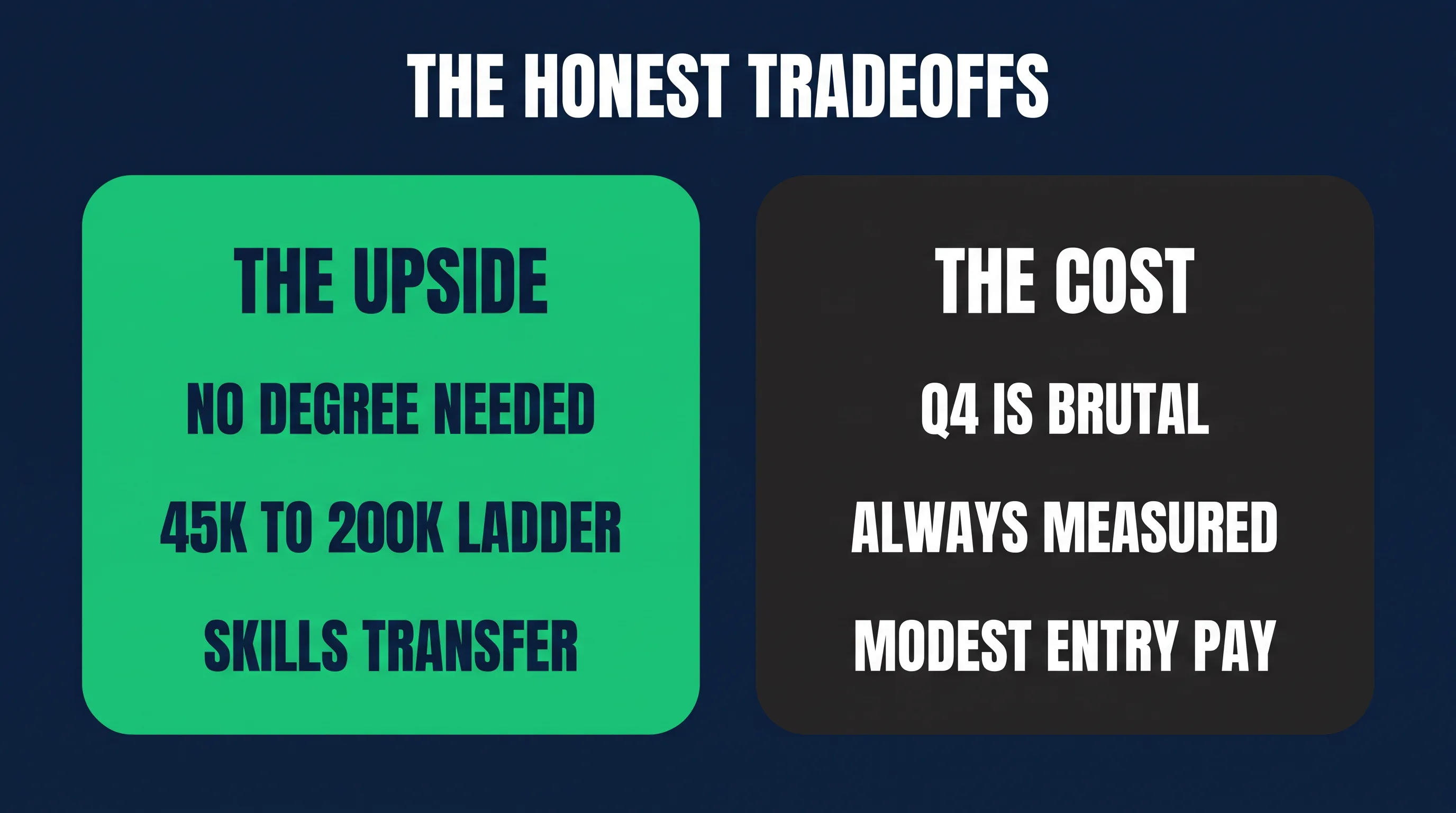
It hires without degrees. The entry roles are genuinely reachable from retail, customer service, and admin work. The ladder runs from about $45k to past $200k, and the skills transfer across every industry that sells something online, which is nearly all of them.
But I'd rather give you the full answer, including the parts that would make me tell someone not to do it.

The case for it
The on-ramp is real. Most tech-adjacent careers ask you to spend a year learning before anyone will pay you. Ecommerce has genuine entry-level jobs, assistant and coordinator roles at $40k to $65k, that hire people with no ecommerce background at all. You learn the rest on payroll.
The ladder is long and the rungs are close together. Assistant, specialist, manager, senior manager, director. Each step is one to three years and each adds meaningful money. The full map is here.
Nobody cares about your degree. They care whether you've had your hands on a store. That's a fairer test than most fields apply and it's one you can pass by yourself in a few months.
It's measurable, which protects you. When budgets get cut, roles nobody can measure go first. Ecommerce sits on top of a revenue number that everyone watches. That's uncomfortable day to day and it's excellent job security.
The skills travel. Every industry sells online now. Someone with real ecommerce operating experience can move between food, fashion, industrial supplies, and software without starting over.
You can branch. If the operations side suits you, operations management pays well. If it's the data, analytics. If it's building, development. If it's deciding, product or director. Few careers offer that many exits from the same starting point.
The case against it
Q4 is not negotiable. October through December, the store is the business. Long days, weekend monitoring, no holidays in December. Every year, for as long as you stay in the field. If you have caring responsibilities or health constraints that make that impossible, take this seriously rather than assuming you'll manage.
You're measured constantly and publicly. Conversion is on a dashboard the whole company can see. There is no quiet quarter where nobody notices. Some people find that clarifying, others find it corrosive.
You'll own outcomes you don't control. Marketing sends bad traffic, a supplier misses a date, an app update breaks checkout on a Saturday. Still your number.
The middle can stagnate. A specialist who never learns the technical side or the analytical side can do the same product uploads for four years with incremental raises. This is the single most common way people waste this career.
Entry pay is modest. $40k to $55k to start is a real number, and if you're leaving a job that pays more, the first year is a step down before it's a step up.
Will AI take these jobs?
The honest answer is that it's already changing them, unevenly.
Genuinely exposed: writing hundreds of product descriptions, basic customer service responses, routine reporting. If your job is producing repetitive text or assembling the same report weekly, that portion is shrinking.
Largely unaffected: operations, because physical goods still have to move and integrations still break. Merchandising judgment, because knowing what to feature requires understanding margin and stock and customers. Anything technical, because someone has to build and fix the systems. And decisions, because nobody is letting a model decide the promotional calendar.
The pattern across the whole field is the same one I keep coming back to: the parts that involve producing volume are under pressure, and the parts that involve building, deciding, or diagnosing are getting more valuable.
Which means the practical answer to "is this a safe career" is: it depends on which half of it you learn.
Who it suits
Retail and service workers moving into an office career. Best fit on this list. You already understand customers, inventory, and why the promotion confused people.
Career changers who want speed. Six months to employability is realistic, which very few technical careers can match.
People who like breadth. Ecommerce touches marketing, operations, data, and technology at once.
People who want to run their own thing eventually. You're being paid to learn how online businesses actually work.
Who it doesn't
People who need a predictable calendar. See Q4.
People who want deep specialization in one craft. Most ecommerce roles are broad by nature. Go into engineering or design if depth is what you want.
People who dislike being measured. The dashboard is not going away.
People who want to avoid technology. You can start non-technical. You cannot reach the top of the pay range without picking up real technical skill, and the people who resist that are the ones who plateau.

How long it takes and what to do first
Three to six months of focused work to be employable in an entry role, if you're building rather than just studying.
The sequence that works: build a real store on Shopify with actual products and a working checkout. Install analytics and learn to read them. Set up email flows. Then do the same for one small business, even for free, so you have a case study with numbers.
That package gets you interviews for assistant, coordinator, and junior specialist roles. From there it's one to two years to specialist, three to four to ecommerce manager.
If you want it structured rather than assembled from tutorials, our Ecommerce Specialist path teaches building stores first and running them second, which is the combination that gets past the entry level fastest.
FAQ
Is ecommerce a good career in 2026? For most people entering from retail, service, or admin backgrounds, yes. It hires without degrees, the ladder runs from $45k to over $200k, and the skills transfer across industries. The main costs are peak season intensity and constant measurement.
Is ecommerce a stressful job? Seasonally. Q4 and site launches are genuinely stressful because revenue stops when something breaks. Most other months are manageable.
Does ecommerce pay well? Entry roles are modest at $40k to $55k. Managers earn $75k to $110k, operations and product roles more, and directors $130k to $200k and up. The slope matters more than the starting point.
Do I need a degree for ecommerce? No. It's one of the more credential-blind fields. A live store you built does more for you than a marketing degree.
Will AI replace ecommerce jobs? It's absorbing the repetitive production work: bulk product copy, routine support, standard reporting. Operations, merchandising judgment, technical work, and decision-making are all holding or growing.
How do I start with no experience? Build a store, learn analytics and email, then run it for one small business so you have real numbers. Three to six months is a realistic timeline to your first job.
If you're weighing this against other career changes, here's the comparison I'd make. Ecommerce is not the highest paying thing you could learn, and it's not the most prestigious. It is one of the few where a person with no degree and no network can be employable in six months and earning six figures in five years.
That combination is rarer than it sounds. The people who do best with it are the ones who take the modest first job quickly and then refuse to stay generic.