Ecommerce Director: The Ceiling of This Career and What It Takes to Get There

On this page
Somebody uploading products for $45k and somebody running the whole online channel for $190k are on the same ladder. That's the thing about ecommerce that makes it worth entering.
This post is about the top of that ladder, because it's useful to know what you're aiming at, and because the jump from manager to director is the one where the job stops being about stores and starts being about a business.

What the job is
An ecommerce director owns the online channel as a business unit.
Not the site. The channel. Revenue, margin, budget, headcount, platform strategy, and how the online business fits with retail, wholesale, or whatever else the company does.
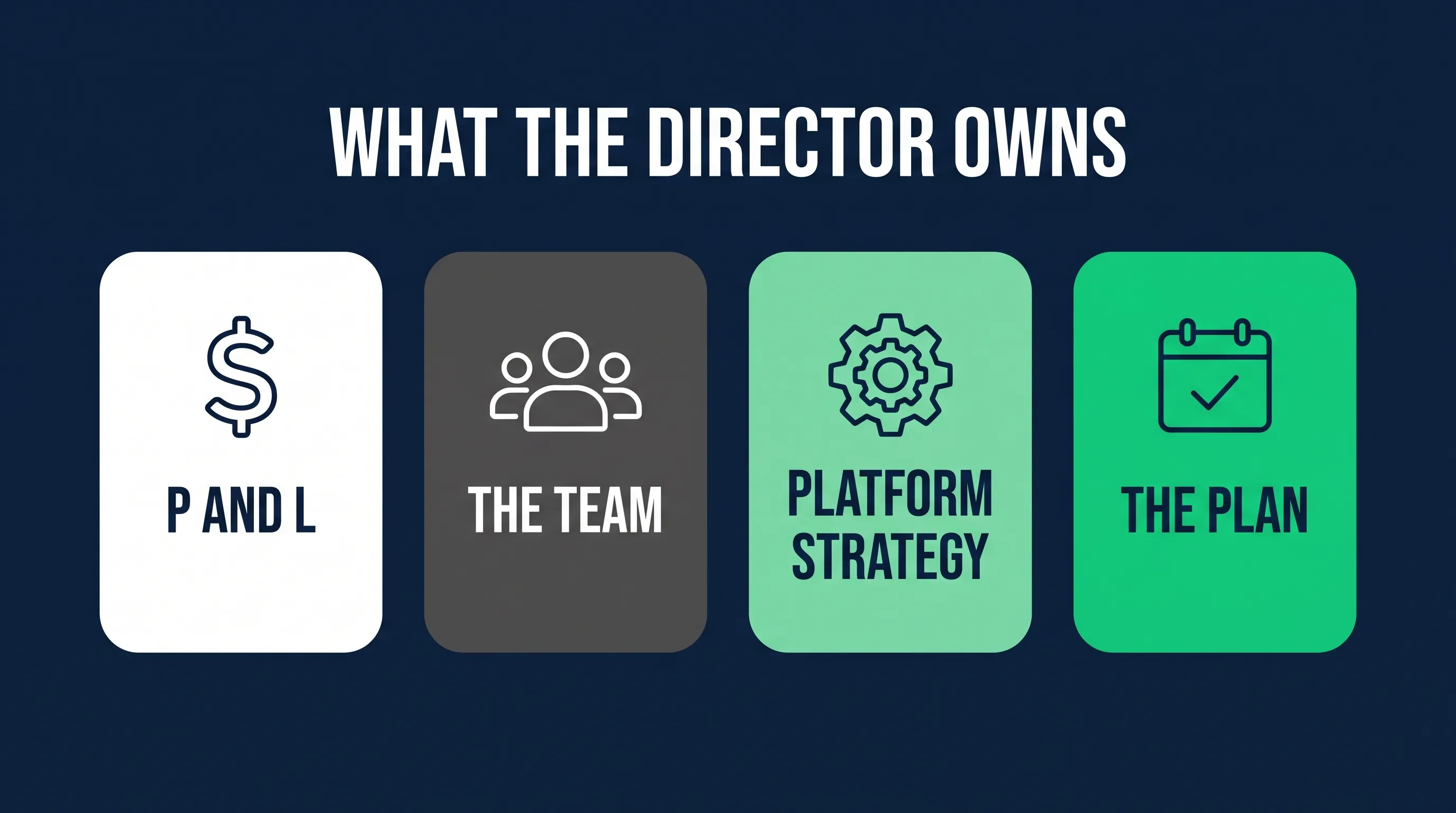
The concrete list: setting the annual and quarterly revenue plan and being accountable for hitting it, owning the P&L including marketing spend and often fulfillment costs, deciding the platform roadmap, hiring and managing the team, and representing ecommerce in the rooms where budget gets allocated.
That last one surprises people. A big part of a director's job is internal: making the case for investment, defending the channel's budget, and getting other departments to do things that help the online business.
What actually changes from manager to director
You stop touching the site. This is the biggest adjustment and where a lot of good managers struggle. You'll still know how everything works, but the moment you're fixing product pages yourself you're doing your team's job and not doing yours.
You own margin, not just revenue. Managers optimize conversion. Directors have to care whether the conversion came from a discount that destroyed the margin, and whether shipping is eating the difference.
Your calendar fills with people. Hiring, one-to-ones, performance conversations, cross-department meetings. If you took this career because you liked building things, be honest with yourself about that trade.
Your timeline stretches. Managers think in weeks and campaigns. Directors think in quarters and years, and the biggest decisions you make, replatforming, entering a new market, restructuring the team, take twelve to eighteen months to pay off.
The politics become real. Not in a cynical way. When you're deciding budget between channels, other directors want that budget, and being right is not sufficient. You need to be persuasive with numbers.
What it pays
$130k to $200k base for most US ecommerce directors, and higher at large retailers or high-growth brands.
On top of that: bonus, typically 15 to 30 percent tied to channel performance, and equity at venture-backed and public companies. Total compensation at the upper end of this role passes $250k.
The spread is driven almost entirely by channel size. Directing a $5m online business and directing a $200m one are different jobs with the same title, and the market prices them accordingly. If you want the number to go up, run a bigger channel, which is often a company change rather than a promotion.
Below this sits the ecommerce manager role at $75k to $110k, with the full ladder in the ecommerce jobs guide and detailed numbers in the salary guide.
The three routes in
Up from ecommerce manager. The most common, and it takes five to eight years from first entry-level job in most cases. What separates the managers who get there: they started thinking in P&L terms before anyone asked them to, and they made themselves visible outside their own team.
Sideways from a general management or retail leadership role. Retail buyers, category managers, and merchandising directors move into ecommerce leadership frequently. They arrive strong on margin and product and weak on the technical side, and the good ones close that gap fast.
In from an agency or consultancy. Someone who has led ecommerce programs for a dozen brands has seen more platform migrations and Q4s than any in-house manager. Brands hire this profile deliberately when they're about to do something big.
There's a fourth route people don't talk about: running your own store to real scale and then joining a company. It's less common, but a founder who took a brand to $3m has genuinely done the job, and some companies value that above a corporate résumé.
What gets you promoted into it
Three things show up every time.
You ran a number, not a function. "I owned the online channel's revenue target and hit it three years running" is the sentence. Not "I managed the website."
You did something structural. A replatform, a market launch, building a team from one person to five, or fixing something that was fundamentally broken. Directors get hired on evidence they can handle change, because change is what the job is.
You can talk to finance. Margin, contribution, customer acquisition cost, lifetime value, inventory turns. Managers who never learn this vocabulary do not become directors, no matter how good they are at the operational work.
The technical depth still matters, incidentally. It stops being something you use daily and becomes something that makes you a better decision maker, because you can tell when a vendor is selling nonsense and when your team's estimate is wrong. That's the long-term argument for learning to build stores properly early, which is what our Ecommerce Specialist path is for.

The honest downsides
The hours are real and the pressure is concentrated. You own a revenue target in a channel that is measured hourly, and Q4 is not a season you get to opt out of at this level.
You're accountable for a lot you don't control. Supply chain misses a delivery date, the CMO redirects budget, the platform has an outage on Black Friday. Still your number.
And the job is less fun than the one below it for a certain kind of person. Managers ship things. Directors approve things, defend things, and wait quarters to find out if they were right. Some people find that far more satisfying and some quietly miss the work.
If you're the second kind, know that staying a strong senior manager or moving into a principal-level technical role is a legitimate choice, not a failure to advance.
FAQ
What does an ecommerce director do? Owns the online channel as a business: revenue and margin targets, budget, team, platform strategy, and representing ecommerce to company leadership.
How much does an ecommerce director make? Typically $130k to $200k base in the US, plus bonus of 15 to 30 percent and often equity. Total compensation can pass $250k at large or fast-growing companies.
What is the difference between an ecommerce manager and an ecommerce director? The manager owns the channel's performance day to day. The director owns its economics, its team, and its strategy, and answers for it at the leadership table.
How long does it take to become an ecommerce director? Commonly five to eight years from an entry-level ecommerce job, faster at small companies where you can own a channel earlier, slower at large ones with more layers.
Do you need a degree to be an ecommerce director? Less often than you'd think. At this level the résumé is results and scale. An MBA helps in large corporate environments and matters very little at brands.
Is ecommerce director the top of the career? For most people, yes. Above it are VP of Ecommerce and Chief Digital Officer roles, which exist mainly at larger companies and shift further toward org strategy and away from the channel itself.
The reason to know all this while you're still early is that it changes what you optimize for now.
If the director chair is what you want, start learning the money side sooner than feels necessary. Margin, acquisition cost, lifetime value. Most people in ecommerce spend their first five years getting very good at the operational work and only then discover that the next promotion is a finance conversation.
Learn both, and the ladder is shorter than the people ahead of you will tell you it is.