Ecommerce Manager Salary: What the Job Really Pays in the US

On this page
Most US ecommerce managers earn between $75k and $110k. That's the honest middle, and if you want one number to carry around, carry that one.
Now let me ruin it slightly, because that range hides two people making $40k apart with the same title.
One of them runs a Shopify store for a 12-person brand, reports to the founder, and does the email marketing too. The other owns a $30m channel at a retailer, manages three people, and spends half the week in planning meetings. Same words on LinkedIn. Very different jobs, very different pay.
Here's how to figure out which version of the job you're looking at, and what it should pay you.

The ranges by level
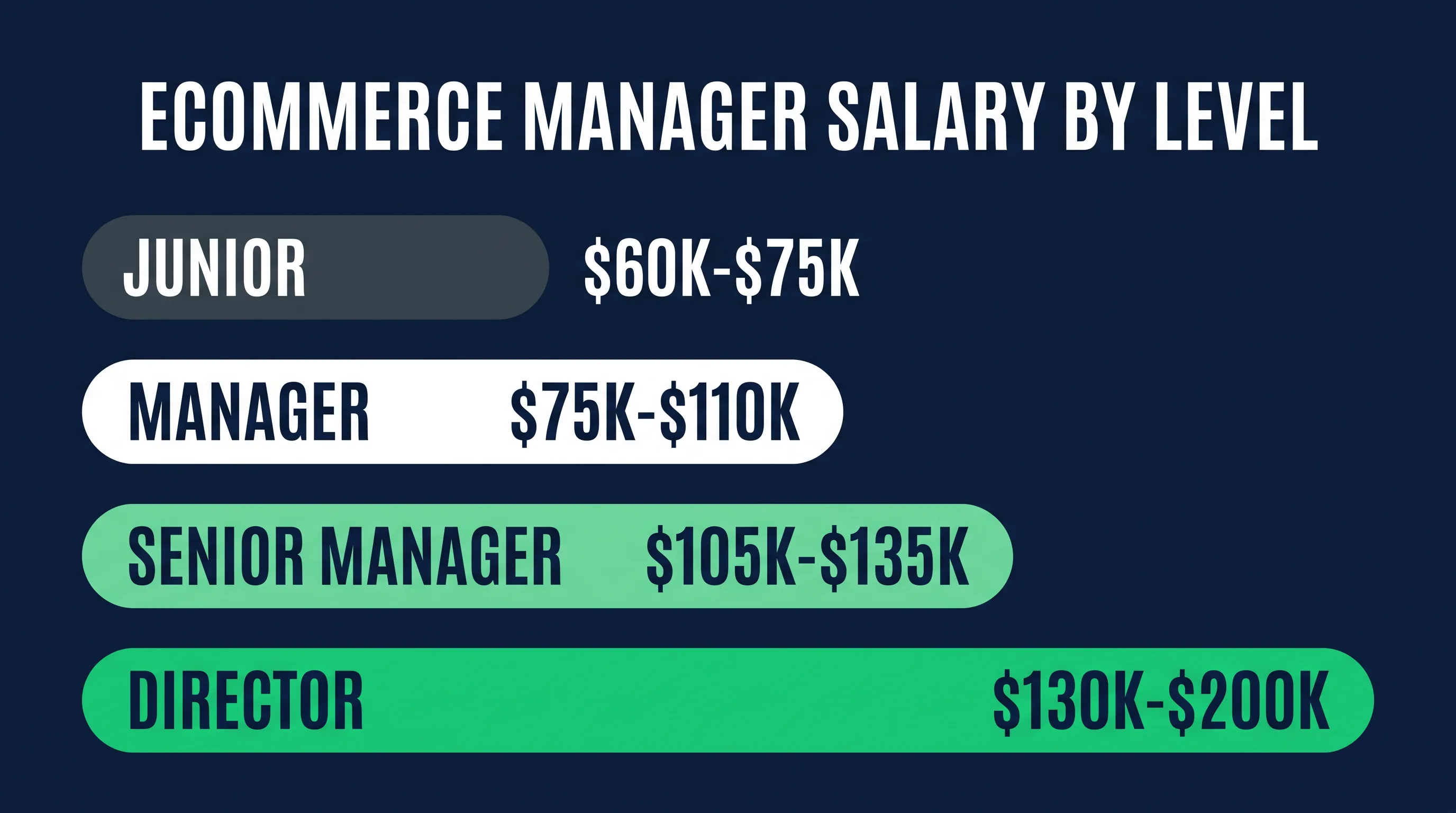
| Level | Typical US range | What you're doing |
|---|---|---|
| Junior / associate manager | $60k to $75k | Running a small store, mostly executing |
| Ecommerce manager | $75k to $110k | Owning the channel and its number |
| Senior manager | $105k to $135k | Multiple sites or regions, managing people |
| Director | $130k to $200k+ | The whole online channel, P&L and team |
Those brackets overlap on purpose. Titles are inconsistent in this field, and companies hand out "senior" for free while paying the same money.
What actually moves the number
Five things, roughly in order of how much they matter.
Company revenue. The biggest single factor, and the one people underweight. A store doing $50m pays more for the same work than a store doing $2m, because the value of a one percent conversion improvement is a hundred times bigger. If you want a raise, one legitimate strategy is simply managing a larger store.
Technical depth. The manager who can read Liquid, debug a broken app, and rebuild a product template is worth noticeably more than one who files a ticket for every change, because they ship five times as fast. This is the clearest gap I see between the $85k version of this job and the $120k version. I made the same argument about the build side in the Shopify developer salary guide, and it holds here too.
Paid media ownership. If you own an ad budget as well as the site, you're doing two jobs and should be paid accordingly. Many postings quietly include this. Read the responsibilities before you accept the band.
Team size. Managing people moves you toward the senior bracket faster than almost anything else, fairly or not.
Category. Fashion and beauty pay less than you'd hope because supply of candidates is high. B2B, industrial, and anything with complex catalogs or configurators pays better because far fewer people want to learn it. That's an easy arbitrage if you don't care what you sell.
City matters, but less than it used to
New York, San Francisco, and Seattle run roughly 15 to 25 percent above the national middle. Chicago, Boston, LA, and Austin land somewhat above it. Most of the Midwest and South sit a little below.
Remote has flattened this. Plenty of brands now hire remotely at a national band rather than a local one, which is very good news if you live somewhere cheap and very slightly bad news if you live in Manhattan. When you see a remote posting with a band attached, that band is usually the whole conversation.
What to expect at each stage of your career
Coming in from assistant or specialist. Expect the low end, $70k to $85k, and expect to be told it's because you haven't managed the channel before. That's fair for a first manager job. What isn't fair is staying there after you've delivered a year of results.
Two to four years in. $90k to $115k, and this is where the technical skills start showing up in your offers. If you've been at the same company the whole time, check the market. Internal raises in this field routinely lag external offers by ten grand or more.
Five plus years. $110k to $140k as a senior manager, or you make the jump to director and the number changes shape, with bonus and sometimes equity attached to it.
The freelance and fractional route. Running ecommerce for two or three small brands at once, typically $3k to $8k per client per month. The math can beat a salary. The tradeoff is that you're also running a business, chasing invoices, and carrying your own health insurance.

How to actually get paid more
Bring numbers. That's the whole tactic, and it's shocking how few people do it.
"I improved the site" is worth nothing in a salary conversation. "Conversion went from 1.8% to 2.4% over eight months, which is about $310k in additional revenue on the same traffic" is worth ten grand, because it lets your manager go to finance with an argument instead of a feeling.
So the work starts long before the review. Screenshot your baseline the week you start. Keep a running list of every change you shipped and what happened after. Track revenue, conversion, average order value, and page speed. When the conversation comes, you're not asking for a raise, you're presenting a case.
Second thing: know the band before you're asked. If you're asked for a number first, give a range whose bottom is a number you'd genuinely accept, because that bottom is what you'll get. Say it plainly and stop talking.
Third: get the technical skills that let you say yes to more. Every "I can't do that, we'd need a developer" is money leaving your ceiling. Our Ecommerce Specialist path exists for exactly this reason, because managers who can build are the ones who stop being capped by someone else's sprint.
What the job is worth versus what it costs you
I'd be lying if I sold this as free money. The number comes with Q4, with a dashboard everyone stares at, and with accountability for outcomes you only partly control. I wrote about that honestly in what an ecommerce manager actually does all day.
What you get in exchange is a career with an unusually short on-ramp and a real ceiling. Somebody uploading products for $45k and somebody running the channel for $180k are on the same ladder, and the distance between them is skills rather than credentials. Not many fields can say that.
FAQ
What is a good salary for an ecommerce manager? In the US, $90k or more puts you comfortably in the healthy middle for a standalone manager role at a mid-sized company. Below $70k, you're either very early or being underpaid, unless the store is genuinely tiny.
How much do ecommerce managers make in NYC? Typically 15 to 25 percent above the national middle, so roughly $95k to $135k, with senior roles at larger retailers going higher. Cost of living eats most of the difference.
Do ecommerce managers get bonuses? Often, especially at bigger companies, usually tied to channel revenue or company performance. Expect somewhere between 5 and 20 percent of base. Ask how it's calculated and whether it actually paid out last year, because plenty of plans don't.
Does an ecommerce manager make more than an ecommerce specialist? Yes, generally $20k to $30k more, because the manager owns the number and often people. The gap narrows at small companies where the roles blur.
What pays more, ecommerce manager or ecommerce developer? At the top end, developers do, especially ones building custom apps and working on Shopify Plus. In the middle they're comparable. The difference is that developer pay scales with technical depth while manager pay scales with the size of what you own. The comparison is laid out in ecommerce developer vs ecommerce specialist.
Can I get an ecommerce manager job with no experience? Directly, rarely. Through an assistant or specialist role first, absolutely, and often in under two years. The full ecommerce jobs map shows every entry point.
If you're reading this because you're about to have a salary conversation, do one thing before it: open your analytics and write down what the store looked like when you arrived versus now. Whatever those two numbers are, they're your leverage, and most people walk into the room without them.
And if you're reading it because you're deciding whether this career is worth aiming at, the answer is in the ladder. Few jobs let someone with no degree start at $45k and reach $150k on skills alone. This is one of them, as long as you keep learning the technical half that most managers avoid.