Ecommerce Manager: What the Job Is, What It Pays, and How People Get It

On this page
The number one result on Google for "ecommerce manager" is a Reddit thread where somebody asks the people already doing it what their day actually looks like.
That tells you everything. The job title is everywhere, thousands of companies are hiring for it, and almost nobody can explain what the person in the chair does between nine and five.
So let's fix that, because it's a genuinely good job and the vagueness is costing people applications.

What does an ecommerce manager do?
An ecommerce manager owns the revenue that comes through a company's online store. They watch the numbers daily, fix what breaks on the site, decide what gets merchandised and discounted, set what gets built next, and explain the results to leadership.
That's the one-sentence version stretched to two. Everything else is detail. If the store made $340k last month and the target was $400k, you're the person who has to explain why and what you're doing about it. You don't necessarily build the site. You don't necessarily write the emails. You're accountable for the number the site produces, and you have some combination of budget, tools, and people to move it.
That accountability is what separates this title from ecommerce specialist or coordinator. A specialist executes. A manager owns.
What the day actually looks like
Here's a fairly typical Tuesday at a mid-sized brand doing a few million a year online. Not a glamorous one, a normal one.
8:45am. Open the analytics dashboard before anything else. Yesterday's revenue, conversion rate, average order value, traffic by channel. You're looking for anything weird. Revenue down 20% with traffic flat means something broke. Traffic down with conversion flat means marketing changed something.
9:15am. Slack from customer service: three people couldn't check out last night on iPhone. You test it, reproduce it, and now you're triaging. Is this the new app you installed Friday? You disable it and test again. Fixed. That's maybe $4k you just saved, and nobody will ever know.
10:00am. Merchandising. The new collection drops Thursday, so you're reordering the homepage, writing the collection description, checking that every product has images at the right ratio and a description that isn't the manufacturer's copy paste.
11:30am. Meeting with marketing about the promo calendar. They want to run 20% off sitewide. You push back because margin on half the catalog can't take 20%, and you propose a tiered offer instead. This is a big part of the job that nobody tells you about: arguing about discounts with people who don't look at margin.
1:00pm. Reporting. Weekly numbers for whoever you report to, usually with a short story attached. Not "conversion was 2.1%," but "conversion dropped to 2.1% because paid social sent us a lot of cold traffic that bounced, here's what I'd change."
2:30pm. Working through the fix list. Product page loads slowly on mobile, the size guide link is broken on twelve products, the search results for "jacket" return a candle for some reason.
4:00pm. Planning Q4. It's August and you are already thinking about November, because everyone who doesn't ends up in a very bad November.
That's the job. Some days are strategy and some days are eight hours of putting out fires, and you don't get to choose which kind of day it is.
What you're responsible for
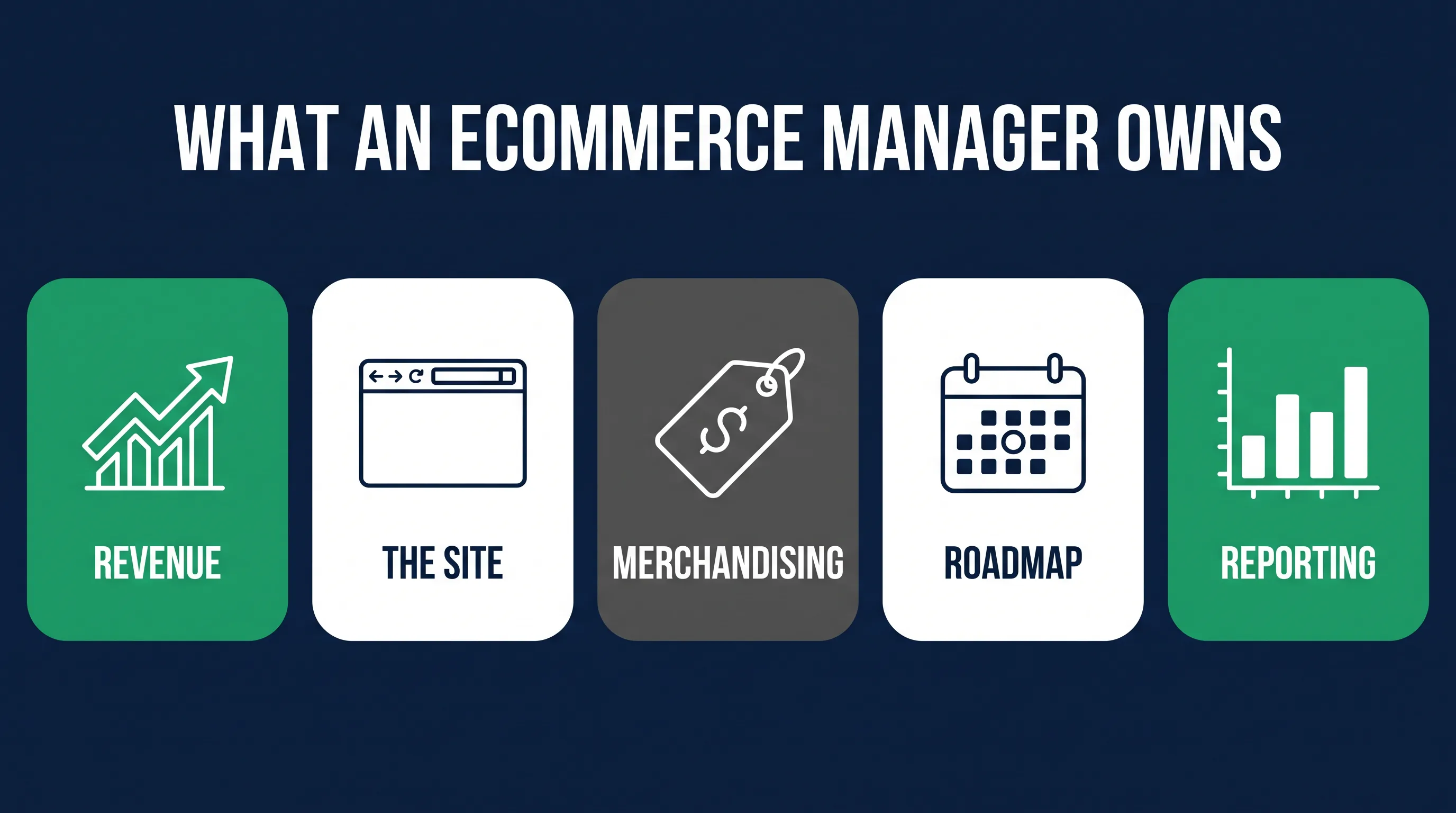
Every posting words this differently, so here's the underlying set:
Revenue and conversion. The store's numbers are yours. You watch them daily, you explain them monthly, and you have a plan for improving them.
The site itself. Product data, collections, navigation, site search, page speed, and whatever integrations keep it all running. You may not write the code, but when it breaks it's your problem.
Merchandising and promotions. What gets featured, what gets discounted, when, and by how much.
The roadmap. What gets built next and in what order, which usually means negotiating with developers or an agency for a fixed number of hours a month.
Reporting. Turning what happened into something a non-ecommerce executive can act on. This is a bigger part of getting promoted than most people expect.
At a small company you'll do all of that yourself plus the email marketing. At a large one you'll have a specialist, a merchandiser, and an analyst, and your job becomes deciding and unblocking rather than executing.
The numbers you get judged on
Every ecommerce manager is measured on a short list of KPIs, and it helps to know them before the interview, because the good interviewers will ask which one you'd fix first.
Conversion rate. Orders divided by sessions. Most stores live somewhere around 1% to 3%, and a move of a few tenths of a point is real money.
Average order value. What a typical basket is worth. Bundles, free shipping thresholds, and cross-sells push this one.
Revenue per session. The one I'd watch if I could only pick one, because it folds conversion and order value together and is harder to fool yourself with.
Returning customer rate. How much of the revenue comes from people who already bought once. If it's falling, email and retention need attention, and that's usually a conversation with whoever owns the CRM side.
Margin after discounts. The quiet one. Revenue that came from a 30%-off promo is not the same revenue as full-price sales, and the manager who reports only top-line sales gets caught out eventually.
Traffic belongs to marketing at most companies. What happens once the traffic lands is yours.
What it pays
Most US ecommerce managers land between $75k and $110k, with the range running lower at small brands and well past $130k at large ones or in expensive metros.
The spread is wide because "ecommerce manager" at a 12-person apparel brand and "ecommerce manager" at a national retailer are different jobs wearing the same badge. Here's how the ladder usually prices out:
| Level | Typical US pay | What changes |
|---|---|---|
| Assistant or coordinator | $40k to $55k | You execute tasks someone else assigns |
| Ecommerce specialist | $55k to $80k | You run parts of the store on your own |
| Ecommerce manager | $75k to $110k | You own the revenue number |
| Senior manager | $105k to $135k | Multiple sites or regions, usually people to manage |
| Director | $130k to $200k+ | The whole online channel, P&L included |
Location moves it too. New York, San Francisco, and Seattle run roughly 15 to 25 percent above the national middle, while most of the Midwest and South sit a little below it. Company size moves it more than city does, in my experience. I broke all of it down properly in the ecommerce manager salary guide.
How people actually get this job
Almost nobody gets hired as an ecommerce manager first. Two routes cover most of the people I've seen do it.
Route one: up from inside. You start as an ecommerce assistant, coordinator, or specialist, you're the person who notices things, and eighteen months later you own the channel. This is the most common path by a mile and the reason I keep telling people to take the $45k assistant job at a company with a real store. The full ladder is laid out in the ecommerce jobs guide.
Route two: sideways from adjacent work. Retail buyers, merchandisers, digital marketers, and Shopify freelancers move into this constantly. If you already understand margin, or already understand traffic, you're halfway there and you're learning the other half.
What both routes have in common is a store you can point at. Someone who says "I ran the site, here's what conversion did while I was there, here's the three changes I made" beats a stronger résumé with no numbers attached, every time.
If you're coming from outside with no store to point at, build one. Yes, really. A live Shopify store in a niche you care about, with real products, real collections, and analytics installed, gives you something to talk about in an interview that most applicants don't have. How to become a Shopify developer walks the build side of that, and the Ecommerce Specialist path covers the build and the operate half together.

What the job description actually asks for
Read twenty ecommerce manager postings and the same lines keep coming back. Translated:
"3 to 5 years of ecommerce experience." Soft. A strong specialist with two years and a store they can talk about in numbers gets interviews all the time.
"Experience with Shopify Plus, Salesforce Commerce Cloud, or Magento." They want to know you won't need training on the platform. Name the one you know in your first paragraph.
"Owns the P&L" or "accountable for revenue targets." This is the manager line. If your résumé only says "supported" and "assisted," it reads as a specialist application.
"Partners cross-functionally with marketing, merchandising, and operations." Translation: you'll spend a lot of time in meetings persuading people who don't report to you.
"Strong analytical skills, GA4 required." They'll test this. Expect to be handed a small dashboard in the interview and asked what you'd look at first.
If a posting lists everything from paid social management to photography direction, it's a small company hiring one person to be the whole department. Those can be great jobs. Price the salary conversation accordingly.
The skills that matter, ranked honestly
Analytics literacy. Non-negotiable. You need to read a funnel, understand where sessions die, and know the difference between a conversion problem and a traffic problem. You don't need to be a data scientist. You need to stop being fooled by a revenue number that went up because traffic went up while everything else got worse.
Platform fluency. Shopify most commonly, sometimes BigCommerce, Magento, or a custom build. Knowing your platform deeply means you can fix things in ten minutes instead of filing a ticket and waiting two weeks.
Merchandising instinct. Which products to push, how to bundle them, what to put above the fold. Partly learned, partly taste, and it gets better every season you work.
Enough technical depth to be dangerous. You don't have to write production code. Being able to read Liquid, understand what an app is doing to your page speed, and talk to a developer without translation makes you dramatically more effective. This is the single biggest difference between managers who plateau at $85k and managers who clear $120k.
Communication. You spend a lot of the week explaining numbers to people who don't live in them.
The honest downsides
Q4 owns you. October through December is the year for most stores, and the job expands to fill it. If you need a predictable calendar, know this going in.
You get measured constantly and publicly. Conversion is on a dashboard everyone can see. There's nowhere to hide a bad month, which is either motivating or miserable depending on your wiring.
And you'll be accountable for outcomes you don't fully control. Marketing sends bad traffic, the warehouse runs out of the hero product, an app update breaks checkout on a Saturday. It's still your number. Managers who last are the ones who get comfortable owning results while sharing control.
FAQ
What does an ecommerce manager do? Owns the performance of a company's online store. Day to day that means watching the numbers, fixing what's broken on the site, deciding what gets merchandised and promoted, prioritizing what gets built next, and reporting on results. At small companies they also do the hands-on work; at large ones they direct a team that does it.
What is the difference between an ecommerce manager and an ecommerce specialist? Ownership and budget. A specialist executes across the store, a manager owns the revenue number and usually a person or two. In a small company the same human does both jobs.
How much do ecommerce managers make? Typically $75k to $110k in the US, with larger companies and expensive cities pushing past $130k. Details in the salary guide.
Do you need a degree to be an ecommerce manager? No. Plenty of people in these chairs came up from retail, customer service, or a store they ran themselves. A live store with real numbers attached does more for you than a marketing degree with nothing to show.
What is the average salary for an ecommerce manager in the US? Roughly $90k at the middle, inside a typical $75k to $110k range. Senior managers earn $105k to $135k, directors $130k and up, and big coastal cities add roughly 15 to 25 percent.
Is ecommerce manager a stressful job? Spiky rather than constant. Launches and Q4 are genuinely intense because revenue stops if something breaks. Most other months are manageable.
What KPIs does an ecommerce manager track? Conversion rate, average order value, revenue per session, returning customer rate, and margin after discounts. Traffic numbers matter too, but at most companies marketing owns them.
What's the difference between an ecommerce manager and a digital marketing manager? The digital marketing manager brings people to the site. The ecommerce manager is responsible for what happens after they arrive: the store, the merchandising, checkout, and the revenue. At small brands one person does both, and the job is harder for it.
What tools should I learn first? Shopify, Google Analytics 4, and a spreadsheet you're genuinely fast in. After that, Klaviyo or whatever email platform your target companies run, and enough Liquid to read a theme without panicking.
What's this job called at a small company? Usually online store manager, and it's a broader job for less money because you personally do everything. The comparison is in the online store manager guide.
If the job sounds like a lot, that's because it's broad rather than difficult. There isn't one hard thing in this list. There are fifteen medium things, and being the person who calmly handles all fifteen is what the salary is actually paying for.
Start by getting close to a store, any store. Build one, volunteer to run a friend's, or take the assistant role at a company whose products you like. The numbers you generate there become the story you tell in the interview, and that story is what gets you the chair.