Digital Marketing Manager: The Job, The Pay, and Why Reddit Says Avoid It

On this page
Search this job title and one of the first things Google shows you is a Reddit thread telling people to stay away from roles called digital marketing manager.
That's an unusual thing to find at the top of a career search. It's also fair, and understanding why is the most useful thing I can give you about this job.
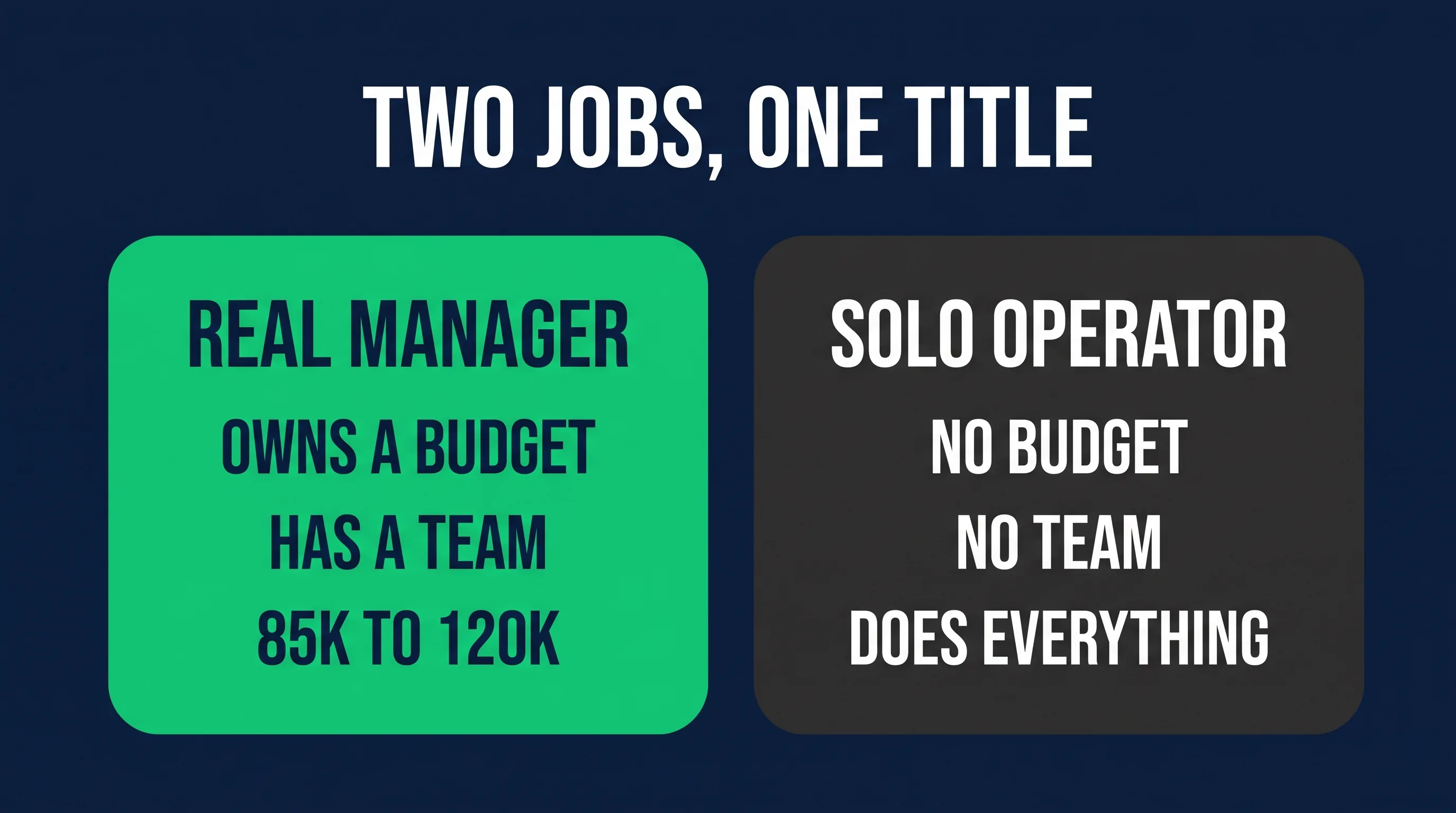
Because there are two versions of this role. One is a genuine management job running a real budget with a real team. The other is a one-person marketing department with a manager title instead of a raise, doing the work of four people for the pay of one. Same words in the posting.

The good version
You own a company's digital marketing: strategy, budget, channels, and a team of specialists or agencies who execute.
Your week is planning, allocating spend, reviewing performance, and deciding what to stop doing. You're accountable for pipeline or revenue, you sit in the meetings where budget is set, and you have people or partners who handle the day-to-day building.
Pay: $85k to $120k in the US, higher at large companies and in expensive metros, often with a bonus attached to pipeline or revenue targets.
That job is good. It's a real step up from specialist work, the skills compound, and the next stop is director.
The version Reddit is warning you about
A ten-person company posts "digital marketing manager." You get the title and a $65k salary. There is no team. There is no budget worth managing. You personally write the emails, run the ads, post to social, update the website, produce the content, and report on all of it.
You're not managing anything. You're doing five specialist jobs at once for less than any one of those specialists would earn, and the title is the compensation.
The trap isn't just the workload. It's what it does to your next job. Two years of being spread across everything leaves you with no depth in anything, and depth is what the market pays for. You come out with a manager title and a specialist's salary expectation that nobody wants to meet, because you can't point to a channel you actually own.
How to tell which one you're looking at
Read the posting for these signals, in this order.
Team size. Does it mention direct reports, agencies, or contractors? No mention anywhere usually means no team.
Budget. A real management role names a budget or says you own spend. If the posting never mentions money you'll be managing, you probably aren't.
The responsibilities list. Count the channels. Three or four with strategic language around them is a manager. Nine channels described as hands-on execution is a solo operator.
Company size and marketing team size. Ask in the interview: how many people are in marketing today? At a 40-person company with a two-person marketing team, "manager" means "the marketing department."
The salary band. Below $75k for a manager title at a US company is usually the tell. That's specialist money with a manager's workload attached.
None of this means you should refuse the small-company job. Sometimes it's the right move, especially early, because you'll learn enormously fast. Just take it knowing what it is, negotiate the salary as though the title said specialist, and plan to leave with one deep skill rather than nine shallow ones.
What the real job involves
Strategy and planning. What are we trying to achieve this quarter, which channels get investment, what are we testing.
Budget allocation. Where the money goes, and defending that when someone senior wants it spent elsewhere.
Team and vendors. Managing specialists, agencies, or freelancers. A lot of this job is managing an agency well, which is a genuine skill most people learn badly.
Performance and reporting. Owning the numbers and explaining them upward in language a CFO accepts.
Cross-functional work. Sales wants better leads. Product wants a launch supported. You're the translation layer.
Notice how little of that is doing marketing. That's the actual transition, and it's the part people find hardest. If you love building campaigns, this promotion takes that away.
How to get there
The common route is specialist to manager, in three to five years. What makes it happen faster is depth plus proof: own one channel, produce a number, and start thinking about budget before anyone asks you to. I laid out the specialization decision in the digital marketing specialist guide.
The faster route is depth in an expensive channel. People who own paid media budgets or lifecycle programs get to manager quicker, because those channels have obvious money attached and the accountability translates directly.
The route I'd actually recommend is to get genuinely good at one technical thing on the way up. A digital marketing manager who understands how a website is built, can read analytics properly, and can ship a landing page without waiting on anyone is dramatically more effective than one who can only assign work. It also protects you in the version of this job with no team, which is most of them.
That's the whole idea behind our career paths: the technical half is what makes the marketing title defensible.
What it pays, honestly
$85k to $120k is the healthy middle for a genuine manager role in the US. Directors run $120k to $160k. Below $75k with this title is a warning sign rather than a starting point.
Two things move the number more than experience: the size of the budget you control, and whether your work is tied to revenue or to activity. Someone who can say "I own $80k a month in paid spend and it returns 4x" negotiates from a completely different position than someone who can only describe campaigns they ran.
City still matters, though remote has flattened it. New York and San Francisco run 15 to 25 percent above the national middle.

Is it a good job?
Yes, in the version with a team and a budget. You're close to revenue, the skills transfer to any industry, and the ladder to director and CMO is well worn.
The honest downsides are real though. You're accountable for outcomes that depend on other people's work, attribution will never be as clean as your CFO wants, and marketing is often the first budget cut when a quarter goes badly. Digital marketing managers get made redundant more often than engineers do, and pretending otherwise would be dishonest.
The way to be safe in this role is the same as everywhere else in marketing: be the person who can prove what they produced, and have a skill that isn't just coordination.
FAQ
What does a digital marketing manager do? Owns a company's digital marketing strategy, budget, and channels. In a real management role that means planning, allocating spend, managing specialists or agencies, and answering for the results. At small companies it means personally doing all the marketing.
How much do digital marketing managers earn? Typically $85k to $120k in the US for a genuine management role, with directors at $120k to $160k. A manager title paying under $75k usually signals a solo-operator job.
Do digital marketers get paid well? Relative to the entry bar, yes. It's one of the better-paying careers you can enter without a degree or a technical background. Relative to engineering at the same level of experience, no.
Is a digital marketing manager a good job? The version with a budget and a team is good. The version where you're the entire marketing department with a nicer title is a trap that costs you two years of depth. Check for team size and budget before accepting.
How do I become a digital marketing manager? Usually three to five years from a coordinator or specialist role. Own one channel, produce measurable results, learn how budget decisions get made, and pick up enough technical skill to ship things yourself.
What's the difference between a digital marketing manager and a marketing manager? Digital scopes it to online channels. Marketing manager often includes brand, events, and print. The digital version is generally more measurable and pays slightly better.
If you're taking one of these jobs, ask two questions in the interview: how many people are in marketing, and what budget does this role control. The answers tell you which of the two jobs you're being offered.
And if it turns out to be the solo version, that's still fine at the right salary and the right stage. Just go in with a plan to leave with one deep skill, because that's the thing the next employer will actually pay for.