Digital Marketing Specialist: The Job, The Pay, and the Trap in the Title

On this page
Digital marketing specialist is the most searched job title in marketing, and it's the one I'd warn you about most.
Not because it's a bad job. It's a genuinely good first job, it hires people with no experience, and it teaches you the whole landscape in eighteen months.
The trap is what happens after that. The people who stay generalists plateau around $70k and compete with everyone. The people who pick something specific and go deep double it within a few years. Same start, very different five-year mark.

What the job actually covers
You run some mix of a company's marketing channels. Which mix depends entirely on the company, which is why the postings look so different from each other.
The usual ingredients: email campaigns, social media, paid ads, SEO and content, the website, landing pages, and reporting on all of it. At a 30-person company you'll do all seven. At a 3,000-person company you'll do one of them and the title will be more specific.
The honest description of the job at a small company: you're the marketing department, you have no budget, and you're expected to know everything. That sounds bad and it's actually the fastest education in marketing available, as long as you leave before it becomes your identity.
A day at a mid-sized company
Check yesterday's numbers across channels. Website traffic, ad spend and results, email performance, whatever the CEO looked at this morning and had an opinion about.
Build and schedule this week's email. Fix a landing page that isn't converting, or file a ticket and wait, depending on whether you can edit the site yourself.
Write and schedule social posts. Reply to the comments.
Check the ads. Pause the one burning money, raise the budget on the one working, argue internally about whether the tracking is even accurate.
Then the meeting where someone asks why leads are down, and you explain that the form broke on mobile for six days and nobody noticed until you did.
What it pays
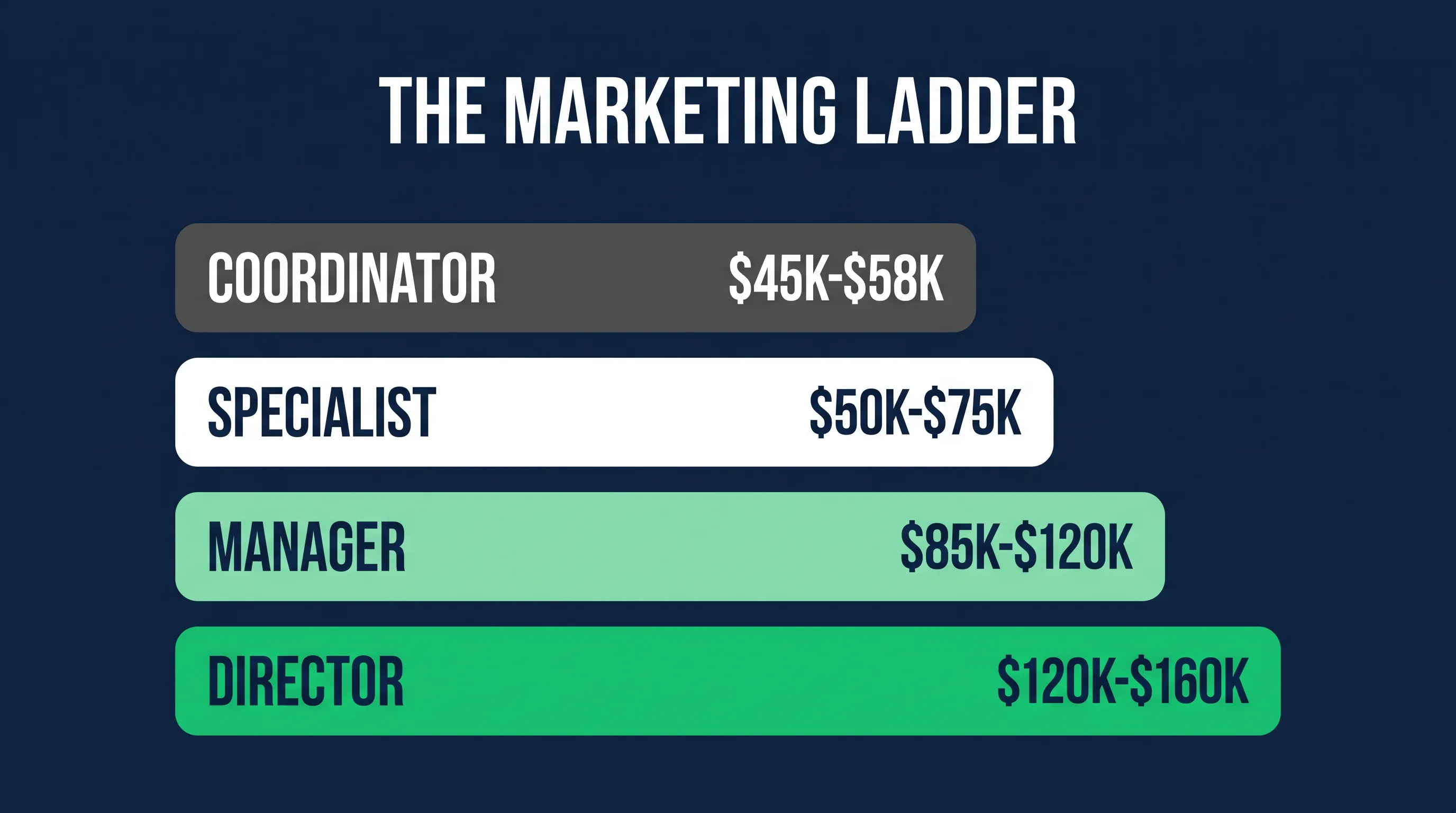
$50k to $75k is where most US digital marketing specialists sit, with $55k to $65k being a common first offer.
Above it: digital marketing manager at $85k to $120k, director at $120k to $160k. Below it: digital marketing coordinator, roughly $45k to $58k, which is the most common actual entry point.
That's a healthy ladder. What it hides is that the fastest movement up comes from specialization rather than promotion. An email specialist with three years of depth often earns more than a digital marketing specialist with five, because "I can do a bit of everything" is hard to price and "I run a $2m email program" is not.
The specialization decision
At some point in your first two years you should pick a lane. Here's how the common ones compare, honestly.
Email and lifecycle. Closest to revenue, most measurable, least crowded, and technical enough to be defensible. Consistently underrated. The whole ladder is in email marketing jobs.
SEO. Deep skill, strong ceiling, currently going through a real shift as AI answers absorb informational searches. Also the specialty where technical ability pays off most. Covered properly in the SEO specialist guide.
Paid media. Fast feedback, high stress, very portable. You live and die by CPA and you'll always know exactly how you're performing, for better or worse.
Ecommerce. Broadest of the specialties and the one where marketing meets operations. Pays well and has an unusually short on-ramp. Mapped out in the ecommerce jobs guide.
Marketing automation and martech. The most technical of the lot and the least crowded. If you can code even a little, this is where that skill compounds fastest. See marketing automation specialist.
Content and brand. Most competitive, hardest to measure, and the specialty most exposed to AI writing tools. I'd think carefully before making this the plan.
The pattern across all of them: the specialties that involve building or measuring something pay better than the ones that involve producing something.
How to get in with no experience
Learn the tools, not the theory. Google Analytics, Google Ads, one email platform, one social scheduler, and enough spreadsheet ability to be useful. The free certifications from Google and HubSpot take a weekend and get you past filters.
Run real marketing for something. Your own site, a friend's business, a nonprofit, a side project. Run one paid campaign with real money, even $100. Send real emails to a real list. The difference between people who have spent someone's actual budget and people who have only learned the concepts is obvious in an interview within two minutes.
Learn a little code. HTML and CSS at minimum. Marketers who can build and edit pages are dramatically more employable than marketers who file requests, and it's the same lever that runs through every job in this cluster.
Apply to coordinator titles too. Digital marketing coordinator, marketing coordinator, marketing associate, growth associate. Same door, lower bar, and you'll be a specialist within a year.
Expect a small first number. $50k is a common starting point. It moves fast if you specialize.

The honest downsides
You'll be measured on things you don't control. Sales blames marketing for lead quality, marketing blames sales for follow-up, and you're in the middle with a dashboard.
At small companies the role is a dumping ground. Anything vaguely "marketing" arrives on your desk, including the trade show booth and the office Instagram.
Attribution is a mess everywhere. You'll spend real energy proving what worked, and sometimes you genuinely won't know.
And the generalist version of this job is the most exposed to AI tools of anything in this article, because a lot of it is producing content and copy at volume. That's exactly why the specialization advice above isn't optional.
FAQ
What is a digital marketing specialist? Someone who runs a company's digital marketing channels: some mix of email, social, paid ads, SEO, content, and the website, plus reporting. The exact mix depends on company size.
Is digital marketing a high-paying career? It can be, but not at the generalist level. Specialists at $50k to $75k are fine; the money is in choosing a lane and going deep, where managers reach $120k and directors go past $150k.
Can I start digital marketing with no experience? Yes, and it's one of the most accessible entry points in tech-adjacent work. Free certifications, a real campaign you ran with your own money, and a coordinator title are a realistic three to six month plan.
Do I need a degree? No. Marketing degrees are common in this field but rarely decisive. Demonstrated campaigns beat coursework in almost every hiring process I've seen.
Which specialty pays the most? Marketing automation, paid media at scale, and ecommerce leadership sit at the top. Email is the most underrated relative to how measurable it is. Content is the most crowded.
Will AI replace digital marketing specialists? It's already absorbing the produce-more-content parts of the job. The parts involving systems, data, budget decisions, and code are getting more valuable, which is another argument for specializing early.
What's the entry-level version of this role? Digital marketing coordinator, at $45k to $58k, which is where most people actually start. Covered in the digital marketing coordinator guide.
Take the digital marketing specialist job if it's what's available. It's a good education and a fair first salary.
Just decide, some time in the first year, what you're going to be good at specifically. The people who never make that decision are still generalists at 35, competing with every 23-year-old who did the same free certification. The ones who choose early are running a channel and getting paid for depth nobody else on the team has.