SEO Specialist: The Job, The Pay, and What AI Search Actually Changed

On this page
Ask Google what an SEO specialist does and you'll get five career guides that could have been published in 2018.
They're not wrong exactly. Keywords, content, backlinks, technical fixes. That's still most of the job. But every one of them is missing the thing that has changed the work more than any algorithm update in a decade: a growing share of searches now end with an answer instead of a click.
If you're deciding whether to learn this skill, that shift is the whole question. So let's do the job properly, and then talk about it honestly.

What is an SEO specialist?
An SEO specialist improves how often a website shows up in search results for the things its customers look for. The work covers technical fixes so search engines can crawl the site, content that matches what people search, and earning links and mentions from other sites.
Shorter version: you make a website appear when people search for what it sells.
That breaks into three areas, and most SEO specialists are strong in one, competent in the second, and vague about the third.
Technical SEO. Can search engines reach and understand the site. Crawling, indexing, site structure, page speed, redirects, canonical tags, structured data, and fixing the 400 duplicate URLs the CMS quietly generated. This is the least crowded specialty and the best paid, which is not a coincidence.
Content and on-page. What the pages say and how they're built. Keyword research, mapping topics to pages, titles and meta descriptions, internal linking, and improving pages that are ranking at position eleven and going nowhere.
Off-page. Earning links and mentions from other sites. Digital PR, outreach, partnerships. The least controllable part and the one where most of the industry's nonsense lives.
A normal week
Monday is data. Search Console, rankings, traffic by page, and looking for anything that dropped. A page falling from three to nine matters more than any new idea you have this week.
Tuesday you're auditing something. A section of the site, a competitor, a set of pages that used to work.
Wednesday is briefs and content. Writing what a page should cover, why, and which existing pages should link to it. Some SEO specialists write the pages, most brief someone else.
Thursday is technical work with a developer, or on your own if you can code, which is a large part of why being able to code matters here. "The template needs the H1 changed and the breadcrumbs need schema" is a two-week ticket if you can't do it and an afternoon if you can.
Friday is reporting and arguing. SEO takes months to show results, so a real part of this job is keeping people patient with evidence.
In-house, agency, or freelance
The same title means three fairly different jobs.
In-house means one company's site, usually a big one. You go deep, you wait on developers a lot, and you spend real time persuading people outside marketing to prioritize your tickets.
Agency means several clients at once. Faster learning, more reporting, lower pay to start, and a lot of audits. A lot of good SEO people started there.
Freelance usually comes after one of the other two. You pick your clients and your rate, and you also do your own sales, invoicing, and chasing. It works best once you have a specialty people search for, which is why so many freelancers niche down: local SEO for service businesses (the map pack results you see for "plumber near me"), ecommerce SEO for Shopify stores, or technical SEO for large sites.
What it pays
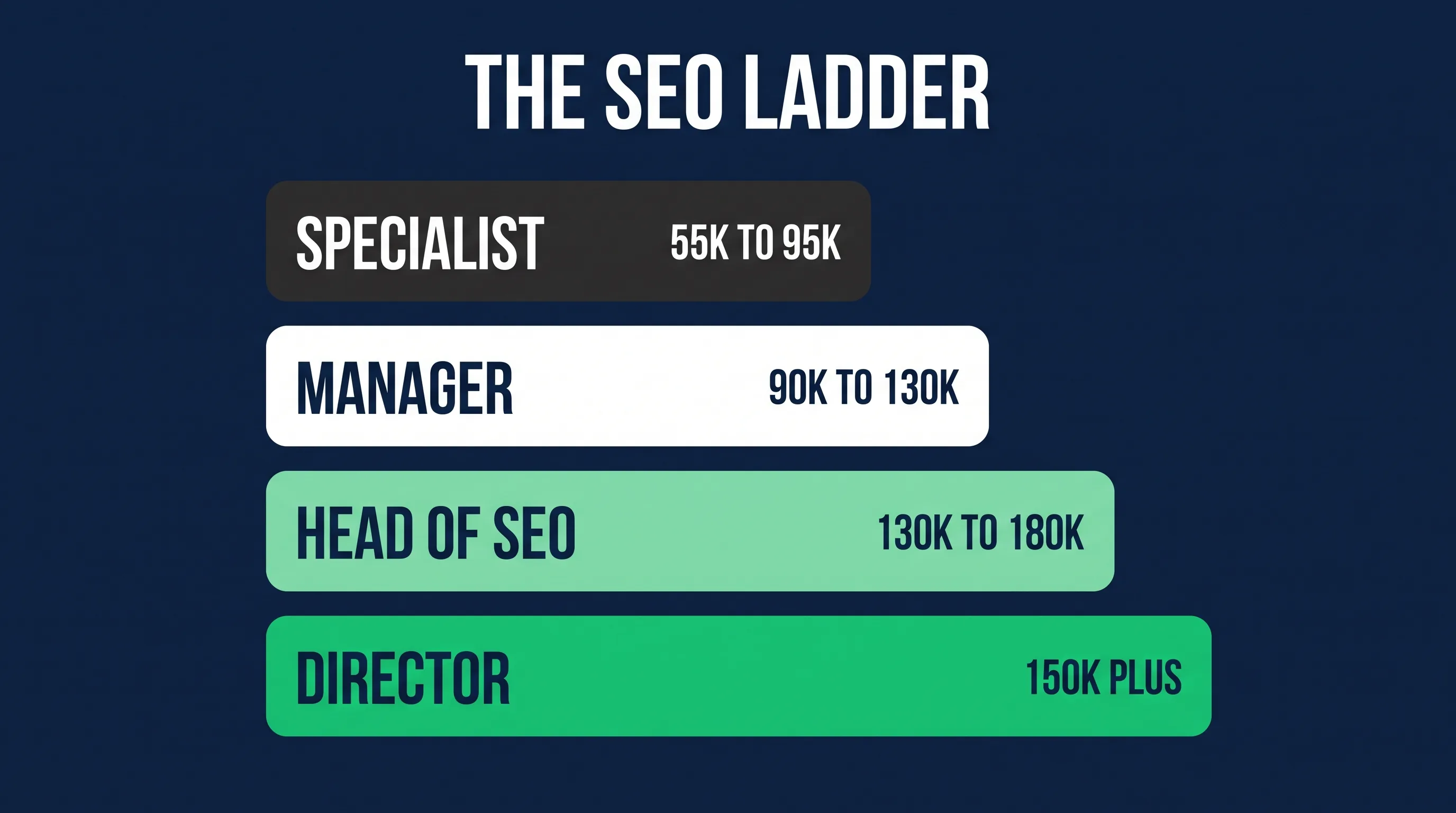
$55k to $95k covers most US SEO specialists, with the higher half going to technical specialists and people at larger companies.
Above that: SEO manager at $90k to $130k, head of SEO or director at $130k to $180k. Agency roles start lower and teach faster. Freelance and consulting is a real path here, with experienced consultants charging $100 to $250 an hour, though you're then running a business as much as doing SEO.
The clearest pay divide is technical ability. Technical SEO carries the highest commercial value in the field, because it's the part that requires understanding how sites are actually built and the part most SEO people avoid.
SEO specialist vs SEM specialist
They get lumped together constantly, and they're different jobs. SEO earns organic rankings you don't pay per click for, and it takes months. SEM (search engine marketing, in practice mostly Google Ads) buys placement in the results, and it works the day you turn it on and stops the day the budget does.
The two teams should talk, because paid search data tells you which keywords actually convert before you spend six months ranking for them. At small companies one person often handles both. If you have to pick one, SEO work compounds for years after you do it, while paid search is easier to prove in an interview because every dollar is tracked. Either is a fine career.
The part every other guide is missing
Search stopped being one thing.
People still type queries into Google, and Google still returns links. But a growing share of questions now get answered directly: AI Overviews at the top of the results, ChatGPT and Perplexity answering without a search page at all, and assistants summarizing three sources into one paragraph that never sends anyone anywhere.
That has two consequences for this job, and they pull in opposite directions.
The bad one: informational content that used to earn clicks now feeds an answer box instead. If your traffic model depended on "what is X" articles, that model is under real pressure. I wrote about a version of this playing out in the Google update that tanked a lot of sites.
The good one: being the source those answers cite is a new and largely uncontested skill. Almost nobody currently doing SEO knows how to optimize for it, which is exactly the situation SEO itself was in around 2005. It has a name, answer engine optimization, and it involves structuring content so machines can quote it, earning mentions on the sites those models draw from, and measuring visibility inside AI answers rather than only rankings. The full method is in the AEO guide.
If you're learning SEO now, learn both. The people who only learn the 2018 version are training for a job that's shrinking, and the people who learn both are the only ones in the room who can answer the question every executive is currently asking.
The tools
Search Console. Free, essential, and the only source of truth about how Google actually sees your site. Learn this before any paid tool.
One full-suite tool. Ahrefs or Semrush. Keyword research, competitor analysis, backlink data, rank tracking. Most job postings name one of them.
A crawler. Screaming Frog for technical audits.
Analytics. GA4, well enough to tie organic traffic to something a business cares about.
A spreadsheet, seriously. Most real SEO work happens in a spreadsheet with 4,000 URLs in it.
And increasingly, scripting. Being able to pull data from an API and process it yourself instead of exporting CSVs by hand is a genuine multiplier. How to automate your SEO workflow covers where that pays off.

The skills that actually get you hired
Tools are learnable in a weekend. These take longer:
Reading data without fooling yourself. Traffic went up 30%, but was it the branded searches, one viral page, or a seasonal bump? Most of the job is knowing which question to ask of a Search Console export.
Enough HTML to find problems yourself. You don't need to build sites. You do need to open the source of a page and spot the stray noindex tag, the missing canonical, or the H1 that's actually an image.
Writing. Titles, meta descriptions, briefs, and the occasional full page. Clear beats clever.
Explaining things to people who don't care about SEO. You'll need a developer to change a template and an executive to wait six months for results. Being able to say why, in plain words and with a number attached, is what gets your recommendations done instead of filed.
The numbers you'll report on are organic clicks, non-branded traffic, conversions from organic, and rankings for the pages that make money. Increasingly also how often AI answers cite the site, which the next section gets into.
How to become one
Run a real site. This is not optional and it's the fastest route. Buy a domain, build a site about something you know, and try to rank it. You will learn more from three months of watching your own pages fail than from any course, because SEO is a feedback loop and you need to be inside one.
Learn the technical half early. HTML, how a page renders, what a redirect does, how a CMS generates URLs. This is where you separate from the crowd, and it's why we teach SEO inside a technical curriculum rather than as a marketing subject. Our Web Content Manager path covers the site side of it.
Get free tool certifications, then ignore them. They're a filter for HR, not an education.
Do one real audit for a real business. Same advice as every job in this family: a written audit of a real site, with specific problems and a prioritized fix list, is the single best portfolio piece and the exact deliverable you'd produce in week one of the job.
Apply to agencies first if you can stand it. You'll work on twelve sites in a year instead of one. Brutal, and the best training available.
The honest downsides
Results are slow and you'll be judged on them anyway. Six months is a normal timeline for meaningful movement, and plenty of executives lose patience at three.
You don't control the platform. Google changes something, your traffic drops 40%, and nothing you did caused it. Everyone in this field has lived through at least one of those.
The industry has a lot of noise in it. Fake gurus, recycled advice, tactics that stopped working years ago. Developing a filter takes time.
And the informational-content end of the job is genuinely under pressure from AI answers. I'd be lying if I said otherwise. The commercial pages, the technical work, and the AEO side are not.
FAQ
What does an SEO specialist do? Improves a website's visibility in search: technical fixes so engines can crawl and understand the site, content and on-page work so pages match what people search for, and off-page work to earn links and mentions.
How much does an SEO specialist earn? Typically $55k to $95k in the US, with managers at $90k to $130k and directors past $150k. Technical SEO pays at the top of every band.
How do I become an SEO specialist with no experience? Run your own site and try to rank it, learn the technical fundamentals, do a real audit for a real business, and apply to agencies where the volume of work teaches you fastest. Six months is a realistic timeline.
Do you need a degree for SEO? No. This field hires almost entirely on demonstrated results. A site you ranked beats a marketing degree.
Is SEO dead because of AI? No, but it changed. Informational content that existed to capture clicks is under real pressure. Commercial pages, technical work, and being the source AI answers cite are all growing. The specialists in trouble are the ones who only learned the old version.
Do I need an SEO certification? No, but a free one can help you get past a résumé filter. Google Analytics, Semrush Academy, Ahrefs Academy, and HubSpot all offer free SEO or analytics courses. None of them matters as much as one site you ranked or one real audit you wrote.
What's the difference between SEO and SEM? SEO earns unpaid rankings over months. SEM, mostly Google Ads, pays for placement and works immediately but stops when the budget does. Small companies often have one person doing both.
Can SEO specialists work remotely or freelance? Yes, it's one of the most remote-friendly marketing jobs. Freelancing is common too, usually after a year or two at an agency or in-house, and it pays best when you niche down into local, ecommerce, or technical SEO.
What's the difference between an SEO specialist and a digital marketing specialist? Depth versus breadth. The SEO specialist goes deep on search; the digital marketing specialist covers several channels at a shallower level. Specialists generally earn more per year of experience.
What's the entry-level SEO job called? SEO coordinator, usually, at $45k to $60k. It's the cheapest ticket into the field and the route out of it is short. See the SEO coordinator guide.
If you want the short version: SEO is still one of the most valuable skills you can attach to a website, and it's currently in the middle of the biggest shift it has had in fifteen years.
That's usually the best moment to enter something. Everyone with ten years of experience is defending an old playbook. If you learn the technical side and the AI-answer side together, you'll be more useful in twelve months than people who have been doing this since 2015.