Technical SEO Specialist: The Best Paid Corner of SEO and the Least Crowded

On this page
Here's a number that tells you something. Across every job title I pulled for this whole career cluster, the highest cost-per-click by a wide margin belongs to "technical seo specialist." Advertisers pay around $13 a click to reach people searching this term.
Advertisers don't bid $13 on a whim. They bid it because whoever is searching that phrase is either about to hire someone expensive or about to become someone expensive.
That's the summary of this job. It's the part of SEO most people in SEO can't do, and the market prices it accordingly.

What technical SEO actually is
Everything that determines whether a search engine can reach your pages, understand them, and decide they're worth showing. None of it involves writing an article.
Crawling and indexing. Whether search engines can find your pages at all, whether they're wasting their time on 40,000 useless filter URLs, and why the pages you care about aren't in the index.
Rendering. Modern sites build content with JavaScript. Search engines handle that unevenly. Knowing what actually gets rendered, and what silently doesn't, is one of the most valuable diagnostic skills in the field.
Site architecture. How pages connect, how deep they sit, how internal linking distributes authority, and why the page you need to rank is eleven clicks from the homepage.
Performance. Core Web Vitals and real page speed, which means understanding what a browser does with your HTML, CSS, JavaScript, and images.
Structured data. Schema markup so search engines and AI systems can parse what a page is about. Increasingly important, and covered in depth in the schema and AEO work.
Migrations. Moving a site without destroying its traffic. Redirect mapping, parity checks, staged rollouts. This is the highest-stakes work in SEO and where consultants earn their biggest fees, because getting it wrong costs a company millions.
Log file analysis. Looking at what search engine bots actually did on your server, rather than what you assume they did.
Why this pays more than the rest of SEO
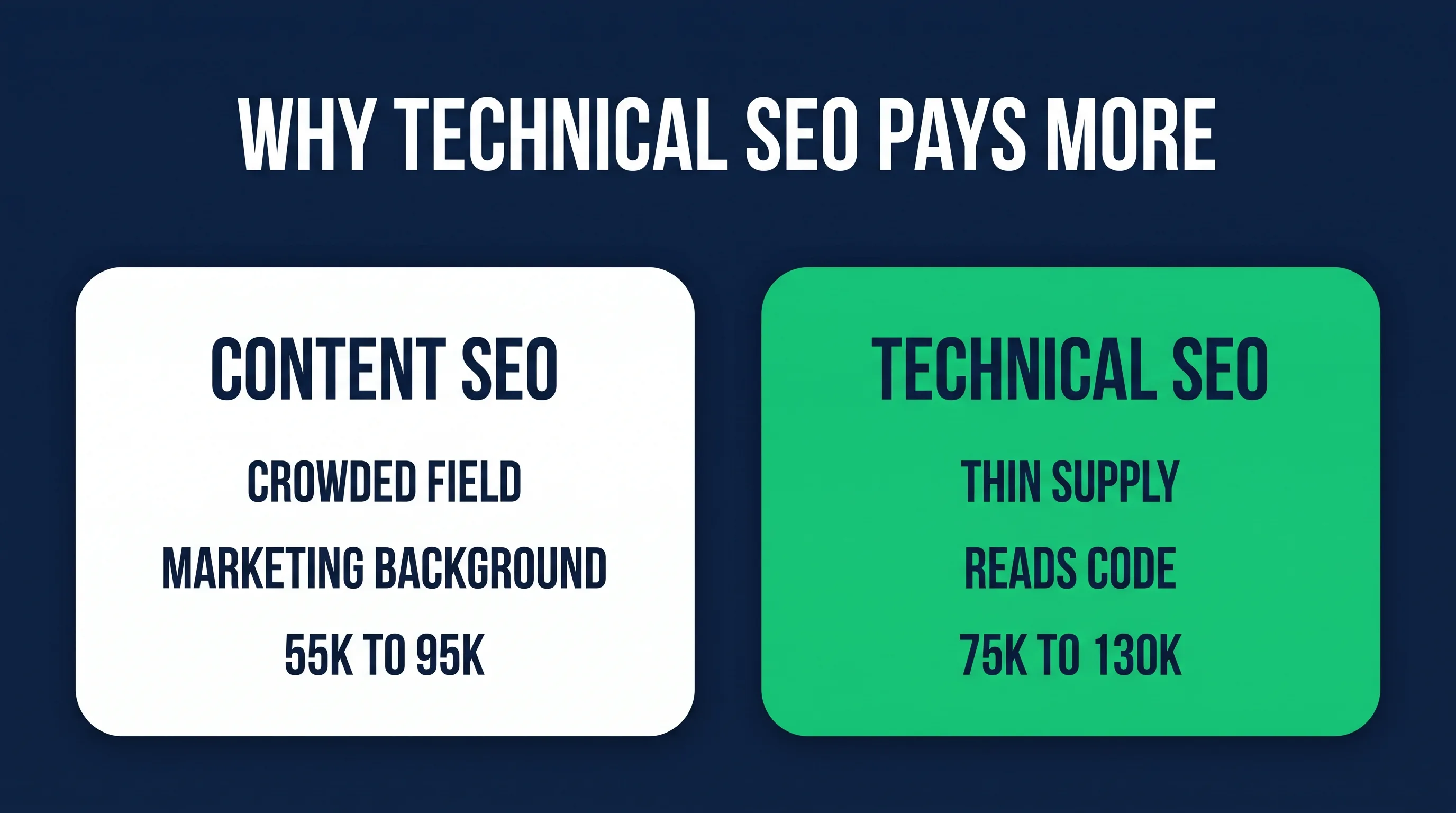
Supply.
Content SEO attracts people from writing and marketing, and there are a lot of them. Technical SEO requires being comfortable with how websites are built: HTML, HTTP status codes, JavaScript rendering, server responses, and enough command line to not be helpless. Most marketers hit that wall and turn back.
Meanwhile the demand went up. Sites got more complex, JavaScript frameworks became the default, and every company now has a site nobody fully understands. Somebody has to be able to open the hood.
The result is a specialty where a competent person is genuinely hard to replace, and where the diagnosis you deliver in an afternoon can be worth six figures of recovered traffic.
What it pays
$75k to $130k for in-house technical SEO specialists in the US, with senior roles and enterprise environments going higher.
Agency roles run somewhat lower, typically $65k to $100k, with the usual tradeoff: less money, far more variety, much faster learning.
Consulting is where the ceiling disappears. Experienced technical SEO consultants charge $150 to $300 an hour, and migration work is often priced as a project in the tens of thousands, because the downside of doing it badly is enormous.
For context on where this sits in the wider field, the SEO specialist guide has the general ladder and the SEO manager guide covers the management route.
The skills, in the order to learn them
HTML and how a page is actually built. Not to write applications. To read a page and know what's there.
HTTP. Status codes, redirects, headers, canonical tags. What a 302 does that a 301 doesn't, and why that matters.
How rendering works. Server-side, client-side, and what a crawler does with each. This single topic separates the people who can diagnose modern sites from the people who can't.
Crawling tools. Screaming Frog first, then Sitebulb or similar. Learn to configure a crawl properly rather than pressing start.
Search Console, deeply. Coverage, crawl stats, the URL inspection tool. It's free and it's the only view of what Google actually thinks about your site.
Structured data. JSON-LD, the common schema types, and how to validate them.
Performance. Core Web Vitals, what causes each one, and how to write a fix a developer can implement.
Some scripting. Python or JavaScript, enough to process a 200,000-row crawl export or hit an API. This is the step that takes you from good to genuinely rare, and it's where automating your SEO workflow starts paying for itself.
How to learn it when you're not a developer
The barrier here is psychological more than intellectual. None of this is as hard as writing production software, and you're allowed to learn it in public.
Break your own site. Build a site, then deliberately create the problems: block a page in robots.txt and watch what happens, set up a redirect chain, add a canonical tag pointing somewhere wrong. Seeing cause and effect on a site you control teaches faster than any course.
Crawl real sites. Screaming Frog's free tier handles 500 URLs. Crawl small business sites and write up what you find. Do ten of these and you'll start recognizing patterns instantly.
Learn just enough code. HTML and CSS properly, JavaScript to the point where you can read it. Our Web Content Manager path covers that ground in a site-operations context, which is the right frame for this work.
Do a migration, even a small one. Move a small site to a new structure with proper redirect mapping and no traffic loss. That project alone is a portfolio.

What the job looks like day to day
Less glamorous than the salary suggests. A lot of it is patient investigation.
A typical stretch: run a crawl, find 12,000 URLs that shouldn't exist, trace them to a faceted navigation setting, write up the fix, argue for it against six other engineering priorities, wait three weeks, verify it shipped correctly, then watch indexing recover over the following month.
The satisfying part is that the work is real. There's an actual answer to most technical SEO questions, which is a relief compared to arguing about content strategy in the abstract.
The frustrating part is that you rarely control implementation. You diagnose, you recommend, and then you wait for a developer with their own backlog. The specialists who advance fastest are the ones who can implement small fixes themselves.
The AI search angle
Technical SEO is quietly the most future-proof corner of this field.
Whatever happens to informational content in AI answers, machines still have to crawl, render, and parse your site. If anything, being machine-readable matters more now, because AI systems are less forgiving than Google about messy markup and slow rendering. Structured data and clean architecture are the substrate for both.
While content roles worry about being replaced, the technical roles are being asked new questions: is our content accessible to AI crawlers, is our schema good enough to be quoted, what does our llms.txt say. That's covered in the AEO guide.
FAQ
What does a technical SEO specialist do? Makes sure search engines can crawl, render, and understand a website. Crawl and index management, site architecture, page speed, structured data, JavaScript rendering, migrations, and log analysis.
How much does a technical SEO specialist make? Typically $75k to $130k in-house in the US, $65k to $100k at agencies, and $150 to $300 an hour consulting. It's the best paid specialty within SEO.
Do you need to code for technical SEO? You need to read code fluently and write a little. HTML and CSS properly, JavaScript enough to understand what a page is doing, and ideally some Python for data work. You don't need to be a software engineer.
Is technical SEO hard to learn? It's less hard than it looks and mostly gated by willingness. The concepts are learnable in a few months. What takes longer is the pattern recognition that comes from crawling a lot of real sites.
Is technical SEO in demand? Yes, and the supply is thin because most SEO people come from marketing backgrounds and avoid it. The $13 cost-per-click on this exact search term is a decent proxy for how much employers want these people.
What's the difference between a technical SEO specialist and an SEO specialist? The general specialist covers content, on-page, and some technical. The technical specialist goes deep on the infrastructure side and typically earns $20k to $30k more for it.
If you're already doing SEO and feeling capped, this is the most reliable raise available to you, and it does not require going back to school.
Download Screaming Frog this week, crawl a site you know, and go find out why one of its pages isn't indexed. That first real diagnosis is the beginning of the specialty.