SEO Manager: What It Pays, Why the Range Is So Wide, and How to Get There

On this page
There's a post going around from someone who pulled 50,000 marketing salary submissions and filtered them to one job title: SEO manager. Two people, same title, same years of experience, $70,300 apart.
Elsewhere on the same search results page, someone is asking whether they're underpaid at $46k managing three clients solo in Austin.
Both of those are SEO managers. That spread is the most important thing to understand about this job, because almost all of it comes down to a few specific choices you can actually make.

What the job is
You own a company's organic search performance and the people or agencies working on it.
The daily reality: setting the strategy for what gets targeted and in what order, prioritizing technical fixes with engineering, directing content production, tracking performance, and explaining slow results to people who wanted them last month.
You still do hands-on work at most companies. Very few SEO manager roles are purely directive, and the ones that are tend to be at large enterprises where you spend more time in stakeholder meetings than in Search Console.
Where the $70k gap comes from
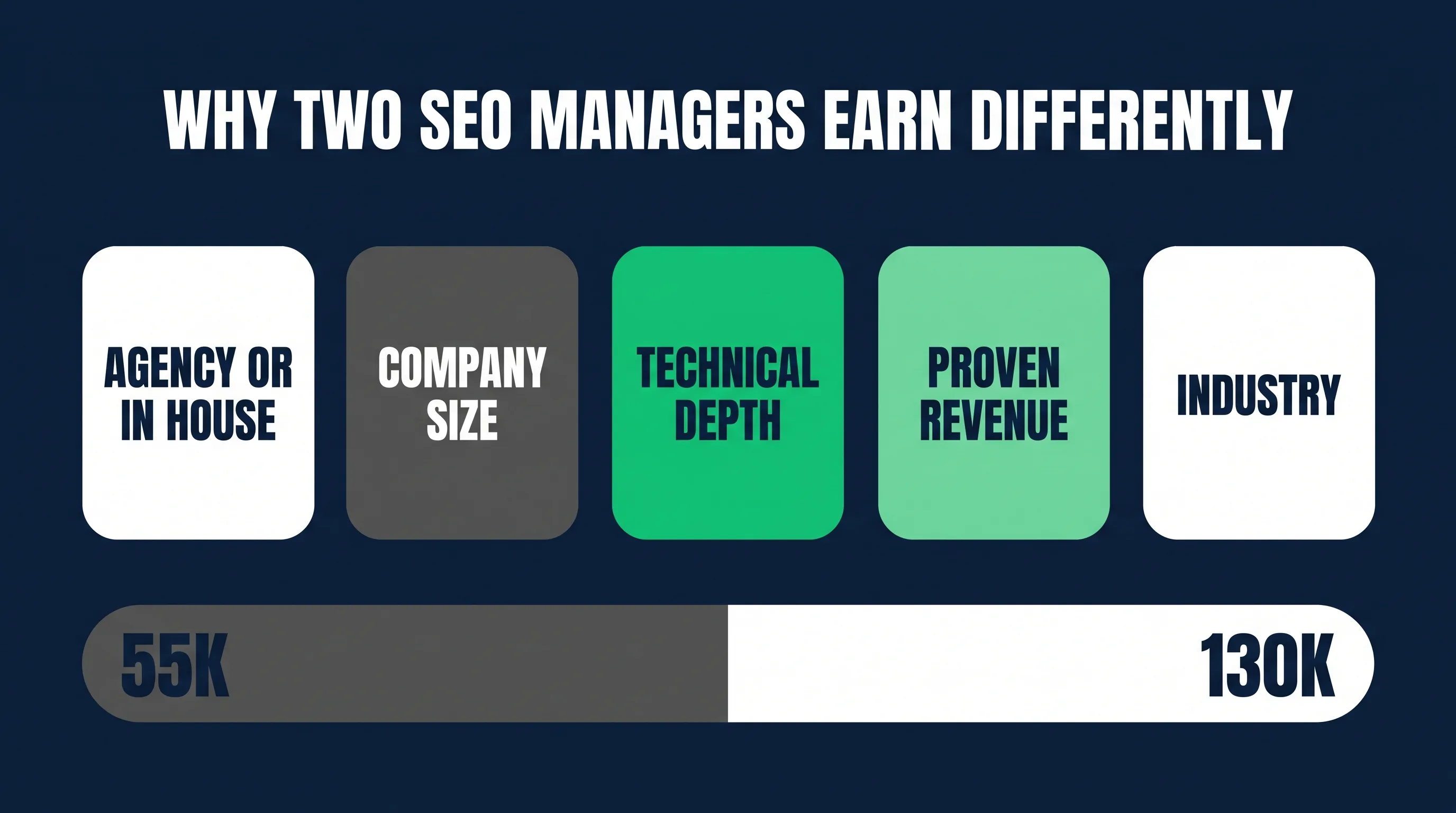
Five things, and only one of them is time served.
In-house versus agency. Agency SEO managers handle several clients and get paid less for it, frequently $55k to $85k. In-house managers at one company with real revenue attached run $90k to $130k. Same work, different economics, because the agency has to price your time against a client retainer.
Company size and what search is worth to them. SEO at a company where organic drives 60% of revenue is a different job than SEO at a company where it's a nice-to-have. The first pays far more because the stakes justify it.
Technical depth. This is the biggest controllable lever. A manager who can audit a JavaScript-rendered site, diagnose crawl budget problems, and talk credibly with engineers is in a different pay bracket than one who manages a content calendar and calls it SEO. Technical SEO carries the highest commercial value in the field, which is why technical SEO specialist carries the highest CPC of anything in this space.
Whether you can prove revenue. "Rankings improved" is worth nothing in a salary conversation. "Organic revenue went from $180k to $310k a month over three quarters" is worth twenty thousand dollars.
Industry. B2B SaaS, finance, and healthcare pay more than agencies, ecommerce, and media. Regulated industries pay for people who won't get them in trouble.
The $46k Austin person and the $116k person are not separated by talent. They're separated by being on different sides of three or four of those bullets.
What it pays
$90k to $130k for most in-house US SEO managers. Agency roles run lower, commonly $55k to $85k. Senior managers and heads of SEO reach $130k to $180k, and directors at large companies go past that.
Below that sits the SEO specialist role at $55k to $95k, which is where most people enter.
Freelance and consulting is a genuine parallel track, with experienced consultants at $100 to $250 an hour. The catch is that you're running a business, and half of that work is sales.
The skills that get you the job
Technical fluency. Crawling and indexing, rendering, site architecture, page speed, structured data, and how a CMS generates URLs. You don't have to write production code. You do have to be able to write a technical brief a developer respects and spot when an engineering answer is wrong.
Prioritization. There are always four hundred things you could fix. The manager's actual job is knowing which twelve matter this quarter and being able to defend that order.
Content direction. Deciding what gets written, for whom, and how it connects to the pages that make money.
Data. Search Console, GA4, a full-suite tool like Ahrefs or Semrush, and enough spreadsheet skill to work with thousands of URLs at once. Increasingly, enough scripting to pull from an API rather than exporting by hand, which is where automating your SEO workflow pays for itself.
Stakeholder management. SEO takes two to three quarters to show real movement. Managing the patience of people who don't understand that is genuinely half the role.
The part that's changing
Anyone taking an SEO manager job now inherits a question their predecessor didn't have: what happens to organic traffic as more searches get answered without a click.
AI Overviews, ChatGPT, and Perplexity are absorbing a chunk of informational queries. That mostly hits blog traffic rather than commercial pages, but it's real and executives are asking about it.
The managers who come out of this well are the ones who can answer that question with a plan instead of a shrug. Being cited inside AI answers is a discipline now, with its own methods for structuring content, earning mentions on the sources models draw from, and measuring visibility that isn't a ranking. It's covered properly in the AEO guide.
Being the person in the building who already understands that is currently the fastest way to look senior in an SEO interview.

How to become one
From SEO specialist, in two to four years. The trigger is the same as every management jump in this cluster: own an outcome, not a task list. Pick a section of the site, improve it, measure the revenue, and say that sentence in your review.
From agency to in-house is the single most common pay jump in this field. Two years at an agency handling five clients teaches you more than four years in-house, and then you leave for an in-house role at a $30k premium. Plenty of people run that play deliberately.
From content or web work. Content managers and web content managers move into SEO regularly, because they already understand the CMS and how pages get published. That's the same lane as the web content manager path, and the crossover is natural.
What you need to show, regardless of route: a site whose organic performance you improved, with numbers, and a technical audit you can talk through in detail.
FAQ
What is an SEO manager? The person responsible for a company's organic search performance: strategy, technical priorities, content direction, and the team or agency doing the work.
How much does an SEO manager make? Typically $90k to $130k in-house in the US, $55k to $85k at agencies, and $130k to $180k for senior and head-of roles. The spread within the same title is unusually wide.
Can a beginner do SEO? Yes. SEO is one of the most self-teachable skills in marketing because the feedback loop is public: build a site, try to rank it, watch what happens. What a beginner can't do immediately is the manager job, which requires having been wrong a few times and learned from it.
Is SEO an IT skill? Partly. Technical SEO overlaps genuinely with web development and pays accordingly. Content and strategy SEO is a marketing skill. The best-paid people in the field can do both.
How long does it take to become an SEO manager? Two to four years from a specialist role. Faster at agencies, where people take on manager scope earlier because the client load demands it.
Is SEO a dying career? No, but it's changing shape. Informational content built purely to capture clicks is under pressure from AI answers. Technical work, commercial pages, and AI-answer visibility are all growing. The people struggling are the ones who only learned the 2018 playbook.
If you're currently on the wrong side of that $70k gap, the fix is usually one of two moves: go in-house from an agency, or get technical enough that engineering takes you seriously.
Both are within your control this year, which is more than most careers can offer when the pay range is that wide.