Digital Marketing Coordinator: The Entry Job, What It Pays, and How to Leave It Well

On this page
Almost everyone in marketing started in a job like this one, and almost nobody talks about it afterwards, because the honest description of a coordinator role is "you do the parts other people don't have time for."
That sounds dismissive. It isn't. Being in the room while a marketing team operates is worth more than any course, and the ladder out of this seat is short if you climb it deliberately.
The people who get stuck are the ones who treat it as a job rather than as a year of paid education.

What you'll actually do
Scheduling and publishing. Social posts, emails, blog posts. You're the one who gets it live, on time, with the right link and no typos.
Trackers and calendars. The content calendar, the campaign tracker, the asset list. Keeping the team's shared reality accurate.
Basic reporting. Pulling weekly numbers into a template for someone else to present.
Chasing. The designer who owes you an asset, the agency that hasn't sent the report, the product manager who hasn't approved the copy.
Small execution work. Building an email, updating a landing page, setting up a form, adding UTM parameters.
Whatever falls through. The trade show shipment, the office Instagram, the swag order. This part is real and it is not in the job description.
What it pays
$45k to $58k in the US, a little higher in expensive metros and at larger companies, sometimes lower at small nonprofits and agencies.
The number that matters more: digital marketing specialist at $50k to $75k is usually twelve to eighteen months away, and manager money at $85k to $120k is three to five years out. This is a fast ladder if you move on it.
How to get one with no experience
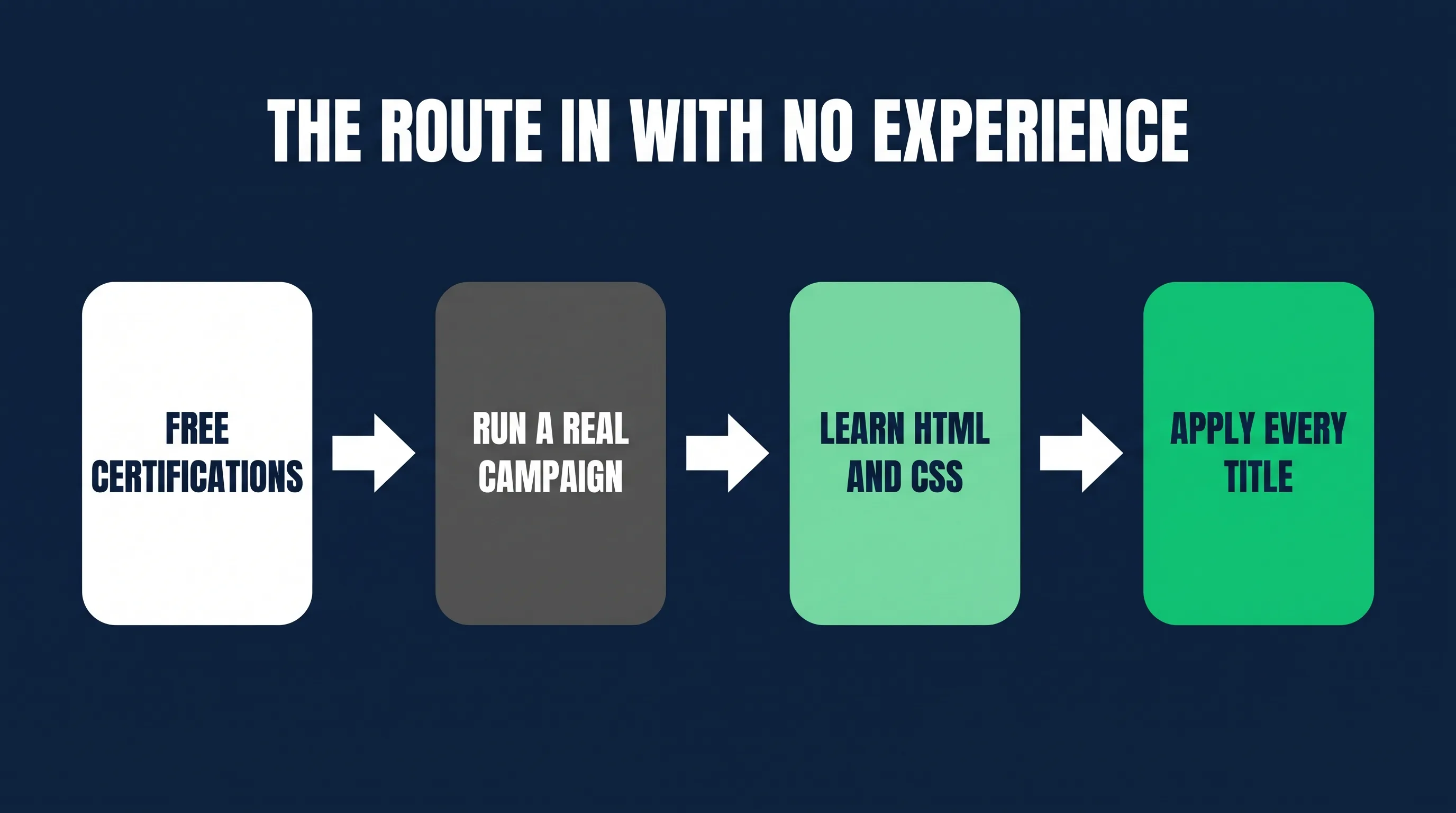
Do the free certifications. Google Analytics, Google Ads, HubSpot, Meta Blueprint. A weekend each. They matter for getting past the first screen and almost nothing after that, which is exactly how you should treat them.
Run real marketing for something small. A side project, a friend's business, a club, a local nonprofit. Actually spend $100 on ads. Actually send emails to a real list. Actually publish and measure. The gap between candidates who have done this and candidates who have only studied is visible within two minutes of an interview.
Be genuinely good with spreadsheets and tools. Coordinators live in shared docs, calendars, and platforms. Being fast and organized is the core competency, and plenty of applicants overstate it.
Learn a little HTML and CSS. Nobody expects it at this level, which is precisely why it stands out. A coordinator who can fix a landing page instead of filing a ticket becomes indispensable fast.
Apply broadly across titles. Marketing coordinator, marketing associate, digital marketing assistant, growth associate, marketing operations coordinator. Same job, different labels.
The part that decides your next three years
You will be handed a queue of tasks. The default path is to complete the queue well, get told you're reliable, and still be doing it in year three at $52k.
The alternative is to pick something and own it.
Choose one channel or one problem nobody has time for. The email program nobody has touched. The landing pages that all load slowly. The reporting that takes someone four hours every Monday. Take it, improve it, and measure what happened.
That's it. That single move converts "reliable coordinator" into "the person who owns email," and owning something is the only real currency in marketing careers. It's also how you end up with the depth that gets you specialist money, because the generalist trap is the biggest risk in this whole career line.
Second thing: pick your specialty early. Email and lifecycle, SEO, paid, ecommerce, or marketing automation. The ones that involve building or measuring something pay better than the ones that involve producing something, and the technical end is the least crowded. Marketing automation specialist and email marketing specialist are the two I'd point most coordinators at.
The honest downsides
You have very little authority and you'll watch decisions you disagree with. That's genuinely useful to experience, but it stings.
The work is fragmented. You'll rarely finish a day with one thing you can point at.
And the title travels badly if you stay too long. Four years as a coordinator reads to a hiring manager as four years of not being promoted, fairly or not. Two years is plenty.

FAQ
What does a digital marketing coordinator do? Supports a marketing team's execution: scheduling and publishing content, maintaining calendars and trackers, pulling reports, building emails and landing pages, and coordinating between the people producing the work.
How much does a digital marketing coordinator make? Typically $45k to $58k in the US, moving to $50k to $75k as a specialist within a year or two.
Do I need a degree? No, though marketing degrees are common in the applicant pool. Free certifications plus a campaign you actually ran will compete with one.
How do I get a digital marketing coordinator job with no experience? Get two or three free certifications, run real marketing for a small business or side project so you have results to talk about, and apply across all the title variants rather than one.
How long should I stay in the role? One to two years. Long enough to learn how a marketing team operates, short enough that the title doesn't define you.
What's the difference between a coordinator and a specialist? The coordinator supports across everything, the specialist owns one area. Moving between them is mostly about claiming ownership of something measurable rather than waiting to be given it.
Take the coordinator job. It's the most reliable door into marketing there is, and the pay is fine for a first step.
Then, in month three, pick one thing in that company that's broken and quietly make it yours. That's the whole difference between people who use this job as a launchpad and people who are still explaining it in interviews four years later.