Email Marketing Specialist: The Job, The Pay, and the Skill Nobody Else Has

On this page
One of the questions Google shows under this job title is "is email marketing a legit job?"
I understand why people ask. Email feels like the thing your aunt gets too much of. It's hard to believe there's a career in it, let alone one paying $65k to $100k with companies competing over you.
But look at it from a business's side. Email is the only channel a company owns outright. No algorithm, no ad auction, no platform that can change the rules on a Tuesday. A brand with a 200,000-person list has a machine it can point at revenue whenever it wants. The person who runs that machine is not doing arts and crafts.

What is an email marketing specialist?
An email marketing specialist plans, builds, and sends a company's email program. That means one-off campaigns and automated flows, plus the list segmentation, deliverability, testing, and reporting that decide whether those emails make money or land in spam.
Put more simply, you own what gets sent, to whom, and when.
That breaks into campaigns and flows. Campaigns are the one-off sends: the launch, the sale, the newsletter. Flows are the automated sequences that run forever in the background: welcome, abandoned cart, post-purchase, win-back. Flows are where most of the money quietly comes from, and they're what separates someone who "does email" from someone who runs an email program.
Around that sits the unglamorous half of the job. List hygiene, segmentation, deliverability, testing, consent and compliance, and the reporting that tells everyone whether it worked.
The flows most programs run, roughly in the order they earn:
- Welcome series for new subscribers, usually three to five emails.
- Abandoned cart and browse abandonment for people who got close and left.
- Post-purchase for thank-yous, how-to-use content, review requests, and the second sale.
- Win-back for customers who've gone quiet for a few months.
- Sunset for people who haven't opened anything in a long time, so you can stop mailing them before they hurt your deliverability.
Newsletters and promotions sit on top of that as campaigns.
A normal week
Monday is planning and numbers. Last week's sends, what the flows produced, what's on the calendar.
Tuesday you're building. In the platform, assembling the campaign, wiring the segment, setting exclusions so the people who bought yesterday don't get the "still thinking about it?" email tomorrow.
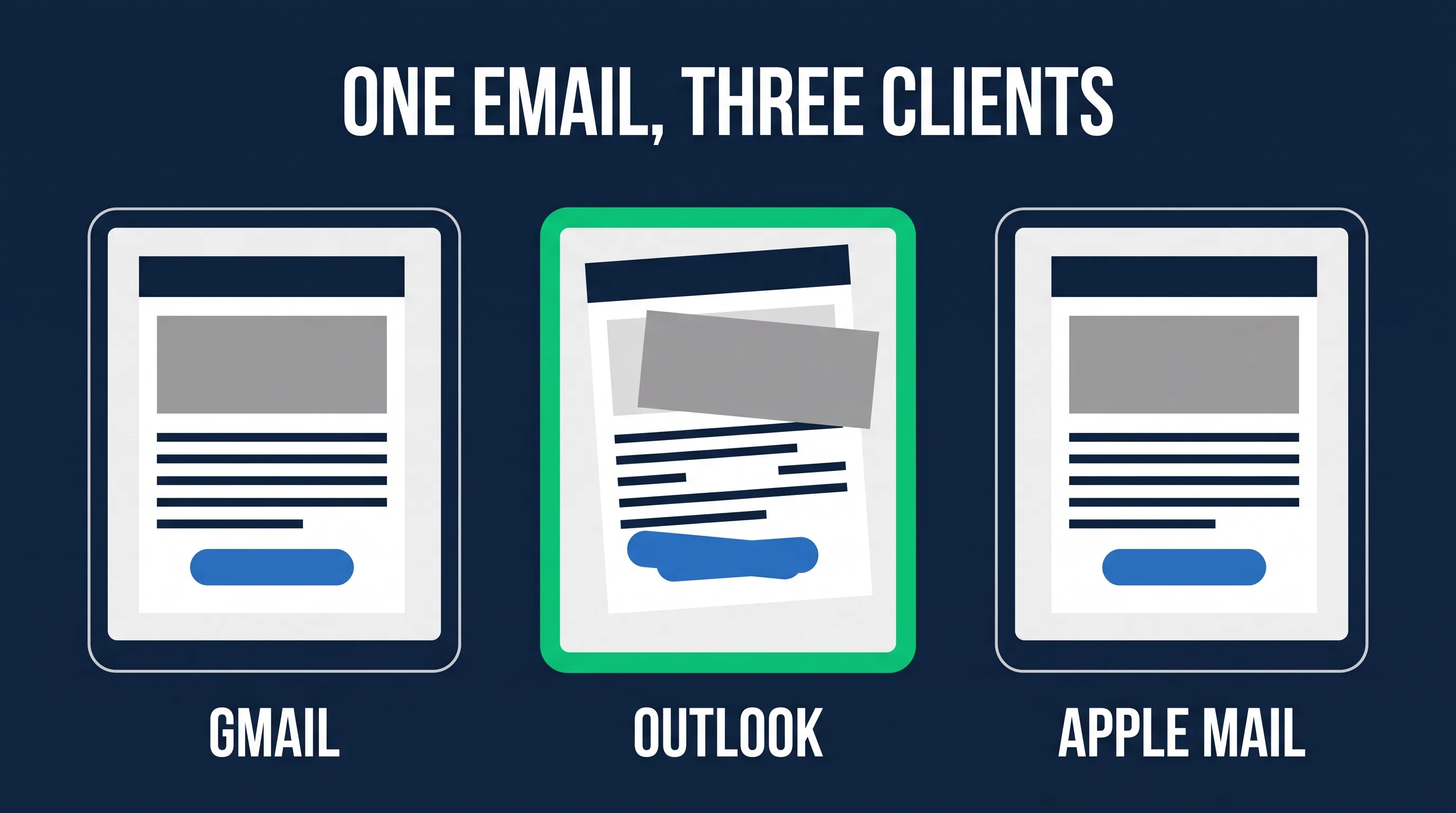
Wednesday something renders badly in Outlook and you spend two hours in table layouts from 2006 fixing it. More on that in a second, because this is the interesting part.
Thursday you send, then you watch. Opens are a soft signal now, so you're watching clicks, revenue per recipient, and unsubscribes.
Friday is flows and cleanup. Improving the welcome sequence, sunsetting people who haven't opened anything in a year, and arguing gently with someone who wants to email the entire list about a product that applies to 4% of it.
The skill almost nobody in this job has
Here's the thing that shaped how we teach this whole path.
Every article ranking for this job title is strategy content. Segmentation frameworks, subject line tips, the best time to send. All fine. None of it helps at 4pm when the template is broken, the send goes out at 6, and the design has collapsed into a single column of stacked images in Outlook.
Email HTML is genuinely stuck decades in the past. Tables for layout. Inline CSS. Conditional comments for Outlook's rendering engine, which is Microsoft Word, which is exactly as bad as it sounds. Dark mode inverting your logo. Gmail clipping the message at 102kb.
Most email marketers deal with this by never touching the code and hoping the drag-and-drop builder holds. Which means the moment something breaks, or the brand wants something the builder can't do, the whole program stops and waits for a developer who doesn't exist.
If you can open the HTML and fix it, you are immediately the most useful person on that team. Not the most senior. The most useful. That is a very good position to be in during a salary conversation, and it's why our Email Marketing Specialist path starts by teaching you to hand-code emails before it teaches you to plan them.
What it pays
Email marketing specialists in the US typically earn $65k to $100k, with the top of that range going to people who can build as well as plan.
Above that, an email marketing manager runs $70k to $110k and owns the program. Senior and lead roles at larger ecommerce and SaaS companies reach $100k to $160k. Below it, an email marketing coordinator starts around $50k to $70k and is the most realistic first title if you're coming in fresh.
Freelance rates hold up well too, especially for people who can code templates, because that work is specific and most agencies don't have anyone who does it. The wider set of titles and pay bands is in email marketing jobs.
Where the jobs are
Any company that sells to a list it owns hires for this. Ecommerce and DTC brands are the biggest employer by a distance, because for a lot of them email is one of the few channels that makes money without an ad bill attached. SaaS companies hire for onboarding and retention email. B2B firms hire for lead nurturing, usually inside HubSpot or Marketo. Then there's the long tail: hospitality, fitness, publishers, nonprofits, and agencies running email for all of the above.
Agencies are underrated as a first job. You'll touch eight or ten brands in a year instead of one, and that volume teaches you faster than anything.
It's also one of the more remote-friendly marketing roles, since everything happens inside a platform. The catch is that remote postings pull applicants from the whole country, so a portfolio matters even more there. Remote email developer jobs covers where those openings tend to show up.
The skills, in the order worth learning them
Email HTML and CSS. Tables, inline styles, bulletproof buttons, and how to test across clients. Start here, because it's the rarest and it makes everything else easier.
One platform, deeply. Klaviyo for ecommerce, HubSpot for B2B, Mailchimp at smaller companies, Braze or Iterable at bigger ones. Learn one properly and the rest are variations.
Deliverability. SPF, DKIM, DMARC, warming a domain, why sending to people who never open is actively damaging. This is the knowledge that saves a company from landing in spam, and remarkably few marketers have it.
Segmentation and lifecycle thinking. Who should get what and when. This is the strategy half, and it's the part every other guide starts with.
Copywriting. You don't have to be brilliant. You have to be clear, and you have to be willing to write the fifth version.
Analytics. Revenue per recipient over open rate, always. Learn to attribute properly so you can prove the program made money.

How to break in with no experience
Build a real program for a real business, even a tiny one.
The version that works: find a small local business or a friend's store with an email list they never use. Offer to set up their welcome flow and abandoned cart flow for free or nearly free. Code the templates by hand, wire them up in Klaviyo, and then measure what happens over the following month.
That gives you three things at once. A portfolio with actual code in it, a case study with a revenue number attached, and a reference. Most applicants for these jobs have a certificate and some opinions about subject lines.
Certifications are worth doing as a screening filter, not as the point. Klaviyo's and HubSpot's are free. Do one, then spend your real time building.
If you want the step-by-step version of that route, how to become an email marketing specialist walks the whole thing.
Isn't AI going to write all the emails?
AI writes email copy fine. It doesn't decide who to send to, doesn't know that your VIP segment should be excluded from the discount, doesn't fix a template that broke in Outlook, and doesn't get held responsible when the whole list receives a test send at 2am.
In practice, the specialists I see using AI well lean on it for four things. First drafts of copy and subject line variants to test. Segment ideas pulled from purchase history. Send-time optimization, which Klaviyo and most big platforms now do per subscriber. And predictive fields like "expected date of next order," which make win-back and replenishment flows much sharper. Every one of those still needs a person deciding whether the output is right.
What AI has changed is the floor. Being merely okay at writing marketing emails is worth less than it was. Being the person who owns the system, the data, and the code around those emails is worth more, because there's suddenly more email being produced and the same small number of people who can make it work properly.
That's the honest version. The strategy-only end of this job is under pressure. The technical end is not.
FAQ
Is email marketing a legit job? Yes. It's one of the few marketing roles that ties directly to revenue, which is why it survives budget cuts that kill brand and social roles. Companies with a customer list will always need someone to run it.
What does an email marketing specialist do? Plans, builds, and sends a company's email program: one-off campaigns and automated flows, plus the segmentation, deliverability, testing, and reporting that keep it working.
How much does an email marketing specialist make? Typically $65k to $100k in the US, with managers at $70k to $110k and senior roles reaching $160k at larger companies. Coordinators start around $50k to $70k.
What skills are required for email marketing? Hands-on platform skill (Klaviyo, HubSpot, Mailchimp, or Braze), segmentation, copywriting, reading campaign data, and deliverability basics like SPF, DKIM, and DMARC. HTML and CSS for email is the skill that moves you to the top of the pay band.
Can an email marketing specialist work remotely? Often, yes. The work lives entirely in software, so plenty of companies hire remote or hybrid. Remote roles get more applicants, so expect to compete with a stronger portfolio.
Do you need a degree? No. This field hires on demonstrated work more than credentials. A portfolio of templates you coded and flows you built with results attached will beat a marketing degree with no hands-on experience.
What's the difference between an email marketing specialist and a manager? The specialist executes the program, the manager owns it, including strategy, budget, and often people. Email marketing manager vs specialist breaks down the difference and when to make the jump.
Is email marketing specialist the same as email developer? No, though they're merging. The developer codes the templates, the specialist runs the program. The most employable version of this career does both, which is exactly why we teach it that way.
What exactly will the job description ask for? A fairly predictable set, and knowing what each line really means helps you read the posting properly. There's a full template with the subtext in the email marketing specialist job description.
If you're weighing this as a career, here's the summary I'd give a friend: it's a technical marketing job disguised as a soft one. The people who treat it as a soft one earn the low end of the band and get anxious every time someone mentions AI. The people who learn the code, the data, and the deliverability underneath it become genuinely hard to replace.
Pick a platform this week, code one email by hand, and send it to yourself in three different clients. Whatever breaks, fix it. That single exercise puts you ahead of most people applying for these jobs.