Email Marketing Manager vs Specialist: The Real Difference and the Jump Between Them

On this page
Two people work on the same email program. Same Klaviyo account, same brand, same weekly calendar. One is on $72k and one is on $105k.
The gap isn't talent and it usually isn't tenure. It's what happens when the campaign underperforms. The specialist explains what they built. The manager explains what they're going to do about the number.
That's the whole distinction, and understanding it is the difference between waiting for a promotion and going and getting one.

What each job owns
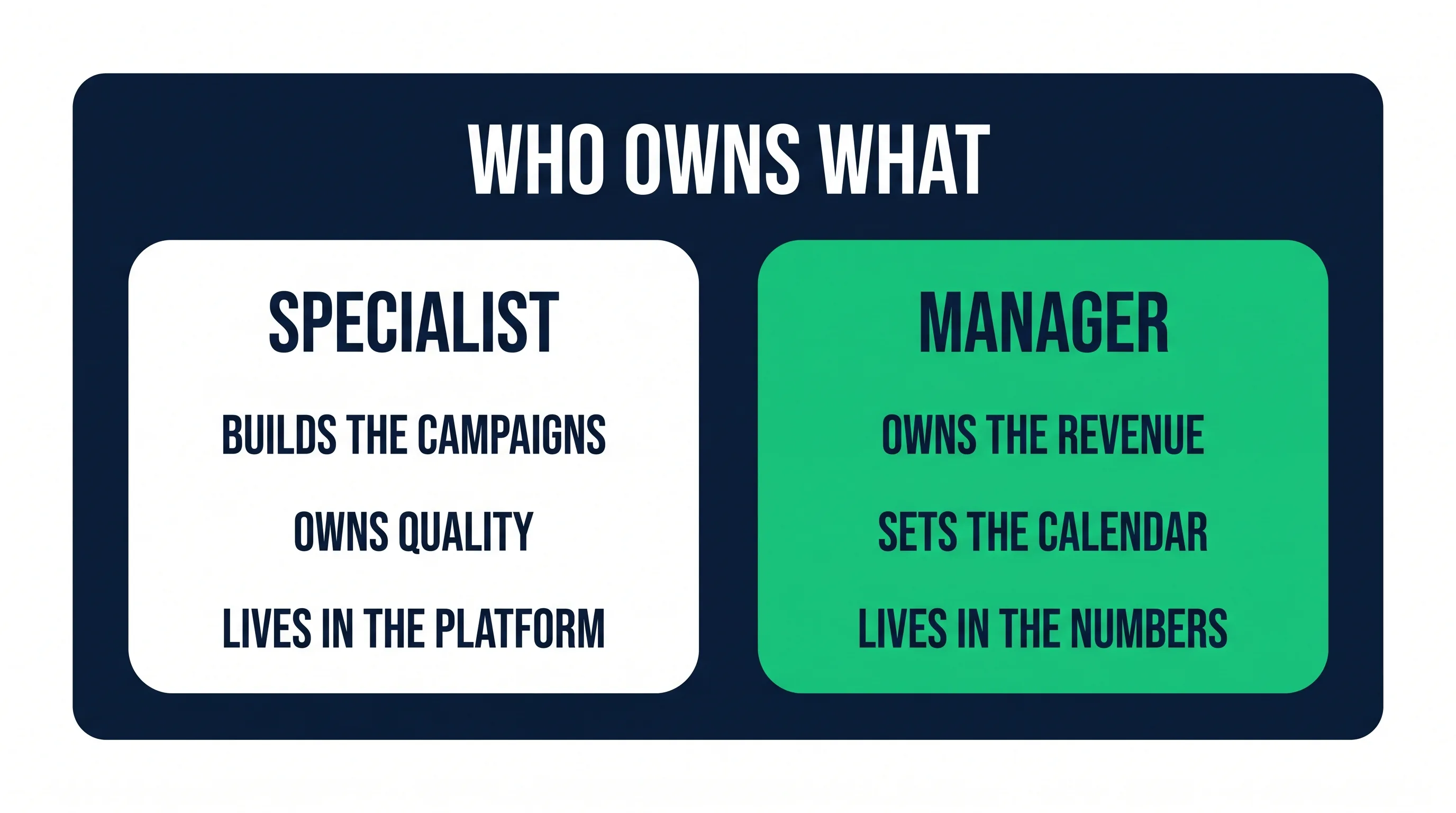
The specialist owns output. The campaign got built correctly, the segment was right, the exclusions worked, the template didn't break, it sent on time. Success is a program that runs cleanly.
The manager owns outcomes. Email revenue is a line in a forecast and it's theirs. They decide what the program is for this quarter, how often the brand sends, what gets tested, what the calendar looks like, and how much of the discount budget email gets.
Everything else falls out of that. The manager sits in more meetings because that's where resources are argued over. The specialist spends more hours in the platform because that's where the work happens. Neither is more important. They're paid differently because accountability is what companies pay for.
Side by side
| Specialist | Manager | |
|---|---|---|
| Typical US pay | $65k to $100k | $70k to $110k, more at scale |
| Owns | Execution and quality | Revenue, strategy, calendar |
| Spends the day in | The email platform | Analytics, planning, meetings |
| Measured on | Sends shipped, errors avoided, campaign performance | Email revenue, retention, program growth |
| Decides | How to build it | Whether to build it at all |
| Manages people | Rarely | Often one to three |
Notice the pay ranges overlap heavily. A strong senior specialist at a big ecommerce brand can out-earn a manager at a small one, because company size moves the number as much as title does. Chasing the word "manager" at a tiny company is a common and expensive mistake.
The day, honestly
A specialist's Tuesday: build the Thursday campaign, fix a broken template, set up a new abandoned cart variant, pull last week's numbers, notice the flow that stopped firing on Sunday and fix it before anyone else spots it.
A manager's Tuesday: review the numbers and decide the send frequency isn't working, argue with merchandising about a promotion that would train customers to wait for discounts, plan next quarter's testing roadmap, one-to-one with the specialist, and rewrite the forecast because the list grew slower than planned.
If reading those two paragraphs made one of them sound like relief and the other like a chore, you have your answer about which you want next.
What actually triggers the promotion
Not time served. I've watched people wait three years for a title while someone hired after them got it in one.
Four things move it:
You start bringing numbers unprompted. Not "the campaign went out" but "revenue per recipient is down 12% over six weeks, I think it's send frequency, here's the test I want to run."
You own a flow end to end and it makes money. Pick the win-back or the post-purchase sequence, rebuild it properly, measure it, and be able to say what it produced. One owned, measurable win is worth more than a year of clean execution.
You start saying no with a reason. Managers get made when leadership notices someone who pushes back on a bad send with data rather than sending it and complaining afterwards.
You make yourself replaceable in the execution. This is the counterintuitive one. Document your flows, write the process down, train whoever's next. Nobody promotes the person who is the only one who knows how the account works, because promoting them breaks the program.
The technical route is faster than the political one
There's a second way to make this jump that people underuse, especially at smaller companies.
Become the person who can build things nobody else can. Code the templates by hand so the brand stops being limited by the drag-and-drop builder. Fix deliverability when the domain starts landing in spam. Wire the platform to the store or the CRM properly through the API.
Do that and you stop being an email marketer with a queue of requests. You become the person the company can't operate the channel without, and that's a much stronger position than "I've been here three years." It's also, bluntly, rare: almost nobody in email marketing can code, which is why our Email Marketing Specialist path teaches the technical half first.
The full argument for why that skill is the differentiator is in the email marketing specialist guide.
Where the manager jobs actually are
Worth knowing before you start applying: the search results for "email marketing manager" are almost entirely job boards, which tells you these roles turn over constantly and get listed in volume.
Ecommerce brands hire the most, because email is directly attributable to revenue there. SaaS companies hire for lifecycle rather than campaigns, so the title is often "lifecycle marketing manager" instead. Agencies hire managers to run several client programs at once, which is brutal but teaches you more in a year than three years in-house.
Search for all the labels, not one. Email marketing manager, CRM manager, lifecycle marketing manager, retention marketing manager, and marketing automation manager overlap enormously. The email marketing jobs guide maps the whole set, and the CRM manager guide covers the closest neighbor.

Should you even want the manager job?
Genuine question, and the answer isn't automatically yes.
You'll build less. If the part you love is opening the HTML and making something work, management takes that away and replaces it with planning and people. Plenty of people make the jump, hate it, and go back to a senior individual role, sometimes for similar money.
The alternative track is real: senior specialist, lead, or the technical route into marketing engineering and automation, where pay keeps climbing without a single one-to-one in your calendar. Marketing automation specialist is the clearest version of that path.
Choose based on which problems you want to spend your Tuesdays on, not on which word looks better on LinkedIn.
FAQ
What is the difference between an email marketing specialist and an email marketing manager? The specialist executes the program, the manager owns its results. Managers set strategy, hold the calendar and budget, answer for revenue, and often manage a person or two.
Which pays more? Manager, on average, but the ranges overlap a lot. A senior specialist at a large company often earns more than a manager at a small one. Company size is as big a lever as title.
How long does it take to go from specialist to manager? Commonly two to four years, and faster if you own a revenue-producing flow and can prove what it did. Time alone doesn't do it.
Do email marketing managers still build campaigns? At small companies, constantly. At larger ones they review and approve while a specialist builds. Most managers keep their hands in the platform at least partly, and the ones who fully stop tend to lose credibility with their team.
Can I skip specialist and get hired as a manager? Rarely from outside email, but often from an adjacent manager role, like CRM or lifecycle, where you already own a number. Coming from execution, the specialist seat is the normal route.
What's a lifecycle marketing manager, then? Broadly the same job with a wider channel mix, usually including SMS and push, and framed around the customer journey rather than around email specifically. Common at SaaS and app companies.
If you're a specialist reading this and wondering why the promotion hasn't come: pick one flow this month, rebuild it properly, and measure what it does to revenue. Then say that sentence out loud in your next review.
Owning one number is how everyone I've seen make this jump actually made it. The title follows the ownership, never the other way round.