Marketing Automation Specialist: The Job, The Tools, and What It Pays
On this page
Somewhere in most mid-sized companies there's a HubSpot account somebody bought in 2021, with 40 workflows in it, and nobody left who knows how any of them work.
Half are turned off. Two are sending duplicate emails to the same people. One has been quietly tagging every new contact as a customer for eight months, which is why the reporting has been nonsense all year.
That mess is a job. It's called marketing automation specialist, and companies are paying real money for someone who can walk in and untangle it.

What the job actually is
You build and maintain the automated systems that move people from stranger to customer.
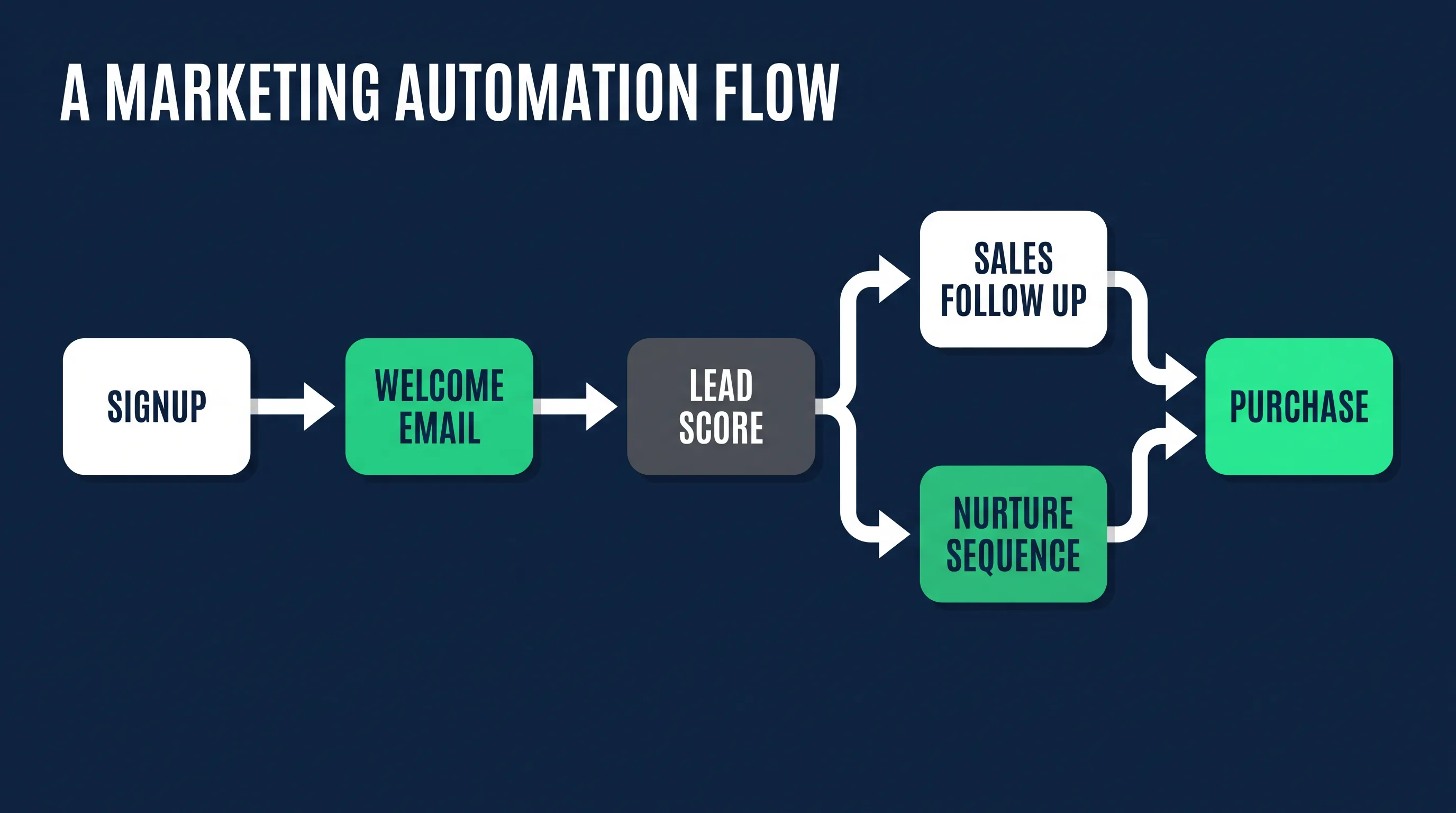
Concretely: the welcome sequence that fires when someone signs up. The lead scoring that decides who sales calls first. The abandoned cart flow. The integration that pushes form submissions into the CRM with the right fields attached. The suppression logic that stops a customer getting a "come back, we miss you" email two days after they bought.
It's plumbing. Unglamorous, invisible when it works, extremely visible when it doesn't. It's also the closest thing marketing has to engineering, which is exactly why the pay holds up and the applicant pool is thin.
Why this role is easier to get than it looks
Marketing teams bought automation tools faster than they hired people who could run them. That's the whole opportunity in one sentence.
The average applicant for these jobs is a marketer who has clicked around in HubSpot. They can build a basic email workflow. They cannot debug why the API integration is dropping records, cannot write a regex to clean a phone number field, and go quiet when someone asks what happens if a contact enters two workflows at once.
If you can do those things, you are not competing with them. You're in a different pile.
That's also why the technical version of this role pays better than the marketing version, and why I keep telling developers to look sideways at these jobs instead of sending their four hundredth front-end application. I made that case in full in why engineers are switching to martech.
A normal day
Morning starts with alerts and errors. A sync failed overnight, forty contacts didn't make it into the CRM, you find out why and replay them.
Then build work. Marketing wants a nurture sequence for a new product, so you map the logic first, on paper or in a diagram, because building it directly in the tool is how you end up with the 40-workflow mess. Entry conditions, exit conditions, what happens to someone already in another sequence, what data has to exist for it to work.
Then data hygiene, which is more of this job than anyone admits. Duplicate records, inconsistent country fields, people who unsubscribed in one system and not the other.
Then a meeting where someone asks for something impossible, and you translate it into the thing that's actually possible.
Then reporting. Which flows are producing revenue, which are just producing sends.
The tools you need
A marketing automation platform. HubSpot and Marketo dominate B2B. Klaviyo dominates ecommerce. Braze and Iterable show up at bigger consumer companies. Salesforce Marketing Cloud is its own universe and pays well precisely because it's painful. Learn one deeply rather than five badly, and pick the one your target industry uses.
A CRM. Usually Salesforce or HubSpot. You need to understand objects, fields, and how records relate, because most automation problems are really data problems wearing a costume. If you'd rather own that side, the CRM manager role is the neighboring job, and CRM specialist is the usual way into it.
Integration tooling. Zapier, Make, or n8n for connecting things without a developer. n8n is the one worth learning if you want the technical end of the market, because it's open-source, self-hostable, and increasingly what the AI-heavy teams reach for. Start with what n8n is or the honest Zapier vs Make comparison.
Enough code to be dangerous. HTML and CSS for email templates, basic JavaScript, an understanding of APIs and webhooks, and comfort with a spreadsheet at a level most marketers never reach. You don't need a computer science degree. You need to not be helpless when the no-code option runs out.
Email fundamentals. Deliverability, authentication, list hygiene, and why the beautiful template renders like a ransom note in Outlook. Almost nobody in marketing knows this. It's a genuine differentiator.
What it pays
Roughly $65k to $95k for a specialist in the US, with the technical end of that range going to people who can code and integrate rather than only configure.
Move up and it keeps going. Marketing automation manager runs about $95k to $130k. Senior and lead roles at large companies, especially anyone deep in Salesforce Marketing Cloud or Braze, clear $140k. Contract and freelance work in this space is steady too, because companies constantly need someone to come in and fix the mess before hiring a permanent person.
For context on the neighboring titles and where they sit, email marketing jobs lays out the whole field.
How to get in
Learn one platform properly. HubSpot's certifications are free and genuinely useful for getting past a first screen. Klaviyo's are free too and matter more if you want ecommerce. Do the certification, but understand that it gets you the interview, not the job.
Build something real. This is the part people skip. Spin up a free HubSpot or Klaviyo account, create a fake business, and build an actual system: a signup form, a welcome sequence with branching logic, lead scoring, a re-engagement flow, and a dashboard showing what happened. Then screenshot all of it and write up the logic.
Then automate something for a real business. A friend's store, a local gym, anyone. Connect their form to their CRM, build the follow-up sequence, and measure the result. One real case study with a number attached beats any certificate.
Learn the integration layer. The moment you can say "I connected their booking system to their CRM with a webhook and stopped the manual data entry," you've left the pile of marketers who can only click.

The honest downsides
You're invisible when it works. Nobody sends a thank-you note because the welcome sequence fired correctly 14,000 times this month. When something breaks, everybody notices immediately.
You'll inherit other people's disasters. Most jobs in this field start with an audit of a system built by three people who all left. That's genuinely interesting work if you like puzzles and miserable if you wanted a blank canvas.
And you sit between teams. Marketing wants it now, sales wants it different, IT wants to know why you're touching the CRM. Getting good at this job means getting good at saying no with a reason attached.
FAQ
What does a marketing automation specialist do? Builds and maintains the automated systems that handle marketing at scale: email sequences, lead scoring, CRM data flows, integrations between tools, and the reporting on top of it. Part marketer, part systems person, with the balance depending on the company.
How do I become a marketing automation specialist? Learn one platform deeply, get its free certification, build a complete working system in a sandbox account, then do it for one real business so you have a case study. Most people get there in three to six months of serious work, often moving in from a coordinator or email marketing role.
Do you need to code for marketing automation? Not to start. To reach the top of the pay band, yes. HTML and CSS for email, basic JavaScript, and comfort with APIs and webhooks separate the specialists who plateau from the ones who become the person nobody can replace.
Is marketing automation a good career? It's one of the better bets in marketing right now, because demand grew faster than the supply of people who can actually operate the tools. The work is stable, it transfers across industries, and it's close enough to revenue that it survives budget cuts better than most marketing roles.
What's the difference between a marketing automation specialist and an email marketing specialist? Overlap is heavy. The email specialist owns the messages and the campaigns; the automation specialist owns the systems, data, and integrations underneath them. At small companies it's one person. See the email marketing specialist role for the other side of that.
Which tool should I learn first? HubSpot if you want B2B, Klaviyo if you want ecommerce. Both are free to learn in, both are everywhere in job postings, and skills transfer between platforms more easily than the job ads suggest.
What's the next step up from specialist? Marketing automation manager, where you own the stack and the data model rather than the workflows inside it. The role and its pay are covered in the marketing automation manager guide.
The thing I'd want you to take from this: the barrier here is not talent or a degree. It's that most marketers stop learning at the point where the tool stops being obvious, and most developers never look at marketing tools at all. Standing in that gap is a whole career, and it's a fairly comfortable place to stand.
If you want the structured version of that gap, our Email Marketing Specialist path teaches the technical half most automation people never pick up, starting with coding the emails themselves and ending with the systems that send them.