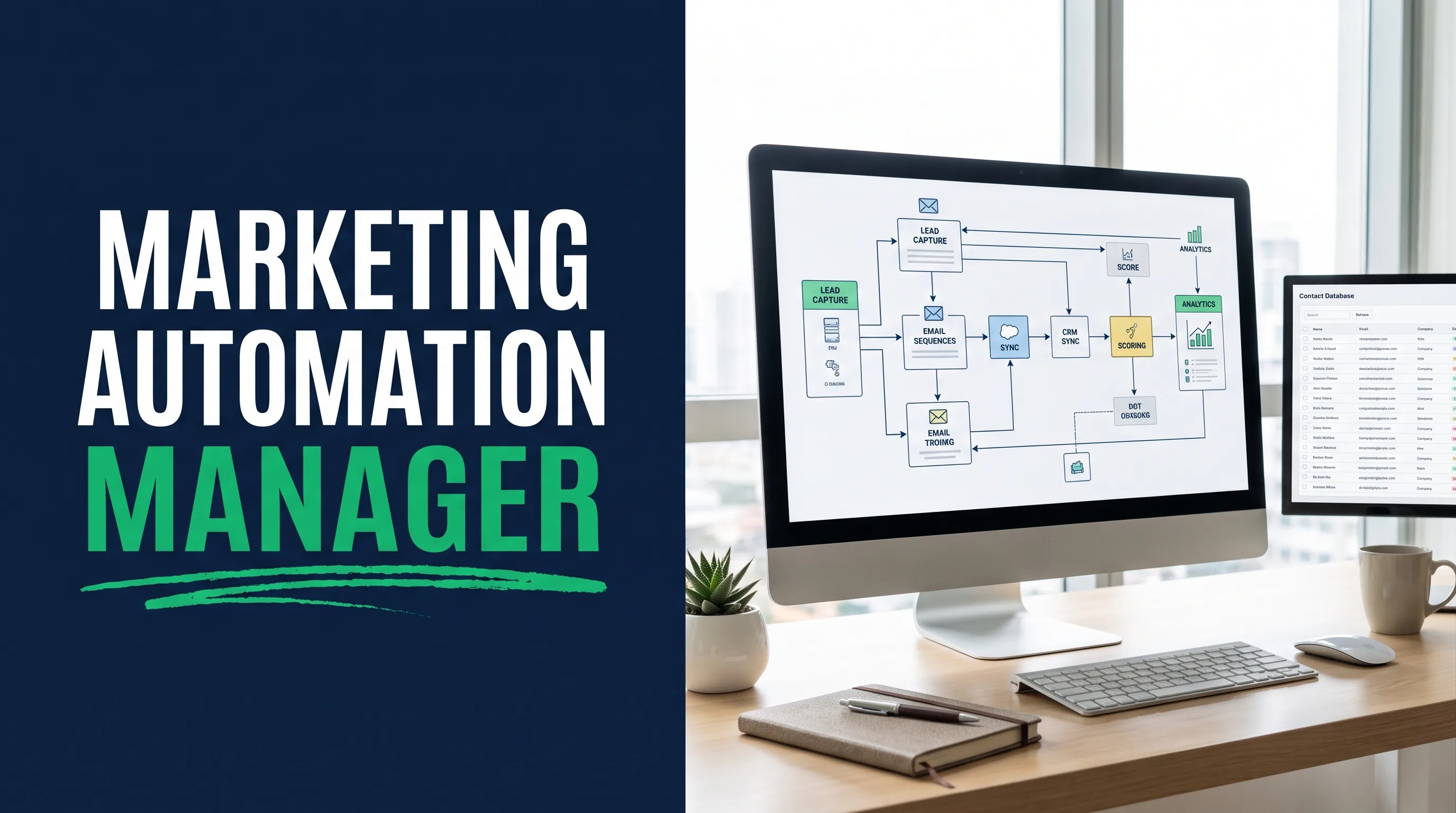
Marketing Automation Manager: Owning the Machine Instead of Building It
On this page
There's a specific moment when a company realizes it needs this role.
Usually it's when someone asks a simple question, like how many leads came from last quarter's webinar campaign, and three systems give three different answers. Nobody can say which is right. The CRM and the marketing platform disagree about who a contact even is.
That's a systems problem, not a marketing problem, and the person who fixes it is a marketing automation manager.

What the job is
You own the marketing technology stack and the processes running inside it.
The platform. Whatever the company runs on: HubSpot, Marketo, Salesforce Marketing Cloud, Braze, Pardot. You're responsible for how it's configured, who has access, and whether it does what people think it does.
The data model. How contacts, accounts, and activity are structured and kept clean. This is the foundation everything else sits on, and it's where most automation programs quietly fail.
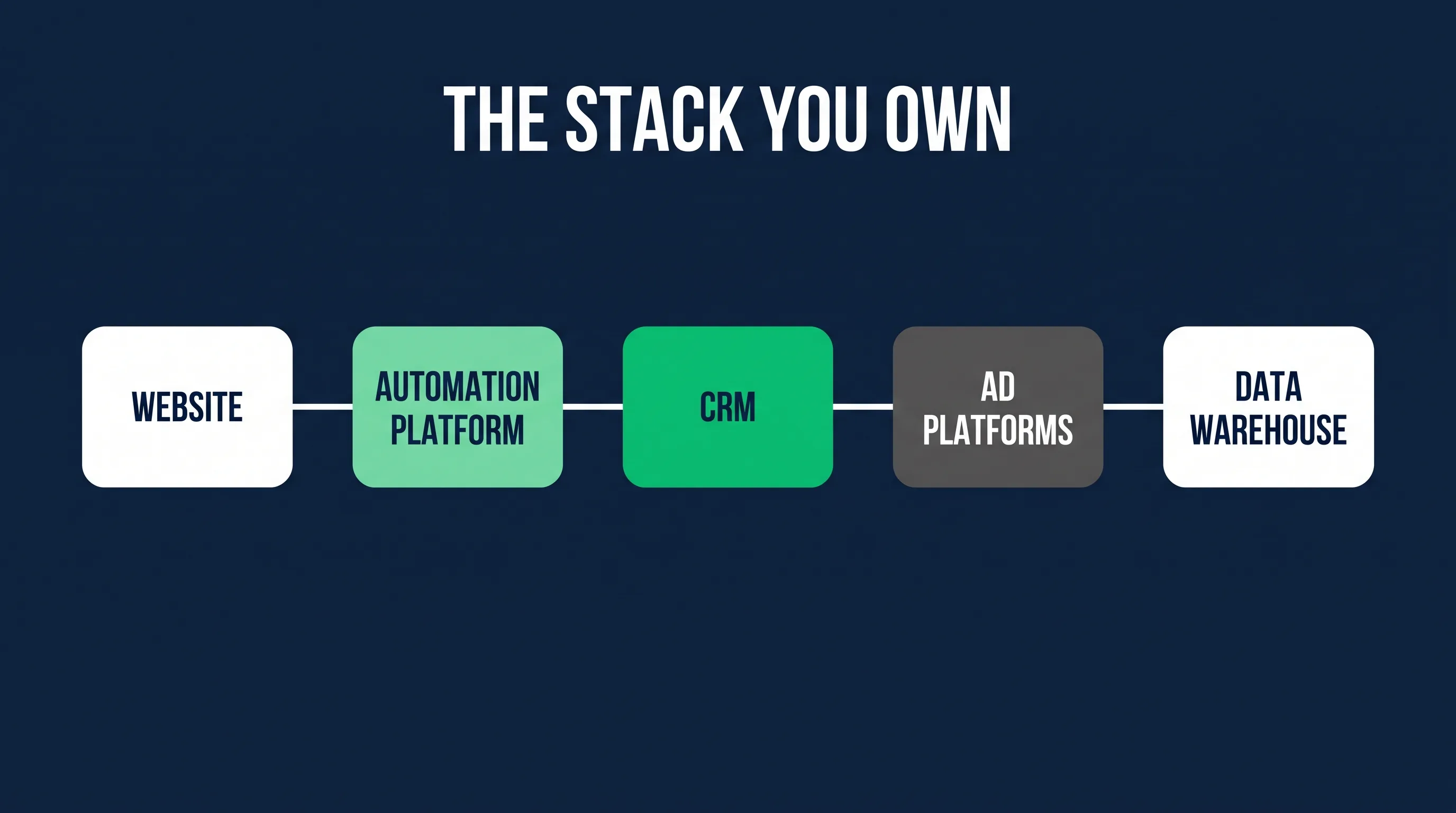
Integrations. The connections between the marketing platform, the CRM, the website, the ad platforms, the data warehouse, and whatever the product team built. Every one of these can rot silently.
Programs at scale. Lead scoring, routing, nurture tracks, attribution setup, and the operational plumbing behind campaigns.
Governance. Naming conventions, templates, documentation, and stopping five people from building five slightly different versions of the same workflow.
A team, usually. One or two specialists, or contractors, or an agency.
How it differs from the specialist role
The marketing automation specialist builds and maintains workflows. The manager decides what the system should look like, owns the roadmap, and answers for whether the data anyone reports on is trustworthy.
The clearest difference is scope of consequence. A specialist's mistake breaks a campaign. A manager's mistake breaks the reporting for a whole quarter, or floods 20,000 contacts with duplicate emails at 3am.
That's why the pay steps up and why companies interview carefully for it.
What it pays
$95k to $130k for most US marketing automation managers, with senior and director-level marketing operations roles at $130k to $170k.
Two things push you toward the top of that. Depth in an enterprise platform, especially Salesforce Marketing Cloud or Marketo, which are painful enough that experienced people are scarce. And genuine technical ability: someone who can write SQL, work with APIs, and reason about data architecture is doing a job most marketers can't do at all.
This role also has an unusually strong contract market. Companies constantly need someone to come in for three months and untangle an instance before hiring permanently, and day rates for that work are good.
The skills that matter
Systems thinking. The ability to hold the whole stack in your head and predict what a change in one place does three systems downstream. This is the core competency and it's hard to fake.
Data fluency. Field structures, deduplication, identity resolution, and enough SQL to answer questions yourself rather than raising a ticket.
Platform depth. One major platform, properly. Certifications matter more here than in most marketing roles, particularly Salesforce and Marketo, because enterprise buyers use them as a filter.
Integration work. APIs, webhooks, iPaaS tools, and knowing when a no-code connector is fine versus when it will silently drop records.
Documentation and governance. Boring, and the thing that separates a manager whose system survives their departure from one whose successor rebuilds everything.
Translation. You sit between marketing, sales, and IT, all of whom want different things and use different words for the same thing.
How to get there
From specialist, in two to four years. The trigger is owning the architecture rather than the tickets: proposing how the system should be structured, then delivering it.
From marketing operations or revenue operations. Practically a lateral move, and the titles increasingly overlap.
From a technical background. Developers and analysts move into this and do well, because the hard part is the systems reasoning rather than the marketing. If you already code, the marketing context takes months rather than years, which is the argument in why engineers switch to martech.
What gets you hired: a system you rebuilt. "I inherited an instance with 400 workflows, audited it down to 60, fixed the lead routing, and cut our sync failures to zero" is the kind of sentence that ends interviews well.

The honest downsides
You inherit chaos, every time. Nobody hires this role when the system is in good shape.
Your best work is invisible. A stack that runs quietly generates no praise, while one visible failure generates a lot of attention.
You're accountable for data quality that other teams degrade. Sales types nonsense into fields, the website form collects the wrong things, and the report built on top is somehow your problem.
And there's a real risk of becoming the only person who understands the system, which feels like job security and is actually a trap. It makes you unpromotable and unable to take a holiday. Documentation is self-defense.
FAQ
What does a marketing automation manager do? Owns the marketing technology stack: platform configuration, data model, integrations, lead scoring and routing, governance, and usually a small team.
How much does a marketing automation manager make? Typically $95k to $130k in the US, with senior marketing operations roles reaching $170k. Contract work in this space pays well too.
What's the difference between this and a marketing automation specialist? The specialist builds workflows inside the system. The manager decides what the system should be, owns the roadmap and data integrity, and carries the consequences.
Which platform should I specialize in? HubSpot for mid-market breadth, Marketo or Salesforce Marketing Cloud for enterprise pay. The enterprise platforms are harder and compensate accordingly.
Do I need to code? Not formally. In practice, SQL and comfort with APIs are what separate the top of the band from the middle, and they make you far more useful in the day-to-day.
Is marketing automation a stable career? More stable than most marketing roles, because the systems don't get switched off in a downturn and someone has to keep them running. It also sits close to revenue reporting, which protects budget.
If you're a specialist wondering how to make this jump, stop waiting for permission to fix the architecture.
Audit the instance you work in, write down what's broken and what it costs, and bring the plan to your manager unprompted. Every automation manager I've met got there by doing that once.