CRM Manager: What the Job Is (It's Two Different Jobs), and What It Pays
On this page
People searching for this job title keep asking Google the same strange question: is CRM an IT job?
It's a reasonable thing to be confused about. Two genuinely different careers are hiding behind the same three letters, and job postings do nothing to help. One of them is a marketing job about keeping customers. The other is a systems job about keeping the database sane.
Figure out which one you're looking at and everything else about this role gets clear.

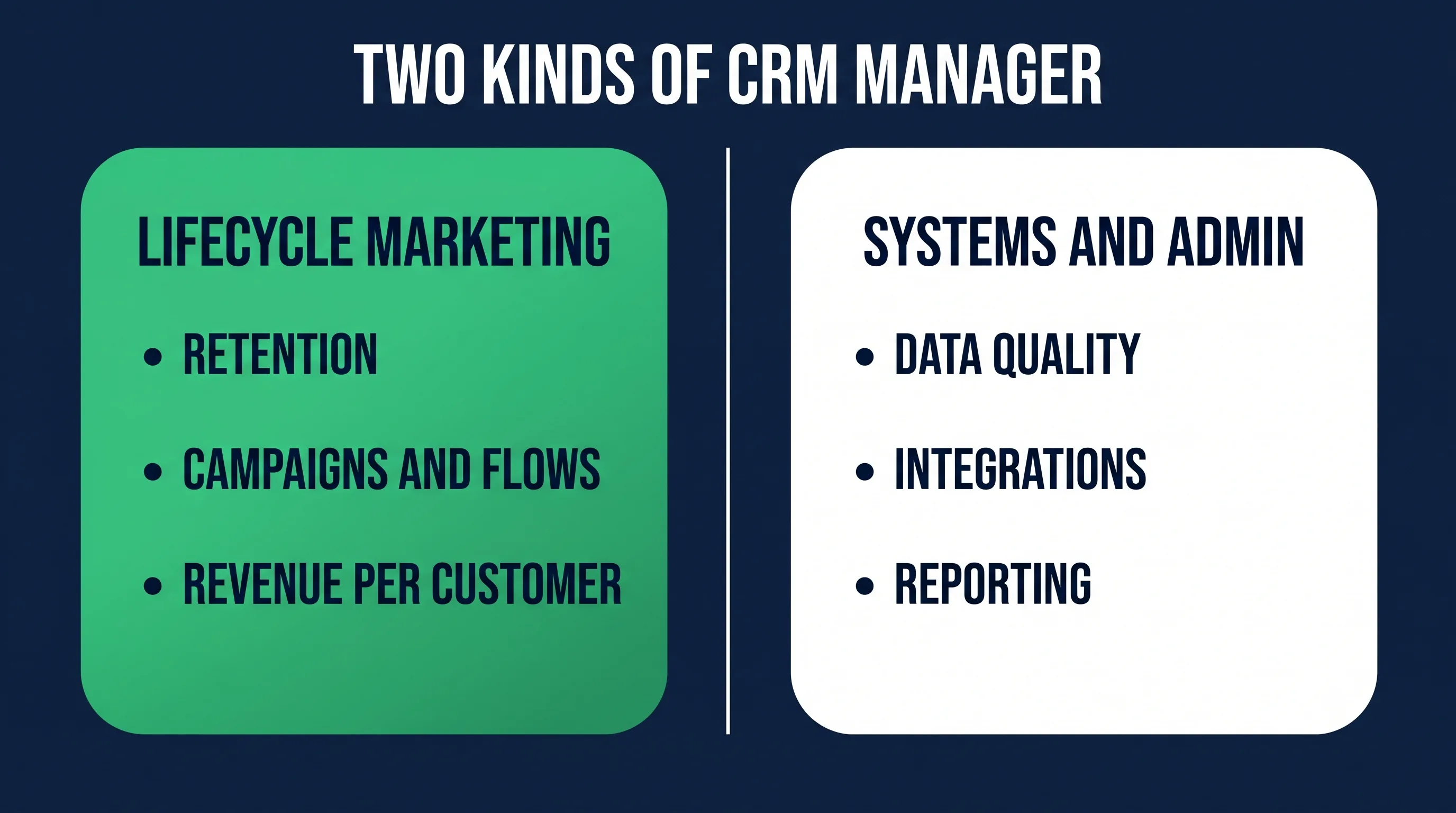
The two CRM managers
The lifecycle marketing version. You own the relationship with existing customers. Email, SMS, push, loyalty programs, win-back campaigns, retention. You're measured on repeat purchase rate, churn, and revenue per customer. This is what "CRM manager" means at most retail, ecommerce, and consumer brands, especially in the UK and increasingly in the US.
The systems version. You own the CRM platform itself, usually Salesforce or HubSpot. Data model, fields, permissions, integrations, reporting, and keeping sales from destroying the database with free-text fields. This is what it means at a lot of B2B and enterprise companies, and it sits closer to IT and revenue operations than to marketing.
Both are good jobs. They need different brains, and the interviews are nothing alike, so read the responsibilities on any posting before you decide it's the job you want.
How to tell in ten seconds: scan the posting for the metrics. If it says retention, churn, repeat purchase, or lifecycle, it's marketing. If it says data quality, adoption, integrations, or reporting, it's systems. If it says all of them, it's a small company and you'll do both.
What the lifecycle version does all day
Look at yesterday's numbers first: retention cohorts, repeat purchase rate, how the last campaign performed against control.
Then segmentation. Which customers haven't bought in 90 days, which ones bought once and never returned, which ones buy every month and should never receive a discount because they'd have paid full price anyway. Most of the value in this job is in not wasting margin on people who were going to buy regardless.
Then building the campaign. Brief the copy, build the flow, set the audience and the exclusions, test it on a real phone, schedule it.
Then the ongoing automated flows, which quietly earn more than any single campaign: welcome, post-purchase, replenishment, win-back, abandoned browse.
Then a meeting about the promo calendar, where you argue for sending less to more relevant people, and someone from merchandising argues for sending everything to everyone.
What the systems version does all day
Ticket queue first: a sales rep can't see an account, a field isn't syncing, a report is wrong.
Then data work. Deduplication, validation rules, cleaning up the six ways people have typed the same company name.
Then building. New fields, workflows, approval processes, dashboards for whoever needs to see pipeline.
Then integrations, which is where the real complexity lives. The CRM talks to the marketing platform, the billing system, the support desk, and the data warehouse, and any one of those connections can quietly rot.
Then training, because a CRM is only as good as whether people actually use it properly.
What it pays
CRM managers in the US typically land between $85k and $120k.
The systems side skews a little higher, especially anyone with real Salesforce depth, where senior admin and architect-adjacent roles run past $140k. The lifecycle marketing side tops out somewhat lower at manager level but scales well into director of retention or director of lifecycle roles.
Below manager, a CRM specialist or CRM coordinator usually sits at $55k to $80k. Above it, senior and head-of roles run $130k to $170k, higher at large companies with equity attached.
Salary in this field tracks two things more than anything else: how big the customer base is, and whether you can prove you moved retention.
The skills that matter
Data literacy. You need to be genuinely comfortable with segments, cohorts, and the difference between a metric going up and a metric going up for a good reason. Learn SQL if you can. A CRM manager who can query the warehouse instead of filing a request is worth a lot more than one who can't.
Platform depth. Salesforce, HubSpot, Klaviyo, Braze, or whatever your industry runs on. Depth in one beats shallow familiarity with four.
Email and messaging fundamentals. Deliverability, list hygiene, consent, and what happens when you send too much. Almost every CRM manager inherits a list that's been abused.
Enough technical ability to build. APIs, webhooks, and at least basic HTML for the emails. This is the recurring theme across every job in this cluster, and it's the difference between waiting on a developer and shipping today. It's also why our Email Marketing Specialist path starts with hand-coding emails rather than with strategy slides.
Commercial judgment. Knowing when not to send, when not to discount, and when the answer to "can we email everyone" is no.
How people get into it
The most common route is sideways from an adjacent seat: email marketing specialist, CRM specialist, marketing coordinator, or customer support. Support is an underrated feeder, because you already understand the customer better than the marketing team does.
For the systems side, the classic path is Salesforce administrator. The certification is well-defined, widely respected, and there's a genuine ladder above it.
For the lifecycle side, get your hands on a real customer base. Run email and retention for a small brand, even part time or unpaid at first, and get numbers you can point at. "I built a win-back flow that recovered 6% of lapsed customers" is the sentence that gets you hired.
If you're starting from zero and not sure which lane, the email marketing jobs guide maps the full set of titles around this one, and the marketing automation specialist role covers the closest neighbor.

The honest downsides
You inherit whatever the last three people built, and it's usually a mess held together by one workflow nobody understands.
You'll be blamed for data you don't control. Sales types garbage into the CRM, the website form collects the wrong fields, and the report you produce from all that is somehow your fault.
And retention work is slow. Acquisition shows results in a week. A retention improvement shows up over quarters, which makes it harder to get credit for and easier for an impatient executive to underfund.
FAQ
Is CRM an IT job? Sometimes. The systems version, where you administer Salesforce or HubSpot, sits close to IT and revenue operations. The lifecycle version is a marketing job that happens to be technical. Same title, different departments.
Is a CRM manager a good job? Yes, with a caveat. The pay is solid, the skills transfer across industries, and every company with repeat customers needs someone doing it. The caveat is that you're often cleaning up inherited systems and proving value on a slow timeline.
Is CRM difficult to learn? The tools are not hard. Building a workflow in HubSpot takes an afternoon to figure out. What's hard is the judgment: knowing which segment to target, when to stop emailing someone, and how to structure data so it still makes sense in two years. That takes real reps.
How much does a CRM manager earn? Typically $85k to $120k in the US, with senior and Salesforce-heavy roles going past $140k. Specialists below manager level usually sit at $55k to $80k.
What's the difference between a CRM manager and a CRM specialist? Scope and ownership. The specialist executes campaigns or handles requests; the manager owns the strategy, the platform, and usually the budget. The CRM specialist role covers the entry point in more detail.
Do I need a Salesforce certification? For the systems side, it helps a lot and is close to a default expectation. For the lifecycle marketing side, it matters much less than being able to show retention numbers you moved.
If you take one thing from this: before you apply, read the posting twice and work out which of the two jobs it is. People wash out of CRM roles not because they weren't capable but because they took the systems job wanting the marketing one, or the other way round.
Once you know which one you want, the route is short. Pick the platform that lane uses, learn it properly, and get your hands on a real customer base as fast as you can. That's the entire qualification.