CRM Specialist: The Entry Point Into a $120k Career

On this page
If you've ever been the person on a team who actually kept the spreadsheet clean, this job is closer than you think.
CRM specialist is the working title underneath CRM manager. You're the one in the system every day: building the segments, sending the campaigns, fixing the records, running the reports that somebody else presents. It pays $55k to $80k in the US, it hires people from support and admin backgrounds constantly, and it opens onto a ladder that reaches $120k and beyond.

What does a CRM specialist do?
A CRM specialist runs the day-to-day work inside a company's customer relationship management system. You keep customer data clean, build segments and automated flows, send campaigns to existing customers, and report on what those customers did next.
In practice the job splits into four repeating chunks.
Building and sending. Campaigns and automated flows for existing customers. Someone decides the strategy, often the CRM manager, and you turn it into a real thing in the platform: audience, exclusions, content, schedule, test, send.
Data work. Deduping records, standardizing fields, importing lists correctly, fixing what a bad import broke last Thursday. This is more of the job than any posting admits, and being genuinely good at it is how you become indispensable early.
Reporting. Pulling the numbers on what you sent and what it did. Repeat purchase rate, churn, revenue per email, list growth.
Requests. Sales needs a segment. Support needs a field added. Marketing needs to know why 40 people got the wrong email. You're the person who knows where things live.
At a small company you'll also write the copy and design the emails. At a big one you'll be one of several specialists, each on a different part of the program.
Is a CRM specialist an IT job or a marketing job?
Both, and which one you get depends on the company. Google's own suggested questions for this title include "is CRM an IT job?", which tells you how confusing the postings are.
The marketing version lives in retail, ecommerce, and consumer brands. You report to a CRM or lifecycle manager, and your work is campaigns, segments, and retention. The platform is often Klaviyo, Braze, or Salesforce Marketing Cloud.
The systems version lives in B2B and larger companies. You report into sales operations, revenue operations, or IT, and your work is the platform itself: fields, permissions, data imports, integrations, dashboards for the sales team. The platform is usually Salesforce or HubSpot, and the next step up looks more like Salesforce administrator than marketing manager.
Read the posting for the verbs. "Campaigns," "journeys," and "retention" mean marketing. "Configure," "user access," and "data model" mean systems. The CRM manager guide goes further into the split, since it follows you up the ladder.
What it pays
$55k to $80k is the honest US range for a CRM specialist, with the higher end at larger companies and for people with real platform depth.
The reason to care about this job isn't the starting number, though. It's the next one. CRM manager runs $85k to $120k, and the jump usually takes two to four years rather than a decade. Senior and head-of roles go past $150k. The CRM manager guide covers what that next seat actually involves, including the fact that it's really two different jobs depending on the company.
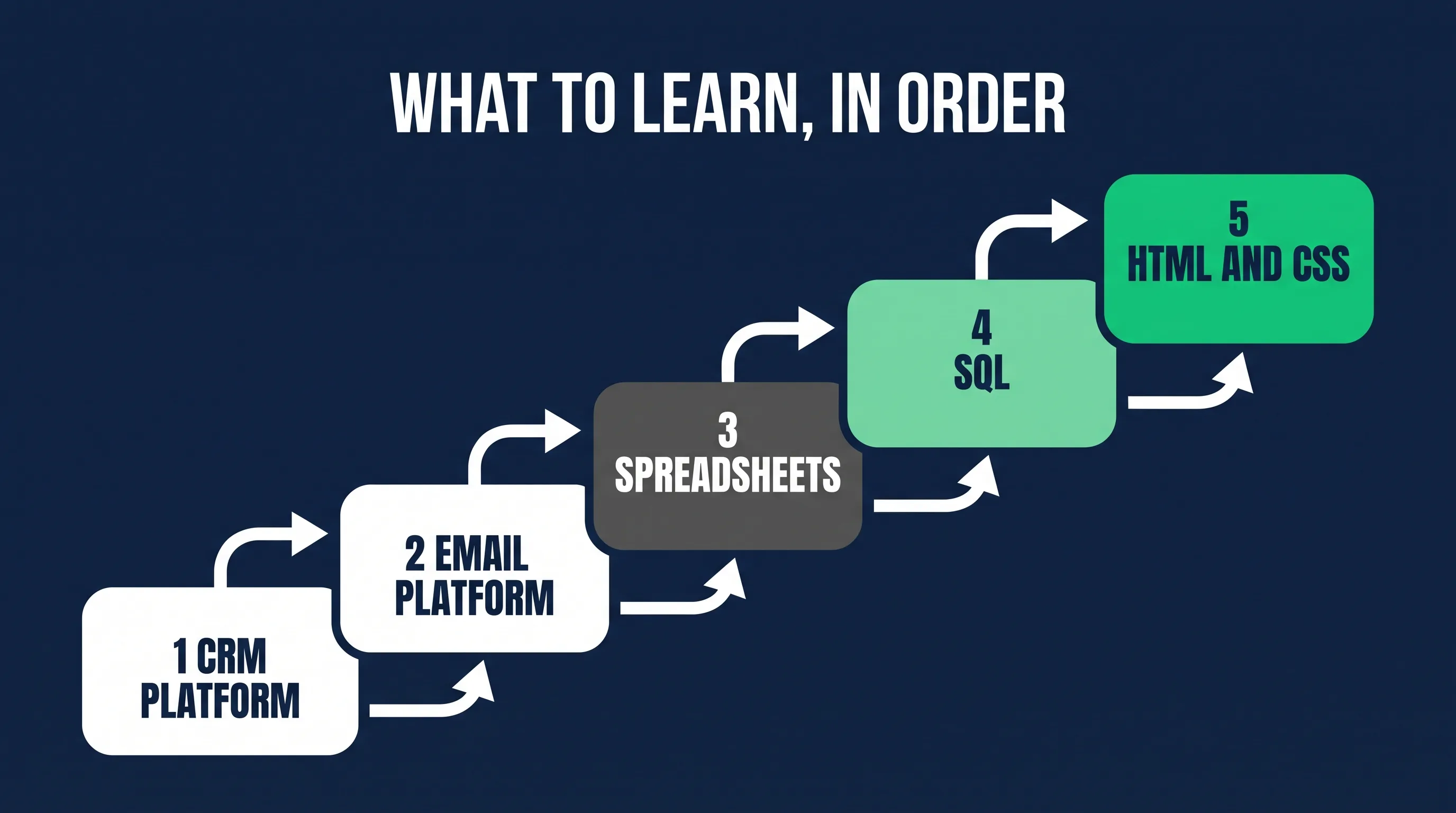
The tools to learn, in order
Start with one CRM. Salesforce if you're aiming at B2B or enterprise, HubSpot if you want the friendlier route with more mid-market jobs. Both have free learning tracks and both are named directly in thousands of job postings.
Add the email platform your target industry uses. Klaviyo for ecommerce, Marketo or HubSpot for B2B, Braze at larger consumer companies.
Get properly good at spreadsheets. Not "I've used Excel." Pivot tables, lookups, cleaning a messy export without doing it by hand. This is the single most useful practical skill in the first year.
Then SQL, if you can. The specialist who can query the data warehouse instead of asking an analyst gets promoted faster than the one who can't. It's a few weeks of learning for a lasting advantage.
Then a bit of HTML and CSS. Enough to fix an email template when it breaks. Nobody else on the marketing team can do it, which makes it disproportionately valuable. That's the same argument I make in the email marketing specialist guide, and it's the reason our path teaches code first.
Where automation and AI fit
A lot of what used to be manual in this job is now automated: lead assignment, follow-up tasks, lifecycle stage changes, deduplication rules. HubSpot and Salesforce both ship AI features that summarize records, suggest segments, and score leads.
That doesn't shrink the role so much as change the skill that matters. Someone has to decide what the automation should do, test that it does it, and notice when it's quietly doing the wrong thing to 12,000 records. Specialists who can build and audit workflows are pulling ahead of the ones who only click through them. If that side appeals to you, marketing automation specialist is where it leads.
Who gets hired for this
The backgrounds I see most often are customer support, retail, admin and operations coordination, and junior marketing.
Support is the strongest of those and the most underrated. If you've worked a support queue, you already know what customers complain about, which is exactly the knowledge a CRM program needs and exactly what a marketing graduate lacks.
What hiring managers are actually screening for: can you be trusted with the database. That's it. This role touches customer data at scale, so evidence of carefulness beats evidence of creativity. Anything you can show that demonstrates methodical work with data will do more for you than a portfolio of pretty emails.
How to get the first one
Get into a platform now. HubSpot has a free tier. Klaviyo has a free tier. Create an account today and build something in it.
Build a small but complete program. Import a sample contact list, clean it deliberately, build three segments with clear logic, create a welcome flow and a win-back flow, then build a dashboard reporting on it. Document what you did and why. That's a portfolio.
Do the free certifications. HubSpot and Klaviyo both certify for free. They won't impress anyone deeply, but they get you through the first filter, which is the whole point.
Then find one real business. A friend's store, a gym, a local service company. Clean their list, set up two automated flows, and measure the result over a month. You now have a case study with a number in it, which almost no other applicant will have.
Apply to the adjacent titles too. CRM coordinator, email marketing coordinator, marketing operations coordinator, lifecycle marketing associate. Same work, different HR label, and searching only for "CRM specialist" hides half the openings. The email marketing jobs guide lists the full set.

Interview questions you'll probably get
CRM interviews are practical. Expect some version of these:
"Walk me through how you'd clean up a list with duplicates." They want a method: which field is the match key, what you do with conflicting data, and how you check before you merge. "I'd export it and fix it in Excel" without the checking step is the wrong answer.
"How would you build a segment of customers likely to churn?" Talk about the data you'd use, like time since last purchase, drop in order frequency, or support tickets, and how you'd test whether the segment was any good.
"Tell me about a time you made a mistake with data." Everyone has one. They want to hear that you caught it, owned it, and changed a habit afterwards.
"Which reports would you set up in your first month?" Have an answer ready: list growth, repeat purchase rate, and flow revenue, or pipeline by stage if it's the systems version of the job.
Your first 90 days
If you land the job, the first month is for learning where everything lives. Map the fields, the lists, the automations already running, and who asks you for what. Don't change anything big yet.
The second month is for small, visible fixes. A dedupe, a broken flow repaired, a report somebody's been asking for.
By the third month you should be able to propose one improvement with a number attached, like "our welcome flow stops after one email, here's what a three-email version would likely add." That proposal is usually what people remember at review time.
The honest downsides
You're executing someone else's plan for the first year or two. If you want to decide strategy immediately, this will frustrate you. The upside is that you learn the machine from the inside, which is exactly why specialists make good managers.
The data cleanup never ends. Every import brings new mess. Some people find that soothing, some find it soul-destroying, and you'll know which you are within a month.
And you'll be blamed for errors that are highly visible. Send the wrong email to 30,000 people and everyone in the company knows before lunch. The job teaches you a kind of double-checking discipline that stays with you.
FAQ
What does a CRM specialist do? Runs the day-to-day work inside a company's CRM and email platform: building segments and campaigns, maintaining customer data, setting up automated flows, and reporting on results.
How much does a CRM specialist make? Typically $55k to $80k in the US. Larger companies and Salesforce-heavy roles pay at the top of that, and the next step up to CRM manager moves you into the $85k to $120k range.
What is the difference between a CRM specialist and a CRM manager? The specialist executes, the manager owns. Managers set the strategy, hold the budget, and answer for retention numbers. At small companies one person does both jobs.
Do I need a degree to be a CRM specialist? No. Platform skills, careful data habits, and a portfolio matter far more. Plenty of people move in from support and retail without any marketing credential.
Is CRM an IT job? Sometimes. In B2B companies the CRM specialist often reports into sales operations or IT and manages the platform itself. In retail and ecommerce it's a marketing job focused on campaigns and retention. The posting's verbs tell you which one you're looking at.
How do I become a CRM specialist? Open a free HubSpot or Klaviyo account, build a small but complete program (clean list, three segments, two flows, a dashboard), do the free certification, and then do the same thing for one real business so you have a result with a number in it.
Is CRM specialist a good first job in marketing? It's one of the best, because you learn systems and data rather than only campaigns, and those skills travel to marketing automation, lifecycle marketing, and revenue operations. Marketing automation specialist is the most common sideways move.
Which certification should I get? HubSpot for the general route, Salesforce Administrator if you want the systems and enterprise path, Klaviyo if you want ecommerce. All useful for screening, none a substitute for having built something real.
The thing that makes this role worth aiming at is the gap between where it starts and where it goes. A $60k first job doesn't sound exciting until you notice that the person two seats over, doing what you'll be doing in three years, is on $110k and got there the same way.
Open a free platform account tonight and build one segment and one flow. That's the first hour of the career.