Ecommerce Product Manager: Owning the Store as a Product
On this page
Three titles get confused constantly, and the confusion costs people real money in interviews.
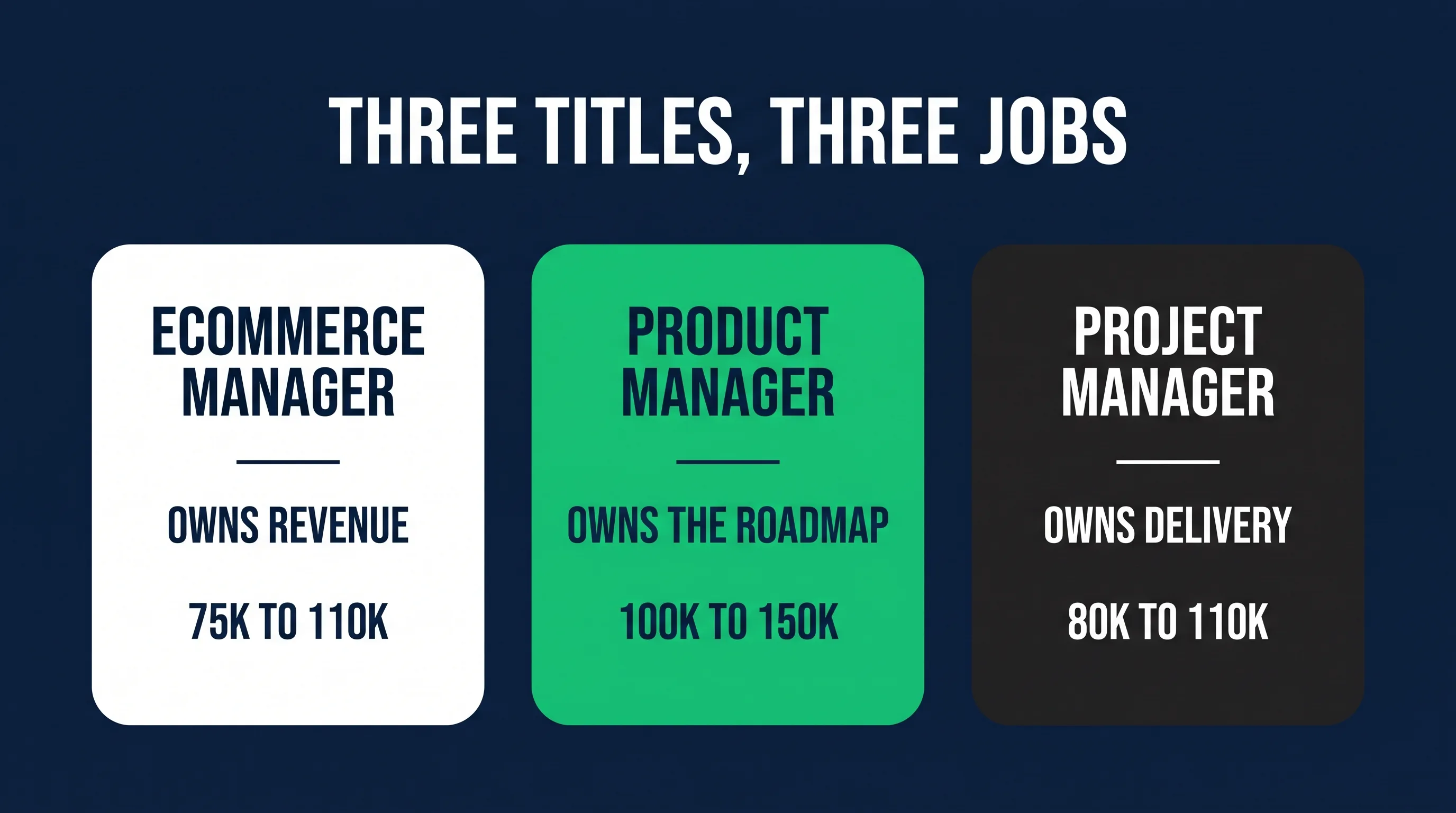
The ecommerce manager owns the revenue the store produces. The ecommerce project manager makes sure the replatform ships on time. The ecommerce product manager decides what the store should be able to do in the first place.
That last one pays the most, and it's the least understood of the three.

What the job is
You treat the storefront as a software product and own its roadmap.
Discovery. Finding out what's actually stopping customers from buying. Session recordings, funnel data, support tickets, user testing, and talking to people. Most of the value in this role is asking the right question before anyone builds anything.
Prioritization. There are always thirty things engineering could build. You decide the order and defend it, usually against people who each believe their thing is the most urgent.
Specification. Turning a problem into something a team can build: the requirements, the edge cases, what happens when it fails, what success looks like.
Working with engineering and design. Daily. You're in standups, refinement sessions, and reviews.
Measurement. Did the thing you shipped do what you said it would. This is where product managers earn their credibility or lose it.
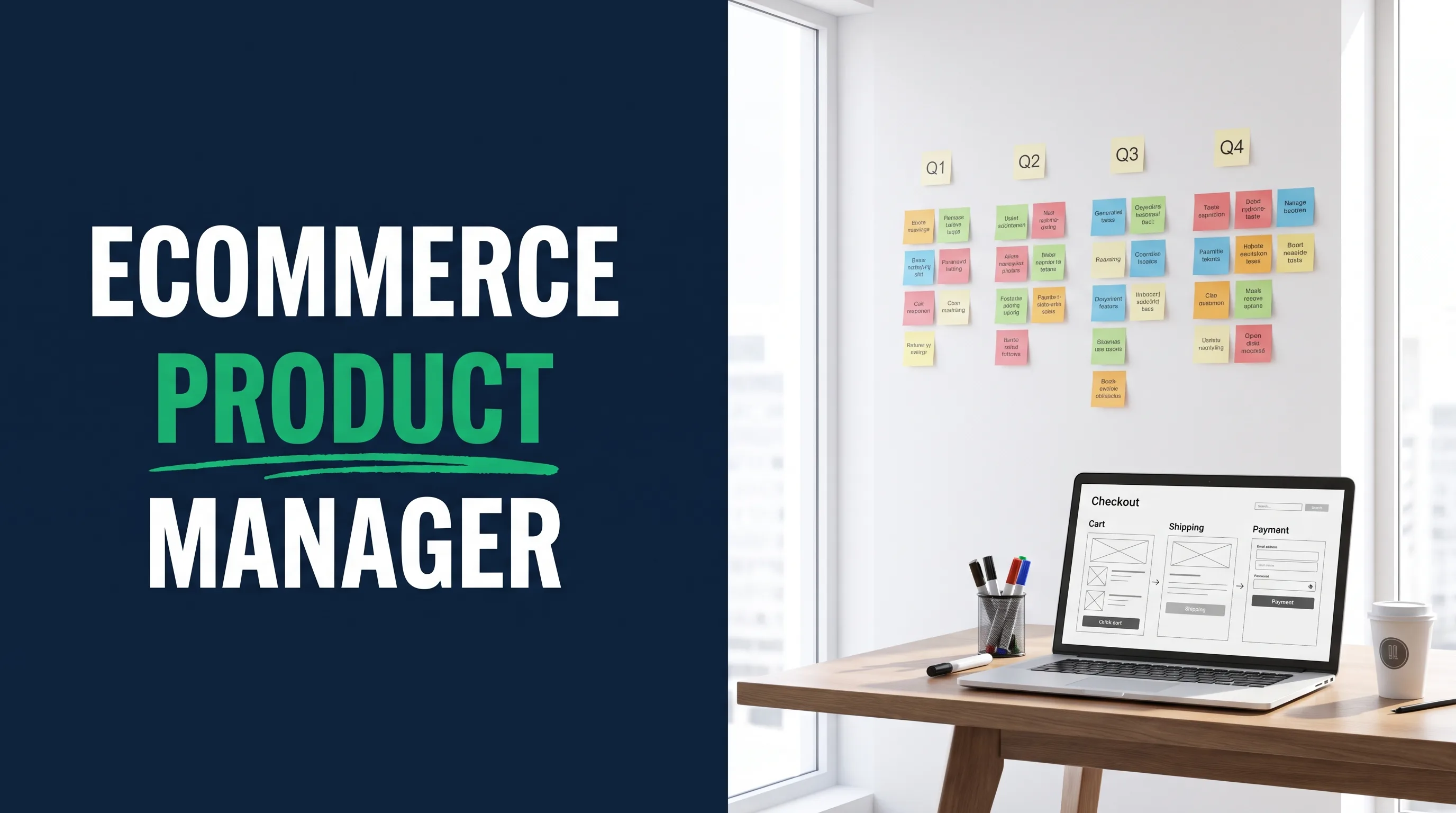
Typical projects: rebuilding checkout, adding a subscription option, redesigning search and filtering, launching a new market with different currencies and tax rules, or replacing the product page entirely.
What it pays
$100k to $150k for most US ecommerce product managers, with senior PMs at $140k to $180k and principal or group PM roles higher, plus equity at larger companies.
That's above ecommerce manager at $75k to $110k and below ecommerce director at $130k to $200k, though a senior PM at a large company often out-earns a director at a small one.
The pay reflects the fact that this is a software product management job that happens to be pointed at a store, and product management salaries are set by the tech market rather than the retail one.
How it differs from the neighbors
| Ecommerce manager | Ecommerce product manager | Ecommerce project manager | |
|---|---|---|---|
| Owns | This quarter's revenue | What gets built next | That this ships on time |
| Thinks in | Campaigns and merchandising | Roadmaps and problems | Timelines and dependencies |
| Works with | Marketing, merchandising | Engineering, design | Everyone, plus vendors |
| Typical pay | $75k to $110k | $100k to $150k | $80k to $110k |
| Measured on | Revenue and conversion | Whether shipped work moved the metric | Delivery |
At a small company, one person does all three and has the title of whichever the founder liked most.
The skills that matter
Problem framing. The most important and the hardest to fake. Bad PMs arrive with solutions. Good ones arrive with a well-defined problem and evidence it's worth solving.
Data fluency. Funnel analysis, cohort behavior, and enough statistical sense to know when a test result is noise. You'll be asked to size opportunities constantly: what is fixing this worth.
Technical literacy. You don't write production code. You do need to understand how the store is built, what an API constraint means, and why the engineer's estimate is four weeks rather than four days. PMs without this get managed by their engineering team rather than working with them, and it's the most common failure I see in people moving over from marketing.
Commercial understanding. Margin, average order value, lifetime value, and how a checkout change affects each. Ecommerce PMs who only think in product metrics miss the point of the business.
Writing. A large portion of the job is written: specs, updates, decision records. Clear writing is close to the whole skill.
Influence without authority. Nobody reports to you. Everything happens because you convinced someone.
How to get there
From ecommerce. The most common route into ecommerce PM specifically. You already understand the commercial side; what you're adding is discovery, prioritization, and working with engineering. The gap is usually technical, which is exactly what the Ecommerce Specialist path covers by teaching you to build stores rather than only run them.
From engineering or technical roles. A strong route. You have the technical half and you're learning the commercial half, and ecommerce is a good domain for that because the metrics are so legible.
From general product management. Straightforward, mostly a domain change.
From project management. Common, and the hardest of the four, because delivery thinking and product thinking are genuinely different muscles. The move requires demonstrating that you can decide what to build, not just get it built.
What to show: a problem you identified, sized, solved, and measured. "Checkout abandonment on mobile was 11 points worse than desktop; we found the address form was the cause, rebuilt it, and closed 7 points of the gap" is the shape of the story. If you have no professional example, run your own store and instrument it properly.

The honest downsides
You're accountable for outcomes and control almost nothing directly. Engineering capacity, design bandwidth, and executive whim all shape what actually happens.
Everyone has an opinion about the store, because everyone uses websites. You'll spend real energy on stakeholder management that has nothing to do with customers.
And the job attracts people who like the idea of strategy and dislike the reality of it, which is a great deal of writing, meetings, and repeating the same explanation to five different groups.
FAQ
What does an ecommerce product manager do? Owns the roadmap for the storefront as a product: discovering what's blocking customers, prioritizing what gets built, specifying it, working with engineering and design, and measuring whether it worked.
How much does an ecommerce product manager make? Typically $100k to $150k in the US, with senior roles at $140k to $180k plus equity at larger companies.
What's the difference between ecommerce product manager and ecommerce manager? The ecommerce manager owns current revenue through merchandising, promotions, and site operations. The product manager owns what capabilities the store gains next.
Do I need to be technical? You need technical literacy, not the ability to ship production code. Understanding how the store is built is what lets you work with engineers as a peer.
Can I move into this from marketing? Yes, and it's a common path in ecommerce specifically. The gap to close is technical fluency and structured discovery.
Is it the highest paying ecommerce role? The highest paying non-leadership one, generally. Director roles pay more at the top but come with a team and a P&L.
If you're already in ecommerce and the part you enjoy is working out why customers behave the way they do, this is the seat that pays for that instinct.
Start by picking one place your store loses people, quantifying it properly, and writing a one-page case for fixing it. That document is both the job and the interview.