Ecommerce Coordinator: The Job Title That Means Six Different Things

On this page
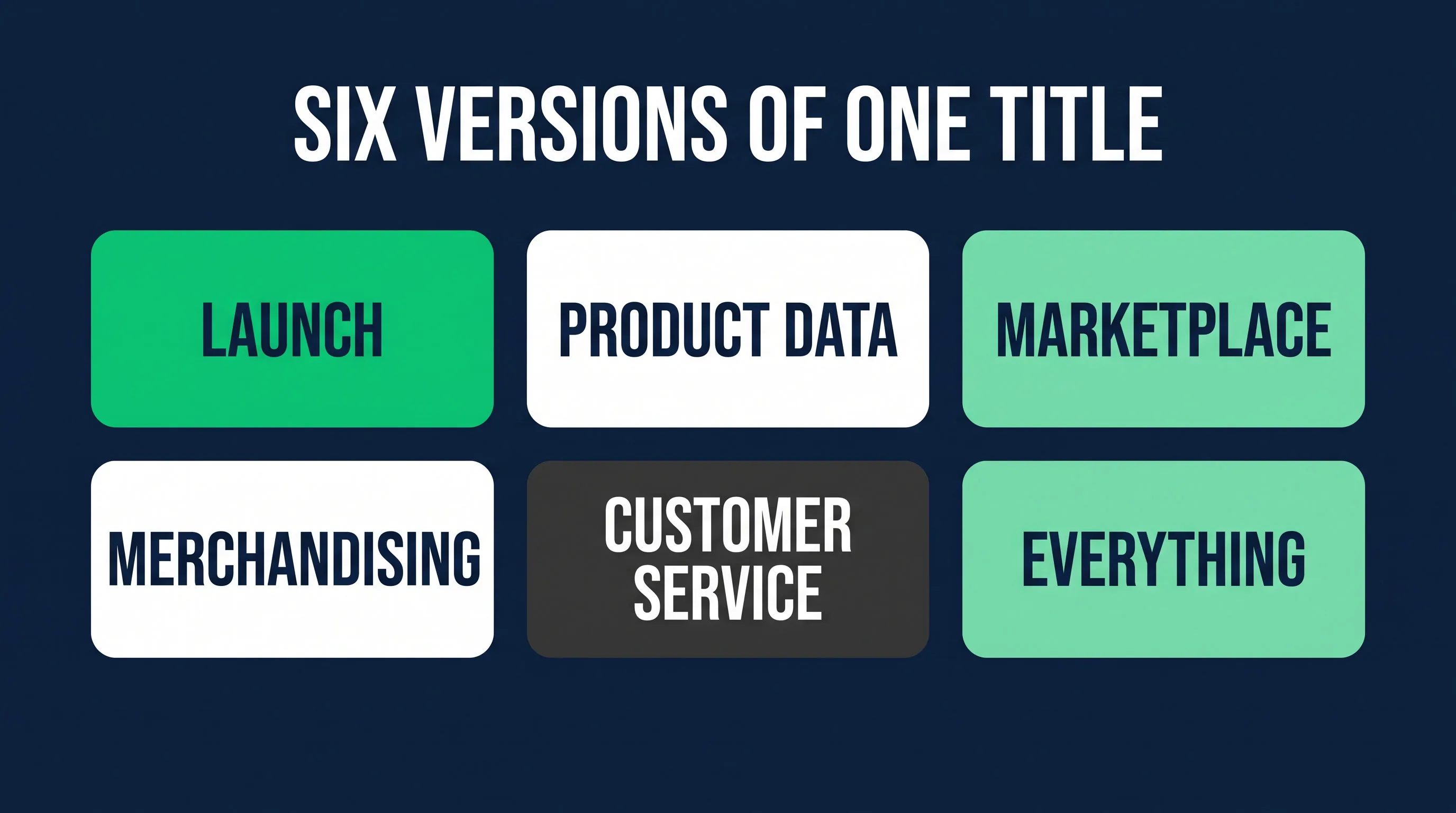
I've read a lot of postings for this title, and they describe at least six different jobs.
At one company the coordinator runs the promotional calendar and briefs the whole team. At another they upload products all day. At a third they're basically in customer service. At a fourth they coordinate between the brand and a third-party marketplace.
Same title, same rough salary, wildly different value to your career. So the useful version of this article isn't a job description. It's how to tell which one you're being offered.

The common thread
Coordinators keep the moving parts in sync. Whatever the specific flavor, you're the person making sure the launch happens on the day it's supposed to, with the right products, the right images, the right prices, and the right page live.
That means chasing people, tracking status, checking details, and being the one who notices that the collection going live Thursday has no product descriptions.
Typical pay: $45k to $65k, slightly above ecommerce assistant at $40k to $55k and below ecommerce specialist at $55k to $80k.
The six versions, and which are worth taking
The launch coordinator. You own the calendar and the process for getting new products and campaigns live. Genuinely good. You see how the whole operation works and you build relationships across teams. Take this one.
The product data coordinator. You maintain the catalog: attributes, categories, pricing, images. Less varied, but product data is the substrate of everything in ecommerce, and people who deeply understand it move into merchandising and operations easily. Decent.
The marketplace coordinator. You manage listings on Amazon, Walmart, eBay, or similar. Narrow, but marketplace expertise is genuinely in demand and transfers to well-paid specialist roles. Worth taking if the brand's marketplace business is real.
The merchandising coordinator. You support the merchandiser: collection ordering, homepage updates, promotional setup. Good route into merchandising, which is an underrated career.
The service-heavy coordinator. Half the job is customer inquiries. Fine as a first job, and it teaches you the store's real problems, but negotiate hard and set a two-year limit.
The everything coordinator. Small company, no boundaries, you do all of the above plus the email marketing. Exhausting and the fastest education available. Best taken young, deliberately, with a plan to leave.
How to tell from the posting
Count the verbs. "Coordinate," "manage," and "own" suggest process responsibility. "Assist," "support," and "enter" suggest execution.
Look for who you work with. A posting naming merchandising, marketing, and warehouse contact means you're a hub, which is where the learning is.
Check for tools. If it names the platform and an analytics tool, they expect you to think. If it only names Excel, expect data entry.
Notice what's measured. Any mention of conversion, revenue, or traffic means you'll be exposed to the numbers. Absence usually means you won't be.
How to get one
Build a store. Same advice as everywhere in this cluster, because it works. A live Shopify store with a real catalog proves you can handle product data, which is the core competency at this level.
Get properly good with spreadsheets. Product data work is spreadsheet work. Lookups, filters, cleaning exports, bulk edits. Most applicants overstate this ability and it shows in a practical test.
Learn the vocabulary. SKU, variant, attribute, collection, feed, fulfillment, conversion rate, average order value. Using these correctly signals you've been near a store.
Apply across titles. Ecommerce coordinator, ecommerce assistant, digital coordinator, merchandising coordinator, marketplace coordinator, online sales coordinator.
Target mid-sized brands. Big companies have rigid coordinator roles with narrow scope. Small brands give you everything but pay less. Mid-sized is usually the best learning-to-money ratio.
How to leave it in eighteen months
Take one recurring problem and own it permanently.
Every ecommerce operation has something that breaks weekly. The product data that arrives inconsistent from suppliers. The launch checklist that lives in someone's head. The reporting that takes four hours every Monday. Pick one, systematize it, measure the time or money saved, and write it down.
That's the promotion case, and it works because coordinators are judged on reliability until they demonstrate judgment. Systematizing something is judgment.
Then pick a direction. Merchandising if you liked deciding what to feature. Operations if you liked the systems. Analytics if you liked the numbers. The technical route if you liked fixing the site, which is what the Ecommerce Specialist path is built for.

FAQ
What does an ecommerce coordinator do? Keeps the operational parts of an online store in sync: launch calendars, product data, promotional setup, cross-team coordination, and status tracking. The exact mix varies a lot by company.
How much does an ecommerce coordinator make? Typically $45k to $65k in the US, moving to $55k to $80k as a specialist within one to two years.
What's the difference between an ecommerce coordinator and an assistant? Coordinator usually implies more process ownership and more cross-team work; assistant is more purely executional. In practice the titles overlap and pay is close.
Do I need experience? No. This is one of the accessible entry points. A store you built yourself substitutes well for professional experience.
What comes after ecommerce coordinator? Specialist, then manager. Or a branch into merchandising, operations, analytics, or the technical side.
Is it a good first job in ecommerce? Yes, if it's the launch, merchandising, or marketplace version. Less so if it's mostly customer service with a coordinator title.
Before you accept one of these, ask a single question in the interview: what does a normal Tuesday look like?
The answer separates the launch coordinator from the data entry job faster than any job description will, and those two roles lead to very different places three years out.